
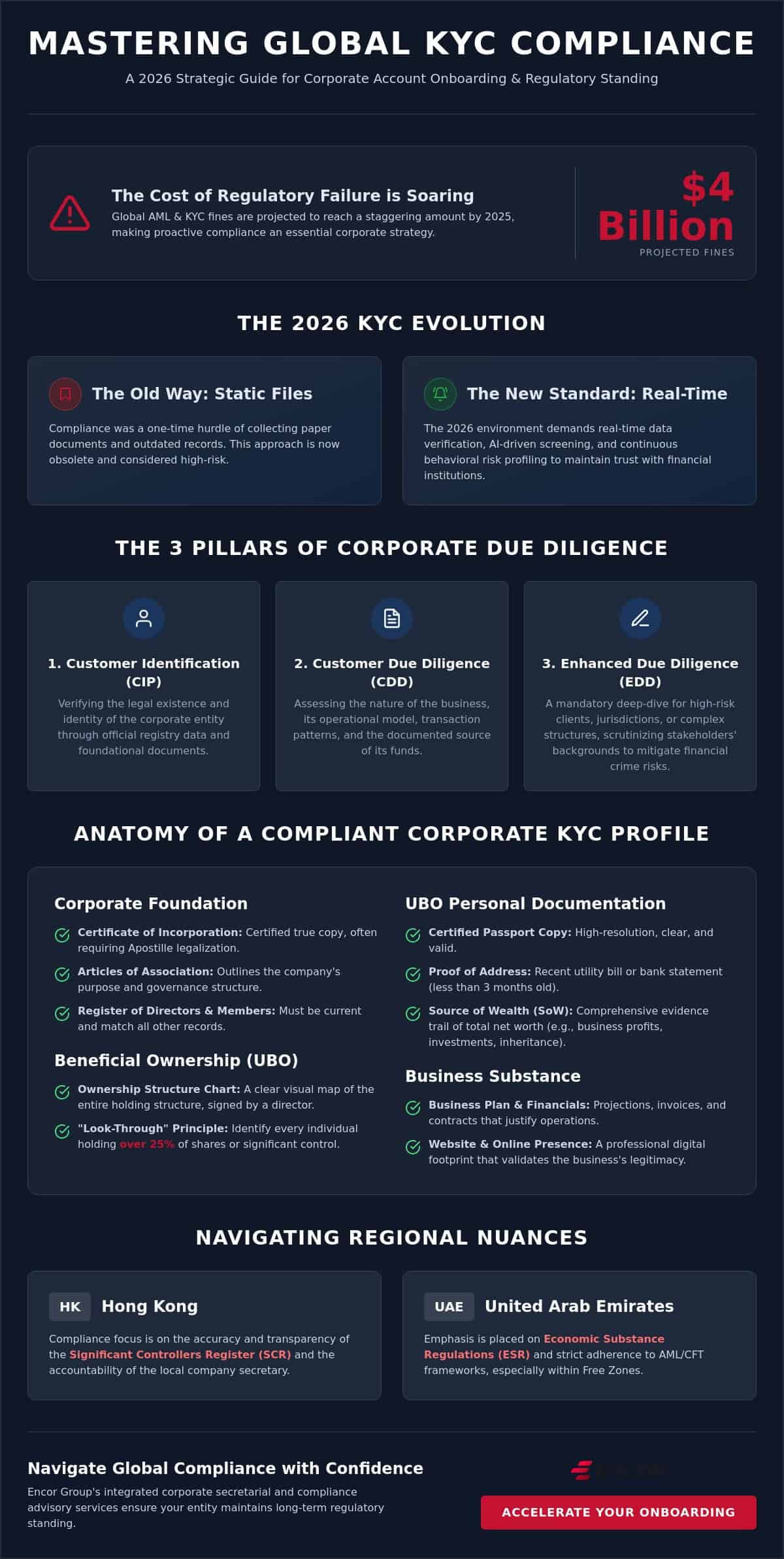
With global AML and KYC fines reaching nearly $4 billion in 2025, the cost of regulatory failure has never been more tangible for international entities. You likely recognize that achieving KYC compliance for corporate accounts is no longer a simple administrative task; it’s a high-stakes gatekeeping process that demands precision. Most executives find the experience frustrating, often facing opaque banking requirements and intrusive requests for personal data that lead to significant account opening delays. It’s difficult to maintain momentum when regional compliance standards between hubs like Hong Kong and the UAE remain inconsistent and unpredictable.
This guide shifts the perspective on these requirements, positioning transparency as a form of strategic collateral for your business. You’ll learn how to master the complexities of global regulations to ensure rapid account approval and maintain your long-term regulatory standing. We provide a clear roadmap for documentation and specific strategies to minimize friction during annual compliance reviews. By following this framework, you’ll gain the tools to navigate the global financial landscape with institutional confidence and operational excellence.
Key Takeaways
- Understand the transition from static document collection to real-time behavioral risk profiling in the 2026 regulatory environment.
- Identify the critical legal and ownership documentation necessary to satisfy the “look-through” principle for all beneficial owners.
- Accelerate the bank account opening process by conducting a pre-submission audit to ensure rigorous KYC compliance for corporate accounts.
- Develop strategies to justify operations in emerging markets and manage the complexities of Politically Exposed Person (PEP) status.
- Discover how integrating corporate secretarial services with compliance advisory maintains your global entity’s long-term regulatory standing.
Defining KYC Compliance for Modern Global Corporations in 2026
KYC (Know Your Customer) constitutes the mandatory identification and verification framework that financial institutions apply to corporate clients and their ultimate beneficial owners. While once viewed as a hurdle of static paperwork, the standards in 2026 have shifted toward real-time data verification and sophisticated behavioral risk profiling. The Financial Action Task Force (FATF) continues to set the global benchmarks that dictate how corporations prove their legitimacy. For modern entities, achieving consistent KYC compliance for corporate accounts is the only way to secure the trust of tier-one banks and maintain operational continuity across borders.
This year represents a significant evolution in the regulatory environment. With the EU’s Anti-Money Laundering Authority (AMLA) now assuming full regulatory oversight in 2026, the movement toward a single, harmonized rulebook has accelerated. The widespread adoption of AI-driven screening and the interconnectivity of global UBO registries mean that discrepancies in corporate data are identified almost instantly. It’s no longer possible to rely on outdated records or opaque structures. Banks now prioritize entities that demonstrate a proactive commitment to transparency, using automated tools to monitor transaction patterns and ownership shifts in real time.
The Three Pillars of Corporate Due Diligence
The Customer Identification Program (CIP) verifies the legal existence of the entity through official registry data. Customer Due Diligence (CDD) then assesses the business nature and source of funds. For complex structures or high-risk jurisdictions, Enhanced Due Diligence (EDD) is mandatory. This process involves a rigorous deep-dive into the identities and backgrounds of all stakeholders to mitigate financial crime risks and ensure institutional security.
Regional Nuances: Hong Kong vs. UAE Standards
Hong Kong focuses on the Significant Controllers Register and the specific accountability of local secretarial providers. In contrast, the UAE emphasizes Economic Substance Regulations (ESR) and AML/CFT frameworks within Free Zones. These regional variations significantly influence the duration of bank account opening. Mastering these nuances is vital for maintaining KYC compliance for corporate accounts across a diversified global portfolio while avoiding unnecessary administrative delays.
The Anatomy of a Corporate KYC Profile: Essential Documentation
Constructing a robust legal profile begins with the Certificate of Incorporation and the Articles of Association. These documents serve as the foundation of your entity’s legal identity, establishing its purpose and governance structure. For cross-border banking, institutions require these to be presented as certified true copies, often necessitating Apostille legalization to confirm their validity across different jurisdictions. Maintaining KYC compliance for corporate accounts requires a meticulous approach to these foundational records. Any discrepancy in the registered office address or director list can trigger an immediate rejection from the compliance committee.
Financial institutions apply the “Look-Through” principle to peel back layers of corporate ownership. This standard requires the identification of every individual who holds more than 25% of the shares or exercises significant control over the entity. For shareholders meeting this threshold, banks demand a clear documentation of their Source of Wealth (SoW). In 2026, the Source of Wealth requirement is defined as a comprehensive evidentiary trail that validates the origin of a shareholder’s total net worth through historical accumulation, investment returns, or inheritance records. Engaging a professional for bank account opening assistance ensures that these sensitive documents meet the exact standards required by international underwriters.
Ultimate Beneficial Ownership (UBO) Transparency
Defining the UBO becomes increasingly complex when structures involve trusts or foundations. Banks require a full set of personal documentation for each beneficial owner, including high-resolution passport copies, recent utility bills as proof of address, and professional references. While privacy is a valid concern for high-net-worth individuals, maintaining full regulatory disclosure is the only way to avoid the “high-risk” classification. Transparency acts as a bridge to institutional trust. Understanding the precise reporting obligations for each jurisdiction is equally critical; our beneficial ownership reporting guide for 2026 provides a definitive framework for identifying reportable individuals and meeting specific deadlines across Hong Kong, the UAE, and the United States.
Proof of Business Substance and Operational Logic
Modern compliance officers look beyond the legal paperwork to verify business substance. You must provide evidence of a physical presence, such as office leases and local employee records, to prove the entity is not a mere shell. Utilizing an AI-powered HR platform like Humae can significantly streamline the management of these records, ensuring they are readily available for compliance reviews. Financial history is equally critical; banks will scrutinize previous bank statements, tax returns, and audited financial statements. A well-structured business plan is also mandatory. It must explain the operational logic behind your regional expansion to satisfy the internal risk models of the bank underwriter.
Navigating the Onboarding Lifecycle: From Submission to Approval
The onboarding lifecycle is a methodical progression rather than a single event. Achieving KYC compliance for corporate accounts requires understanding that banks view your submission as a risk assessment prompt. It’s essential to recognize the distinct roles within the financial institution. Your Relationship Manager acts as your internal advocate, aiming to secure your business, but the Compliance Officer holds the ultimate veto power based on risk appetite and regulatory alignment. Success depends on providing the latter with a narrative that leaves no room for ambiguity.
Timelines for approval vary significantly based on corporate structure and jurisdictional footprint. A standard application typically spans 4 to 12 weeks. Simple structures in transparent jurisdictions move toward the shorter end of this spectrum. Conversely, multi-layered holding companies involving several international regions will inevitably face more prolonged scrutiny. Managing expectations during this window is critical for your operational planning and capital deployment strategies.
The Pre-Submission Due Diligence Phase
Conducting a pre-submission audit is the most effective way to identify documentation gaps before a bank’s automated systems flag them. This phase involves a rigorous review of your internal records to ensure they align with the latest requirements of the relevant Companies Registry. You should prepare a “Compliance Pack” that anticipates common objections. This pack includes:
- Internal background checks on all key stakeholders to identify potential red flags in public records.
- Verification that all corporate records and filings are up-to-date and consistent across all jurisdictions.
- A summary of the corporate structure that clearly illustrates the path to the ultimate beneficial owners.
Managing Post-Submission Bank Inquiries
Once your application is submitted, you enter the “Request for Information” (RFI) cycle. Stagnation often occurs here when responses are delayed or insufficient. You must be prepared to answer technical queries regarding anticipated transaction patterns and specific capital injections. While the previous section covered Source of Wealth, banks will now focus on the “Source of Funds” (SoF) for specific deposits. This requires providing bank statements or contracts that prove exactly where the money for a specific transaction originated. If an application hits an institutional bottleneck, your strategy should involve escalating the matter through your Relationship Manager, providing additional context to satisfy the compliance team’s specific risk concerns.
By treating the RFI process as a collaborative disclosure rather than a series of hurdles, you maintain the momentum necessary for final approval. This proactive approach to KYC compliance for corporate accounts ensures that your entity is viewed as a low-risk, high-transparency partner from the outset.
Overcoming Common Compliance Friction Points and Delays
Friction in the approval process often stems from a mismatch between a corporation’s operational reality and a bank’s internal risk models. When an entity is flagged with a “high-risk” label due to operations in emerging markets, the burden of proof shifts to the applicant. You must provide a granular justification for your presence in these regions, emphasizing the legitimacy of your local partners and the robustness of your internal anti-financial crime controls. Successfully managing KYC compliance for corporate accounts in these scenarios requires a proactive defense of your business model before the bank’s risk committee raises an objection.
Complex Ownership and Holding Company Structures
Multi-layered ownership structures often confuse automated screening tools, leading to manual reviews and significant delays. To resolve this, you must provide a certified organizational chart that clearly “tells the story” of the group from the operating entity up to the ultimate beneficial owners. The use of nominee directors is a specific friction point, as it often inflates a company’s risk rating. If your structure includes nominees, you must disclose the underlying service agreements to prove that control remains with the rightful stakeholders. For entities owned by Private Equity or Venture Capital funds, banks will require documentation regarding the fund’s regulatory status and its own internal KYC standards. Coordinating these disclosures effectively requires robust corporate compliance services that can navigate the fragmented requirements across multiple jurisdictions.
Regulatory Reporting and Economic Substance
Aligning your disclosures with Economic Substance Requirements (ESR) is now a fundamental component of the banking relationship. Financial institutions have largely moved away from “shell companies,” and any entity lacking a physical presence or local management is likely to face account closure. You must demonstrate active management through local office leases, employee records, and evidence that core income-generating activities occur within the jurisdiction of incorporation. This link between physical substance and tax residency is critical for maintaining long-term KYC compliance for corporate accounts.
For entities facing persistent delays or complex structural challenges, our compliance and regulatory advisory services provide the strategic intervention needed to resolve institutional bottlenecks and secure your global financial mobility.
Strategic KYC Management: Partnering with Encor Group
Encor Group acts as a strategic intermediary, aligning your corporate interests with the rigorous expectations of global financial institutions. Maintaining KYC compliance for corporate accounts is not a static milestone but a continuous obligation that requires expert oversight. By integrating corporate secretarial services directly with your banking compliance strategy, we ensure that your legal records and banking profiles remain perfectly synchronized. This alignment prevents the administrative discrepancies that often trigger account freezes or intrusive inquiries during annual reviews.
Outsourcing these functions to a specialized consultant removes the repetitive administrative burden from your internal executive teams. We conduct proactive annual reviews to verify that all beneficial ownership information and business substance evidence remain current. This methodical approach ensures that your compliance profile remains a strategic asset rather than a logistical bottleneck, safeguarding your global financial mobility and reputation.
Integrated Compliance and Banking Support
Our regional hubs in Hong Kong and the UAE provide the localized expertise necessary to navigate distinct regulatory environments with precision. We provide direct corporate bank account opening assistance, managing the entire communication cycle with bank underwriters to ensure clarity. We constantly monitor regulatory shifts, such as the 2026 implementation of the New York LLC Transparency Act and the evolving EU AMLA standards, to anticipate changes before they impact your operations. This proactive stance allows your leadership to focus on expansion while we handle the technical complexities of institutional trust.
Future-Proofing Your Corporate Governance
Centralized entity management is vital for multinational groups seeking to standardize their compliance footprint across multiple jurisdictions. We help you implement robust internal KYC and AML policies that mirror the standards of top-tier banks, making your entity a preferred client for premier financial partners. Encor Group maintains an uncompromising commitment to precision in global regulatory advisory, ensuring every disclosure is accurate and strategically presented. This institutional-grade governance reduces the friction of expanding into new markets and simplifies the process of securing credit facilities or investment capital. By maintaining KYC compliance for corporate accounts through a centralized framework, you ensure that your global structure remains resilient against shifting regulatory tides.
Securing Your Global Financial Footprint through Strategic Compliance
Mastering KYC compliance for corporate accounts is the definitive foundation for modern international business. As global regulations in 2026 shift toward real-time monitoring and harmonized standards, your entity’s ability to demonstrate transparency and physical substance remains its most valuable asset. Success requires more than a simple submission of paperwork; it demands a proactive governance framework that anticipates institutional scrutiny and aligns with the specific expectations of tier-one banks.
By centralizing your entity management and conducting rigorous pre-submission audits, you eliminate the friction that leads to account opening delays. Encor Group provides executive-level compliance consulting with specialized expertise in Hong Kong and UAE regulatory frameworks. Serving clients across 10+ global markets, we act as your strategic navigator in a complex financial landscape. Consult with Encor Group for Strategic Compliance and Banking Support to streamline your onboarding processes and ensure your global operations remain resilient. Your path to efficient financial mobility is secure when backed by institutional-grade expertise.
Frequently Asked Questions
Why does the bank require personal information from shareholders who do not manage the company?
Banks adhere to the “look-through” principle to identify every Ultimate Beneficial Owner (UBO) with significant influence. Even if a shareholder doesn’t participate in daily management, an ownership stake of 25% or more implies a level of control that regulators must monitor. This transparency is a mandatory component of KYC compliance for corporate accounts, designed to prevent the use of corporate structures for illicit financial activities.
How long does the KYC process typically take for a new corporate account in Hong Kong?
The onboarding timeline in Hong Kong generally ranges from 4 to 12 weeks. While simple structures with local directors may see faster results, entities with complex international footprints or multi-layered holding companies require deeper scrutiny. Delays are frequently caused by incomplete documentation or slow response times during the “Request for Information” (RFI) cycles that occur after the initial submission.
What is the difference between Customer Due Diligence (CDD) and Enhanced Due Diligence (EDD)?
CDD is the standard protocol for identifying a client and verifying their business nature through official registries. EDD is a more rigorous deep-dive triggered by high-risk indicators, such as Politically Exposed Persons (PEPs) or operations in high-risk jurisdictions. EDD requires more granular evidence regarding the source of wealth and specific transaction patterns to satisfy the bank’s internal risk committee.
Can a company be rejected for a bank account even if all documentation is provided?
Yes, providing a complete set of documentation doesn’t guarantee account approval. Banks operate within their own internal risk appetite and may reject applications that don’t align with their current commercial strategy. If a bank chooses to “de-risk” by exiting a specific industry or geographical region, they’ll decline the application regardless of the entity’s individual legitimacy or the quality of its paperwork.
How often do banks refresh their KYC records for existing corporate clients?
Banks typically conduct periodic reviews every one to five years, depending on the entity’s risk rating. High-risk accounts undergo annual reviews, while low-risk entities are refreshed less frequently. However, trigger events such as a change in directors, a shift in ownership exceeding 25%, or significant changes in transaction volume can prompt an immediate, ad-hoc KYC compliance for corporate accounts refresh.
What are the specific KYC requirements for a UAE Free Zone company?
UAE Free Zone entities must provide valid trade licenses, proof of physical substance such as an office lease, and evidence of compliance with Economic Substance Regulations (ESR). Banks also require detailed profiles of all beneficial owners, including their residency status and professional backgrounds. Adherence to local AML/CFT frameworks is strictly monitored to ensure the entity meets both local and international banking standards.
How does a complex corporate structure affect the KYC risk rating?
Multi-layered structures involving offshore holding companies or trusts often result in a higher risk rating. Banks view these arrangements as inherently less transparent, which necessitates a manual review by compliance officers rather than automated screening. To mitigate this risk, you must provide certified organizational charts that clearly illustrate the path to the ultimate beneficial owners, accompanied by a logical business justification for the structure.
What role does a corporate secretary play in the KYC process?
The corporate secretary serves as the custodian of the entity’s statutory records and ensures all filings are current. They’re responsible for producing the certified true copies of incorporation documents, registers of members, and board resolutions that banks require for verification. Their proactive management of corporate records is essential for maintaining a seamless KYC compliance for corporate accounts profile and preventing administrative delays during onboarding.