

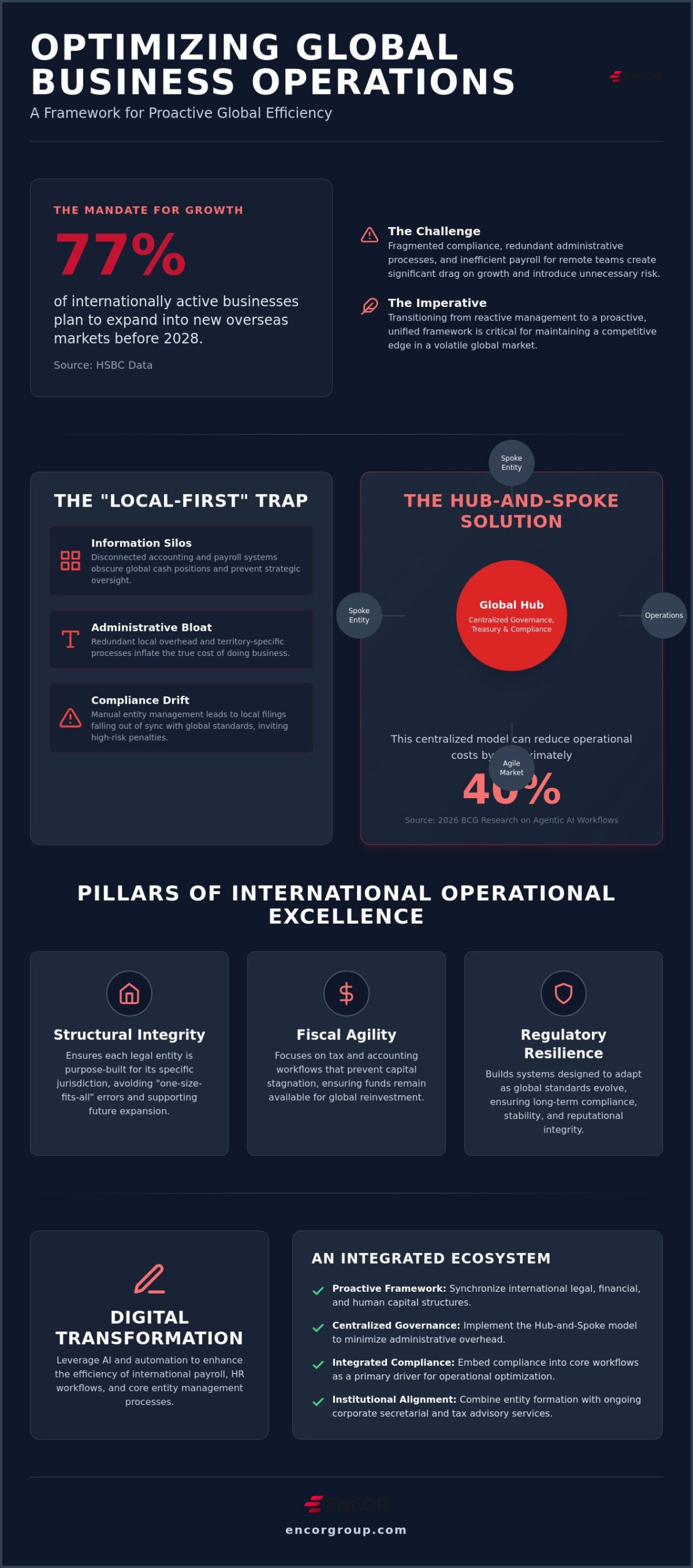
Recent data from HSBC indicates that 77% of internationally active businesses plan to expand into new overseas markets before 2028. For these organizations, optimizing global business operations is no longer a secondary goal but a critical necessity for maintaining a competitive edge in a volatile market. You’ve likely experienced the friction caused by fragmented compliance across different jurisdictions, where redundant administrative processes and inefficient payroll management for remote teams create significant drag on your growth.
This guide outlines the institutional strategies and structural models required to streamline your international entities and achieve true operational excellence. We’ll explore how shifting toward a hub-based centralization model can reduce operational costs by approximately 40%, a figure supported by 2026 BCG research on agentic AI workflows. We’ll also examine the frameworks needed to create a unified system for your cross-border financial and HR workflows. By adopting these strategic navigations, your organization can move from a state of reactive compliance to one of proactive, global efficiency.
Key Takeaways
- Transition from reactive management to a proactive framework that synchronizes international legal, financial, and human capital structures.
- Implement a hub-and-spoke structural model to centralize governance and minimize administrative overhead across diverse jurisdictions.
- Identify how integrating compliance into core workflows serves as a primary driver for optimizing global business operations and regulatory precision.
- Leverage agentic AI and automated systems to enhance the efficiency of international payroll and global human resource workflows.
- Discover the institutional advantages of an integrated ecosystem that aligns entity formation with ongoing corporate secretarial and tax advisory services.
The Fundamentals of Global Business Operational Efficiency in 2026
In the current economic climate, optimizing global business operations requires a fundamental shift in how organizations perceive their international footprint. It’s no longer sufficient to treat overseas branches as independent silos. True optimization is the precise alignment of international legal structures, financial workflows, and human capital. This integrated approach ensures that every entity serves the broader corporate objective without creating unnecessary friction or risk. By synchronizing these core elements, firms can achieve a level of agility that was previously impossible in fragmented models.
The year 2026 marks a definitive transition from reactive optimization, where firms merely correct administrative errors, to proactive strategic planning. Modern investors and stakeholders demand institutional excellence as a baseline. They view a multinational corporation not just by its revenue, but by the stability and transparency of its global operational framework. Resilient, compliant expansion has replaced the outdated “growth at any cost” mantra. This shift is foundational for any leader focused on optimizing global business operations in a market that rewards precision over raw scale.
The Core Pillars of International Operational Excellence
Operational success rests on three specific foundational elements. First, structural integrity ensures that each legal entity is purpose-built for its specific jurisdiction, avoiding the “one-size-fits-all” error. This involves confirming that the chosen structure supports both current operations and future expansion strategies. Second, fiscal agility focuses on tax and accounting workflows that prevent capital stagnation. Efficient treasury management ensures that funds aren’t trapped in local accounts but remain available for global reinvestment. Third, regulatory resilience involves building systems that don’t just follow current laws but are designed to adapt as global standards evolve, ensuring long-term stability.
Why Traditional Expansion Models are Failing
Many organizations fall into the “local-first” trap. This occurs when companies allow each territory to dictate its own administrative processes, leading to redundant local overhead and massive administrative bloat. These redundancies often hide the true cost of doing business. Disconnected accounting and payroll systems create information silos that blind leadership to global cash positions. Manual entity management leads to “compliance drift,” a high-risk scenario where local filings fall out of sync with global standards. In the high-stakes environment of 2026, this lack of oversight isn’t just an inefficiency; it’s a liability that can invite heavy penalties or severe reputational damage.
Strategic Structural Optimization: The Hub-and-Spoke Model
The Hub-and-Spoke model has emerged as the premier framework for optimizing global business operations in 2026. This structure replaces the inefficient “local-first” approach discussed in the previous section with a centralized administrative architecture. By establishing Global Hubs, organizations can consolidate high-level governance, treasury, and compliance functions while maintaining agile “spoke” entities in satellite markets. This consolidation significantly reduces per-entity overhead by eliminating the need for full-scale administrative teams in every jurisdiction. It’s a calculated move that prioritizes structural stability over decentralized chaos.
Academic research on Developing Global Strategies emphasizes that service-oriented and administrative functions thrive under centralization. For instance, utilizing Hong Kong company formation services provides an institutional gateway for Asian operations, offering a stable legal environment that serves as a financial anchor. Similarly, UAE Free Zones act as strategic pivot points for Middle Eastern and European trade, providing a tax-efficient environment for global treasury management. These locations aren’t just offices; they’re the engines of operational excellence.
Selecting Your Strategic Global Hubs
Selecting the right hub requires a rigorous assessment of three specific criteria: regulatory stability, tax efficiency, and access to specialized professional talent. Hong Kong remains a preferred choice for APAC expansion due to its proximity to mainland China and its sophisticated financial infrastructure. In contrast, the UAE offers unparalleled flexibility for businesses requiring a tax-neutral base for international management. Organizations often find that a dual-hub approach, leveraging both jurisdictions, provides the most robust coverage for global trade routes while ensuring long-term institutional resilience.
Implementing the Spoke Execution Strategy
The success of this model depends on maintaining a “minimum viable presence” in satellite markets. While the spokes handle local sales and customer engagement, all back-office functions, such as accounting and payroll, are centralized within the hub. Leveraging professional corporate secretarial services allows leadership to maintain local compliance across multiple jurisdictions from a single, centralized point of control. Standardizing reporting formats across all spoke entities is also critical; it ensures data transparency and allows for real-time decision-making based on a unified global data set. This methodical approach ensures that expansion doesn’t lead to administrative bloat, but rather to a streamlined, high-performance ecosystem.
Integrating Compliance into the Operational Workflow
Compliance serves as the structural scaffolding for any organization focused on optimizing global business operations. In the complex regulatory environment of 2026, treating compliance as a secondary administrative task is a high-risk strategy that invites operational friction. Instead, institutional leaders must adopt a “Compliance-by-Design” approach, where regulatory requirements are integrated into every entity management workflow from the outset. This methodology ensures that as the organization grows, its legal and operational frameworks remain perfectly aligned with jurisdictional demands. A robust global business expansion strategy pre-emptively identifies these bottlenecks, transforming compliance from a hurdle into a competitive advantage.
One of the primary objections to centralization is the fear that it diminishes local regulatory precision. The opposite is true. By centralizing oversight, a multinational group gains a “single source of truth” that local offices often lack. This visibility allows headquarters to monitor filing deadlines, changes in local tax law, and corporate governance requirements with far greater accuracy than a fragmented, territory-by-territory approach. Centralization doesn’t ignore local nuance; it provides the institutional framework required to manage it with precision.
Centralizing Global Entity Management
Managing corporate secretarial needs through a single institutional partner across multiple jurisdictions eliminates the inefficiencies of disparate service providers. This unified approach allows for a synchronized annual return and filing calendar, ensuring no entity falls into bad standing. It also drastically reduces the “Compliance Tax,” which is the hidden cost of redundant administrative labor and the risk of penalties. By standardizing these processes, leadership can reallocate resources from basic maintenance to high-value strategic initiatives, ensuring that optimizing global business operations remains the priority.
Tax and Accounting as Operational Enablers
Modern operational excellence requires moving beyond basic bookkeeping toward proactive tax advisory and cross-border planning. Standardizing a global Chart of Accounts (CoA) enables real-time financial monitoring and ensures consistent reporting across the entire group. This financial transparency is essential for maintaining KYC and AML readiness, which in turn facilitates seamless corporate bank account opening in challenging jurisdictions. When accounting workflows are standardized, the organization can move capital with greater speed and precision. This fiscal agility ensures that the enterprise remains resilient in the face of shifting global economic conditions.
Digital Transformation: AI and Automation in Entity Management
Digital transformation serves as the execution layer for any strategy aimed at optimizing global business operations. In 2026, the focus has shifted from simple digitization to the deployment of agentic AI. Research from Wolters Kluwer indicates that 44% of finance teams are expected to utilize agentic AI this year, representing a 600% year-over-year increase. These systems don’t just store data; they autonomously execute complex workflows with minimal human oversight. This is particularly evident in the rise of “Self-Healing Compliance” systems that identify regulatory gaps and initiate corrective actions before they escalate into institutional risks.
Automating Global Payroll and HR
The integration of international payroll solutions with AI-driven HR platforms has eliminated the drag of manual data entry. These systems now automatically navigate the nuances of local labor laws. This ensures that statutory contributions and tax withholdings remain accurate regardless of the jurisdiction. A unified digital platform for global recruitment allows organizations to maintain a consistent corporate culture while adhering to regional employment standards.
- Eliminate manual data entry in complex multi-currency payroll environments.
- Use AI to navigate local labor laws and ensure statutory compliance automatically.
- Centralize employee data to improve global talent acquisition and retention strategies.
Predictive Analytics for Global Risk Management
Predictive analytics provide the foresight required for high-stakes decision-making and optimizing global business operations. By analyzing historical and real-time data, organizations can forecast regulatory shifts in key markets like Hong Kong or the UAE. This allows leadership to pivot their structure or treasury strategy ahead of legislative changes. Proactive optimization of cash flow through automated tax reporting ensures that capital remains liquid. These technologies can increase capacity by up to 65% and reduce operational costs by 40%, as documented in 2026 BCG reports.
- Use data to forecast regulatory changes in key markets like Hong Kong or the UAE.
- Proactively optimize cash flow through automated tax reporting.
- Utilize digital twins to simulate global expansion scenarios and test operational impact.
To leverage these advanced technological frameworks for your organization, explore our operations optimization services.
Partnering for Excellence: The Institutional Encor Approach
Achieving a state of operational excellence in a fragmented global market requires more than just local presence; it demands a strategic navigator capable of harmonizing complex international requirements into a single, cohesive framework. Encor Group serves as this institutional partner, providing the steady guidance and technical depth necessary for optimizing global business operations. By aligning corporate secretarial, tax, and human capital functions under a unified service model, we eliminate the friction points that typically hinder multinational growth. This integrated ecosystem ensures that every entity, regardless of its jurisdiction, operates with the same level of precision and strategic intent.
The value of a single point of accountability cannot be overstated for organizations managing diverse international portfolios. Relying on a patchwork of local providers often leads to communication breakdowns and inconsistent compliance standards. Encor Group provides a centralized advisory structure that maintains deep local roots in primary global hubs like Hong Kong and the UAE. This dual-layered approach offers the benefits of local expertise with the reliability of a global institutional standard. It’s this commitment to high-level corporate success that provides leadership teams with the confidence to expand aggressively into new territories.
The Encor Advantage: End-to-End Operational Support
Our reach across more than 10 strategic markets simplifies the inherent complexity of cross-border expansion. We’ve engineered a synergy between our corporate secretarial, tax advisory, and HR recruitment services to ensure that no operational detail is overlooked. Whether you’re navigating UAE Free Zone incorporation or managing complex accounting and bookkeeping across several time zones, our team maintains a consistent, executive-level standard of service. This end-to-end support model allows your internal leadership to focus on core commercial objectives while we handle the intricacies of regional regulatory adherence and administrative efficiency.
Next Steps: Auditing Your Global Footprint
The journey toward optimizing global business operations begins with a rigorous assessment of your current institutional structure. Many organizations carry significant administrative debt in the form of redundant local processes and disconnected filing systems. A comprehensive structural audit is the first step in identifying these inefficiencies and preparing for a transition to a hub-based entity management model. This transition reduces overhead and enhances your organization’s ability to respond to market shifts with agility.
To begin this process, we invite you to engage with our team for a strategic consultation. We’ll analyze your current international footprint and outline a framework for centralization that aligns with your 2026 growth objectives. Contact Encor Group today to discover how our operations optimization and compliance advisory services can secure your organization’s position as a leader in the global market.
Securing Your Institutional Competitive Edge
The landscape of 2026 demands a definitive transition from fragmented local management to a centralized hub-and-spoke architecture. This evolution allows for the seamless synchronization of compliance and digital automation into the core of your business. By optimizing global business operations through these structural and technological advancements, your organization can achieve significant cost reductions without sacrificing local regulatory precision. The integration of “Compliance-by-Design” and agentic AI ensures that your international footprint remains both agile and resilient.
Encor Group provides the institutional expertise required to navigate this complex transition. We offer comprehensive end-to-end support, from initial incorporation to global payroll management, serving over 10 markets through four strategic regional hubs. Our executive-level consulting focuses on creating a stable, high-performance ecosystem for your international entities. Consult with Encor Group to optimize your global operations and ensure your business is architected for success in the coming years. We are ready to help you secure a future of institutional excellence and sustainable global growth.
Frequently Asked Questions
What is the most effective way to optimize global business operations?
The most effective strategy involves adopting a hub-and-spoke model that centralizes administrative, financial, and legal governance. This structure eliminates redundant local processes and ensures that all satellite entities align with a single institutional standard. By consolidating high-level functions, organizations reduce overhead and improve decision-making speed across diverse jurisdictions.
How does centralizing entity management improve international compliance?
Centralization provides a single source of truth for all corporate records and filing deadlines. This visibility prevents the “compliance drift” common in fragmented models where local offices operate in isolation. A centralized framework ensures that annual returns, tax filings, and regulatory updates are managed with uniform precision, which significantly reduces the risk of penalties.
What role do Hong Kong and the UAE play in global operational strategy?
These jurisdictions serve as strategic regional hubs due to their stable legal environments and tax-efficient frameworks. Hong Kong acts as the primary gateway for APAC expansion, while UAE Free Zones provide an institutional anchor for Middle Eastern and European trade. Utilizing these hubs allows firms to centralize treasury and management functions within highly reputable financial centers.
Can AI really assist in managing international payroll and HR?
Yes, agentic AI systems now autonomously navigate complex multi-currency environments and local labor laws. These technologies eliminate manual data entry errors and ensure statutory contributions remain accurate across different jurisdictions. By 2026, AI-driven platforms have become essential for maintaining real-time oversight of global talent and payroll compliance.
What are the biggest risks of decentralized global operations?
The primary risks include administrative bloat, inconsistent compliance standards, and significant information silos. Decentralized models often lead to redundant local overhead and a lack of visibility into global cash positions. This fragmentation increases the “compliance tax” and leaves the organization vulnerable to regulatory scrutiny and operational inefficiencies.
How often should a multinational company audit its operational efficiency?
A comprehensive structural audit should occur at least annually to identify emerging redundancies or compliance gaps. However, real-time digital monitoring systems now allow for continuous oversight of key performance indicators. Regular reviews ensure that the organization’s framework remains fit for purpose as it expands into new markets or as international regulations shift.
What is the difference between global entity management and local compliance?
Global entity management is the high-level governance of all international subsidiaries, while local compliance focuses on meeting specific jurisdictional requirements. Effective optimizing global business operations requires integrating these two layers. The global framework sets the institutional standard, while local execution ensures that specific filings and statutory duties are met in each territory.
How do corporate secretarial services contribute to business optimization?
These services provide the institutional foundation for corporate governance and regulatory adherence. By managing entity lifecycles, board resolutions, and statutory filings, corporate secretarial teams ensure that the business remains in good standing. This professional oversight allows leadership to focus on strategic growth rather than administrative maintenance, which is a key component of optimizing global business operations.