

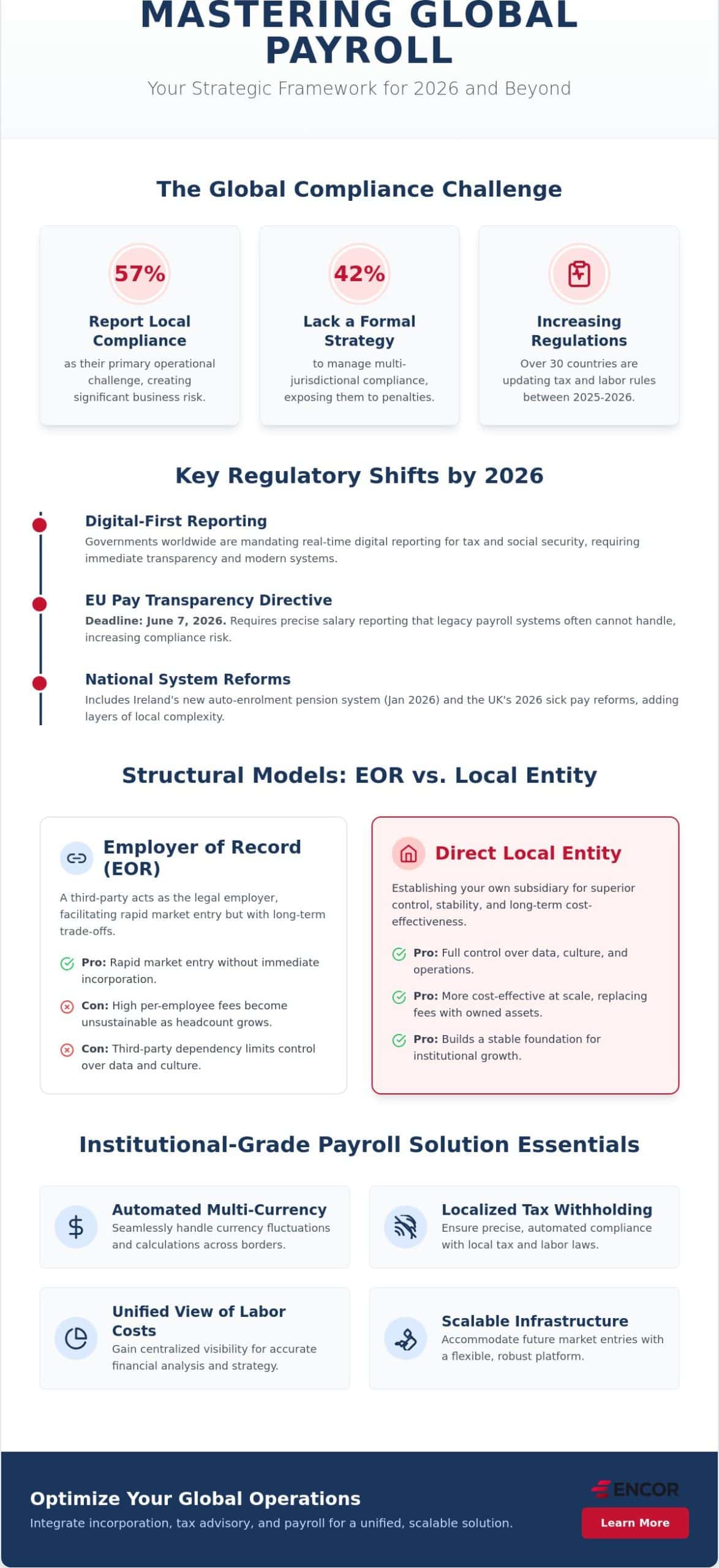
57% of global payroll professionals report that local compliance is their primary operational challenge, yet 42% of organizations lack a formalized strategy to address it. This gap creates significant exposure as regulatory velocity increases, with over 30 countries updating tax and labor rules between 2025 and 2026. Managing fragmented data across various local providers often leads to a lack of transparency and an increased risk of non-compliance with local tax laws. Implementing robust international payroll solutions is no longer a back-office preference; it’s a strategic necessity for any enterprise maintaining global hubs.
You likely recognize that manual processes and currency fluctuations introduce unnecessary friction into your cross-border operations. This article provides a strategic framework to master the complexities of multi-jurisdictional payroll, ensuring seamless regulatory compliance and operational excellence. We’ll examine how to build a unified view of global labor costs while establishing a scalable infrastructure that accommodates future market entries with absolute precision.
Key Takeaways
- Understand the 2026 shift toward digital-first regulatory environments and real-time tax reporting to mitigate global enforcement risks.
- Evaluate the strategic trade-offs between Employer of Record (EOR) models and direct local entity management for long-term operational stability.
- Identify the essential technical requirements for institutional-grade international payroll solutions, including automated multi-currency calculations and localized tax withholding.
- Learn the critical implementation steps for establishing a presence in strategic jurisdictions like UAE Free Zones to facilitate efficient local payments.
- Discover how integrating incorporation, tax advisory, and payroll services provides a unified view of global labor costs and a scalable infrastructure for expansion.
The Strategic Importance of International Payroll Solutions in 2026
The global business environment in 2026 demands a departure from legacy administrative models. Modern international payroll solutions are no longer viewed as simple disbursement tools but as sophisticated compliance frameworks. While understanding payroll fundamentals is necessary for any domestic operation, global expansion introduces layers of complexity that require institutional-grade oversight. Governments across Europe, Asia, and Latin America have transitioned to real-time digital reporting, mandating immediate transparency in tax and social security contributions.
Fragmented payroll systems often become the primary bottleneck for organizations attempting to scale. When data remains siloed across disparate local providers, leadership loses the visibility required for accurate global labor cost analysis. This lack of centralization compromises corporate transparency and complicates international audit standards. High-performing enterprises prioritize integrated international payroll solutions to ensure that every cross-border payment aligns with both local mandates and broader corporate strategy.
Beyond Payments: The Compliance Mandate
Compliance in 2026 requires navigating the intricate intersection of local labor laws and international tax treaties. For example, the EU Pay Transparency Directive, which reached its transposition deadline on June 7, 2026, requires precise salary reporting that many legacy systems can’t handle. Errors in these filings don’t just result in fines; they elevate your global Permanent Establishment risk profile by signaling an unmanaged corporate presence to tax authorities. International payroll is the strategic nexus where human resources, tax advisory, and corporate law converge to protect the organization’s global standing. Enterprises operating across multiple jurisdictions should reference a compliance checklist for global entities to ensure their multinational obligations are fully consolidated and their subsidiaries maintain a zero-penalty status throughout 2026.
Operational Efficiency in Multi-Hub Expansion
Centralized payroll architecture provides executives with the granular cost visibility needed for high-stakes decision-making. Consolidating multiple local vendors into a single, unified platform reduces administrative overhead and eliminates the friction of managing different reporting cycles. This consolidation fosters institutional confidence when managing multinational teams. It ensures that employees in various jurisdictions, from Hong Kong to the UAE, receive accurate payments that reflect local requirements, such as the UK’s 2026 sick pay reforms or Ireland’s new auto-enrolment pension system launched in January 2026. Consistent, error-free execution across all global hubs reinforces the brand’s reliability as a stable and professional employer.
Structural Models for Global Payroll: EOR vs. Local Entity Management
Selecting the appropriate engagement model is a foundational decision that dictates the long-term viability of your international payroll solutions. Organizations typically choose between an Employer of Record (EOR) and direct local entity management. While EOR providers facilitate rapid market entry by acting as the legal employer, they often introduce high per-employee fees that become fiscally unsustainable as headcount grows. Direct management through a subsidiary offers superior control over corporate culture and operational data, providing a more stable foundation for institutional growth. A well-defined global business expansion strategy ensures that these structural decisions align with your long-term market entry objectives and hub-centric entity management goals.
Hybrid models allow enterprises to balance speed with structural integrity. A firm might utilize an EOR for a three-month pilot in a new jurisdiction before transitioning to a permanent incorporated structure. Managing payroll through an owned entity ensures that your organization maintains direct relationships with local tax authorities. This direct oversight is critical when navigating complex requirements, such as U.S. tax compliance for foreign employees or similar withholding mandates in other high-scrutiny regions. Transitioning to an owned model is a strategic move that replaces third-party dependency with internal operational excellence.
When to Transition from EOR to a Local Subsidiary
Headcount thresholds are the primary indicator for shifting from an EOR to a dedicated subsidiary. Once a team reaches a certain scale, the administrative costs of incorporation are frequently lower than the cumulative service fees paid to an EOR. Utilizing Hong Kong company formation services provides a strategic entry point for Asian markets, offering a robust legal framework for regional payroll hubs. Owned entities also provide better protection for intellectual property and sensitive employee data by eliminating the need for third-party data processing.
The Role of Corporate Secretarial Services in Payroll
Payroll functionality depends entirely on the legal standing of your local entity. Corporate secretarial services manage the ‘registered office’ requirements and ongoing compliance filings that are prerequisites for local payroll registration. These services ensure that payroll data is accurately reflected in annual returns and regulatory reports, maintaining a transparent audit trail. Integrating these functions prevents the administrative silos that often lead to compliance failures. For organizations seeking to streamline this transition, engaging with strategic compliance advisory ensures that your corporate structure remains fully aligned with your payroll obligations.
Essential Features of an Institutional-Grade Payroll Solution
Institutional-grade international payroll solutions must address the inherent volatility of global markets while maintaining rigid compliance standards. A primary requirement for any enterprise-level system is the ability to perform automated multi-currency calculations. This feature mitigates the risks associated with foreign exchange volatility, ensuring that employees receive precise net amounts while the organization maintains predictable labor costs. Beyond simple calculations, these platforms must integrate robust Know Your Customer (KYC) and Anti-Money Laundering (AML) protocols directly into the payment treasury to prevent regulatory friction during cross-border transfers.
Selecting a partner involves evaluating technical capabilities against the specific needs of your global hubs. While many platforms offer basic payment tools, the best international payroll services provide a comprehensive suite that includes employee self-service portals. These portals are essential for global mobility, allowing a remote workforce to access localized payslips and tax documents without administrative intervention. High-performance systems ensure that data flows seamlessly between the treasury, local tax authorities, and the corporate ledger.
Tax and Social Security Automation
Automation must extend to the specific statutory requirements of every operating jurisdiction. For enterprises with a presence in Asia, this includes the precise management of Mandatory Provident Fund (MPF) contributions in Hong Kong. Similarly, operations in the Middle East require strict adherence to the Wage Protection System (WPS) in the UAE to ensure legal validity of payroll disbursements. Institutional solutions provide integrated management for over 10 jurisdictions, featuring automatic updates for changing tax brackets and local labor regulations. This proactive approach eliminates the need for manual monitoring of legislative shifts.
Reporting and Executive Insights
Executive leadership requires real-time visibility to optimize global operations effectively. Customizable dashboards allow for the immediate tracking of labor costs across different regions, providing a clear view of the organization’s financial health. These systems generate audit-ready reporting that aligns with international accounting standards, facilitating smoother year-end reviews and regulatory inspections. Data-driven payroll architecture enhances the fiscal depth of multinational enterprises by transforming routine compensation data into actionable strategic intelligence. This level of transparency ensures that every payroll run contributes to the overall stability and scalability of the global enterprise. Organizations looking to reduce operational costs further can benefit from optimizing global business operations through hub-based centralization models that streamline cross-border financial and HR workflows.
Strategic Implementation: From Entity Setup to First Pay Run
Implementing international payroll solutions requires a methodical approach that prioritizes legal and financial infrastructure over simple software installation. The process begins with selecting an optimal jurisdiction for your regional headquarters. For instance, UAE Free Zone Incorporation offers specific tax advantages and regulatory frameworks that facilitate efficient regional operations. Once the entity is established, securing a corporate bank account is the essential next step to enable local currency payments and treasury management. Enterprises navigating the increasingly complex KYC and due diligence requirements of 2026 should seek professional corporate bank account opening assistance to avoid the multi-month delays that commonly obstruct payroll go-live timelines. This structural foundation ensures that the payroll function remains legally valid and operationally stable.
Following the banking setup, the organization must register with local tax and labor authorities to obtain the necessary payroll tax IDs. This phase involves mapping global HR policies to local statutory requirements, ensuring that every contract complies with jurisdictional mandates. Before the final go-live, executing a shadow run is a critical safeguard. This parallel processing allows the team to verify calculation accuracy against local tax brackets and social security caps without impacting actual employee compensation. A successful implementation follows a logical progression from entity formation to localized execution.
The Critical Path: Bank Accounts and Local Registrations
The path to a compliant pay run is often obstructed by the complexities of corporate bank account opening. Many international markets impose rigorous due diligence requirements that can delay operations by several months. Strategic local tax advisory is equally vital to mitigate the risk of double taxation for expatriate employees. By coordinating these efforts with corporate secretarial teams, enterprises ensure that all registrations remain in good standing. This coordination prevents administrative lapses that could trigger regulatory penalties or disrupt the payment cycle.
Policy Localization for Global Teams
Localization involves more than simple translation; it requires adapting leave policies, notice periods, and severance packages to meet or exceed local statutory minimums. For example, the UK reforms in April 2026 removed the waiting period for sick pay, requiring immediate updates to local policy documents. Benefits administration, including health insurance and pension contributions such as Ireland’s auto-enrolment system launched in January 2026, must be competitive within the local talent market while remaining strictly compliant. Organizations must also manage cultural nuances like 13th-month pay or regional bonuses. For a seamless transition, consult with our experts on operations optimization to align your global strategy with local execution.
Optimizing Global Operations with Encor Group’s Integrated Solutions
Encor Group bridges the critical gap between high-level strategic consulting and the granular execution of international payroll solutions. While many providers offer simple digital interfaces, we provide the institutional foundation required to manage a global workforce with absolute precision. Our integrated approach treats payroll as the operational output of a correctly structured global entity. This ensures that your corporate governance, tax obligations, and employee compensation remain perfectly aligned across every jurisdiction.
Consolidating your global requirements under a single point of contact reduces the friction of managing multiple local vendors. This centralized model provides executive leadership with a unified view of labor costs and compliance status across all hubs. By integrating incorporation, corporate secretarial services, and payroll, we eliminate the administrative silos that often lead to regulatory oversights. In the high-velocity regulatory environment of 2026, this level of coordination is vital for maintaining operational continuity and fiscal transparency.
The Encor Advantage in Hong Kong and the UAE
Our regional hubs provide the local expertise necessary to navigate complex markets with a global perspective. In Hong Kong, our deep knowledge of business registration and ongoing compliance ensures that your Asian operations remain in good standing with the Inland Revenue Department. Similarly, we guide enterprises through the intricacies of UAE Free Zone incorporation, managing the specific labor standards and Wage Protection System requirements that define the region. This localized mastery, combined with our commitment to operational excellence, provides a stable platform for high-stakes corporate growth.
Next Steps for International Expansion
Successful global scaling begins with an honest assessment of your current payroll maturity. Identifying compliance gaps before they trigger regulatory action is essential for protecting your organization’s reputation and financial health. Encor Group works as a strategic navigator, designing a scalable global HR and payroll infrastructure that grows alongside your business. We invite you to consult with Encor Group on your international payroll strategy to secure your operational excellence across every global hub.
Advancing Your Global Operational Framework
Navigating the global regulatory landscape of 2026 requires a shift from reactive payment processing to a unified, strategic framework. Mastering international payroll solutions involves more than ensuring timely disbursements; it requires a deep integration of corporate structuring, tax advisory, and localized operational excellence. By transitioning from third-party dependency to owned-entity models in strategic hubs, your organization gains the visibility and control necessary for sustainable expansion. This structural integrity is the foundation of long-term scalability and institutional stability. Enterprises committed to optimizing global business operations can achieve significant reductions in operational costs by adopting hub-based centralization and unified cross-border workflows.
Encor Group provides the strategic depth required to manage these complexities with quiet efficiency. Serving over 10 international markets through four regional hubs, we offer comprehensive end-to-end support from initial incorporation to recurring payroll execution. Our specialized expertise in Hong Kong and UAE regulatory frameworks ensures your operations remain in full compliance with evolving local standards. Secure your global compliance with Encor Group’s international payroll solutions and establish a robust foundation for your future market entries. We look forward to facilitating your continued international success and operational excellence.
Frequently Asked Questions
What is the difference between global payroll and an Employer of Record (EOR)?
Global payroll involves managing compensation for employees through your own local entities, whereas an Employer of Record (EOR) employs the staff on your behalf. While EOR models facilitate rapid entry, direct global payroll management through incorporated subsidiaries offers superior control and long-term cost efficiency. This model ensures your organization maintains a direct legal relationship with its workforce and local tax authorities, providing a more stable foundation for institutional growth and data security.
How do international payroll solutions handle different tax years across jurisdictions?
Advanced platforms synchronize disparate fiscal calendars by utilizing automated reporting engines that map to specific jurisdictional deadlines. For example, while the UK tax year runs from April to April, other regions like the UAE or Hong Kong follow different cycles. These systems ensure that tax withholding and social security contributions are calculated and filed according to the local statutory calendar of each operating hub, eliminating the risk of late or inaccurate filings.
Is it better to centralize payroll or use local providers in each country?
Centralized governance combined with localized execution is the optimal model for multinational enterprises. Utilizing a single, unified platform eliminates data fragmentation and provides executive leadership with a consolidated view of global labor costs. This approach maintains the precision of local expertise while ensuring that all operations align with the organization’s broader corporate standards and audit requirements, replacing manual processes with a scalable, institutional-grade infrastructure.
What are the common compliance risks associated with international payroll?
Primary compliance risks include incorrect worker classification, failure to meet digital reporting mandates, and non-compliance with local social security caps. Misinterpreting the distinction between employees and contractors can lead to significant tax penalties and legal exposure. Robust international payroll solutions mitigate these risks by integrating automatic updates for local labor laws and maintaining a transparent audit trail for all disbursements, ensuring your organization remains prepared for intensifying regulatory scrutiny. A structured compliance checklist for global entities provides an institutional-grade framework to consolidate these multinational obligations and protect your subsidiaries from penalties throughout 2026.
How does the UAE’s Wage Protection System (WPS) affect international payroll?
The Wage Protection System (WPS) mandates that all private sector employers in the UAE transfer salaries through authorized financial institutions and the Central Bank. Failure to comply with these electronic transfer requirements results in significant fines and the suspension of work permits. Any institutional-grade payroll solution must facilitate Salary Information File (SIF) generation to ensure the legal validity of disbursements within the UAE’s regulatory framework and maintain operational continuity.
Can an international payroll solution manage both full-time employees and contractors?
Comprehensive international payroll solutions are designed to manage payments for both full-time employees and independent contractors within a single interface. These systems maintain separate workflows for statutory withholding and invoice-based payments, ensuring that all labor costs are accurately captured in the corporate ledger. This integration maintains the necessary legal distinctions required for global compliance and worker classification audits, providing a unified view of your entire global workforce and operational spend.
What are the requirements for setting up payroll for a new Hong Kong company?
Setting up payroll in Hong Kong requires a valid business registration certificate and the establishment of a Mandatory Provident Fund (MPF) scheme. Employers must register all eligible employees within 60 days of their employment start date and maintain accurate records of monthly income and contributions. Integrating these requirements into your broader accounting and bookkeeping infrastructure ensures that annual tax filings remain precise and timely, reflecting the high standards of Hong Kong’s regulatory environment.
How do multi-currency payroll systems protect against exchange rate fluctuations?
Multi-currency payroll systems utilize automated foreign exchange management to lock in rates or calculate net payments based on real-time market data. This automation mitigates the risk of currency volatility affecting the employee’s net compensation or the organization’s budget. By integrating these treasury functions directly into the payment cycle, enterprises ensure that cross-border transfers are executed with predictable costs and minimal administrative friction, regardless of the number of operating currencies involved.