
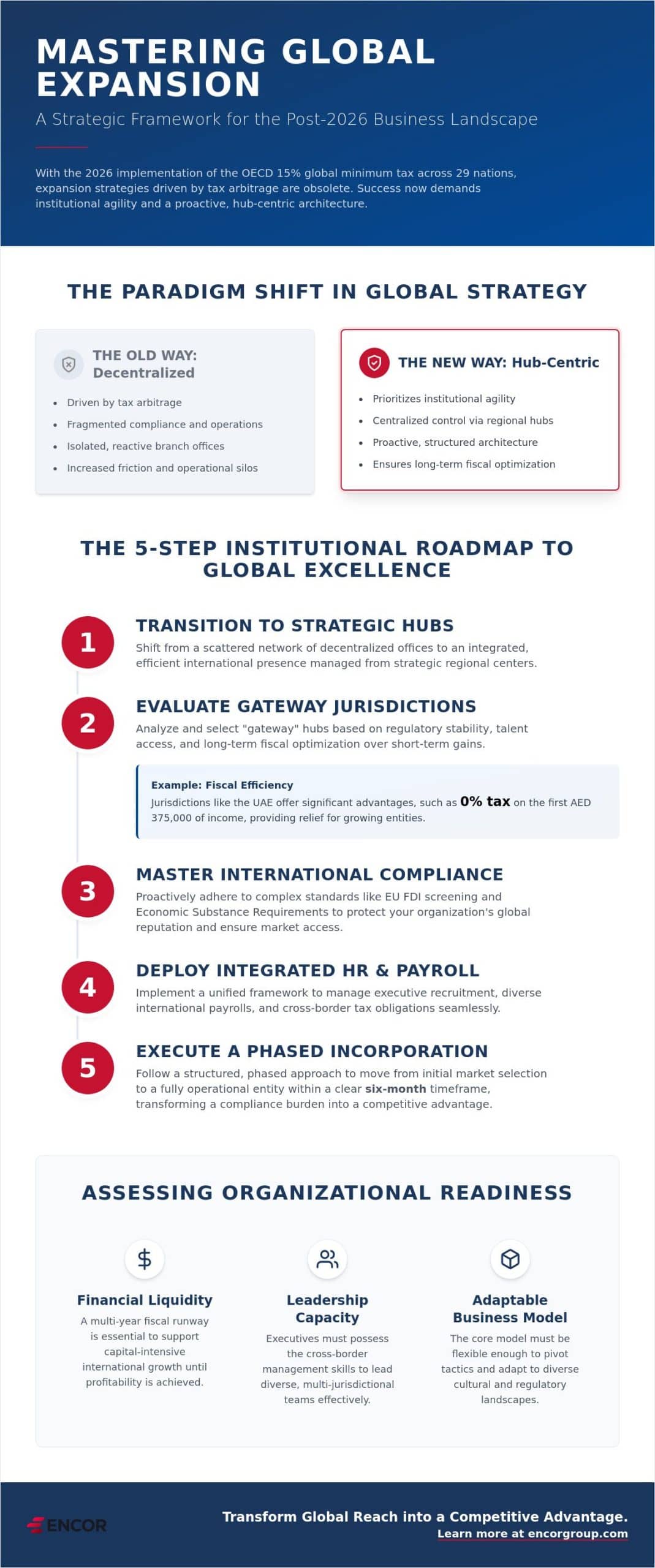
The 2026 implementation of the OECD 15% global minimum tax across 29 nations marks the definitive end of expansion strategies driven solely by tax arbitrage. For modern executives, a successful global business expansion strategy must now prioritize institutional agility and a hub-centric approach to entity management. You understand that managing fragmented compliance across multiple jurisdictions and navigating complex international payroll requirements often creates significant friction. These challenges require more than just reactive fixes; they demand a structured, proactive architecture that ensures stability in an increasingly nonlinear environment.
This guide provides a professional-grade framework to master the complexities of international growth, from initial market entry to large-scale operational scaling. We’ll detail how to leverage regional hubs like the UAE, which maintains 0% tax on the first AED 375,000 of income, while ensuring full alignment with the latest EU FDI screening regulations. By following this strategic roadmap, you’ll establish a centralized system for entity management that secures long-term fiscal optimization and operational excellence. The following sections outline the precise steps required to transform global reach from a compliance burden into a competitive advantage.
Key Takeaways
- Transition from decentralized offices to strategic regional hubs. This shift ensures a more integrated and efficient international presence.
- Evaluate gateway jurisdictions using a professional global business expansion strategy. Prioritize regulatory stability and long-term fiscal optimization during the selection process.
- Master the nuances of international compliance. Adhering to Economic Substance Requirements and corporate secretarial standards protects your organization’s global reputation.
- Deploy integrated HR and payroll frameworks. These systems must manage executive recruitment and diverse tax obligations across multiple borders simultaneously.
- Execute a phased institutional roadmap. This structured approach streamlines the transition from initial market selection to operational entity incorporation within six months.
The Evolution of Global Business Expansion Strategy in 2026
The year 2026 marks a definitive shift in how enterprises approach international growth. A modern global business expansion strategy is no longer a series of isolated market tests; it’s a holistic integration of legal structures, fiscal optimization, and human capital management. In previous decades, companies often favored decentralized branch offices, yet this approach frequently led to fragmented compliance and operational silos. Today, high-performing organizations utilize strategic regional hubs to centralize control and ensure regulatory agility. This transition allows for a unified command structure that can respond to jurisdictional changes with precision.
Success in this environment requires a proactive stance on transparency. With the OECD 15% global minimum tax now effective in 29 countries as of 2026, the era of simple tax haven navigation has concluded. Organizations must demonstrate institutional confidence to secure international market share. This involves more than just operational presence. It requires a deep commitment to global compliance standards and sophisticated market entry strategies that prioritize long-term stability over short-term gains. By establishing a robust corporate foundation, businesses signal reliability to local regulators and partners alike.
Key Drivers for International Scaling
The primary motivation for expansion has evolved from simple market capture to the acquisition of specialized talent. Emerging tech and financial centers now offer access to engineering and digital expertise that is often scarce in domestic markets. For enterprises requiring a specialized digital strategy to navigate this technological transformation, Sterck provides the necessary expertise; find out more. Additionally, geographic diversification serves as a critical hedge against domestic market volatility. By spreading operations across multiple jurisdictions, such as Hong Kong or the UAE, firms achieve economies of scale and optimize their global supply chains. This strategic positioning is essential for protecting margins in a BANI (Brittle, Anxious, Nonlinear, and Incomprehensible) business environment.
Assessing Organizational Readiness for Expansion
Before initiating a global business expansion strategy, leadership must evaluate financial liquidity for long-term commitments. International growth is capital-intensive and requires a multi-year fiscal runway to reach profitability. Beyond capital, internal leadership capacity is a decisive factor. Executives must possess the cross-border management skills necessary to lead diverse teams across different time zones. Finally, the core business model must remain adaptable. While brand consistency is vital, the ability to pivot operational tactics to suit diverse cultural and regulatory landscapes determines the ultimate success of the venture. Readiness is not merely a financial state; it’s an institutional capability. To ensure your leaders are prepared for the shift toward nature-aligned practices, check out Jannine Barron for regenerative business mentoring.
Selecting Strategic Hubs: The Gateway Approach to International Markets
Direct market entry into multiple jurisdictions simultaneously often results in operational fragmentation and increased compliance risks. A sophisticated global business expansion strategy prioritizes the use of “gateway” jurisdictions. These hubs act as central nodes that facilitate smoother entry into broader regions while providing a stable base for operations. By concentrating resources in a single, high-standard jurisdiction, enterprises can optimize their tax structures and legal frameworks before scaling further. This methodical approach reduces the complexity of managing disparate local requirements during the early stages of growth.
When evaluating potential hubs, executives must weigh several critical factors. Regulatory stability and the ease of doing business are paramount. According to the Export Solutions guide, understanding the local legal landscape is essential for risk mitigation. Fiscal efficiency also plays a decisive role. For instance, the UAE offers a 0% tax rate on the first AED 375,000 of taxable income, providing significant relief for growing entities. Access to a deep talent pool and sophisticated infrastructure further distinguishes a premier hub from a mere administrative base.
Hong Kong as a Strategic Asian Hub
Hong Kong remains the preeminent gateway for organizations targeting the Asia-Pacific region. Utilizing professional Hong Kong company formation services allows businesses to establish a presence within a world-class financial ecosystem. The HKSAR regulatory framework provides a familiar, common-law based legal system that offers high levels of protection for intellectual property and commercial contracts. For a comprehensive look at regional growth, read our guide on how to expand business to Asia. This strategic positioning provides the fiscal depth required to support complex cross-border transactions across the continent.
The UAE Framework for Global Enterprises
For those looking toward the Middle East and Africa, UAE Free Zone incorporation offers unparalleled advantages. These zones permit 100% foreign ownership and full repatriation of capital and profits, making them ideal for a global business expansion strategy. The UAE’s location between East and West markets provides a logistical advantage that few other regions can match. Executives navigating the GCC’s evolving corporate tax regimes and Saudization requirements should consult our detailed Middle East market entry strategy framework to ensure their entity structure aligns with regional mandates. Beyond incorporation, managing corporate bank account opening in the Middle East requires a nuanced understanding of local compliance standards. Aligning with a partner like Encor Group ensures these operational hurdles are handled with institutional precision, allowing leadership to focus on market share acquisition.
Navigating Complex Regulatory Environments and Global Compliance Standards
In 2026, regulatory scrutiny has reached an unprecedented level of intensity. A successful global business expansion strategy requires more than just a physical presence; it demands meticulous adherence to evolving transparency standards across every jurisdiction. Centralizing entity management allows organizations to mitigate risk by creating a single, authoritative source for compliance data. This structured approach ensures that Know Your Customer (KYC) and Anti-Money Laundering (AML) protocols for corporate banking are handled with the necessary rigor to avoid operational delays or account freezes. Without a centralized framework, companies often face inconsistent reporting, which can trigger unwanted audits in sensitive regions.
Effective compliance relies on a comprehensive Global Expansion Strategy that anticipates jurisdictional shifts before they impact the bottom line. Organizations must prioritize Economic Substance Requirements (ESR) and Beneficial Ownership reporting to maintain institutional credibility. Regulators now look beyond simple incorporation; they require documented proof of genuine economic activity, such as local payroll and physical office space. Failure to demonstrate this substance can lead to significant financial penalties or the revocation of corporate licenses. Corporate secretarial services play a critical role here, acting as the custodian of a firm’s legal standing and ensuring all statutory obligations are met with precision.
International Tax Advisory and Structuring
Optimizing global tax liabilities requires a compliant corporate structure that accounts for the OECD’s 15% global minimum tax. Professional tax advisory ensures that transfer pricing models are robust, defensible, and aligned with current international standards. Ongoing accounting and bookkeeping provide the transparency required by regulators and financial institutions alike. These fiscal foundations prevent the risks of double taxation and ensure the enterprise remains optimized for long-term, sustainable growth across borders. Engaging strategic business consulting international experts can further strengthen your tax structuring approach by translating high-level growth objectives into precise, compliant operational realities.
Corporate Governance and Secretarial Duties
Maintaining annual return filings and regulatory reporting is a continuous, high-stakes obligation. A registered office address isn’t merely a mailing point; it establishes local substance and serves as the legal domicile in hubs like Hong Kong or the UAE. Directors must fully understand their fiduciary duties and shareholder rights within each specific legal framework. Managing these responsibilities across multiple borders requires a disciplined approach to governance that protects the integrity of the entire corporate group and its leadership.
Scalable Human Capital: Integrating Global HR and Payroll Solutions
A robust global business expansion strategy depends entirely on the caliber of the leadership team established in new territories. While the legal and fiscal frameworks provide the necessary structure, human capital serves as the operational engine. Executives must move beyond simple hiring practices to develop a comprehensive global recruitment strategy that targets high-level talent capable of navigating local market nuances. This requires a sophisticated approach to vetting, ensuring that local leaders possess both the technical expertise and the cultural intelligence to represent the brand effectively in hubs like Hong Kong or the UAE.
Managing a multinational workforce introduces significant administrative complexity, particularly regarding cross-border compensation. Organizations must implement international payroll solutions that integrate seamlessly with their broader corporate compliance protocols. It’s not just about timely salary delivery; it’s about adhering to diverse tax regimes, social security requirements, and statutory benefit mandates that vary by jurisdiction. For example, EU Blue Card thresholds for 2026, such as Germany’s €50,700 standard minimum, demand precise salary structuring to ensure visa eligibility and regulatory adherence. Precise payroll management prevents the legal friction that often stalls international growth.
Global Talent Acquisition and Recruitment
Identifying top-tier talent in emerging tech and financial centers requires an active executive search presence. Relying on passive recruitment often leads to a mismatch between local leadership and global corporate standards. Successful firms build a cohesive multinational culture by respecting local norms while maintaining the core values of the parent organization. This balance ensures that regional hubs remain productive and aligned with the company’s long-term vision. Institutional stability is reinforced when local teams feel integrated into the global mission rather than treated as isolated subsidiaries.
Payroll and Benefits Administration
Centralizing HR data through advanced technology is essential for maintaining transparency and operational efficiency. Compliant payroll delivery in multiple currencies prevents exchange rate friction and ensures that employees are compensated fairly according to local standards. Beyond base pay, managing statutory benefits and social security contributions requires a meticulous, data-driven approach. Centralized reporting allows leadership to monitor labor costs in real-time, facilitating more accurate fiscal forecasting. To ensure your workforce management remains fully compliant with international standards, you should partner with Encor Group to optimize your global HR and payroll operations.
Executing the Expansion: A Roadmap for Institutional Growth
The successful execution of a global business expansion strategy requires a methodical, time-bound roadmap that prioritizes institutional stability at every stage. This process is divided into three distinct phases designed to move an organization from conceptual planning to a fully operational international entity:
- Phase 1: Strategic Planning and Hub Selection (Months 1-3). Leadership must analyze fiscal and regulatory data of potential gateway jurisdictions, such as Hong Kong or the UAE, to ensure alignment with long-term corporate objectives.
- Phase 2: Entity Incorporation and Financial Setup (Months 4-6). This stage transitions the strategy into a legal reality by formalizing the corporate structure and establishing the necessary financial foundations.
- Phase 3: Talent Acquisition and Operational Launch (Months 7-12). Following the recruitment frameworks established in previous sections, the business begins active market participation and scales its local presence; to ensure your digital platform is ready for this launch, find out more.
Continuous monitoring through regular regulatory audits and performance tracking ensures the entity remains in good standing as it matures. Establishing these milestones early prevents the operational drift that often compromises international ventures.
Setting Up the Financial Infrastructure
Establishing a robust financial base is a prerequisite for a sustainable global business expansion strategy. Providing corporate bank account opening assistance for non-resident entities is a critical component of this phase. Many international banks have implemented stringent KYC and AML requirements that can delay setup if not managed with professional precision. Organizations must also implement rigorous accounting and bookkeeping protocols from the outset to ensure transparency and compliance with local tax authorities. Securing tax residency certificates is often necessary to leverage double taxation treaties and optimize the group’s global tax position. These financial pillars protect the entity from liquidity issues and regulatory friction during the initial launch period.
Optimizing Operations for Long-Term Success
Once the initial launch is complete, the focus shifts toward long-term operational efficiency. Executive-level consulting provides the operations optimization needed to refine internal processes and reduce overhead. As the business matures within a region, the legal structure may need to scale to accommodate increased headcount or expanded service offerings. Partnering with a global corporate services provider ensures end-to-end support, covering everything from corporate secretarial duties to ongoing tax advisory. This institutional partnership allows leadership to delegate administrative complexities and focus on capturing market share. To secure your organization’s future in international markets, you should engage with professional advisory services to streamline your expansion roadmap.
Securing Your Institutional Legacy in Global Markets
Success in 2026 requires moving beyond fragmented entry methods toward a unified, hub-centric model. By prioritizing regulatory transparency and centralizing entity management, your organization can navigate complex jurisdictions with institutional confidence. A robust global business expansion strategy integrates legal, fiscal, and human capital needs into a single, scalable framework. This approach ensures that your international presence remains both compliant and operationally efficient as you scale across borders. It’s no longer sufficient to merely enter a market; you must establish a foundation that withstands shifting global standards.
Navigating these complexities demands a partner with deep regional expertise and a proven track record of excellence. Encor Group serves 10+ global markets through 4 regional hubs, providing specialized knowledge in the Hong Kong and UAE regulatory environments. From initial incorporation to ongoing payroll solutions, we offer the end-to-end support necessary for sustained institutional success. Consult with Encor Group for your global expansion strategy to begin your journey toward international leadership. The path to global prominence is defined by strategic precision and foresight.
Frequently Asked Questions
What is the most effective entry mode for a global business expansion strategy?
Selecting a gateway jurisdiction like Hong Kong or the UAE is the most effective entry mode for a modern global business expansion strategy. This hub-centric model allows for centralized entity management and superior regulatory agility. It mitigates the risks of fragmented operations while providing a stable, high-standard platform for regional scaling across broader continents.
How long does it typically take to incorporate an international entity?
Incorporation timelines vary by jurisdiction but typically range from a few days to several weeks. In Hong Kong, the process can often be completed within 24 to 48 hours once all documentation is verified. Conversely, UAE Free Zone incorporation might take between two and four weeks depending on the specific zone’s administrative requirements and the complexity of the corporate structure.
What are the main risks associated with global business expansion?
Regulatory non-compliance and tax exposure are the primary risks in international growth. Fragmented compliance across multiple borders can lead to severe financial penalties or the loss of operating licenses. Additionally, failing to adhere to Economic Substance Requirements or mismanaging transfer pricing can trigger aggressive audits from local authorities, compromising the organization’s fiscal stability and global reputation.
Do I need a physical office address for international company formation?
Most jurisdictions require a registered office address to establish a local legal domicile. This address serves as the official point of contact for regulatory authorities and is essential for maintaining good standing. While some businesses utilize a registered office service for administrative purposes, others may require physical substance, such as dedicated desk space, to satisfy specific tax-efficiency requirements in certain hubs. For entrepreneurs seeking to establish an executive-grade presence in the California region, you can explore Private Offices to secure a professional and compliant workspace.
How does a global entity management framework improve compliance?
A centralized global entity management framework improves compliance by creating a single source of truth for all corporate data and statutory deadlines. This system ensures that annual filings, director changes, and beneficial ownership reporting are handled consistently across every jurisdiction. By eliminating administrative silos, organizations reduce the risk of oversight and ensure that the parent company maintains full visibility over its international subsidiaries.
Can I open a corporate bank account without being a resident of the country?
It’s possible to open a corporate bank account as a non-resident, though the process involves rigorous Know Your Customer (KYC) and Anti-Money Laundering (AML) checks. Banks typically require comprehensive documentation, including proof of business activity and clear ownership structures. Professional corporate bank account opening assistance is often necessary to navigate these institutional requirements and avoid lengthy delays or application rejections.
What is the role of a corporate secretary in global expansion?
The corporate secretary acts as the primary custodian of an entity’s legal standing and regulatory compliance. They manage statutory filings, maintain corporate registers, and ensure that the board of directors adheres to local governance standards. In a comprehensive global business expansion strategy, the corporate secretary provides the essential administrative infrastructure required to keep international entities in good standing with local registrars.
How do I manage international payroll for a remote global team?
Managing international payroll for remote teams requires a centralized solution that can handle multiple currencies and diverse tax regimes simultaneously. You must ensure that all local social security contributions and statutory benefit requirements are met for each employee’s specific jurisdiction. Utilizing a professional payroll solution prevents the legal friction associated with misclassification and ensures that your remote workforce remains fully compliant with local labor laws.