

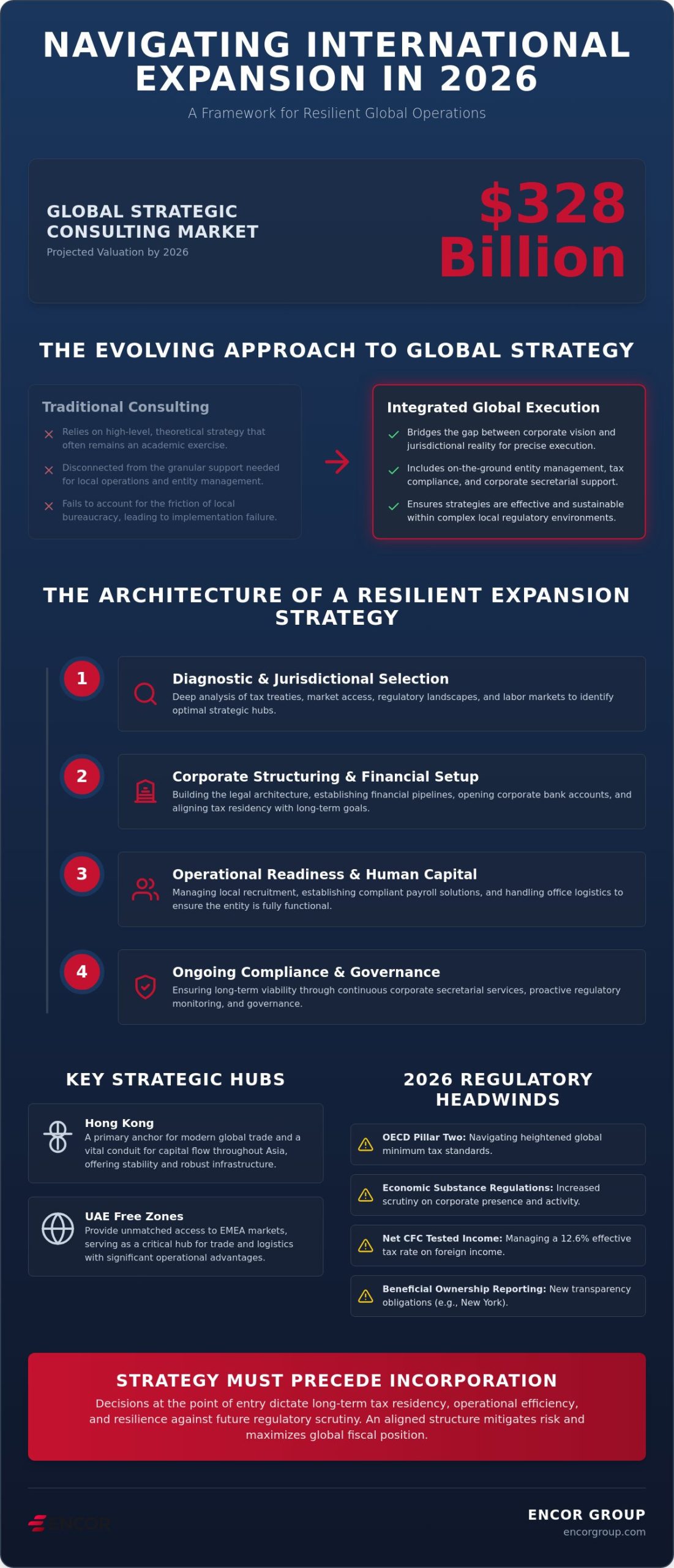
By 2026, the global strategic consulting market is projected to reach a valuation of 328 billion dollars, reflecting a corporate environment where the margin for error in cross-border expansion has effectively disappeared. Organizations now require strategic business consulting international experts who can translate high-level growth objectives into precise operational realities. You likely recognize that the complexity of global operations has intensified. Managing fragmented regulatory environments and the shift toward Net CFC Tested Income, with its 12.6% effective tax rate, requires more than just a vision; it demands institutional precision.
This article provides the institutional framework you’ll need to scale multinational operations through expert strategic consulting and integrated execution. You’ll learn how to secure a seamless entry into strategic global hubs and establish fully compliant international entities. We’ll also examine the requirements for opening corporate bank accounts in foreign jurisdictions and maintaining optimized operating models that withstand the scrutiny of 2026’s evolving trade and tax mandates. By aligning your global strategy with local execution, you can navigate these complexities with the confidence of a market leader.
Key Takeaways
- Learn to bridge the gap between high-level jurisdictional selection and granular corporate structuring to ensure a resilient foundation for multinational operations.
- Identify the essential performance metrics for selecting a strategic business consulting international partner capable of managing both fiscal strategy and local compliance.
- Gain critical insights into the 2026 regulatory environment, specifically regarding the implementation of OECD Pillar Two and heightened Economic Substance Regulations.
- Discover how an integrated execution model streamlines expansion through centralized hubs, reducing the complexity of managing disparate international entities.
Defining Strategic Business Consulting for International Markets in 2026
Professional strategic business consulting international in 2026 is defined as the bridge between corporate vision and jurisdictional reality. It’s a specialized advisory service that ensures every move a company makes aligns with the complex regulatory and fiscal environments of the global market. We’ve seen a definitive transition from traditional consulting models toward what we call ‘Integrated Global Execution.’ This approach recognizes that a strategy is only as effective as the entity management and secretarial support that sustain it on the ground. High-level strategy often fails when it lacks the granular support of local operations. Without these, even the most sophisticated international business strategy remains a theoretical exercise that fails to account for the friction of local bureaucracy.
Strategic hubs like Hong Kong and the UAE serve as the primary anchors for modern global trade. Hong Kong remains a vital conduit for capital flow in Asia, while the UAE’s Free Zones offer unmatched access to EMEA markets. These jurisdictions provide the stability and infrastructure required for scaling. However, high-level plans frequently collapse without technical execution, such as local bank account opening or tax compliance. Consultants must provide more than just a roadmap; they must facilitate the actual vehicle of expansion.
The Scope of International Strategic Advisory
Market entry analysis now requires a rigorous diagnostic phase that goes beyond simple market size projections. This includes jurisdictional selection based on tax treaty networks and the specific structural optimization required for multinational entity management. A consultant’s role is to bridge the gap between corporate headquarters and regional subsidiaries. They ensure that regional offices aren’t just outposts but integrated components of the global operating model. This scope includes:
- Evaluation of local regulatory burdens and licensing requirements.
- Analysis of labor markets and human resources compliance.
- Optimization of supply chain logistics within specific trade corridors.
Why Strategy Must Precede Incorporation
Decisions made at the point of entry dictate tax residency and long-term operational efficiency. Incorporation shouldn’t be the first step; it’s the result of a deliberate strategy. If an entity structure doesn’t account for future capital raising or potential M&A activity, it becomes a liability. Proactive regulatory planning mitigates risks associated with shifting compliance standards, such as the New York Beneficial Ownership Information reporting or the EU AI Act transparency obligations. Aligning tax residency with long-term operational goals ensures that the business remains compliant while maximizing its global fiscal position. It’s about building a structure that can withstand the scrutiny of 2026’s evolving trade mandates.
The Architecture of a Resilient International Expansion Strategy
Resilience in global expansion isn’t accidental. It’s the result of a structured methodology that prioritizes stability over speed. A robust strategic business consulting international framework typically follows a four-phase progression to ensure no detail is overlooked. This methodical approach transforms a high-risk venture into a calculated corporate move. The process begins with a diagnostic phase and moves through the complexities of structuring before reaching operational maturity.
- Phase 1: Diagnostic and Jurisdictional Selection. This involves a deep dive into tax treaties, market access, and the regulatory landscape of potential hubs.
- Phase 2: Corporate Structuring and Financial Setup. Here, the legal architecture is built, and the necessary financial pipelines are established.
- Phase 3: Operational Readiness and Human Capital. This phase focuses on recruitment, payroll solutions, and local office logistics.
- Phase 4: Ongoing Compliance and Governance. The final phase ensures long-term viability through corporate secretarial services and proactive regulatory monitoring.
This sequence ensures that every operational decision is backed by a legal and fiscal rationale. By following this architecture, businesses can avoid the common pitfalls of fragmented expansion, such as mismatched entity types or non-compliant payroll systems.
Jurisdictional Selection: Choosing Your Strategic Hub
The choice of a strategic hub defines the trajectory of your growth. When evaluating Hong Kong company formation services, executives aren’t just looking for a legal entity. They’re seeking a sophisticated entry point into the Asian capital markets and a gateway to the Greater Bay Area. Conversely, the UAE Free Zones offer a unique regulatory environment for those targeting expansion into the Middle East and Africa. Leading voices in international business consulting highlight that these decisions must balance tax treaty benefits with local talent availability and the ease of doing business. It’s about finding the right fit for your specific industry and operational goals.
Financial Infrastructure: Beyond the Incorporation
Incorporation is merely the first step. The true challenge lies in establishing a functional financial infrastructure that supports global trade. This includes strategic assistance with corporate bank account opening, which remains a significant hurdle in high-barrier jurisdictions. Your strategic business consulting international partner must also address accounting and bookkeeping standards to ensure that multi-market reporting is both accurate and compliant. Structuring for fiscal efficiency is no longer optional; it’s a requirement for maintaining international tax compliance in an era of increased global transparency. Organizations that prioritize these structural pillars find they’re better equipped to handle the complexities of 2026. For those ready to begin, exploring comprehensive compliance and regulatory advisory services can prevent costly delays during the initial setup.
Evaluating International Consulting Partners: A Selection Framework
Choosing a partner for strategic business consulting international requires a clear understanding of the trade-offs between different firm models. The ‘Big Four’ provide institutional prestige and vast networks, but their service models often prioritize high-level advisory over the hands-on execution needed by mid-market enterprises. Boutique consultancies offer deep specialization in specific niches, yet they often lack the infrastructure to manage a multi-jurisdictional footprint. Integrated service providers have emerged as the preferred choice for 2026, as they combine strategic advisory with the direct fulfillment of corporate services. This model eliminates the friction between planning and implementation.
When you look to export and expand your business, your evaluation should center on tangible Key Performance Indicators (KPIs). These metrics must go beyond simple project timelines. Reliable partners are measured by their success rates in corporate bank account openings, the accuracy of their local tax filings, and their ability to maintain entities in ‘Good Standing’ without administrative lapses. A critical component of this success is a partner’s local presence. Physical offices in regional hubs like Hong Kong or the UAE ensure that your consultant has direct access to local regulators and a real-time understanding of shifting requirements. Relying on a ‘single point of contact’ for global entity management is the only way to prevent the communication silos that typically plague international operations.
Expertise vs. Execution: The Critical Divide
A common failure point in expansion is the gap between a theoretical strategic business consulting international plan and its practical application. You must determine if a partner can deliver a comprehensive global business expansion strategy while simultaneously handling technical filings. This includes having in-house HR and recruitment services to staff your new entities and robust corporate secretarial services to manage ongoing governance. If a consultant only provides the roadmap without the vehicle to drive it, your internal teams will likely struggle with the administrative burden of local compliance.
Technological Integration and Reporting
In 2026, manual reporting is an unacceptable operational risk. Modern consulting partners must provide digital-first solutions that offer real-time access to compliance status across all jurisdictions. This technological integration should include centralized payroll solutions for multinational teams and transparent bookkeeping systems. Digital transparency allows headquarters to maintain oversight without micro-managing local offices. It’s about ensuring that financial data is accessible, accurate, and ready for audit at any moment. When your consulting partner integrates these technologies, they transform from a service provider into a strategic asset.
Mitigating Risk: Regulatory and Fiscal Compliance in 2026
The landscape of 2026 demands a shift in how organizations perceive risk. Compliance isn’t just a back-office function; it’s a strategic imperative for any multinational corporation. Navigating the implementation of OECD Pillar Two requires a specialized strategic business consulting international partner who understands the nuances of the 15% global minimum tax requirements. This framework impacts your tax liability and your entire corporate architecture. You’ll also need to account for the transition of Global Intangible Low-Taxed Income (GILTI) to Net CFC Tested Income (NCTI), which maintains a permanent 12.6% effective tax rate. These fiscal changes mean your strategy must be dynamic and highly responsive to international shifts.
Economic Substance Regulations (ESR) have evolved into a rigorous standard for companies operating in low-tax jurisdictions. Economic Substance is defined as the requirement for an entity to demonstrate a genuine, functional presence and perform core income-generating activities within its registered jurisdiction. It’s no longer enough to maintain a “brass plate” presence. Managing KYC and AML hurdles has also become more complex due to the New York Beneficial Ownership Information reporting effective January 1, 2026. This regulation requires foreign LLCs to disclose beneficial owners, creating a higher documentation burden. Additionally, the EU AI Act transparency obligations, which apply from August 2, 2026, require providers to label AI-generated content, adding another layer of regulatory oversight for tech-integrated firms.
The Global Compliance Checklist
Maintaining ‘Good Standing’ requires a methodical approach to recurring administrative tasks across your global footprint. Your strategic business consulting international advisor should provide a centralized framework for the following:
- Annual return filings and statutory audit requirements to ensure transparency with local authorities.
- Provision of registered office addresses and the appointment of resident secretaries to meet legal presence mandates.
- Strict adherence to data privacy standards, including GDPR compliance for all international data transfers between regional hubs.
Managing International Human Capital
Your expansion strategy is only as effective as the team driving it. Compliance with local labor laws is essential to avoid litigation and operational disruptions. Implementing robust international payroll solutions ensures that your multinational workforce is paid accurately and in accordance with local tax withholding requirements. This becomes particularly complex when managing expatriate teams and executive-level local leadership.
- Strategic recruitment of local leadership who possess the cultural and regulatory fluency to manage regional operations effectively.
- Efficient visa and residency processing to ensure seamless mobility across your global corporate network.
To ensure your entities remain fully compliant with these 2026 standards, you can secure professional compliance and regulatory advisory services today.
Strategic Execution with Encor Group: Your Global Expansion Partner
Encor Group provides the institutional infrastructure required for sophisticated global growth. Our approach to strategic business consulting international transcends traditional advisory by integrating high-level planning with direct operational execution. We utilize a Four-Hub Model that allows us to serve over 10 markets with localized expertise. This ensures that your expansion isn’t just a legal filing but a fully realized business operation. We manage every detail from the initial market entry strategy to daily bookkeeping, allowing your leadership to focus on core commercial objectives. We’ve built our reputation on the ability to handle high-stakes requirements with quiet efficiency and strategic depth.
Multinational operational optimization requires a partner who understands the friction between different jurisdictions. We act as a facilitator of growth, solving complex problems before they disrupt your timeline. By aligning your corporate goals with local regulatory realities, we create a sense of order and predictability. This methodical approach is why elite enterprises choose us to navigate the intricacies of cross-border operations. We don’t just provide answers; we provide the execution framework that makes those answers reality.
Gateway to Asia and the Middle East
We provide specialized expertise in Hong Kong company formation and UAE Free Zone incorporation. These jurisdictions represent the most vital gateways for modern enterprises seeking scale. Our team delivers a strategic roadmap for how to expand business to Asia in 2026, accounting for the region’s unique regulatory shifts and trade corridor designs. We recognize that legal setup is only one component of market entry. We provide bespoke corporate bank account opening assistance to overcome the significant hurdles presented by international financial institutions. This end-to-end support ensures that your entity is operational and ready to transact from day one.
Institutional Reliability and Professional Excellence
Success in foreign markets depends on institutional reliability and precise execution. Encor Group maintains a steadfast commitment to financial transparency and rigorous regulatory reporting. Our strategic business consulting international services include comprehensive HR, payroll, and recruitment solutions tailored for global teams. We identify the right local leadership and ensure they’re managed through compliant payroll systems that respect local labor laws. Strategic tax advisory is integrated into our model to ensure long-term fiscal health and adherence to the latest international standards, such as OECD Pillar Two. By centralizing your compliance and operations with Encor Group, you secure a stable foundation for high-level corporate success.
Securing Your Global Position in 2026
The corporate landscape of 2026 leaves no room for speculative expansion. Success depends on a unified framework that bridges the gap between jurisdictional selection and technical execution. You’ve seen that a resilient architecture must prioritize compliance with evolving mandates like OECD Pillar Two and Economic Substance Regulations. By aligning your global operating model with these fiscal realities, you ensure that your multinational entities remain stable and fully optimized for growth. This methodical approach protects your brand’s reputation while maximizing operational efficiency in complex markets.
Effective strategic business consulting international requires more than theoretical advice; it demands a partner with a physical presence in key hubs and a commitment to institutional excellence. Encor Group serves over 10 markets through four regional hubs, providing the end-to-end compliance and HR management necessary for modern enterprises. With deep expertise in the Hong Kong and UAE markets, we facilitate seamless entry into the world’s most strategic trade corridors. Take the next step in your expansion journey and Schedule a Strategic Consultation with Encor Group to secure your global future. Your path to a compliant and high-performing international presence begins with precise, expert-led execution.
Frequently Asked Questions
What does strategic business consulting international actually include?
Integrated strategic business consulting international services include market entry analysis, jurisdictional selection, and the architectural design of multinational corporate structures. It bridges the gap between high-level corporate objectives and the granular execution of local entity management. This encompasses tax advisory, structural optimization, and the provision of essential operational pillars like payroll and corporate secretarial support. The goal is to ensure that your global footprint is both compliant and operationally efficient.
How do I choose between Hong Kong and the UAE for my regional headquarters?
The choice depends primarily on your target market and specific fiscal requirements. Hong Kong remains the premier gateway for Asian market access and capital flow, especially for businesses targeting the Greater Bay Area. The UAE offers strategic advantages for expansion into the Middle East and Africa, particularly through its diverse Free Zone environments. We evaluate tax treaty networks and local regulatory stability to determine which hub best supports your long-term operational goals.
Can a strategic consultant help with corporate bank account opening?
Yes, strategic consultants provide essential assistance with corporate bank account opening by navigating the rigorous KYC and AML requirements of international financial institutions. This involves preparing the necessary documentation and presenting the business case to banks in high-barrier jurisdictions. Since banking is often the most significant hurdle in global expansion, professional guidance ensures that your financial infrastructure is established alongside your legal entity to prevent operational delays.
What are the biggest compliance risks for international businesses in 2026?
The most significant risks involve the implementation of OECD Pillar Two and the heightening of Economic Substance Regulations (ESR). Businesses must also navigate the transition of GILTI to Net CFC Tested Income and new beneficial ownership disclosure mandates, such as the New York reporting requirements effective January 1, 2026. Failure to maintain ‘Good Standing’ or align with these standards can result in severe financial penalties and the potential loss of operational licenses.
How much does it cost to set up an international business entity?
The total cost of establishing an international entity depends on the chosen jurisdiction, the complexity of the corporate structure, and specific licensing requirements. Initial setup fees are typically followed by recurring costs for corporate secretarial services, registered office addresses, and tax compliance. We provide detailed projections based on your specific operational scope to ensure full transparency during the planning phase, as costs vary significantly between a UAE Free Zone and a Hong Kong limited company.
What is the difference between a corporate service provider and a strategic consultant?
A corporate service provider typically handles transactional filings and administrative tasks, whereas a strategic consultant provides the institutional framework that precedes incorporation. Strategic business consulting international involves aligning your expansion with long-term goals, risk mitigation, and operational optimization. While a provider might simply file your documents, a consultant ensures those documents reflect a structure that supports future capital raising, M&A activity, and global tax efficiency.
How long does the international business setup process typically take?
Setup timelines vary significantly by jurisdiction and the complexity of the required business licenses. UAE Free Zone incorporations can often be completed in a matter of weeks, while more complex structures in Hong Kong or those requiring extensive bank account vetting may take several months. A structured roadmap helps manage these timelines by ensuring all documentation is prepared proactively to avoid administrative delays and ensure a predictable market entry.
Does Encor Group provide ongoing compliance support after incorporation?
Yes, we provide comprehensive ongoing support to ensure your entities remain fully compliant with local and international regulations. Our services include corporate secretarial support, accounting, bookkeeping, and tax advisory. We also manage human resources and payroll solutions, allowing your headquarters to maintain oversight of regional subsidiaries through a centralized, institutional framework that adapts to the shifting regulatory landscape of 2026.