

For a multinational executive, a missed filing deadline in Hong Kong is not merely an administrative error; it’s a direct threat to your entity’s institutional standing and global operational continuity. You likely recognize that maintaining a subsidiary in a premier financial hub requires more than just meeting basic requirements. The complexity of aligning local statutory obligations with international corporate governance often leads to unnecessary friction and the risk of significant financial penalties. Utilizing a comprehensive Hong Kong corporate compliance checklist is no longer optional for those managing the intersection of local mandates and global strategy in 2026.
This guide provides the strategic clarity needed to secure your firm’s presence in the region. We’ll examine the 2026 regulatory environment, including the mandatory 42-day filing window for Annual Returns and the non-negotiable audit requirements for all incorporated entities. You’ll gain a methodical timeline of essential filings and a clear understanding of the Company Secretary’s role as a vital anchor for your operations. This roadmap ensures your organization moves beyond reactive filing toward a state of total corporate standing and institutional confidence.
Key Takeaways
- Understand the dual-authority oversight of the Companies Registry and the Inland Revenue Department to ensure full adherence to the Companies Ordinance.
- Implement a definitive Hong Kong corporate compliance checklist to manage mandatory requirements, including the maintenance of a registered office and a licensed Company Secretary.
- Navigate annual obligations with precision by coordinating financial year-end accounting with the required statutory audit performed by a Certified Public Accountant.
- Mitigate institutional risk by recognizing the escalating penalty structures for late filings and the potential for director prosecution in cases of non-compliance.
- Optimize global operations by centralizing compliance tracking and leveraging digital tools to maintain seamless standing across multiple international jurisdictions.
Understanding the Hong Kong Regulatory Landscape in 2026
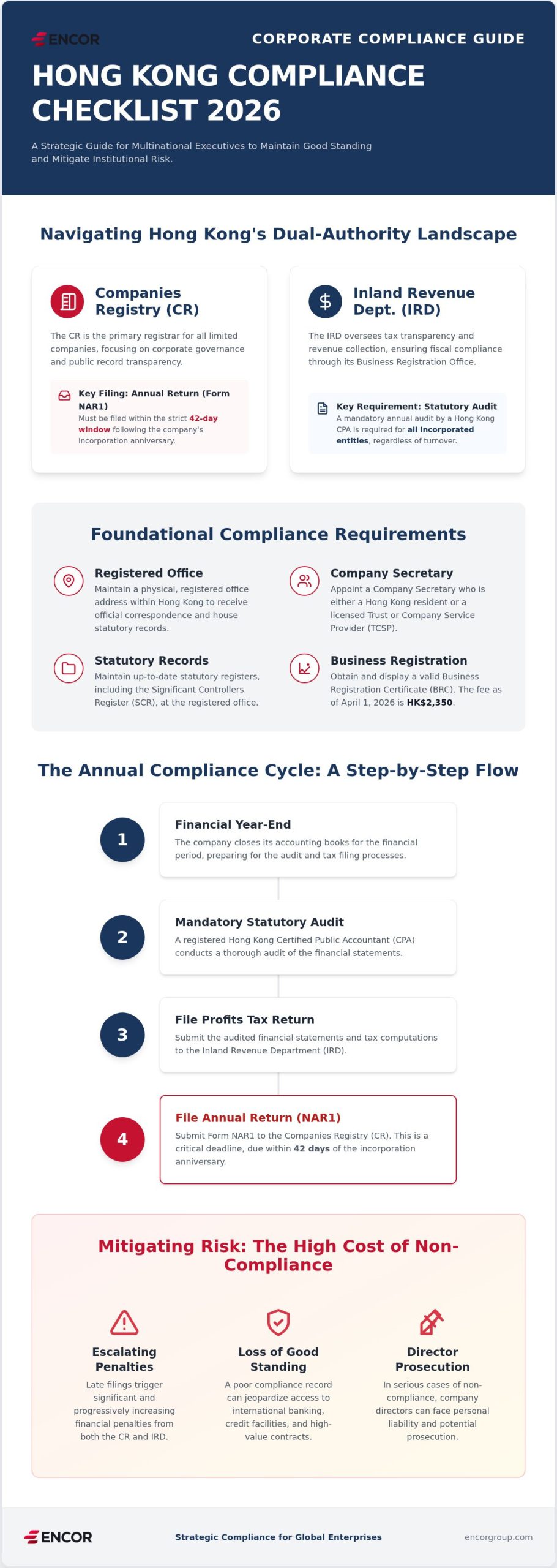
Corporate compliance in Hong Kong represents the rigorous adherence to the statutory frameworks established by the Companies Ordinance and the Inland Revenue Ordinance. It is a multi-layered requirement that demands precision and foresight. For multinational executives, a robust Hong Kong corporate compliance checklist acts as a critical safeguard against regulatory friction and institutional risk. The system operates through a dual-authority structure where the Companies Registry (CR) and the Inland Revenue Department (IRD) maintain separate but intersecting oversight. Effective governance requires a thorough understanding of how these entities interact to regulate your corporate presence.
In 2026, the standard for operational excellence has shifted toward Global Entity Management. This approach centralizes the oversight of Ultimate Beneficial Ownership (UBO) and Know Your Customer (KYC) data to satisfy heightening transparency requirements. Maintaining a status of “Good Standing” is no longer just a legal formality; it’s a commercial necessity for securing international banking facilities and executing high-value contracts. Financial institutions now conduct deeper scrutinies into the Significant Controllers Register (SCR) and historical filing patterns before approving credit lines or cross-border transactions.
The Role of the Companies Registry (CR)
The Companies Registry serves as the primary registrar for all Hong Kong limited companies. Its mandate involves maintaining a comprehensive public register that provides transparency to investors and creditors. To preserve a company’s legal existence, the CR requires specific statutory filings, most notably the Annual Return (Form NAR1). Failure to submit these documents within the 42-day window following the incorporation anniversary triggers escalating penalties. In 2026, the CR has intensified its focus on the accuracy of the Register of Members and the accessibility of company records for law enforcement and regulatory bodies.
The Inland Revenue Department (IRD) and Fiscal Compliance
The IRD focuses on tax transparency and revenue collection, operating under a regime that prioritizes clarity and efficiency. A central component of this oversight is the Business Registration Office, which issues the Business Registration Certificate (BRC). As of April 1, 2026, the fee for a one-year certificate is HK$2,350, reflecting the reinstated levy for the Protection of Wages on Insolvency Fund. Understanding Hong Kong’s taxation system is essential for any enterprise aiming to optimize its fiscal position while remaining fully compliant. Fiscal discipline directly impacts a company’s eligibility for a Hong Kong profit tax exemption, as the IRD requires documented proof of offshore operations to grant such status. All incorporated entities must also undergo an annual statutory audit by a Hong Kong Certified Public Accountant, regardless of their turnover size.
The Essential Hong Kong Corporate Compliance Checklist
Effective governance begins with a structured approach to statutory requirements. A comprehensive Hong Kong corporate compliance checklist distinguishes between high-impact activities required immediately after company formation and the recurring duties that sustain legal standing year after year. Central to this framework is the requirement for a physical presence within the jurisdiction. Every entity must maintain a registered office address in Hong Kong to receive official correspondence and house statutory records. Additionally, the law mandates the appointment of a Company Secretary. This individual or corporate body must be a Hong Kong resident or a licensed Trust or Company Service Provider (TCSP), serving as the primary liaison with the Hong Kong Companies Registry.
Transparency remains a priority in the 2026 regulatory environment. The Significant Controllers Register (SCR) must be maintained at the registered office, identifying any person or entity with significant control over the company. This register, along with the registers of directors, members, and secretaries, must be kept accurate and available for inspection by law enforcement officers upon demand. Maintaining these records is a foundational element of institutional credibility that prevents unnecessary scrutiny during global audits or mergers.
Post-Incorporation Milestones
The first 90 days of a company’s life are critical for establishing a compliant foundation. Directors must formalize the internal governance structure by adopting the Articles of Association and issuing share certificates to all members. The appointment of the first auditors is another non-negotiable step; this must occur within the statutory timeframe to prepare for the first financial year end. Opening a corporate bank account remains a significant milestone, requiring rigorous Know Your Customer (KYC) documentation to satisfy global anti-money laundering standards. Organizations often benefit from expert compliance and regulatory advisory to navigate these initial hurdles without operational delays.
Annual Recurring Obligations
Sustainability depends on the timely execution of recurring tasks. The Annual Return (Form NAR1) acts as a snapshot of the company’s current structure, including details of directors, shareholders, and share capital. This must be filed within 42 days of the incorporation anniversary. Parallel to this, the Business Registration Certificate (BRC) requires renewal through the Inland Revenue Department. Executives can choose between a one-year or three-year renewal option, depending on their long-term administrative strategy. Finally, private companies must hold an Annual General Meeting (AGM) to approve financial statements and reappoint auditors, unless they’ve opted for a statutory waiver under the Companies Ordinance. This meeting must typically occur within nine months after the end of the company’s accounting reference period.
How to Execute Your Annual Compliance Obligations: A Step-by-Step Guide
Execution of a Hong Kong corporate compliance checklist requires a methodical approach that aligns with the statutory windows provided by the Companies Registry and the Inland Revenue Department. Managing these obligations is not a singular event but a continuous cycle that demands coordination between your internal finance team and external advisors. Following a logical progression prevents administrative bottlenecks and ensures your entity remains in good standing throughout the fiscal year.
- Step 1: Financial Year End (FYE) Determination. Select a date that aligns with your global operations, such as December 31 or March 31. This choice dictates your deadlines for accounting preparation and subsequent tax filings.
- Step 2: Statutory Audit Engagement. You must engage an independent Hong Kong Certified Public Accountant (CPA) to examine your financial records. This process should begin immediately after your FYE to allow sufficient time for detailed verification.
- Step 3: AGM and Financial Statement Approval. Convene the Annual General Meeting within nine months of your FYE. During this session, the board must formally approve the audited financial statements and reappoint the auditors for the coming year.
- Step 4: Filing the Annual Return (NAR1). Submit this document to the Companies Registry within 42 days of your incorporation anniversary. It’s a critical update of your corporate structure, including details of directors and share capital.
- Step 5: Tax Return Submissions. File your Profits Tax Return and Employer’s Return with the tax authorities. Timely submission is vital to avoid penalties and maintain your fiscal credibility.
Coordinating with Your Company Secretary
A professional Hong Kong company secretary is essential for the precise execution of these steps. This officer acts as the primary custodian of your statutory books, ensuring that any changes in corporate structure or directorship are recorded and filed within the legal timeframes. Delegating these tasks allows the board to focus on strategic growth while the secretary manages the granular details of regulatory adherence. Clear and timely communication between your leadership and the secretary is the only way to prevent missed deadlines that lead to escalating fines.
Audit and Tax Filing Procedures
The Hong Kong Inland Revenue Department typically issues Profits Tax Returns on the first working day of April each year. You must differentiate between a “Nil” tax return, filed when a company hasn’t yet commenced business or has no assessable profits, and a standard filing for active entities. Under the Companies Ordinance, every incorporated entity in Hong Kong must submit its financial statements for an annual audit conducted by an independent Certified Public Accountant, irrespective of the company’s total revenue or asset valuation. This requirement underscores the jurisdiction’s commitment to financial transparency and institutional integrity.
Mitigating Risks: Penalties, Deadlines, and Common Misconceptions
Neglecting the Hong Kong corporate compliance checklist carries immediate financial consequences that escalate with every day of inaction. The Companies Registry enforces a strict penalty structure for the late filing of the Annual Return (Form NAR1). While a timely filing costs a nominal HK$105, missing the 42-day window triggers a significant increase in fees. If you file more than 42 days but within 3 months of the anniversary, the fee rises to HK$870. This continues to climb to HK$1,740 for delays up to 6 months, HK$2,610 for up to 9 months, and reaches a maximum of HK$3,480 for filings delayed beyond 9 months. These are not merely administrative fees; they’re statutory penalties that reflect a lapse in corporate governance.
Persistent non-compliance extends beyond financial loss. Directors face a genuine risk of prosecution and personal liability if the company fails to meet its statutory obligations. In the eyes of the law, a director’s failure to ensure timely filings is a breach of fiduciary duty. This can lead to disqualification from holding directorships in the future. Furthermore, modern global AML and KYC monitoring systems are highly sensitive to filing delays. A company that consistently misses deadlines is often flagged as high-risk by financial institutions, which can lead to the freezing of corporate bank accounts or the termination of essential credit facilities.
A common and dangerous misconception among international executives is the belief that a company with no income is exempt from filing. This is incorrect. Every incorporated entity must fulfill its annual obligations unless it has formally applied for and been granted “dormant” status by the Companies Registry. Even then, specific requirements remain. Without this formal status, the law requires an annual statutory audit regardless of turnover or profit levels. For organizations seeking to mitigate these risks through professional oversight, our Compliance & Regulatory Advisory services provide the necessary institutional security.
The Striking Off Process
When a company fails to file its Annual Returns or respond to official inquiries, the Companies Registry may initiate the “striking off” process. This is a terminal administrative action where the Registrar removes the company from the register, effectively dissolving the entity. Once a company is struck off, its assets are considered bona vacantia and vest in the government. Restoring a company to the register is a complex, costly, and time-consuming process that often requires a court order. It’s a scenario that creates immense operational disruption and can permanently damage a firm’s reputation in the global market.
Managing Changes in Corporate Structure
Compliance is a dynamic requirement that must reflect the current state of the business. Any changes to the corporate structure, such as the appointment of new directors, the resignation of existing ones, or a change in the registered office address, must be reported to the Companies Registry within 15 days. This also applies to share allotments and transfers. Proactive reporting ensures that the public record remains accurate, which is a core component of a successful global business expansion strategy. Maintaining this level of transparency facilitates smoother entries into new markets and reinforces the trust of international partners and stakeholders.
Strategic Compliance Management for Multinational Enterprises
Managing an international entity portfolio requires moving beyond a localized focus to a centralized governance model. For executives overseeing operations in diverse jurisdictions such as Hong Kong and the UAE, the Hong Kong corporate compliance checklist serves as a template for broader institutional discipline. Centralization allows for the synchronization of statutory deadlines and the standardization of KYC documentation, reducing the administrative burden on your global headquarters. Leveraging sophisticated technology for deadline tracking and document management is no longer a luxury; it’s a prerequisite for maintaining global operational continuity and avoiding the friction of local regulatory audits.
Compliance acts as the structural foundation for other critical business functions. Maintenance of impeccable corporate standing is essential for the effective deployment of international payroll solutions and human resource management. Regulatory authorities and local banks often require proof of good standing before facilitating large-scale payroll transfers or issuing work visas for expatriate staff. Encor Group’s network of regional hubs provides the necessary infrastructure to handle these high-stakes requirements with quiet efficiency, ensuring that your regulatory adherence supports, rather than hinders, your growth trajectory in the Asia-Pacific region.
Institutional Advisory vs. Administrative Support
The distinction between basic filing services and strategic regulatory consulting is significant for the modern enterprise. While many providers focus on the mechanical submission of forms, Encor Group delivers executive-level oversight that integrates tax advisory with ongoing compliance. This holistic approach ensures maximum fiscal efficiency by aligning your corporate structure with the latest Inland Revenue Department mandates, such as the two-tiered profits tax regime. Our team functions as a trusted elite consultant, providing the deep knowledge required to navigate cross-border complexities and handle multifaceted operational challenges with precision.
Next Steps for Global Expansion
The first step toward securing your international presence is a comprehensive compliance health check. This audit identifies potential vulnerabilities in your existing Hong Kong entities, such as outdated statutory books or missed significant controller updates that could trigger red flags during a bank review. Establishing a robust framework early in the expansion process prevents the compounding of errors as you enter new markets. We invite you to partner with Encor Group for comprehensive Hong Kong compliance management to ensure your organization maintains the highest standards of institutional credibility and operational excellence throughout 2026.
Future-Proofing Your Hong Kong Operations for 2026 and Beyond
Maintaining total corporate standing in Hong Kong requires a decisive shift from reactive filing to strategic governance. By adhering to a rigorous Hong Kong corporate compliance checklist, multinational executives protect their firm’s bankability and institutional reputation. We’ve established that precision in statutory audits and the proactive management of the Significant Controllers Register are not just legal hurdles but essential components of global operational stability. Neglecting these details invites unnecessary risk, while mastering them provides a competitive advantage in an increasingly complex regulatory environment.
Encor Group provides the executive-level consulting necessary for complex multinational structures to thrive. With a global presence across 10+ markets and dedicated regional hubs, we deliver comprehensive support covering tax, HR, and corporate secretarial needs. Our team acts as a seasoned advisor, ensuring that every filing is a step toward greater institutional depth. Secure Your Institutional Standing with Encor Group’s Compliance Services and ensure your expansion remains seamless. Your commitment to excellence today ensures a resilient and prosperous presence in Asia’s premier financial hub.
Frequently Asked Questions
Is it mandatory to appoint a company secretary in Hong Kong?
Yes, appointing a company secretary is a mandatory statutory requirement for every incorporated entity in Hong Kong under the Companies Ordinance. This officer must be an individual residing in Hong Kong or a body corporate that holds a valid Trust or Company Service Provider (TCSP) license. The secretary acts as the primary link between the company and regulatory authorities, ensuring that the Hong Kong corporate compliance checklist is executed with precision and all statutory books remain current.
What are the consequences of missing the Annual Return filing deadline?
Missing the 42-day filing window for the Annual Return (NAR1) triggers immediate and escalating financial penalties. While a timely filing costs HK$105, late submissions incur fines ranging from HK$870 to a maximum of HK$3,480 for delays exceeding nine months. Persistent failure to file is a criminal offense that can lead to the prosecution of directors and the eventual striking off of the company from the register, which results in the forfeiture of corporate assets.
Can a foreigner be the sole director of a Hong Kong company?
A foreign national can serve as the sole director of a Hong Kong company without any local residency requirements. Hong Kong permits 100% foreign ownership and management, which makes it a preferred jurisdiction for global enterprises seeking a gateway to Asian markets. However, the company must still appoint a local company secretary and maintain a registered office address within the territory to satisfy the necessary physical presence mandates and receive official government correspondence.
How often must a Hong Kong company renew its Business Registration Certificate?
Companies have the option to renew their Business Registration Certificate (BRC) on either a one-year or three-year basis. As of April 1, 2026, the fee for a one-year certificate is HK$2,350, while a three-year certificate costs HK$6,170. Most multinational executives choose the three-year option to streamline administrative workflows and reduce the frequency of recurring renewals within their broader compliance framework, ensuring that the entity’s operational license remains valid without constant oversight.
What is the difference between an Annual Return and a Profit Tax Return?
The Annual Return (NAR1) and the Profit Tax Return (PTR) serve distinct regulatory purposes and are submitted to different authorities. The NAR1 provides the Companies Registry with an update on the company’s corporate structure, including details of directors and shareholders. Conversely, the PTR is filed with the Inland Revenue Department to report financial performance. Both filings are core components of a Hong Kong corporate compliance checklist that ensures your entity’s legal and fiscal standing.
Does a dormant Hong Kong company still need to perform an annual audit?
A company that has formally registered for “dormant” status with the Companies Registry is exempt from the annual statutory audit requirement. This status is only granted to companies that have no “relevant accounting transactions” during the financial year. If a company has not secured this formal status, it must perform an audit regardless of whether it has commenced business or generated any revenue. Simply being inactive is not enough to bypass the audit mandate.
What is the Significant Controllers Register (SCR) and who can access it?
The Significant Controllers Register (SCR) is a mandatory record identifying individuals or legal entities that exercise significant control over a company, typically through a shareholding of more than 25%. While this register is not accessible to the general public, it must be kept at the registered office or a designated location. Law enforcement officers and regulatory authorities have the legal right to inspect the SCR to ensure transparency and prevent financial crimes such as money laundering.
How long must a company keep its statutory records and accounting books in Hong Kong?
Hong Kong law requires companies to maintain their statutory records and accounting books for a minimum period of seven years. These records include invoices, receipts, bank statements, and registers of members or directors. Failure to preserve these documents for the required duration can result in significant penalties. It also complicates the process of responding to tax inquiries from the Inland Revenue Department or conducting due diligence during future corporate mergers and acquisitions.