

In the first half of 2025, UAE regulators issued over AED 380 million in anti-money laundering fines, signaling a definitive end to the era of passive corporate oversight. For international enterprises, the opacity of requirements across various Free Zones and the complexity of multi-layered corporate structures often make compliance feel like a moving target. You likely recognize that maintaining a valid trade license and operational stability now depends entirely on your ability to navigate the evolving UAE ultimate beneficial owner regulations with absolute precision.
This strategic guide provides a definitive framework to master these complexities, ensuring your organization meets the rigorous standards set by Cabinet Resolution No. 109 of 2023. By following this roadmap, you’ll avoid the risk of administrative penalties that can reach AED 100,000 for repeated violations. We’ll examine the specific filing requirements for 2026, the distinct rules within the ADGM and DIFC, and the internal record-keeping protocols necessary to secure your corporate banking operations ahead of the June 2026 FATF evaluation.
Key Takeaways
- Apply the three-tiered test to accurately identify beneficial owners within complex, multi-layered corporate structures and satisfy the 25% ownership threshold.
- Ensure your enterprise remains aligned with the latest UAE ultimate beneficial owner regulations to mitigate the risk of significant administrative fines and trade license suspension.
- Establish and maintain mandatory statutory registers, including the Register of Beneficial Owners and the Register of Partners and Shareholders, at your registered office.
- Utilize a 2026 compliance checklist to manage annual ownership verifications and navigate the Ministry of Economy’s unified digital filing portal.
- Leverage professional corporate secretarial services to centralize data management, facilitating seamless corporate bank account maintenance and long-term operational stability.
The Regulatory Landscape: UAE UBO Regulations in 2026
The transition from Cabinet Resolution No. 58 of 2020 to Cabinet Resolution No. 109 of 2023 established a new baseline for corporate transparency in the Emirates. As we approach 2026, these UAE ultimate beneficial owner regulations represent more than a simple filing requirement; they’re a cornerstone of the nation’s strategy to bolster global financial confidence. The primary objective is to ensure that the natural person who ultimately owns or controls a legal entity is clearly identified, leaving no room for opaque corporate layers to obscure accountability. This shift reflects the UAE’s successful removal from the FATF “grey list” and its commitment to maintaining a world-class regulatory environment.
Under the current framework, Beneficial ownership refers to any individual who owns or controls at least 25% of a company’s shares or voting rights. This federal mandate applies broadly to all entities registered on the UAE Mainland and within commercial Free Zones. While financial hubs like the ADGM and DIFC maintain their own specific regulations, their standards align closely with the federal objective of meeting international transparency requirements. For any international enterprise, understanding that these rules apply regardless of the specific licensing authority is the first step toward institutional stability.
The Legal Framework and Enforcement Bodies
The Ministry of Economy serves as the primary federal supervisor, overseeing the collection and verification of beneficial ownership data across the country. However, the actual implementation occurs at the local level through Licensing Authorities, often referred to as Registrars. Whether you’re operating under a Department of Economy and Tourism (DET) license or a specific Free Zone authority, your Registrar is responsible for maintaining the Register of Beneficial Owners. This system is directly integrated into the UAE’s broader Anti-Money Laundering (AML) and Counter-Terrorism Financing (CFT) protocols. Regulators now conduct frequent spot-checks to ensure that the data provided matches the actual control structures of the enterprise.
Why Compliance is Non-Negotiable for Global Entities
Operational continuity for international firms depends on strict adherence to these rules. Most notably, UAE financial institutions have integrated UBO verification into their core KYC (Know Your Customer) processes. Failure to provide updated UBO data often results in immediate freezes on corporate bank accounts, halting all domestic and international transactions. For entrepreneurs exploring Dubai business setup for foreigners, transparency isn’t just a legal hurdle but a prerequisite for institutional trust. Proactive filing under the UAE ultimate beneficial owner regulations prevents the administrative sanctions outlined in Cabinet Decision No. 132 of 2023, which include progressive fines and the potential suspension of trade licenses. Success in the 2026 business environment requires a shift from reactive reporting to a culture of permanent, verified transparency.
Identifying the Beneficial Owner: The 25% Threshold and Control Criteria
Identifying the natural person at the end of a corporate chain requires a rigorous, three-tiered methodology. This process ensures that UAE ultimate beneficial owner regulations are applied with the precision required by global financial watchdogs. By aligning with FATF standards on beneficial ownership, the UAE mandates that companies look past legal titles to find individuals who exert genuine influence over the entity’s operations and assets.
The identification process isn’t limited to direct shareholders. It involves calculating aggregate control across parent companies and subsidiaries, even when they’re located in different jurisdictions. For example, if an individual owns 50% of a holding company that in turn owns 60% of a UAE subsidiary, that individual’s indirect ownership is 30%, which surpasses the mandatory reporting limit. It’s this level of granular analysis that prevents corporate structures from being used to obscure the identity of the true controllers.
Tier 1: Ownership and Voting Rights
The first step focuses on quantifiable metrics such as share capital and voting power. You must analyze the entire ownership chain, including complex arrangements involving trusts or private foundations. In these cases, identifying the UBO involves determining who holds the power to direct the trust’s assets, the identity of the settlor, or the ultimate beneficiaries who receive distributions. Any natural person who ultimately owns or controls 25% or more of a company’s shares or voting rights is considered a UBO.
Tier 2 and Tier 3: Control and Senior Management
If no individual meets the 25% threshold through equity, the search moves to Tier 2: effective control. This identifies persons who possess the power to appoint or remove a majority of the board of directors or who otherwise dictate the company’s strategic financial decisions. This “control through other means” is a critical component of UAE ultimate beneficial owner regulations, specifically designed to prevent the use of nominee structures to obscure the identity of those driving the business forward.
Tier 3 serves as the final fallback. When no individual can be identified under the first two tiers, the Senior Managing Official (SMO) is designated as the UBO. This is typically the CEO, Managing Director, or an equivalent executive with primary decision-making authority. For state-owned entities or companies listed on recognized stock exchanges, specific exemptions or simplified reporting requirements may apply, though the burden of proof remains with the entity to demonstrate its status through verified documentation.
Navigating these layers requires a proactive approach to entity management. Maintaining clear documentation of your ownership chain is essential for seamless operations. If your structure involves multiple international jurisdictions, seeking specialized compliance advisory ensures your registers remain accurate and defensible during regulatory audits.
Mandatory Statutory Registers: Documentation Requirements
Compliance with UAE ultimate beneficial owner regulations requires more than just identifying controllers; it demands the rigorous maintenance of three specific statutory registers. These documents must be held at the entity’s registered office and made available to the Licensing Authority upon request. While many enterprises focus solely on the beneficial owner, the regulatory framework mandates equal attention to the legal ownership layer and fiduciary arrangements. For a deeper dive into the legal nuances, you can find expert analysis of UAE UBO regulations that details the interplay between these different registers.
The three mandatory registers include the Register of Beneficial Owners, the Register of Partners or Shareholders, and the Register of Nominee Directors. The latter is particularly critical for international structures utilizing nominee arrangements, as failure to disclose these fiduciary relationships can lead to immediate administrative sanctions. Each register serves as a verified map of the company’s control environment, ensuring that no individual or corporate entity remains hidden behind a veil of secrecy.
Data Points for the UBO Register
The Register of Beneficial Owners must contain exhaustive personal data for every individual identified as a UBO. This includes the individual’s full legal name, nationality, date and place of birth, and residential address. For 2026, verification protocols require high-resolution copies of passports and, where applicable, Emirates IDs. You must also record the specific date on which the individual attained UBO status and, should they cease to hold that position, the date of their departure. Precision in these dates is vital, as they form the chronological basis for all subsequent regulatory filings.
Internal Record Keeping vs. Registrar Filing
Maintaining these registers is a continuous obligation. While digital formats are standard, they must be accessible at the entity’s registered office at all times. The most critical operational requirement is the “15-day rule.” Any amendment to the UBO data, such as a change in residential address or a shift in shareholding, must be updated in the internal register and reported to the relevant Registrar within 15 business days. New companies have a slightly longer window, with a 60-day deadline from the date of trade license issuance to complete their initial UBO filing.
Additionally, every entity must appoint a UAE resident to act as the official point of contact for UBO data. This individual is responsible for facilitating communication with the Ministry of Economy or the local Registrar during audits. It’s not enough to simply file the data once; your internal records must reflect the current reality of your ownership structure to withstand the frequent spot-checks now common across all UAE jurisdictions. Operational excellence in this area ensures that your UAE ultimate beneficial owner regulations standing remains impeccable, protecting your trade license and banking relationships from avoidable disruption.
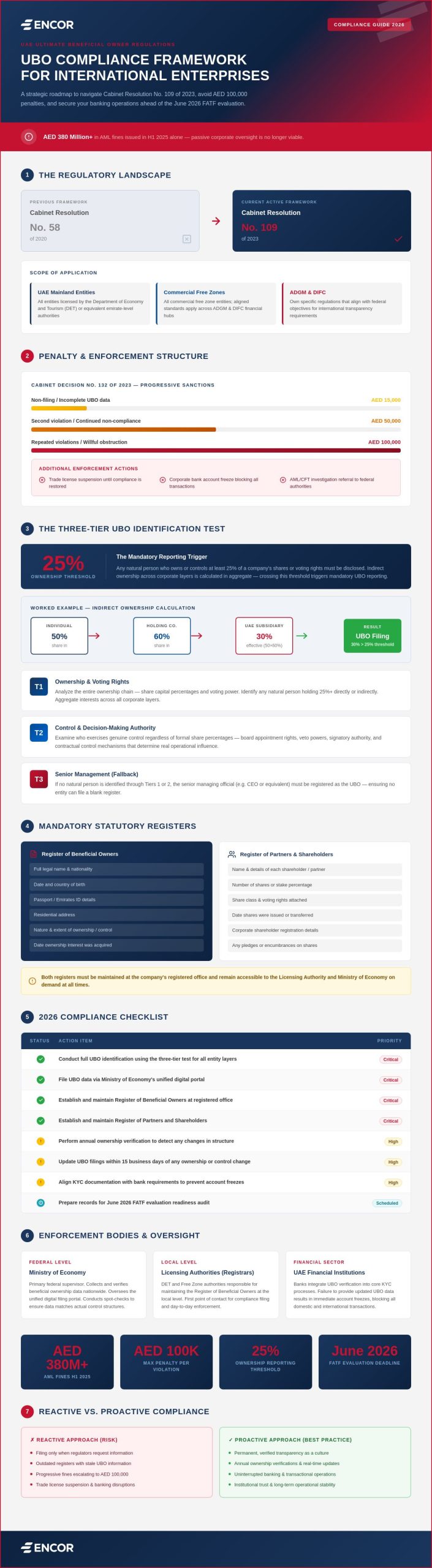
2026 Compliance Checklist: Maintaining Regulatory Standing
Maintaining regulatory standing in 2026 requires a shift from static reporting to active, periodic oversight. The UAE Ministry of Economy now utilizes a unified digital portal to centralize beneficial ownership data, making it easier for authorities to cross-reference information across different jurisdictions. To ensure your enterprise remains compliant with UAE ultimate beneficial owner regulations, you must implement a structured verification cycle that goes beyond the initial filing. This proactive approach protects your trade license and ensures that your corporate identity remains transparent to both regulators and financial institutions.
A critical component of this checklist is the disclosure of nominee arrangements. If your corporate structure utilizes nominee shareholders or directors, these fiduciary roles must be explicitly identified and reported. While the UAE maintains strict confidentiality protocols to protect UBO data from public disclosure, this information is readily available to competent authorities for the purpose of combating financial crimes. Your focus should be on the accuracy of the data submitted to the registrar, as discrepancies can trigger immediate investigations.
Quarterly and Annual Compliance Actions
Operational excellence depends on integrating UBO reviews into your standard corporate calendar. You should implement an internal “Change of Control” notification policy that requires shareholders to report any transfer of equity or voting rights immediately. This internal mechanism ensures you can meet the 15-day reporting deadline for amendments. Additionally, you must verify all UBO data during your annual trade license renewal process. Conducting brief, internal audits twice a year will confirm that your physical registers at the registered office align perfectly with the digital records held by the Licensing Authority.
Mitigating the Risk of Non-Compliance
The UAE employs a tiered penalty system for incorrect, incomplete, or late filings as outlined in Cabinet Decision No. 132 of 2023. These sanctions typically begin with a written warning but can quickly escalate to significant financial burdens. Administrative fines for UBO violations can range significantly depending on the specific registrar and the severity of the infraction, often reaching AED 100,000 for repeated non-compliance. Beyond financial loss, persistent violations may lead to the suspension of your trade license, effectively halting your operations.
Sophisticated entities recognize that UBO transparency is a fundamental pillar of a successful Global Business Expansion Strategy. Maintaining a clean compliance record facilitates smoother entries into new markets and simplifies the due diligence processes required by international partners. If you require assistance in auditing your current ownership structure or managing your statutory registers, our Compliance & Regulatory Advisory team can provide the strategic oversight necessary to secure your standing for 2026 and beyond.
Strategic Entity Management: How Encor Group Secures Your Compliance
Strategic stability in the Middle East is inextricably linked to regulatory transparency. For international enterprises, the UAE ultimate beneficial owner regulations represent a critical data point that influences everything from credit ratings to cross-border capital flow. By centralizing UBO data management through professional Corporate Secretarial Services, organizations transform a mandatory filing into a streamlined operational advantage. This institutional-grade approach ensures that ownership data remains accurate, verified, and ready for immediate disclosure during high-stakes financial transactions or regulatory audits.
Effective entity management also bridges the gap between regulatory filings and practical business needs. When UBO records are maintained with precision, the process of Bank Account Opening Assistance becomes significantly more efficient. Financial institutions prioritize entities that demonstrate a clear, documented ownership chain, as it reduces their own internal compliance burden. Encor Group provides the strategic depth necessary to navigate these requirements, particularly for complex structures involving parent companies or holding entities across multiple international jurisdictions.
The Encor Advantage in UAE Compliance
Our team possesses deep expertise in navigating the specific digital portals utilized by both Mainland authorities and various Free Zone registrars. We provide proactive alerts for regulatory shifts and upcoming filing deadlines, ensuring that your organization never misses the critical 15-day reporting window for data amendments. Beyond UBO advisory, we support global entities through a holistic service suite that includes international payroll solutions and comprehensive HR management. This integration allows executives to focus on market expansion while we handle the underlying administrative complexities of the local regulatory environment.
Next Steps for Your UAE Entity
Securing your regulatory standing for 2026 begins with a thorough audit of your current registers. We recommend scheduling a strategic review of your beneficial ownership documentation to identify any gaps in your multi-jurisdictional chain or nominee disclosures. Outsourcing the administrative burden of reporting to a seasoned advisor mitigates the risk of administrative fines and protects your trade license from potential suspension. To maintain uninterrupted operations and institutional trust, you must ensure your registers are defensible and current. Secure your UAE entity’s compliance with Encor Group to leverage our global expertise and strategic navigation in the Emirates.
Securing Institutional Stability in the 2026 Regulatory Environment
Mastering the UAE ultimate beneficial owner regulations is a fundamental prerequisite for any international enterprise seeking long-term operational success in the Emirates. By maintaining precise statutory registers and strictly adhering to the 15-day reporting cycle for ownership changes, you protect your trade license and ensure uninterrupted access to the global financial system. While the 25% threshold remains the primary trigger for identification, determining effective control requires a sophisticated understanding of multi-layered corporate structures and fiduciary arrangements.
Proactive entity management turns compliance from a complex administrative burden into a strategic asset that fosters institutional trust. Encor Group provides institutional-grade regulatory advisory and specialized UAE Free Zone incorporation support to help you navigate these requirements with absolute confidence. Our global entity management expertise ensures your organization remains aligned with evolving international standards while you focus on scaling your core operations. Consult with Encor Group for UAE Compliance Management to secure your corporate standing and build a durable foundation of transparency. We look forward to facilitating your continued growth and success in this dynamic global hub.
Frequently Asked Questions
What is the deadline for filing UBO information in the UAE?
New companies must file their UBO register within 60 days of trade license issuance. For existing entities, any changes to beneficial ownership must be updated in the internal register and reported to the relevant registrar within 15 business days. This strict timeline ensures that the Ministry of Economy maintains current data across all jurisdictions to prevent administrative sanctions.
Does the UBO regulation apply to companies in all UAE Free Zones?
Yes, the UAE ultimate beneficial owner regulations apply to all entities registered on the mainland and in commercial free zones. Financial free zones like the ADGM and DIFC operate under their own distinct but equivalent regulatory frameworks. Every entity, regardless of its specific licensing authority, must comply with these transparency standards to maintain its operational standing and banking relationships.
What happens if a UAE company fails to identify its Ultimate Beneficial Owner?
If no natural person meets the 25% ownership or control threshold after exhaustive research, the company must identify the individual who exercises control through other means. Should this also prove impossible, the Senior Managing Official is designated as the UBO. This fallback mechanism ensures that a specific natural person is always accountable for the entity’s regulatory compliance and transparency obligations.
Can a legal entity be an Ultimate Beneficial Owner in the UAE?
No, a legal entity cannot be an ultimate beneficial owner; the UBO must always be a natural person. While a company may be owned by another corporation, you must trace the ownership chain until you reach the individual who ultimately exercises final control. This requirement is a core component of the UAE ultimate beneficial owner regulations, designed to eliminate opaque corporate layering.
How is UBO information used by the UAE government?
The UAE government utilizes UBO data primarily to combat money laundering and the financing of terrorism. This information supports the nation’s commitment to international transparency standards and facilitates cooperation with global financial watchdogs like the FATF. By maintaining a centralized database, authorities can effectively monitor corporate structures and mitigate risks associated with cross-border financial crimes.
Is UBO information made available to the general public in the UAE?
UBO information is not made available to the general public and remains strictly confidential under UAE law. Access is limited to competent authorities, such as law enforcement, tax authorities, and regulatory bodies, for official oversight and investigation purposes. This balance protects the privacy of individual investors while ensuring that the state can fulfill its international regulatory obligations.
What is the difference between a shareholder and a beneficial owner?
A shareholder is the legal owner of a company’s equity, which can be an individual or another corporate entity. In contrast, a beneficial owner is always a natural person who ultimately owns or controls the business, either directly or indirectly. While a shareholder and a UBO are often the same person in simple structures, they diverge in complex, multi-layered international organizations.
How often must the UBO register be updated?
The UBO register must be updated immediately upon any change in the beneficial ownership structure or personal data of the controllers. You are required to reflect these amendments in your internal records and notify the licensing authority within 15 business days of the change. Regular internal audits are recommended to ensure that your data remains accurate and aligned with the actual control environment.