

The year 2026 stands as the most regulated period in the history of the Emirates, where the margin for administrative error has effectively disappeared. For many executives, the initial phase of registration was a hurdle, but the current challenge lies in establishing a repeatable, audit-ready framework that satisfies both local and international scrutiny. Maintaining UAE corporate tax compliance is no longer a one-time task; it’s a continuous strategic requirement that demands precision in every filing and documentation process.
It’s understandable if the shifting deadlines and the nuance between Mainland and Free Zone treatments feel like a moving target. This guide provides a comprehensive, executive-level checklist designed to help you master the complexities of this evolving fiscal landscape. You’ll gain a clear roadmap for registration and filing, alongside specific strategies for maintaining Qualifying Free Zone Person status. We also address how to align your operations with global standards like Pillar Two, ensuring your organization remains resilient against the restructured penalty framework that became effective in April 2026.
Key Takeaways
- Comprehend the transition from a legacy zero-tax environment to a sophisticated, OECD-aligned fiscal framework governed by the latest legislative amendments.
- Implement a chronological roadmap for UAE corporate tax compliance that distinguishes between tax periods and filing deadlines to avoid significant financial penalties.
- Determine the specific criteria for Qualifying Free Zone Person status, focusing on the rigorous “Adequate Substance” standards required to maintain the 0% tax rate.
- Address the implications of Pillar Two and the Domestic Minimum Top-up Tax to ensure your multinational operations remain compliant with global minimum tax standards.
- Align your tax obligations with professional corporate secretarial and accounting services to facilitate seamless international growth and long-term operational excellence.
The Evolution of UAE Corporate Tax: A 2026 Compliance Reality
The United Arab Emirates has undergone a paradigm shift in its economic structure. Historically recognized as a tax-neutral environment, the nation has transitioned into a mature, OECD-aligned fiscal jurisdiction. This evolution ensures the Emirates remains a competitive global hub while adhering to international transparency standards, making UAE corporate tax compliance a central pillar of modern business operations. The foundation of this regime is Federal Decree-Law No. 47 of 2022, bolstered by significant 2025 and 2026 amendments that refine enforcement and reporting protocols.
The law classifies entities into three distinct “Taxable Person” categories to ensure comprehensive coverage of the economic landscape. Resident Persons include legal entities incorporated in the UAE or foreign entities managed and controlled within the state. Non-Resident Persons are those with a permanent establishment or UAE-sourced income. Natural Persons are individuals conducting business activities in the Emirates that exceed specific turnover thresholds. Maintaining rigorous Taxation in the United Arab Emirates standards is now vital for preserving corporate reputation and ensuring uninterrupted access to international banking facilities.
Understanding the 9% Threshold and Taxable Income
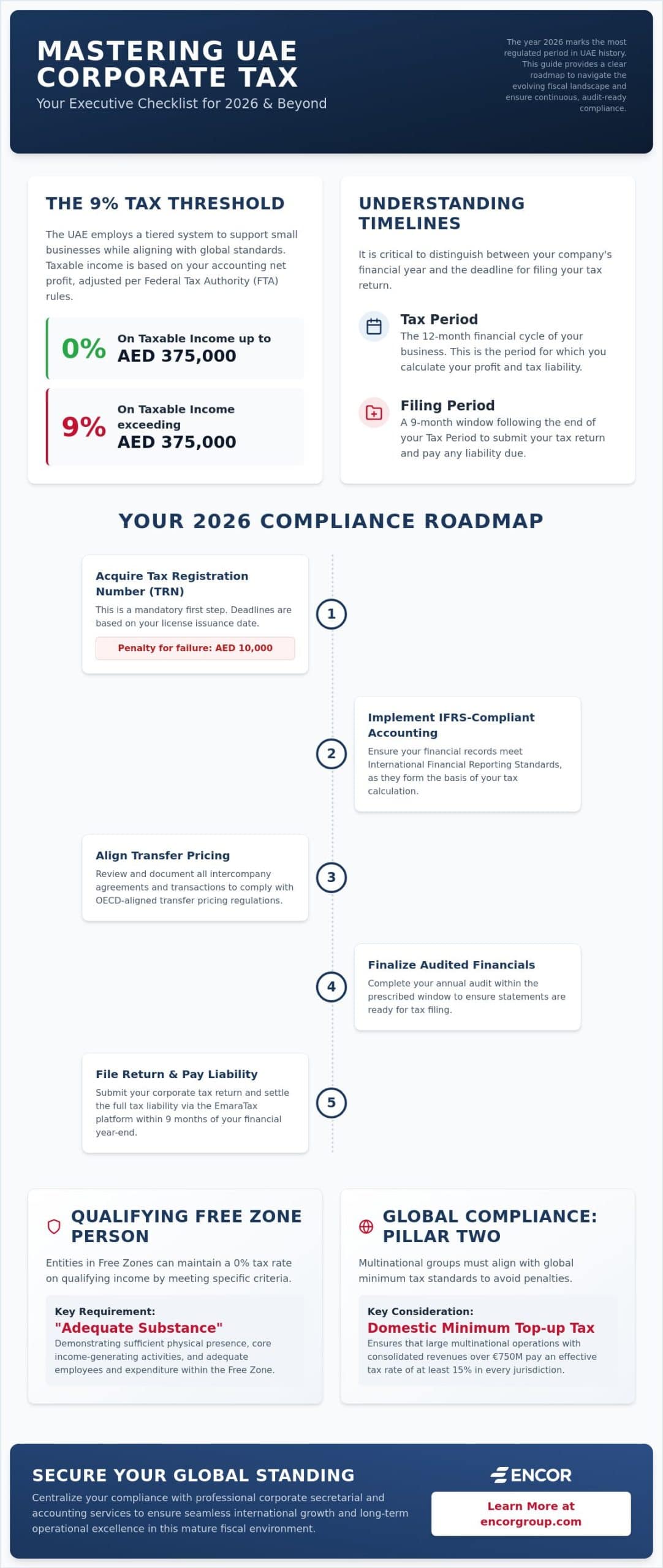
Businesses benefit from a tiered structure designed to support small enterprises and startups. A 0% rate applies to taxable income up to AED 375,000; income exceeding this amount is subject to a standard 9% rate. Calculation begins with the accounting net profit as per audited financial statements, followed by adjustments for depreciation, transfer pricing, and non-deductible interest. Taxable income represents the net profit of a business after adjusting for exempt income, non-deductible expenses, and specific tax reliefs as mandated by the Federal Tax Authority.
The Role of the Federal Tax Authority (FTA)
The Federal Tax Authority serves as the primary regulator for UAE corporate tax compliance, overseeing registration, collection, and enforcement. Central to this administration is the EmaraTax platform, a digital ecosystem that streamlines filing and payment processes. By 2026, the FTA has shifted toward a digital-first auditing model. This approach utilizes real-time data reporting to identify discrepancies, making it essential for businesses to maintain meticulous, digital-ready records. The FTA’s mandate focuses on high-level administrative precision, ensuring that all taxable persons contribute to the nation’s diversified economic future through transparent reporting.
Core Administrative Checklist: Registration, Filing, and Record-Keeping
Achieving UAE corporate tax compliance requires a transition from reactive administration to a structured, repeatable cycle. This process begins with the alignment of the financial year across all global subsidiaries to ensure consolidated reporting remains consistent. It’s vital to distinguish between the “Tax Period,” which is the 12-month financial cycle of the business, and the “Filing Period,” the nine-month window granted to submit the return and settle liabilities. For comprehensive guidance on these timelines, the UAE Ministry of Finance Corporate Tax portal remains the definitive source for legislative updates.
A chronological roadmap for 2026 compliance should include the following milestones:
- Acquisition of a Tax Registration Number (TRN) based on license issuance dates.
- Implementation of IFRS-compliant accounting systems.
- Alignment of intercompany agreements with transfer pricing requirements.
- Finalization of audited financial statements within the prescribed window.
- Submission of the tax return and full payment of the tax liability.
Step 1: Corporate Tax Registration and TRN Acquisition
Registration isn’t optional; it’s a mandatory prerequisite for all taxable persons. The FTA has established specific deadlines based on the month of the original license issuance. Failure to register within these windows results in a flat AED 10,000 administrative penalty. Legal entities must provide their trade license, Emirates ID of the authorized signatory, and proof of authorization, while branch offices must typically register under the parent entity’s profile unless they maintain a separate legal personality. Proactive registration is the only way to avoid unnecessary financial friction.
Step 2: Financial Reporting Standards (IFRS)
Accuracy in reporting depends on adhering to International Financial Reporting Standards (IFRS). While unaudited statements may be acceptable for entities with revenue below AED 50 million, audited financials are generally required for larger enterprises and specific Free Zone entities seeking the 0% rate. UAE law mandates that all financial records and supporting documents be maintained for at least seven years. Violating these record-keeping standards carries a penalty of AED 10,000 for the first offense, doubling for repeat violations. Engaging a professional for tax advisory and compliance ensures these standards are met without operational disruption.
Step 3: Annual Return Filing and Payment
The deadline for filing the corporate tax return and paying the full tax amount is nine months from the end of the financial year. For a company whose financial year ends on December 31, 2025, the mandatory deadline is September 30, 2026. Payments are processed through the EmaraTax portal using supported methods like GIBAN or Magnati. It’s a strategic advantage to file early; this avoids system congestion during peak periods and allows time to resolve any unforeseen discrepancies in the data. Don’t wait until the final month to begin the submission process.
Navigating Exemptions: The Qualifying Free Zone Person (QFZP) Framework
Free Zones remain a cornerstone of the Emirates’ economic appeal, yet the transition to a taxable environment has introduced rigorous criteria for maintaining a 0% rate. UAE corporate tax compliance for Free Zone entities hinges on achieving and documenting the status of a Qualifying Free Zone Person (QFZP). This status isn’t an automatic right; it’s a privilege earned through continuous adherence to five specific statutory pillars. Failure to meet even one requirement
Centralizing Compliance: Strategic Entity Management for Global Success
Managing UAE corporate tax compliance is a fundamental element of a sophisticated Global Business Expansion Strategy. Isolated compliance efforts often lead to operational silos and an increased risk of financial penalties. Encor Group solves this by integrating tax advisory with corporate secretarial and accounting services, creating a unified framework for sustainable growth. This centralized model provides executives with a single point of contact for multi-market requirements, ensuring that compliance in the UAE remains perfectly aligned with obligations in other jurisdictions like Hong Kong. It’s a method that prioritizes institutional stability and strategic clarity over short-term administrative fixes.
The Synergy of Accounting and Tax Advisory
Accurate bookkeeping is the prerequisite for any defensible tax position. The FTA’s shift toward digital-first auditing means that your accounting data must be precise, IFRS-compliant, and readily accessible. Professional accounting and bookkeeping services provide the necessary foundation to support your tax filings and maintain your reputation with international banking partners. For organizations utilizing diverse geographic hubs, our Hong Kong Company Formation Services ensure that your global entity management remains seamless. This integrated oversight prevents the common pitfalls of cross-border operations, such as inconsistent reporting or neglected regulatory deadlines across different time zones. Businesses operating across multiple jurisdictions should also consider how outsourced accounting services in Hong Kong can provide the institutional-grade financial oversight needed to meet the rigorous demands of both local and international reporting standards.
Next Steps: Securing Your UAE Compliance Posture
To maintain a robust standing for the remainder of 2026, businesses must transition from initial implementation to operational optimization. We recommend the following Executive Action Plan to solidify your posture:
- Substance Validation: Perform a rigorous internal audit of your Free Zone operations to confirm “Adequate Substance” as defined by the latest FTA clarifications.
- Transfer Pricing Review: Ensure all related-party transactions are documented according to the arm’s length principle to avoid audit triggers.
- Filing Readiness: Finalize audited financial statements well in advance of the nine-month filing deadline to prevent system bottlenecks and late fees.
- Regulatory Health Check: Schedule a professional review to identify any latent risks in your current corporate structure or reporting methods.
Encor Group possesses the strategic depth and international reach required to manage these complexities with institutional confidence. We specialize in navigating the intricate requirements of the UAE’s Qualifying Free Zone framework, ensuring your business retains its competitive advantages while meeting global transparency standards. Contact Encor Group to optimize your UAE corporate structure and compliance today to secure your organization’s future in the evolving global marketplace.
Secure Your Global Standing in a Mature Fiscal Environment
The transition to a sophisticated tax regime in 2026 demands more than just administrative filing; it requires a synergy between accounting precision and strategic foresight. Success in this landscape hinges on two critical pillars: maintaining rigorous documentation for “Adequate Substance” within Free Zones and aligning regional operations with global standards like Pillar Two. It’s a process that transforms a regulatory requirement into a competitive advantage for those who prepare with diligence.
Navigating the nuances of UAE corporate tax compliance is a complex undertaking that benefits from seasoned expertise. Encor Group serves as a strategic navigator for Multinational Enterprises, providing comprehensive tax, accounting, and compliance advisory across 10+ international markets. For those managing cross-border obligations, a robust international tax structuring strategy is essential to align corporate architecture with genuine economic activity and satisfy the latest global reporting standards. We ensure your corporate structure is not only compliant but optimized for sustainable growth and international excellence. This proactive approach mitigates risk while securing your reputation in the global marketplace.
Ensure your UAE entity remains fully compliant-Consult with Encor Group Today. Your organization is well-positioned to lead with authority in this new era of fiscal transparency.
Frequently Asked Questions
Is corporate tax mandatory for all companies in the UAE?
Corporate tax is mandatory for all legal entities and individuals conducting business activities in the Emirates. This requirement encompasses both Mainland and Free Zone companies. While certain exemptions exist for government entities and specific extractive businesses, the majority of commercial enterprises must register with the Federal Tax Authority and file annual returns regardless of their profit levels.
Can a Free Zone company still benefit from 0% tax in 2026?
Free Zone entities can benefit from a 0% tax rate on qualifying income if they successfully maintain Qualifying Free Zone Person (QFZP) status. This requires the entity to meet strict “Adequate Substance” standards and ensure their revenue does not derive from “Excluded Activities.” If these conditions are satisfied, the 0% rate applies to qualifying income, while any non-qualifying income is subject to the standard 9% rate.
What are the penalties for late corporate tax registration in the UAE?
The administrative penalty for late registration is a flat fee of AED 10,000. This penalty is triggered if a business fails to submit its registration application within the timelines established by the Federal Tax Authority based on its license issuance month. Proactive registration is a fundamental component of UAE corporate tax compliance and prevents immediate financial friction with the regulator.
How does the UAE corporate tax affect foreign companies with a permanent establishment?
Foreign companies are classified as Non-Resident Persons and are subject to tax if they maintain a Permanent Establishment (PE) in the UAE. Taxable income is determined based on the profits specifically attributable to that PE. Income sourced from the UAE that isn’t linked to a PE may be subject to withholding tax, though the current rate remains 0% as of 2026.
Is audited financial reporting mandatory for UAE corporate tax compliance?
Audited financial statements are mandatory for all Qualifying Free Zone Persons and businesses with annual revenue exceeding AED 50 million. These reports must adhere to International Financial Reporting Standards (IFRS) to ensure transparency. Maintaining audited records is essential for UAE corporate tax compliance, as it provides the verified data necessary to support tax positions during an official audit.
What is the difference between UAE Corporate Tax and VAT?
Corporate tax is a direct tax on business profits, whereas Value Added Tax (VAT) is an indirect tax on the consumption of goods and services. Corporate tax applies a 9% rate to taxable income exceeding AED 375,000. In contrast, VAT is a 5% charge on taxable supplies that businesses collect from customers and remit to the government on a monthly or quarterly basis.
How do I know if my business meets the “Adequate Substance” requirement?
Your business meets the “Adequate Substance” requirement if it conducts its core income-generating activities within the UAE. This involves employing an adequate number of qualified staff and incurring sufficient operating expenditure locally. Documentation such as physical office leases, payroll records, and evidence of local management decisions serves as the primary proof of substance during regulatory reviews.
What is the deadline for filing the first UAE corporate tax return?
The deadline for filing the return and paying the tax liability is nine months after the end of the financial year. For a company with a financial year ending on December 31, 2025, the mandatory deadline is September 30, 2026. This timeline is firm; failure to file and pay within this window results in monthly penalties and interest on the unpaid amount.