

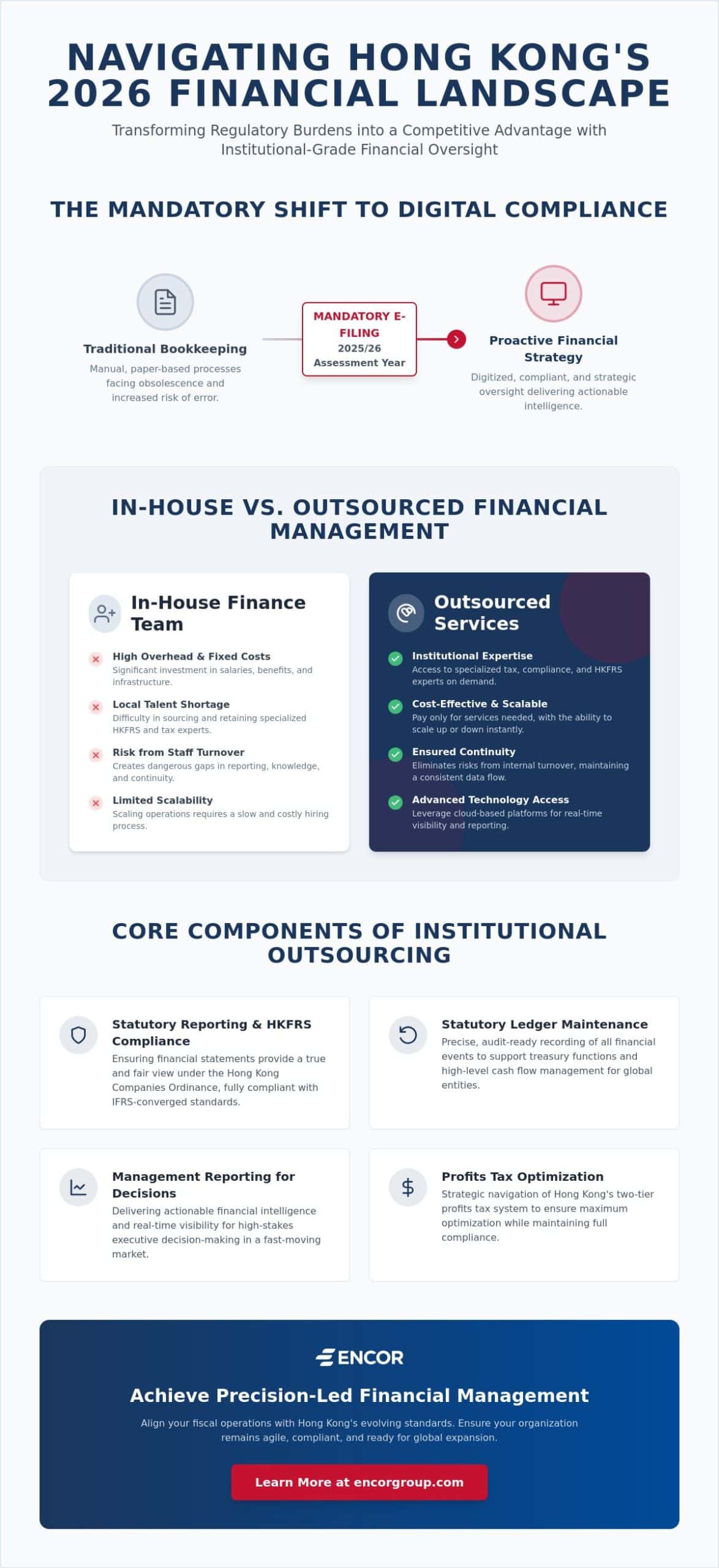
Maintaining an in-house finance department in a jurisdiction as sophisticated as Hong Kong is no longer a standard operational choice; it’s a significant strategic risk. As the Inland Revenue Department implements mandatory e-filing for the 2025/26 assessment year, the margin for error in corporate reporting has effectively vanished. Global executives recognize that traditional bookkeeping cannot keep pace with the complexity of Hong Kong Financial Reporting Standards or the rigorous demands of the Companies (Amendment) Ordinance 2025. Engaging professional outsourced accounting services Hong Kong provides the institutional-grade oversight necessary to transform compliance from a regulatory burden into a clear competitive advantage.
You likely understand that navigating the two-tier profits tax system while managing international expansion requires more than basic data entry. This comprehensive reference provides a strategic framework for 2026, ensuring your entity achieves seamless regulatory compliance and maximum tax optimization. We’ll examine how a structured outsourcing model addresses the local talent shortage and delivers the actionable financial intelligence required for high-stakes executive decision-making. By aligning your fiscal operations with these evolving standards, you ensure your organization remains agile and fully compliant in an increasingly transparent global market.
Key Takeaways
- Define your position within Hong Kong’s 2026 regulatory framework by transitioning from reactive bookkeeping to institutional-grade financial oversight.
- Mitigate the complexities of HKFRS and mandatory e-filing through the strategic deployment of outsourced accounting services Hong Kong.
- Enhance executive decision-making with precise management accounts and statutory ledger maintenance designed for global entity management.
- Analyze the scalability and risk-management advantages of institutional providers compared to the high overhead of internal finance teams.
- Navigate the 2026 Profits Tax landscape with a clear understanding of revised filing deadlines and international tax advisory requirements.
The Strategic Landscape of Outsourced Accounting in Hong Kong
In 2026, Hong Kong’s fiscal environment is defined by digitized transparency and rigorous reporting timelines. The traditional model of back-office bookkeeping has been replaced by a sophisticated integration of technology and regulatory expertise. Utilizing Business process outsourcing (BPO) for financial functions is no longer a cost-saving measure for struggling firms. It’s a strategic prerequisite for high-performing global entities. Professional outsourced accounting services Hong Kong provide the technical infrastructure required to manage complex cross-border transactions while adhering to the latest Hong Kong Financial Reporting Standards (HKFRS).
Hong Kong maintains its status as a Tier-1 financial hub through its territorial tax system and the “One Country, Two Systems” framework. This stability attracts global executives who require a predictable legal environment. However, predictability depends on precise execution. The Inland Revenue Department (IRD) has intensified its focus on digital compliance, making paper submissions obsolete for most. This shift necessitates a move from reactive bookkeeping to proactive financial strategy. Companies that fail to adapt face increased scrutiny during IRD audits and potential penalties for late or inaccurate filings.
The Role of Accounting in International Expansion
Robust financial reporting serves as the bedrock for successful Hong Kong company formation services. It’s not enough to simply incorporate; an entity must demonstrate ongoing fiscal health to maintain its standing. International banking partners and stakeholders demand absolute transparency. A structured accounting framework allows a business to scale its operations across multiple jurisdictions without losing visibility. By centralizing financial data through an expert provider, executives can ensure their Hong Kong operations remain a seamless part of their global portfolio.
Institutional Benefits of External Financial Oversight
External oversight provides a level of institutional confidence that’s difficult to replicate with a small in-house team. Professional providers offer access to specialized tax and compliance experts without the overhead associated with executive-level hires. This model ensures continuity. Internal staff turnover can lead to dangerous gaps in reporting, but an established partner maintains a consistent flow of data. Leveraging advanced cloud-based accounting technologies offers real-time visibility into cash flow and liabilities. This digital edge is essential for making informed decisions in a fast-moving market where delayed data often means missed opportunities.
Core Components of Institutional Outsourced Accounting
Institutional outsourced accounting services Hong Kong provide a comprehensive framework that extends far beyond basic transaction recording. For global entities, the maintenance of statutory ledgers must be precise to support high-level treasury functions and cash flow management. This structured approach ensures that every financial event is captured within a system designed for executive-level review. It also facilitates the seamless coordination of the mandatory annual statutory audit with certified public accountants, ensuring that all filings remain in good standing without disrupting daily operations.
Statutory Reporting and HKFRS Compliance
Hong Kong’s accounting standards are fully converged with International Financial Reporting Standards (IFRS). Navigating the nuances of the Hong Kong Financial Reporting Standards (HKFRS) requires specialized technical knowledge that many in-house teams lack. Under the Hong Kong Companies Ordinance, directors must ensure the preparation of financial statements that provide a true and fair view of the company’s position. This involves the rigorous preparation of balance sheets and profit/loss accounts that meet the exact standards of the Commissioner of Inland Revenue. Professional oversight guarantees that these records are not only compliant but also audit-ready at all times.
Management Reporting for Strategic Decisions
Effective leadership depends on financial data that is both timely and actionable. Customized management reporting provides the granular detail needed for budgeting, forecasting, and variance analysis. By integrating these insights with international payroll solutions, executives gain a holistic view of their operational costs across different jurisdictions. This integration is vital for optimizing resources and ensuring that financial strategy aligns with broader corporate goals. If you’re looking to enhance your fiscal transparency, our accounting and bookkeeping services provide the stability your expansion requires.
Beyond simple reporting, an institutional partner manages the complexity of treasury support. This includes monitoring liquidity and managing the movement of funds between global hubs. In a 2026 environment where interest rates and currency fluctuations remain volatile, having a steady hand on the ledger is a significant advantage. Outsourced accounting services Hong Kong act as an extension of your finance department, providing the stability and precision required to handle high-stakes requirements with quiet efficiency. This methodical approach ensures that no detail is overlooked, from the smallest expense to the most complex cross-border consolidation.
Evaluating Outsourced Providers vs. In-House Teams
Deciding between an internal finance department and outsourced accounting services Hong Kong requires a cold assessment of long-term scalability. While a dedicated in-house team offers immediate proximity, it often lacks the specialized depth required to manage the evolving Hong Kong Financial Reporting Standards. For global entities, relying on a generalist staff member creates a single point of failure. Institutional confidence is built on the collective expertise of a professional firm that manages hundreds of high-stakes entities simultaneously. This model provides an elite level of oversight that a standard salary package rarely secures in a competitive talent market where qualified CPAs are in high demand.
Shifting the burden of technical compliance to an external navigator allows leadership to refocus on core business growth. Instead of managing internal accounting disputes or software updates, executives leverage the precise reports provided by their partner to drive expansion. This strategic realignment ensures that the finance function acts as a driver of value rather than a bottleneck for operational efficiency. A professional firm brings a depth of local knowledge that generalist in-house staff simply cannot match, especially when navigating the intricacies of the 2026 regulatory environment.
Cost-Benefit Analysis for Multinationals
The financial argument for outsourcing extends beyond the simple comparison of service fees against salaries. Direct costs like Mandatory Provident Fund (MPF) contributions, medical benefits, and bonuses are just the baseline. Indirect expenses, including the recruitment of specialized staff and the licensing of premium cloud-based ERP systems, place a heavy burden on operational budgets. An outsourced model converts these fixed overheads into variable costs. This flexibility is essential for multinationals during rapid market entry or phases of contraction. It allows an organization to scale its financial infrastructure up or down without the friction of hiring or redundancy processes.
Security and Data Integrity Standards
Data security is a primary concern for executives handling sensitive cross-border financial records. Professional firms implement institutional-grade protection protocols that far exceed the capabilities of most internal IT departments. This includes encrypted data transmission, multi-factor authentication, and robust disaster recovery planning. Maintaining a clear audit trail is vital for meeting the rigorous standards of the Inland Revenue Department. By delegating these functions to a specialized partner, a business ensures its records remain intact and accessible during regulatory or internal scrutiny. This methodical approach to data integrity reinforces the brand’s image as a stable and composed entity capable of handling high-stakes requirements with quiet efficiency.
Navigating the 2026 Regulatory and Tax Environment
The 2026 regulatory environment in Hong Kong is characterized by a definitive shift toward digital-first compliance. As of April 1, 2026, the Inland Revenue Department (IRD) has mandated electronic filing for the first phase of eligible Profits Tax Returns. This change eliminates the margin for error that previously existed with paper-based submissions. For global entities, this means that outsourced accounting services Hong Kong must now function as a bridge between raw financial data and real-time regulatory requirements. This intersection is particularly critical when aligning accounting records with corporate secretarial compliance, as any discrepancy between financial statements and the annual return can trigger immediate IRD queries.
Profits Tax Filing and Optimization
Managing the annual tax return, specifically forms BIR51 for corporations or BIR52 for unincorporated bodies, requires a strategic understanding of the two-tier profits tax system. Corporations are taxed at 8.25% on the first HKD 2 million of assessable profits, while remaining profits attract a 16.5% rate. For the 2025/26 assessment year, businesses should also account for the proposed one-off 100% reduction in profits tax, which has a ceiling of HKD 3,000. Navigating these requirements involves identifying legitimate exemptions and deductions sourceable under current laws to ensure maximum fiscal efficiency. For multinational groups also subject to the global minimum tax, a robust approach to international tax structuring is essential to reconcile Hong Kong’s territorial system with the 15% GloBE framework and avoid costly compliance gaps.
Strict adherence to filing codes is mandatory for companies utilizing a tax representative under the Block Extension Scheme. The IRD issued approximately 270,000 returns on April 1, 2026, with the following key deadlines for the 2025/26 assessment year:
- “D” Code (Accounting year-end in December): Filing deadline of August 17, 2026.
- “M” Code (Accounting year-end in March): Filing deadline of November 16, 2026, for profit-making cases.
- “N” Code (Accounting year-end between April and November): Filing deadline of May 4, 2026.
Audit Coordination and Assurance
Audit coordination serves as a critical liaison between your internal records and external assurance requirements. All Hong Kong companies are required to have their financial statements audited annually by a Hong Kong registered CPA. Utilizing outsourced accounting services Hong Kong during the audit cycle reduces the administrative burden on your team while ensuring all complex accounting treatments are addressed before the formal audit begins. This is especially vital given the revised HKFRS for Private Entities issued in April 2025, which requires precise implementation to avoid filing delays.
To ensure your entity remains fully compliant with these evolving standards, our tax advisory and compliance solutions provide the technical precision required for risk-free reporting. We handle the complexities of IRD queries with professional authority, allowing you to maintain a steady focus on your global expansion goals.
Encor Group: Precision-Led Financial Management
Encor Group operates as a strategic navigator for global enterprises, providing a unified framework that transcends traditional financial recording. Our approach to outsourced accounting services Hong Kong is rooted in the belief that financial data should serve as a proactive tool for growth rather than a static record of the past. By integrating accounting into a broader suite of corporate services, including company formation and secretarial compliance, we eliminate the friction often found in fragmented service models. This end-to-end support ensures that your entity remains in good standing across all regulatory fronts simultaneously.
We leverage our global hubs to facilitate seamless cross-border accounting for organizations with complex multinational footprints. Whether your operations span from the UAE to Hong Kong, our teams provide a consistent standard of excellence that simplifies global entity management. This international reach allows us to handle high-stakes requirements with quiet efficiency, maintaining the steady, calm assurance that seasoned advisors provide in volatile markets. It’s this commitment to operational excellence that allows us to deliver institutional-grade results for every client we serve.
Tailored Solutions for Global Enterprises
Bespoke service models are essential for meeting the specific needs of complex multinational structures. Encor Group provides high-level consulting designed to optimize financial operations and reporting at scale. We don’t wait for regulatory shifts to impact your bottom line; instead, our proactive advisory identifies upcoming changes in standards like HKFRS well in advance. This foresight allows you to adjust your strategy with precision, ensuring that your financial reporting remains an asset for executive decision-making rather than a source of administrative burden.
The Encor Advantage in Hong Kong
Our team brings decades of collective experience in the Hong Kong regulatory environment to every engagement. This deep knowledge is the foundation of our commitment to institutional confidence and precision. We understand that reliability is the most valuable currency in international business. Every ledger we maintain and every report we generate reflects a meticulous attention to detail that protects your brand’s reputation and ensures compliance with the Inland Revenue Department.
If you require a partner that values precision and strategic depth as much as you do, it’s time to elevate your financial oversight. Consult with our Hong Kong accounting experts to discover how our outsourced accounting services Hong Kong can provide the stability your international expansion demands. Our methodical approach ensures that no detail is overlooked, positioning your organization for long-term corporate success in a high-stakes environment.
Securing Strategic Fiscal Resilience for 2026
Adopting an institutional framework for your financial operations is no longer optional in Hong Kong’s increasingly digitized regulatory environment. The shift toward mandatory electronic filing and the precision required by updated HKFRS standards demand a level of expertise that internal teams often struggle to maintain. By leveraging outsourced accounting services Hong Kong, your organization gains the technical depth needed to navigate the two-tier profits tax system while ensuring seamless cross-border scalability. This strategic alignment transforms compliance from a risk into a foundation for sustainable international growth.
Encor Group provides the elite oversight necessary to handle high-stakes requirements with quiet efficiency. Serving over 10 international markets, our global hub network facilitates seamless expansion through expert-led tax and compliance advisory. We invite you to Secure your institutional financial compliance with Encor Group and position your entity for operational excellence. Your journey toward a more transparent and efficient financial future begins with a commitment to precision and professional authority.
Frequently Asked Questions
What are the mandatory accounting records a Hong Kong company must keep?
Every Hong Kong company must maintain records that sufficiently explain its transactions and provide a true and fair view of its financial position. These include records of all sums received and expended, assets and liabilities, and all sales and purchases of goods. Failure to maintain these statutory ledgers can lead to significant penalties under the Companies Ordinance.
How does outsourced accounting improve compliance with the Inland Revenue Department?
Professional outsourced accounting services Hong Kong ensure your entity meets the 2026 mandatory e-filing requirements for Profits Tax Returns. By managing specific filing deadlines based on your accounting year-end, such as the August 17 deadline for “D” code cases, an expert provider minimizes the risk of IRD audits. This proactive management prevents the accumulation of penalties and ensures all tax computations are technically sound.
Can an outsourced firm handle both bookkeeping and statutory audits?
An outsourced firm typically manages bookkeeping and prepares the final management accounts, but the statutory audit must be performed by an independent Hong Kong registered CPA. Your service provider acts as a critical liaison, coordinating the audit process and addressing complex accounting treatments before the formal review begins. This structured approach ensures the audit’s completed efficiently and submitted within the required regulatory window.
Is it possible to integrate Hong Kong accounting with UAE tax compliance?
Integrating Hong Kong accounting with UAE tax compliance is a core capability for global firms like Encor Group. Our hub network manages cross-border transactions and ensures that consolidated financial reporting meets the regulatory standards of both jurisdictions. This dual-compliance model provides executives with a unified view of their fiscal health while navigating different tax systems, such as the UAE’s corporate tax and Hong Kong’s territorial system. Enterprises managing operations across multiple regions benefit significantly from a structured approach to international tax structuring that aligns corporate architecture with genuine economic substance in each jurisdiction.
What is the standard retention period for financial records in Hong Kong?
Hong Kong law requires companies to retain all business and financial records for a period of seven years from the end of the financial year. This retention period applies to invoices, vouchers, bank statements, and statutory ledgers. Maintaining these records is essential for responding to IRD queries and ensuring a clear audit trail exists for any retrospective regulatory reviews.
How do outsourced accounting services support global business expansion?
Utilizing outsourced accounting services Hong Kong allows businesses to scale their financial infrastructure without the delays associated with local recruitment. Providers offer immediate access to specialized expertise in international tax and HKFRS compliance, which is vital during rapid market entry. This model frees your leadership team to focus on core operational growth while maintaining institutional-grade financial oversight.
What are the key differences between HKFRS and IFRS for 2026?
While HKFRS remains fully converged with IFRS, the key focus for 2026 is the implementation of the April 2025 revision to HKFRS for Private Entities. Additionally, companies must now navigate the new sustainability disclosure standards, HKFRS S1 and S2, which were phased in starting in 2025. These nuances require precise technical application to ensure global financial reporting remains accurate and transparent.
How does Encor Group ensure data security for financial outsourcing?
Encor Group utilizes institutional-grade security protocols, including end-to-end encryption and multi-factor authentication, to protect sensitive financial data. Our infrastructure includes robust disaster recovery and business continuity planning to ensure that your records remain accessible and secure at all times. This methodical approach to data integrity provides the steady assurance required for high-stakes corporate management.