
Establishing a corporate presence in the UAE is no longer a simple administrative task; it’s a high-stakes exercise in jurisdictional positioning. You likely recognize that while the region offers unparalleled growth potential, the landscape of Dubai business setup for foreigners has become increasingly nuanced. Recent shifts in global tax standards and local regulatory updates, such as the 9% corporate tax on income over AED 375,000, have replaced the old tax-free simplicity with a requirement for sophisticated institutional alignment. The objective for any serious executive is to move beyond the friction of Economic Substance Regulations and the persistent hurdles of corporate bank account opening.
This guide provides the institutional clarity you need to master current regulatory requirements, ensuring your entity is built for both compliance and long-term operational excellence. We’ll analyze the strategic selection between mainland and free zone jurisdictions, the intricacies of the 2026 tax framework, and the procedural steps required to secure full profit repatriation. By the end of this analysis, you’ll possess a clear roadmap to establishing a high-performing corporate structure that thrives within the regional market with minimal friction.
Key Takeaways
- Identify the optimal jurisdictional structure by evaluating the operational differences between Mainland entities and Free Zone incorporations.
- Navigate the complexities of Dubai business setup for foreigners by aligning your corporate activities with the specific mandates of the Department of Economy and Tourism or specialized Free Zone Authorities.
- Select a strategic hub based on institutional prestige and logistical advantages, prioritizing destinations such as DIFC or DMCC for high-stakes financial and commodity operations.
- Execute a methodical five-step incorporation process designed to transition your entity from initial trade name reservation to full regulatory approval.
- Maintain operational compliance through rigorous adherence to Economic Substance Regulations and proactive management of corporate banking KYC requirements.
Navigating the Dubai Business Landscape: Mainland vs. Free Zone
Choosing the correct jurisdiction is the foundational step for any international executive. The choice between a Mainland and Free Zone entity dictates your operational reach, tax obligations, and long-term scalability. It’s no longer a decision based solely on ownership restrictions. Since the landmark reforms in 2021, the distinction has shifted toward geographical and commercial scope. Understanding these nuances is essential for a successful Dubai business setup for foreigners, as the wrong choice can lead to operational friction and unnecessary costs.
The primary difference lies in where you’re permitted to trade. Mainland companies can operate anywhere in the UAE and bid for lucrative government contracts. Free Zone companies are generally restricted to trading within their specific zone or internationally. However, Free Zones often serve as “designated zones” for VAT and customs purposes, which provides a significant advantage for businesses focused on global re-exports. These zones are often overseen by the UAE Ministry of Investment to ensure they remain competitive hubs for foreign capital. While 100% ownership is now standard for many mainland activities, professional services may still require a local service agent to act as a liaison with government departments.
The Strategic Case for Dubai Free Zones
Dubai’s specialized Free Zones offer a streamlined environment tailored to specific industries. These ecosystems provide several institutional advantages:
- Full Capital Repatriation: Investors retain the ability to transfer 100% of profits and capital back to their home country without restriction.
- Tax Optimization: While the 9% corporate tax applies to income over AED 375,000, many entities qualify for exemptions on specific international activities through “qualifying income” provisions.
- Industry Synergy: Specialized clusters like the DIFC or Dubai Media City provide immediate access to relevant infrastructure and industry-specific talent pools.
These jurisdictions are particularly effective for businesses that don’t need to trade directly with the UAE’s domestic retail market or government entities.
When to Choose a Mainland License
A Mainland license is the superior choice for businesses that require unrestricted access to the local UAE market. It’s the only structure that allows you to establish a physical presence anywhere in the emirate, from high-street retail to industrial warehouses. The evolution of 100% foreign ownership means you can now control your Mainland entity in most commercial and industrial sectors without a local partner. This structure is also advantageous for companies planning to scale their workforce rapidly. Mainland regulations offer greater flexibility for employee visa quotas and simplified processes for businesses that need to deploy staff across multiple locations within the country.
Understanding the Regulatory Framework and Licensing Requirements
The regulatory architecture in Dubai is governed by two distinct bodies: the Department of Economy and Tourism (DET) for mainland entities and various independent Free Zone Authorities for specialized hubs. Success in Dubai business setup for foreigners depends on precise alignment with these regulators. While the DET oversees the broader commercial landscape of the emirate, Free Zone Authorities provide bespoke regulatory frameworks tailored to specific sectors. A Trade License is the foundational legal document that authorizes an entity to conduct specific commercial, professional, or industrial activities within the UAE.
By 2026, the Dubai Unified License (DUL) has become the standard for digital integration, providing a single identification number for all licensed entities across jurisdictions. This initiative ensures that every business activity is mapped to a standardized international code, enhancing transparency for global regulators. The DUL system facilitates faster data sharing between the DET and the Federal Tax Authority (FTA), which simplifies interactions with government departments and financial institutions. The efficiency of these digital systems is reflected in the World Bank’s Doing Business data for UAE, which highlights the country’s high ranking in administrative agility. Selecting the wrong activity code during this digital filing can lead to immediate tax compliance issues or bank account rejection.
Selecting the Correct License Type
License categorization determines both your operational freedom and your tax exposure. Commercial licenses facilitate general trading and specialized retail operations, allowing for the import and export of goods. Professional licenses are mandatory for service-oriented ventures such as consultancy, engineering, and creative services. Industrial licenses are required for manufacturing and packaging operations, often necessitating specific approvals from the Ministry of Industry and Advanced Technology. Each category carries unique requirements for physical office space and professional qualifications. Precise selection is vital because it dictates the scope of your VAT obligations and your eligibility for specific tax incentives.
Mandatory Legal Structures for Foreigners
Your legal structure defines your liability and ownership rights. The Limited Liability Company (LLC) remains the most robust vehicle for mainland operations, supporting 100% foreign ownership in most sectors. For multinational corporations seeking institutional continuity, establishing a branch office of a foreign parent company allows the entity to maintain its global identity while operating locally. Branch offices are particularly useful for firms that want to leverage the financial history of their headquarters. Sole Establishments are available but are generally restricted to professional activities for non-GCC nationals and don’t offer the same liability protections as an LLC. Ensuring your structure is compliant with local law is essential, and seeking compliance and regulatory advisory can mitigate early-stage risks.
Strategic Jurisdiction Selection: Finding the Right Hub
Jurisdiction selection is a strategic positioning exercise, not a clerical choice. While cost remains a factor, the reputation of your chosen hub acts as a proxy for your firm’s institutional stability. For global enterprises, the prestige of the Dubai International Financial Centre (DIFC) or the Dubai Multi Commodities Centre (DMCC) provides immediate credibility with international banking partners and tier-one investors. These jurisdictions are designed for scale; they offer robust legal frameworks that align with international common law standards. Choosing a high-prestige hub reduces friction during international contracting and cross-border capital movements.
Conversely, service-based startups often find greater utility in agile hubs like the International Free Zone Authority (IFZA) or Meydan Free Zone. These jurisdictions prioritize speed and lower entry barriers, making them ideal for consultancy and digital ventures. For many organizations, Dubai represents just one node in a broader global network. Sophisticated investors often leverage Hong Kong company formation services alongside their UAE presence to create a dual-hub strategy. This approach optimizes jurisdictional arbitrage between the Middle East and Asia-Pacific markets, allowing for seamless capital flow across two of the world’s most business-friendly environments.
Top Free Zones for Foreign Investors in 2026
Selecting the right ecosystem is central to a successful Dubai business setup for foreigners. DMCC remains the global leader for commodities and technology trade, housing over 24,000 companies within a high-density commercial district. IFZA Dubai has established itself as the preferred choice for flexible consultancy setups, offering scalable office solutions that grow with the business. Meydan Free Zone provides a unique advantage for digital nomads and media professionals due to its strategic proximity to downtown Dubai and its focus on digital-first licensing and competitive fee structures.
Assessing Infrastructure and Connectivity
Your physical location must support your logistical requirements. Industrial and logistics firms should prioritize proximity to Jebel Ali Port, which remains one of the world’s largest container ports, to minimize transport overheads. For fintech and AI-driven entities, the digital infrastructure of the hub is the primary metric. Jurisdictions like Dubai Internet City offer tier-three data centers and dedicated high-speed fiber networks. While every free zone requires a physical office address, many now offer “flexi-desk” or virtual office arrangements. These options provide a cost-effective way to meet regulatory requirements while maintaining a lean operational footprint. Ensure your chosen hub supports the specific visa quotas and facility standards your growth plan requires.
The 5-Step Execution Plan for Company Incorporation
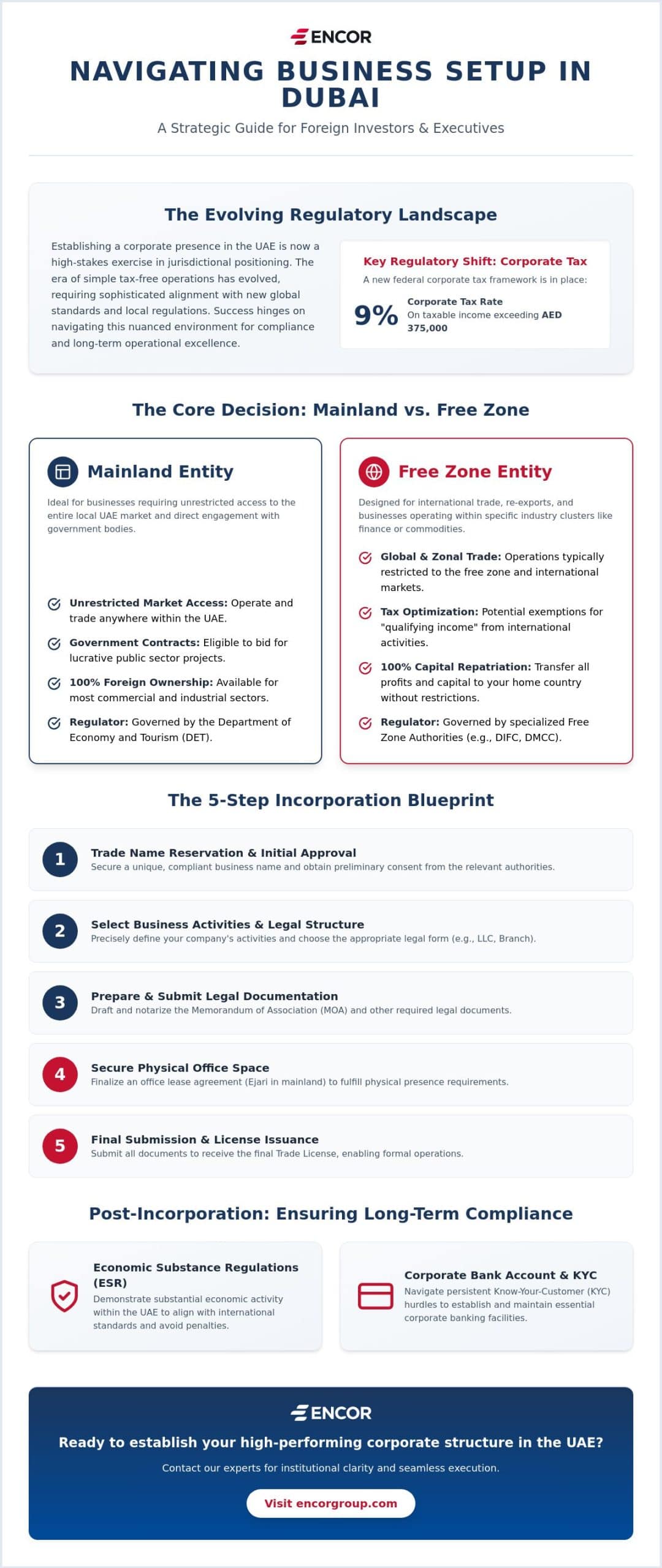
Execution requires methodical precision to avoid administrative delays. While previous sections established the strategic framework, the incorporation phase focuses on procedural accuracy. The process of Dubai business setup for foreigners begins with the finalization of your business activity and legal structure. This selection must align with the standardized codes of the Dubai Unified License to ensure seamless integration with the Federal Tax Authority later. Once the activity is defined, you’ll proceed to trade name reservation and initial approval. Reservation fees typically range from AED 600 to AED 1,000, while the initial approval from the Department of Economy and Tourism (DET) or the relevant Free Zone Authority costs between AED 120 and AED 300. These approvals confirm that the UAE government has no objection to your proposed entity.
The middle stages of the plan involve formalizing your legal and physical presence. You’ll need to draft and sign the Memorandum of Association (MOA), which outlines the ownership structure and operational rules of the firm. Simultaneously, you must secure a physical office space or a flexi-desk arrangement to obtain a lease agreement. In the mainland, this requires an Ejari certificate, whereas Free Zones issue their own internal lease documents. The final step is the payment of license fees and the issuance of your trade license. Secure your UAE Free Zone Incorporation through our streamlined execution framework to ensure every milestone is met with institutional rigor.
Document Preparation and Attestation
For international investors, document attestation is the most significant logistical hurdle. If the shareholder is a foreign corporate entity, you must provide board resolutions, certificates of incorporation, and articles of association. These documents require a multi-stage attestation process, beginning with a notary public in your home country, followed by your Ministry of Foreign Affairs, and finally the UAE Embassy. Individual investors must provide clear passport copies and, in some cases, professional references or bank statements. All foreign language documents must be translated into Arabic by a legal translator certified by the UAE Ministry of Justice before submission to the DET or Free Zone authorities.
Managing the Visa and Residency Process
Once the primary residency is secured, the corporate entity can sponsor visas for family members and domestic staff, provided the minimum salary and housing requirements are met. This residency status is essential for personal banking and long-term stability in the region. To fully appreciate the lifestyle benefits of your new base, you can visit Ares Elite Journeys to arrange curated luxury travel experiences across the Middle East and beyond.
Post-Incorporation Compliance: Ensuring Long-Term Excellence
The transition from incorporation to active operation is where many international investors face the steepest learning curve. Establishing corporate bank accounts requires navigating rigorous Know Your Customer (KYC) protocols and institutional risk assessments. UAE financial institutions prioritize entities with transparent ownership structures and clearly articulated business models. For a successful Dubai business setup for foreigners, you must also determine if your activities fall under Economic Substance Regulations (ESR). This regulatory framework requires firms engaging in “Relevant Activities,” such as headquarters business or shipping, to demonstrate adequate local substance through physical presence, local expenditure, and full-time employees. Ignoring ESR can lead to significant administrative penalties and potential license suspension.
The fiscal landscape has evolved with the 9% corporate tax on taxable income exceeding AED 375,000. Registration with the Federal Tax Authority (FTA) is a mandatory requirement for all licensed entities, regardless of their income level. It’s vital to note that a late corporate tax registration penalty is AED 10,000, making early compliance an operational priority. As your firm scales across borders, managing multi-market teams necessitates the use of international payroll solutions to ensure institutional alignment with both local labor laws and global standards. These systems provide the necessary framework for maintaining tax transparency and operational efficiency.
Financial Reporting and Audit Standards
Most Dubai Free Zones require the annual submission of audited financial statements as a prerequisite for license renewal. Maintaining bookkeeping records according to International Financial Reporting Standards (IFRS) ensures your entity remains audit-ready and transparent for banking partners. Additionally, businesses exceeding the mandatory VAT registration threshold of AED 375,000 must obtain a Tax Registration Number and file quarterly returns. Voluntary registration is available at AED 187,500, which often benefits startups by allowing them to reclaim input tax on initial capital expenditure and setup costs.
Ongoing Corporate Secretarial Support
Long-term excellence requires diligent maintenance of the corporate record and recurring administrative milestones. This includes the annual renewal of your trade license and the continuous updating of the Ultimate Beneficial Owner (UBO) register. Failure to maintain an accurate UBO register can lead to significant fines and jeopardize your standing with regulatory bodies; understanding the full scope of UAE ultimate beneficial owner regulations is essential to avoiding penalties that can reach AED 100,000 for repeated violations. You must also maintain a valid registered office address to serve as the official point of contact for government notifications. Utilizing professional corporate secretarial services ensures these high-stakes requirements are handled with precision, allowing you to focus on the strategic expansion of your enterprise.
Securing Your Corporate Future in Dubai’s Evolving Market
The landscape of Dubai business setup for foreigners in 2026 demands more than just administrative compliance; it requires a deep understanding of jurisdictional positioning and fiscal alignment. You’ve seen how the strategic selection between Mainland and specialized Free Zones dictates your long-term operational scope and tax exposure. Establishing a robust entity involves mastering the five-step execution plan and adhering to rigorous post-incorporation standards, particularly regarding Economic Substance Regulations and the new corporate tax framework. Success in this region depends on your ability to anticipate regulatory shifts before they impact your operational efficiency.
Navigating these institutional complexities is best achieved with a partner that possesses both regional depth and global scale. With a presence in over 10 markets and specialized expertise in UAE Free Zone incorporation, ENCOR Group provides the strategic navigation necessary for cross-border success. Our comprehensive tax and compliance advisory ensures your corporate structure remains resilient and high-performing. Consult with ENCOR Group for your Dubai Strategic Setup to transform your regional expansion into a sustainable competitive advantage. We’re ready to facilitate your next phase of international growth with precision and institutional rigor.
Frequently Asked Questions
Can a foreigner own 100% of a business in Dubai?
Foreigners can indeed own 100% of their business in Dubai across most commercial and industrial sectors. Legal reforms implemented in 2021 removed the requirement for a local Emirati partner to hold a 51% stake in mainland companies. Free zone entities have always permitted full ownership. This change has significantly simplified Dubai business setup for foreigners, allowing international investors to maintain total control over their strategic operations and capital.
How much does it cost to set up a business in Dubai for a foreigner?
Initial investment for a company in Dubai generally ranges from AED 15,000 to AED 50,000 depending on the jurisdiction. Free zone registration and approval fees typically fall between AED 9,000 and AED 15,000. For mainland entities, first-year expenses often exceed AED 40,000 when accounting for trade licenses and physical space. These figures don’t include the cost of residence visas or mandatory security deposits for commercial visit visas.
Do I need a local partner or sponsor to start a business in 2026?
A local sponsor is no longer a mandatory requirement for the majority of commercial and industrial activities in the UAE. Most mainland entities now operate under 100% foreign ownership. However, professional licenses for specific service-based activities may still require a local service agent (LSA). The LSA acts as a liaison with government departments but holds no equity or management control in the firm, ensuring you retain full operational authority.
What is the minimum capital requirement for a Dubai company?
Minimum capital requirements vary significantly based on the chosen hub and business activity. Many free zones don’t mandate a specific minimum capital amount for incorporation. Conversely, prestigious jurisdictions like the DMCC often require a minimum share capital of AED 50,000 per company. Mainland LLCs technically require capital sufficient to achieve the company’s purpose, which is usually specified in the Memorandum of Association during the registration process.
How long does the Dubai business setup process take for foreigners?
The incorporation process typically takes between one and three weeks for most entities. Digital platforms like the Dubai Unified License have streamlined the approval phases for trade name reservation and initial DET clearances. Complex industrial licenses or entities requiring additional regulatory approvals from specific ministries may face longer timelines. Navigating Dubai business setup for foreigners also involves obtaining residency visas, which usually adds an additional seven to ten days to the schedule.
Can I open a bank account in Dubai without a residency visa?
Opening a corporate bank account without a residency visa is nearly impossible due to strict KYC and AML regulations. Financial institutions require the primary signatory to provide a valid Emirates ID and proof of residency within the UAE. While some banks offer non-resident personal accounts, corporate accounts are reserved for entities with a physical presence and resident management. This ensures compliance with regional risk assessment standards and international transparency mandates.
What are the main tax obligations for a Free Zone company in 2026?
Free zone companies are subject to a 9% corporate tax on taxable income exceeding AED 375,000. Entities may qualify for a 0% rate on qualifying income if they maintain adequate substance and meet specific FTA requirements. Additionally, businesses with annual revenues over AED 375,000 must register for 5% VAT. Compliance with Economic Substance Regulations is also mandatory for entities engaged in relevant activities like shipping, banking, or headquarters business.
Is a physical office mandatory for all business setups in Dubai?
A physical office address is a mandatory legal requirement for all business licenses in the UAE. This mandate ensures that every entity has a verified location for regulatory inspections and official correspondence. Free zones often provide cost-effective solutions such as flexi-desks or smart offices to help startups meet this requirement without the overhead of a traditional lease. Mainland entities must secure a physical space and obtain an Ejari certificate to finalize their license.