
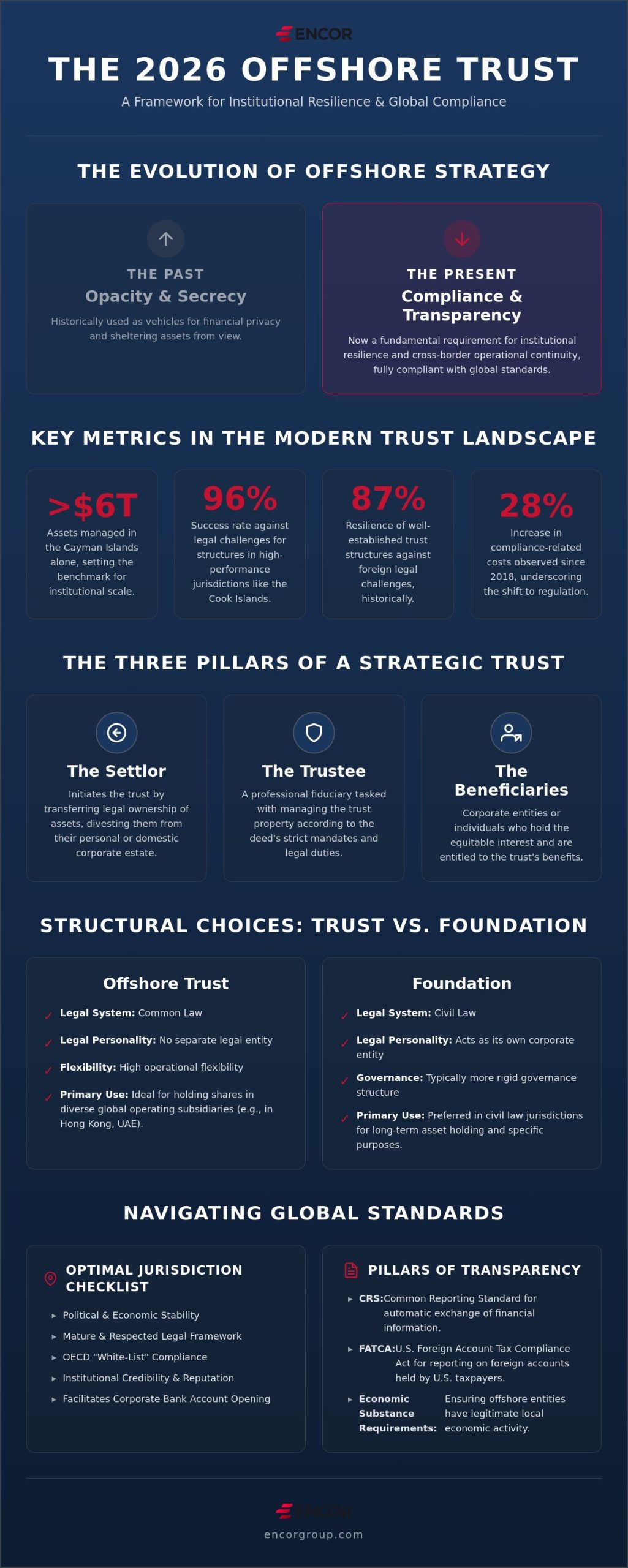
In 2026, the modern offshore trust is no longer a vehicle for opacity but a fundamental requirement for institutional resilience and cross-border operational continuity. With the Cayman Islands alone managing over $6 trillion in assets, global executives recognize that these structures provide the stability necessary to withstand domestic litigation and geopolitical shifts. You likely understand that protecting corporate assets while maintaining absolute compliance with CRS and FATCA reporting is a complex balancing act.
It’s natural to feel concerned about the rising complexity of cross-border fiduciary duties and the 28% increase in compliance costs observed since 2018. Domestic asset vulnerability remains a primary threat to corporate health. This guide will demonstrate how an offshore trust serves as a sophisticated tool for tax optimization, global entity management, and robust asset protection. We’ll show you how to build a framework that supports tax-efficient global expansion and multi-generational leadership.
We’ll examine high-performance jurisdictions like the Cook Islands, which maintain a 96% success rate against legal challenges. We’ll also detail the 2026 tax reporting requirements for U.S. and UK residents and outline the strategic steps to secure your global interests with quiet efficiency. By the end of this article, you’ll have a clear roadmap for implementing an elite asset protection strategy that meets the highest international standards.
Key Takeaways
- Understand the transition of the offshore trust from a secrecy vehicle to a transparent, compliance-based framework essential for institutional asset protection.
- Learn to evaluate “White-Listed” jurisdictions based on legal maturity and political stability to ensure the long-term integrity of your corporate assets.
- Master the complexities of the 2026 transparency era by aligning your structure with CRS, FATCA, and Economic Substance Requirements.
- Explore how a master trust structure can centralize global compliance and hold shares in operating subsidiaries across key markets like Hong Kong and the UAE.
- Establish a secure onboarding path that utilizes strategic assessment and rigorous KYC protocols to facilitate seamless global entity management.
The Evolution of the Offshore Trust: Institutional Strategy in 2026
The modern offshore trust is a fiduciary arrangement governed by international law, where a settlor transfers legal ownership of assets to a professional trustee. In 2026, this structure has transitioned from a vehicle for financial opacity to a sophisticated framework for institutional compliance. This shift is driven by the global adoption of the Common Reporting Standard (CRS) and FATCA, which have standardized transparency across borders. For a comprehensive Offshore trust overview, one must recognize that these entities now function as pillars of legitimate corporate governance rather than mere shelters. They are designed to withstand scrutiny while providing a robust shield for capital.
Global enterprises utilize these trusts to achieve jurisdictional diversification and mitigate domestic risks. By placing assets within a foreign legal system, companies create a layer of protection that is often insulated from local economic instability or aggressive domestic litigation. Historically, well-established structures in leading jurisdictions have withstood over 87% of foreign legal challenges. The trust deed serves as the governing constitution for this arrangement. It establishes clear protocols for asset management, distribution triggers, and successor appointments, ensuring that operational continuity isn’t compromised by regional volatility or leadership transitions.
Core Components of a Strategic Trust
A resilient trust requires three distinct roles defined with absolute precision. The Settlor initiates the transfer with clear strategic intent, effectively divesting legal title to the assets to ensure they are no longer part of their personal or domestic corporate estate. The Trustee acts as the professional fiduciary, tasked with managing the trust property according to the deed’s strict mandates. Finally, the Beneficiaries, which can include corporate entities or specific individuals, hold the equitable interest. In an institutional context, clearly defining these roles ensures that fiduciary duties are executed with precision and that the trust’s objectives remain aligned with the broader corporate strategy.
Trusts vs. Foundations: A Corporate Perspective
Choosing between an offshore trust and a foundation often depends on the jurisdiction’s legal tradition and the required level of governance. Trusts are staples of common law systems and offer exceptional operational flexibility because they don’t possess a separate legal personality. Foundations, conversely, are typically found in civil law jurisdictions and act more like corporate entities with their own legal standing. While both provide institutional stability for long-term expansion, trusts are often preferred for their ability to hold shares in diverse operating subsidiaries across regions like Hong Kong or the UAE, facilitating seamless global entity management and consolidated oversight.
Selecting the Optimal Jurisdiction: Jurisdictional Diversification
Selecting the right jurisdiction for an offshore trust requires a rigorous assessment of political stability and legal maturity. In 2026, the focus has shifted toward “White-Listed” jurisdictions that adhere to OECD standards. This compliance isn’t just about ethics; it’s a practical necessity for institutional credibility. High-tier jurisdictions often present higher setup costs, but they provide the “clean” profile required by international financial institutions. Belize’s offshore sector, which manages approximately $4.2 billion in assets, demonstrates how established legal frameworks attract capital. However, the Cayman Islands, with over 100,000 active trusts managing over $6 trillion, sets the benchmark for institutional scale.
Your choice of location directly influences the success rate of corporate bank account opening. Banks today conduct deep due diligence on trust structures. A trust registered in a reputable hub is far more likely to pass these hurdles than one in a jurisdiction perceived as high-risk. Balancing initial expenditure with long-term operational ease is critical. Since compliance costs have increased by approximately 28% since 2018, the value of a jurisdiction is now measured by its ability to simplify global reporting rather than its ability to hide assets.
Hong Kong and UAE: The Strategic Hubs
Hong Kong remains a premier destination for global enterprises targeting Asian market entry. Its legal system provides a robust foundation for Hong Kong company formation services, which often act as the operating arm of a trust. Meanwhile, UAE Free Zones have introduced sophisticated frameworks for international trusts, offering a gateway to EMEA markets. These hubs offer significant synergies for entities requiring both holding and operational capabilities. Organizations seeking to align their structure with these hubs often benefit from comprehensive compliance advisory to ensure seamless integration.
Traditional Asset Protection Havens
For specialized asset protection trusts, the Cook Islands and Nevis remain top-tier choices. The Cook Islands is renowned for its non-recognition of foreign judgments, maintaining a 96% success rate against legal challenges. Setup costs here typically range between $20,000 and $25,000, with annual maintenance fees of $5,000 to $8,000. Nevis offers unique flexibility through its LLC-Trust hybrid, providing strong privacy standards. Initial setup in Nevis ranges from $10,000 to $35,000. Choosing between these options depends on your primary operational hubs and the specific nature of the assets being protected.
Asset Protection and the Modern Regulatory Landscape
Navigating the 2026 transparency era requires a fundamental shift in how global executives view the offshore trust. With the universal implementation of the Common Reporting Standard (CRS) and the Foreign Account Tax Compliance Act (FATCA), financial privacy has been replaced by structured transparency. Centralized Beneficial Ownership registers now ensure that regulatory bodies have clear visibility into trust participants. This regulatory environment has contributed to a 28% increase in compliance costs since 2018, making it essential to partner with advisors who prioritize regulatory precision over outdated secrecy models. It’s no longer about hiding assets; it’s about establishing a framework that’s legally unassailable.
Modern asset protection relies on sophisticated legal doctrines rather than simple concealment. The “Anti-Duress” clause is a critical defensive feature. It instructs the trustee to ignore any instructions from the settlor or beneficiaries if those instructions are issued under the duress of a domestic court order. Simultaneously, the “Internal Affairs Doctrine” ensures that the laws of the trust’s home jurisdiction govern its validity and administration, regardless of where the settlor resides. These mechanisms provide a robust framework that respects international law while maintaining the integrity of the trust assets against external litigation.
Economic Substance and Compliance Standards
The rise of Economic Substance Requirements (ESR) means that “shell trusts” are no longer viable in Tier-1 jurisdictions. To maintain a legitimate nexus, entities must satisfy the “mind and management” test, demonstrating that key strategic decisions are made within the jurisdiction. This transition is a core component of a successful global business expansion strategy. Ensuring your trust has adequate substance protects it from being classified as a tax sham by foreign tax authorities. It’s a proactive step that reinforces the structural validity of your global holdings.
Mitigating Personal and Corporate Liability
Statutory limitation periods are a primary line of defense against fraudulent transfer claims. In jurisdictions like Belize, 93% of challenges against trusts have failed when the structure was established outside the one-year statute of limitations. Professional trustees manage these risks by conducting rigorous due diligence on all assets entering the trust. Understanding How Offshore Trusts Work is vital for identifying the role of the Protector. This individual or entity provides an additional layer of oversight, balancing the settlor’s desire for influence with the necessity of independent fiduciary control. This balance ensures that the trust remains a neutral, protective vehicle for long-term capital preservation.
Integrating Trusts into a Global Entity Management Framework
The modern offshore trust functions most effectively when integrated as the apex of a global corporate hierarchy. Rather than treating the trust as an isolated asset bucket, institutional leaders use it to centralize global compliance and oversight. This master trust structure typically holds the shares of operating subsidiaries in strategic jurisdictions like Hong Kong or the UAE. This arrangement creates a unified reporting line, which simplifies the consolidation of accounting and financial statements across multiple regions. It provides a level of structural clarity that domestic setups often lack.
Centralizing ownership under a single fiduciary framework allows for the efficient deployment of international payroll solutions across various business units. When the trust-owned entity manages the workforce, it ensures that payroll standards remain consistent and compliant with local labor laws. This institutional approach reduces the administrative friction often associated with managing disparate regional teams. It’s a method that prioritizes operational efficiency while maintaining a robust shield for the parent organization’s capital.
The Trust as a Holding Vehicle
A trust is an ideal vehicle for managing high-value intangible assets, such as intellectual property and trademarks. By centralizing IP within the trust, global enterprises protect these assets from domestic litigation while facilitating cross-border investment and capital mobility. This structure also ensures operational continuity during leadership transitions. Because the trustee holds legal title, the death or resignation of a corporate director doesn’t trigger an asset freeze or a probate process. The business maintains its momentum without the delays of a traditional succession process.
Operational Synergy and Tax Planning
Strategic tax planning within a trust framework involves leveraging Double Taxation Agreements (DTAs) between the trust’s jurisdiction and the locations of its subsidiaries. Managing tax residency at the trustee level is vital to ensuring the structure remains efficient and compliant with international standards. To navigate these complexities, organizations require professional tax advisory and compliance to align their trust-held business units with current global regulations. This proactive management prevents the misclassification of income and optimizes the group’s overall fiscal position.
Consolidating your global operations under a robust fiduciary structure is a significant undertaking that requires precision. For those ready to optimize their corporate architecture, Encor Group provides the expertise needed to implement a compliant global entity management framework.
Establishing a Compliant Offshore Structure with Encor Group
Implementing a resilient offshore trust requires more than a simple legal filing. It demands a methodical approach that aligns with your specific institutional objectives. At Encor Group, we prioritize a strategic assessment before any structural implementation occurs. We analyze your existing corporate footprint to ensure the chosen framework doesn’t just protect assets but also enhances your global operational efficiency. This proactive methodology prevents the common pitfalls of mismatched jurisdictions and ensures that your fiduciary structure supports long-term expansion goals.
The onboarding process at Encor Group is rigorous and transparent. It begins with comprehensive Know Your Customer (KYC) and Anti-Money Laundering (AML) protocols, which are essential for maintaining the integrity of the structure in the 2026 regulatory environment. Once the due diligence phase is complete, we move to the formal drafting and execution of the trust deed, followed by the strategic funding of the entity. Our regional hubs provide the local expertise required to navigate the nuances of diverse legal systems, ensuring that your global reach is supported by stable, professional oversight.
Ongoing compliance management is the pillar of a successful trust. The “set and forget” model is effectively dead in an era where compliance costs have risen by 28% since 2018. Continuous monitoring is required to satisfy evolving CRS and FATCA reporting standards. We manage the administrative burden of these requirements, allowing your leadership to focus on core business growth while we ensure the structure remains in good standing with international regulators. This methodical governance is what separates an elite fiduciary arrangement from a vulnerable one.
The Consultation and Design Phase
The design phase is where we define the trust’s constitutional parameters. We evaluate your primary operational hubs to determine the ideal jurisdiction, ensuring the structure provides maximum protection while facilitating capital mobility. Our team drafts the trust deed to include specific triggers and governance rules that align with your multi-generational leadership plans. By selecting professional trustees with institutional-grade reputations, we provide the steady, calm assurance that your high-stakes requirements are handled with quiet efficiency.
Implementation and Ongoing Governance
Once the structure is established, we coordinate the complexities of corporate bank account opening, leveraging our relationships with international financial institutions to streamline the process. Governance doesn’t end at setup. We oversee annual filings, audits, and economic substance reporting to maintain the trust’s legitimate nexus. This comprehensive oversight ensures that your structure remains a robust asset protection framework capable of withstanding global scrutiny. For organizations ready to secure their institutional future, you can contact Encor Group for a strategic offshore trust consultation to begin the design of your bespoke framework.
Future-Proofing Your Institutional Asset Resilience
The transition toward a transparency-led regulatory environment has redefined the offshore trust as a primary tool for institutional stability. By aligning these structures with global entity management frameworks in hubs like Hong Kong and the UAE, organizations achieve a level of resilience that domestic arrangements cannot match. Success in 2026 depends on moving beyond the “set and forget” mindset in favor of active, professional governance that satisfies Economic Substance Requirements and international reporting standards. Robust asset protection is no longer about concealment; it’s about the precision of your legal architecture.
Encor Group provides the global perspective and specialized compliance expertise necessary to navigate these multifaceted environments. With a presence in over 10 markets and end-to-end entity management solutions, we facilitate the design of structures that withstand both legal challenges and regulatory shifts. We invite you to Consult with Encor Group on Strategic Offshore Structures to secure your corporate interests with quiet efficiency. Your global expansion deserves a foundation built on excellence and strategic depth.
Frequently Asked Questions
Is an offshore trust legal for a multinational business in 2026?
An offshore trust is entirely legal for multinational businesses provided it complies with international tax reporting standards. In 2026, the focus has shifted toward transparency via the Common Reporting Standard and FATCA. Most jurisdictions now require beneficial ownership disclosure to prevent illicit use. When structured for legitimate purposes like asset protection or global entity management, these vehicles are recognized pillars of international corporate governance.
How much does it cost to set up and maintain an institutional offshore trust?
Setup and maintenance costs depend on the jurisdiction’s regulatory demands and the structure’s complexity. Industry averages for establishing a trust typically range from $10,000 to $50,000, with annual maintenance fees varying based on administrative requirements. These costs cover jurisdictional filings, professional trustee services, and compliance reporting. While higher-tier jurisdictions require a larger initial investment, they provide the institutional credibility necessary for opening corporate bank accounts.
Will I lose control of my company if I transfer shares to an offshore trust?
You don’t lose strategic influence over your company when shares are transferred to a trust. While the trustee holds legal title to the assets, the trust deed can be drafted to ensure the settlor or a designated committee retains power over investment decisions and operational direction. This separation protects the company’s assets from personal liability while allowing the business to continue its daily operations without disruption.
What are the main differences between an offshore trust and a domestic trust?
The main difference between a domestic trust and an offshore trust is the legal jurisdiction and the strength of asset protection. Offshore structures are governed by foreign laws that often don’t recognize domestic court orders or foreign judgments. This creates a significant barrier for creditors, as they must often re-litigate their claims in the trust’s home jurisdiction. Domestic trusts generally provide less insulation from local court reach.
How does an offshore trust protect against domestic litigation?
Offshore structures protect against domestic litigation by placing assets under the jurisdiction of a foreign legal system. This separation makes it difficult for domestic courts to seize assets or compel the trustee to distribute funds. Most top-tier jurisdictions have a high success rate in withstanding legal challenges, provided the trust was established before any claims arose. This defensive layer is reinforced by “anti-duress” clauses that prevent trustees from acting under pressure.
What is the role of a trust protector in a corporate structure?
A trust protector serves as an independent monitor who ensures the trustee acts according to the settlor’s original intent. This role is crucial in a corporate structure for maintaining a balance of power. The protector often holds the authority to veto certain trustee actions, remove trustees, or change the trust’s jurisdiction. It’s a strategic safeguard that provides the settlor with peace of mind without compromising the trust’s legal integrity.
How do Economic Substance Requirements (ESR) affect offshore trusts?
Economic Substance Requirements mandate that trusts must have a legitimate presence and operational nexus in their home jurisdiction. This means you can’t simply use a “shell” structure. You must demonstrate that core strategic decisions, or “mind and management,” occur within the jurisdiction. Complying with ESR is essential for maintaining the trust’s validity and avoiding penalties from international tax authorities who monitor for tax-neutral structures without substance.