
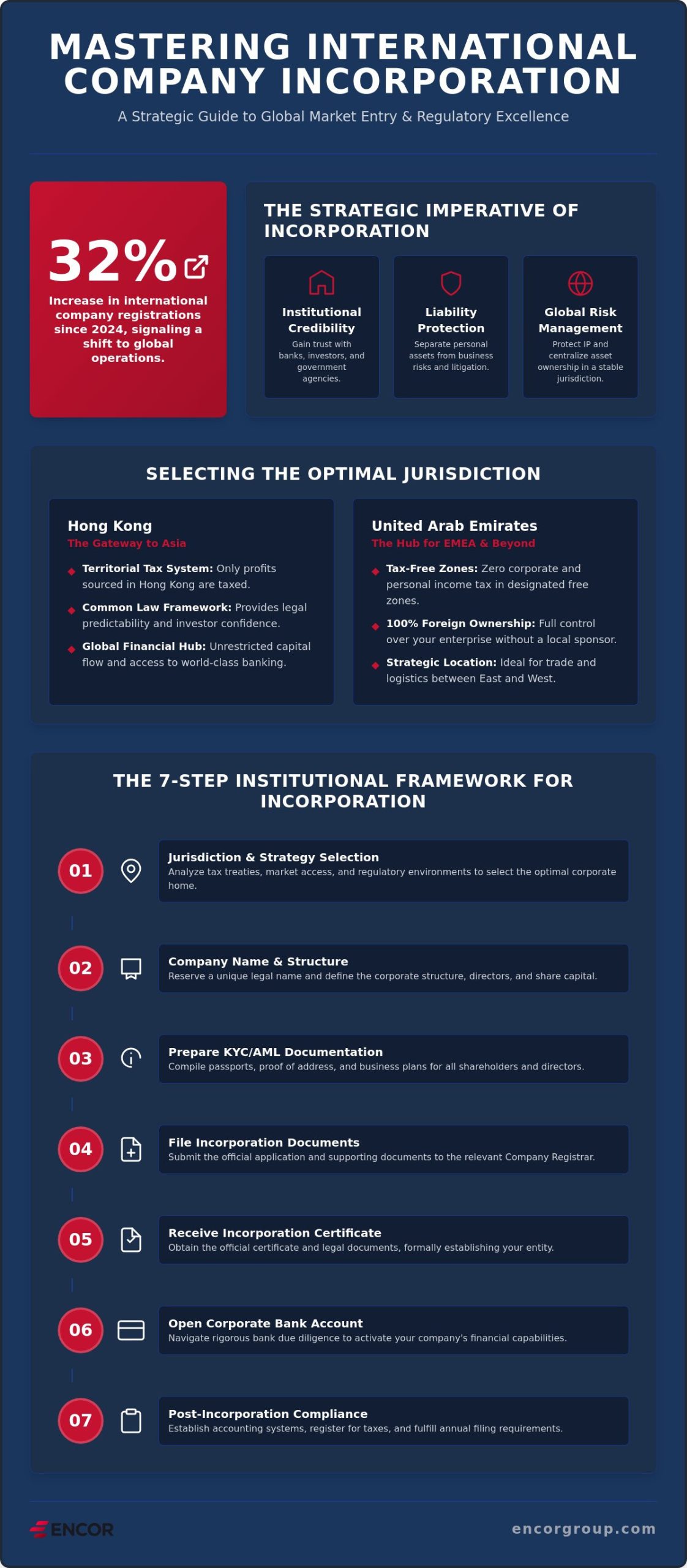
International company registrations have increased by 32% since 2024, reflecting a fundamental shift toward distributed global operations and remote-first business models. While the opportunity for expansion is vast, the process of company incorporation involves far more than simple filing. Many organizations encounter significant friction when managing multi-market compliance or facing unexpected delays in corporate bank account opening. These operational bottlenecks often stem from a lack of familiarity with specific foreign regulatory frameworks and the intricacies of cross-border governance.
We understand that a successful market entry requires a balance of speed and precision. This strategic guide is designed to help you master the complexities of international company incorporation with a focus on regulatory excellence and long-term growth. You will gain a clear understanding of how to select the optimal jurisdiction, establish a tax-efficient corporate structure, and ensure your new entity integrates seamlessly with global banking systems. We provide the roadmap to transform a complex administrative requirement into a powerful lever for institutional success and global market leadership.
Key Takeaways
- Understand how a formal legal entity provides the institutional credibility required to enter and compete in global markets.
- Evaluate the strategic advantages of Hong Kong and the UAE to determine which jurisdiction best supports your tax and ownership goals.
- Master the essential seven-step framework for company incorporation to avoid common regulatory delays and administrative friction.
- Navigate the complexities of international banking by preparing for rigorous KYC and AML standards during the setup process.
- Implement robust post-incorporation systems for accounting and compliance to ensure your global operations remain legally sound.
The Strategic Importance of Company Incorporation in Global Expansion
The incorporation of a business establishes a legal entity that exists independently of its founders. This separation is fundamental. By formalizing this structure, a company gains the capacity to own assets, enter into binding agreements, and assume liabilities in its own name. This transition from a private venture to a recognized corporate person is the first step toward institutional maturity.
Institutional credibility is often the primary barrier to entry in foreign markets. Stakeholders, including government agencies and financial institutions, view a registered entity as a commitment to the local economy. Beyond optics, company incorporation serves as a critical mechanism for protecting intellectual property and managing global risk. It centralizes ownership of patents and trademarks within a specific jurisdiction, preventing the fragmentation of assets across multiple borders. This legal clarity is essential when navigating different legal systems simultaneously.
A formalized structure also streamlines human capital management. Without a local legal presence, organizations often struggle with international recruitment and payroll solutions. Having an incorporated entity allows for direct employment contracts that comply with local labor laws. This ensures operational stability and helps maintain tax compliance across a distributed workforce. It’s about building a foundation that can support rapid scaling without the risk of regulatory collapse.
Incorporation as a Catalyst for Market Entry
Establishing a local entity simplifies the execution of contracts with regional suppliers and clients. Many government tenders and large-scale corporate procurement processes require vendors to be locally registered. This formal presence is often a prerequisite for securing essential business licenses. By integrating these steps into a broader global business expansion strategy, executives can ensure they aren’t just entering a market, but are positioned to dominate it. A local entity signals long-term intent and operational permanence.
Liability Protection and Institutional Credibility
The concept of the corporate veil remains a cornerstone of international commerce. It provides a layer of protection that limits the exposure of parent companies and shareholders during cross-border litigation. Professional investors and global banks typically mandate a formalized corporate structure before committing capital or opening credit lines. This transparency in entity management builds enduring trust with international stakeholders. It ensures the business is viewed as a stable, long-term partner rather than a transient participant in the global economy. Professionalism in structure leads to professionalism in perception.
Selecting the Optimal Jurisdiction: Hong Kong, UAE, and Beyond
Selecting a jurisdiction is a high-stakes decision that dictates your tax exposure, regulatory burden, and overall ease of operation. While many advisors focus solely on domestic US options like Delaware or Wyoming, global enterprises require a broader perspective to capture international growth. The choice of jurisdiction for company incorporation must align with your supply chain, target markets, and capital requirements. For instance, common law jurisdictions offer a level of legal predictability that is highly valued by international investors and venture capitalists. In contrast, civil law systems provide different structural benefits, though many modern hubs have adopted hybrid frameworks to attract foreign capital.
Double Taxation Agreements (DTAs) are another critical factor in this selection process. These treaties ensure that your profits aren’t taxed twice by different governments, facilitating more efficient cross-border capital movement. Before registering your business, you should evaluate the DTA network of your chosen hub to optimize your global tax footprint. A well-chosen jurisdiction doesn’t just house your company; it acts as a strategic lever for financial efficiency.
Hong Kong: The Gateway to Asia
Hong Kong remains the premier gateway for businesses targeting the Asian market. Its territorial tax system is a significant draw; profits earned outside the territory are generally exempt from local tax. Organizations utilizing Hong Kong company formation services benefit from a world-class financial infrastructure and a legal system that mirrors English common law. With 100% foreign ownership permitted and a 24-hour e-Registry for applications, it’s an ideal base for rapid deployment. Its proximity to Mainland China provides unparalleled access to the world’s second-largest economy while maintaining a separate, internationally recognized legal framework.
UAE Free Zones: Strategic Hubs for the Middle East
The UAE has transformed into a strategic hub for the Middle East through its innovative Free Zone model. These zones, such as IFZA, Meydan, and DMCC, allow for 100% foreign ownership and provide a predictable environment for international trade. While a 9% corporate tax rate applies to income exceeding AED 375,000, SME relief remains available for companies with revenue under AED 3 million until the end of 2026. Successful international entity management in the UAE requires a deep understanding of the differences between Mainland and Free Zone requirements. Aligning your company incorporation choice with your long-term goals is essential for sustained success, and we’re here to guide you through these high-stakes decisions.
The Institutional Framework: A 7-Step Process for International Incorporation
While selecting a jurisdiction is a strategic decision, the execution of company incorporation requires a methodical approach to satisfy local registrars. This process begins with Step 1: selecting an entity type that aligns with your specific operational needs, such as a private limited company or a branch office. Step 2 involves corporate name approval. This isn’t merely a branding exercise; it requires adherence to local linguistic and legal standards to avoid infringement or rejection by the registry. Step 3 requires the formal appointment of officers, including directors who will hold fiduciary responsibility. Step 4 is the preparation of constitutional documents, primarily the Articles of Association, which define the internal governance and share structure of the entity. Finally, Step 5 necessitates establishing a registered office address within the chosen jurisdiction to serve as the official point of contact for government authorities.
Following these steps ensures that the legal foundation is robust enough to support future growth. Each jurisdiction has its own nuances, but the underlying logic of company incorporation remains consistent: establishing a transparent, verifiable legal person. Neglecting the precision required in these early stages often leads to significant delays during the final filing process. It’s essential to treat these administrative requirements as a critical component of your broader market entry strategy.
Governance and Secretarial Appointments
In many premier hubs, such as Hong Kong, the appointment of a resident Company Secretary is a mandatory requirement. This officer ensures the entity remains in good standing by managing statutory filings and board resolutions. Some jurisdictions also impose director residency requirements, which may necessitate the use of professional nominee services to maintain compliance while the business scales. Aligning these appointments with robust international payroll solutions ensures that your human capital and governance structures work in tandem from the moment the entity is formed.
Documentation and Filing Standards
Drafting the Articles of Association requires foresight to allow for future capital raising or changes in share structure. For international entities, documents often require notarization and legalization through an Apostille process to be recognized across borders. This mirrors the foundational logic found in the SBA guide to registering your business, though international requirements are often more stringent regarding the verification of beneficial owners. Once the local Registrar of Companies reviews the submission, they issue the Certificate of Incorporation. This document officially brings the legal person into existence and allows the company to proceed with the final steps of operational setup.
Beyond Registration: Managing Post-Incorporation Compliance and Banking
Securing the Certificate of Incorporation is a significant milestone, but it’s only the beginning of the operational journey. The transition from a newly formed entity to a functional business requires a rigorous focus on post-incorporation obligations. These mandates ensure that the organization remains in good standing and can navigate the complexities of global commerce. Most executives find that the most substantial challenges arise when confronting the stringent Know Your Customer (KYC) and Anti-Money Laundering (AML) standards enforced by tier-one financial institutions. These standards are not mere formalities; they’re the gatekeepers to the global financial system.
Operational excellence also depends on the implementation of accounting and bookkeeping systems that align with local GAAP or IFRS standards. In tax-neutral jurisdictions, the management of Economic Substance Requirements (ESR) has become increasingly critical. Regulators now demand proof that an entity has adequate local expenditures and a physical presence. Neglecting these standards can lead to substantial fines or the dissolution of the entity. Ongoing corporate secretarial duties, such as maintaining statutory registers and minute books, are essential to demonstrate institutional transparency and compliance.
Corporate Bank Account Opening Assistance
In 2026, bank account opening has emerged as the primary bottleneck for international business setup. The scrutiny from global banks is unprecedented. They require more than just basic corporate documents. They demand a comprehensive business plan that details your supply chain, target clients, and three-year financial projections. Successfully managing this relationship requires a strategic approach to documentation and communication. We help our clients prepare for these rigorous reviews to ensure their company incorporation results in a fully functional, bankable entity.
Ongoing Regulatory and Tax Compliance
Compliance is a continuous process. For entities in Hong Kong and the UAE, annual audit requirements are mandatory and must be handled by licensed professionals. Filing annual returns on time is the only way to maintain the “Good Standing” status required for contract renewals and visa applications. Specific regional changes also demand immediate attention. For example, starting in July 2026, the UAE mandates electronic invoicing for all B2B transactions. This requires immediate updates to local accounting systems. Integrating international payroll solutions becomes vital for managing multi-market teams without triggering tax liabilities. Our Compliance and Regulatory Advisory services ensure that your global structure remains resilient against these evolving international standards.
Scaling with Authority: Encor Group as Your Strategic Incorporation Partner
Encor Group serves as a comprehensive facilitator for organizations seeking more than just administrative filing. We operate an end-to-end platform that streamlines the entire lifecycle of global business setup. With a presence across 10+ international markets, we offer the localized expertise necessary to handle high-stakes requirements with quiet efficiency. This approach ensures that company incorporation isn’t an isolated event but a coordinated entry into a new ecosystem. We prioritize precision at every stage, from the initial jurisdictional analysis to the final bank account activation.
Transitioning from a successful setup to long-term strategic growth requires a partner who understands the granular details of international operations. Our advisory services don’t end when you receive your certificate. We provide the steady, calm assurance needed to manage ongoing compliance, tax optimization, and operational scaling. By aligning your corporate structure with your commercial objectives, we help you build a resilient foundation for global leadership. It’s about moving beyond basic registration to achieve true institutional excellence.
The Encor Advantage: Global Reach, Local Depth
Our regional hubs in Hong Kong and the UAE serve as anchors for your expansion. These locations provide more than just a registered address; they offer immediate access to a vetted network of professional directors, corporate secretaries, and tax advisors. We recently assisted a multinational client in aligning their complex legal structure with a comprehensive global business expansion strategy. By centralizing their compliance management through our platform, they reduced administrative friction and accelerated their entry into three new markets simultaneously. This level of local depth, backed by global standards, is what sets our services apart.
Executive-Level Consulting for Complex Requirements
We move beyond “off-the-shelf” solutions to provide bespoke corporate structuring tailored to your specific risk profile and capital needs. Our recruitment and payroll services are designed to support your first 100 days in a new market, ensuring you have the right talent and systems in place from day one. We handle the intricacies of local labor laws and tax filings so your leadership team can focus on market capture. This integrated approach minimizes the risk of early-stage operational collapse. Secure your global future with Encor Group’s professional incorporation services to ensure your expansion is built on a foundation of stability and strategic depth.
Strategic Global Expansion: Securing Your Institutional Foundation
Establishing a global footprint requires more than administrative filing; it demands a sophisticated alignment of legal structure and commercial strategy. We’ve explored how selecting the right jurisdiction and maintaining rigorous post-incorporation standards are essential for operational resilience. Mastering the nuances of company incorporation ensures your entity remains a credible, bankable, and compliant vehicle for long-term growth.
Encor Group provides the steady guidance needed to navigate these complexities. With regional hubs in Hong Kong and the UAE, we offer comprehensive support ranging from accounting and bookkeeping to specialized HR and recruitment. Our platform is trusted by multinational enterprises to handle cross-border expansion with precision and institutional depth. We ensure that every detail of your international presence is managed with the highest level of professional gravity.
Your expansion deserves a foundation built on expertise and global competence. Consult with our strategic advisors to begin your global incorporation journey and transform your international ambitions into a structured, high-performing reality. We look forward to facilitating your success in the world’s most dynamic markets.
Frequently Asked Questions
What is the difference between a registered office and a physical office?
A registered office address is the official legal location where a company receives statutory correspondence and government notices. It’s a mandatory requirement for company incorporation in most jurisdictions. In contrast, a physical office is the location where the company conducts its daily commercial activities and houses its workforce. While every entity must have a registered address, a physical office is only necessary if dictated by operational needs or specific economic substance regulations.
How long does the international company incorporation process typically take?
The timeline for international company incorporation varies significantly depending on the chosen jurisdiction and the complexity of the corporate structure. In digital-first hubs like Hong Kong, the process can be completed within 24 hours through electronic filing systems. Other regions may require two to four weeks if physical document notarization or legalization is necessary. These estimates exclude the additional time required for post-incorporation tasks like tax registration and corporate bank account opening.
Do I need to be physically present in the jurisdiction to incorporate a company?
Most premier jurisdictions don’t require the physical presence of directors or shareholders during the initial setup process. Remote filing and digital signatures have become the standard in hubs like the UAE and Hong Kong. However, a visit may be mandatory at a later stage to satisfy the Know Your Customer (KYC) requirements of local banks or to finalize residency visa applications. We recommend verifying specific jurisdictional entry requirements before beginning the setup.
What are the ongoing costs of maintaining an international business entity?
Maintaining an international business entity involves several recurring expenditures beyond the initial setup. These typically include annual return filing fees, registered office address renewals, and corporate secretarial service fees. Additionally, companies must account for annual audit costs and tax advisory fees to ensure compliance with local regulations. Failure to meet these financial obligations can result in significant penalties or the involuntary dissolution of the legal entity.
Can one person be both the Director and the Shareholder of a foreign company?
Most modern jurisdictions allow a single individual to act as both the sole Director and the sole Shareholder of a company. This structure is common for startups and small-to-medium enterprises seeking a streamlined governance model. However, some regions may impose restrictions on the residency of the director or require the appointment of a separate, locally-based Company Secretary to ensure regulatory oversight. It’s essential to review the specific Companies Ordinance of your target market.
What documents are required for corporate bank account opening in 2026?
In 2026, financial institutions require a comprehensive documentation package to satisfy rigorous AML and KYC standards. This includes the Certificate of Incorporation, the Articles of Association, and detailed proof of beneficial ownership for all major shareholders. Banks also mandate a sophisticated business plan that outlines your supply chain, target markets, and projected revenue. Providing evidence of existing commercial contracts or professional references can significantly improve the likelihood of a successful account opening.
How do Economic Substance Requirements affect my company incorporation strategy?
Economic Substance Requirements mandate that entities engaged in specific relevant activities demonstrate a genuine economic link to their chosen jurisdiction. This involves maintaining a physical presence, incurring adequate local operating expenditure, and employing a sufficient number of qualified personnel within the region. These regulations are designed to prevent profit shifting and ensure that the corporate structure reflects the actual location of management and control. Non-compliance can lead to severe financial penalties.
What is a Company Secretary and why is it mandatory in some jurisdictions?
A Company Secretary is a high-level officer responsible for ensuring the entity adheres to all statutory and regulatory requirements. In jurisdictions like Hong Kong, this role is mandatory and requires the appointee to be a local resident or a licensed professional service provider. They maintain the company’s statutory registers, manage board resolutions, and handle the filing of annual returns. This position is vital for protecting the company’s legal standing and ensuring transparent governance.