
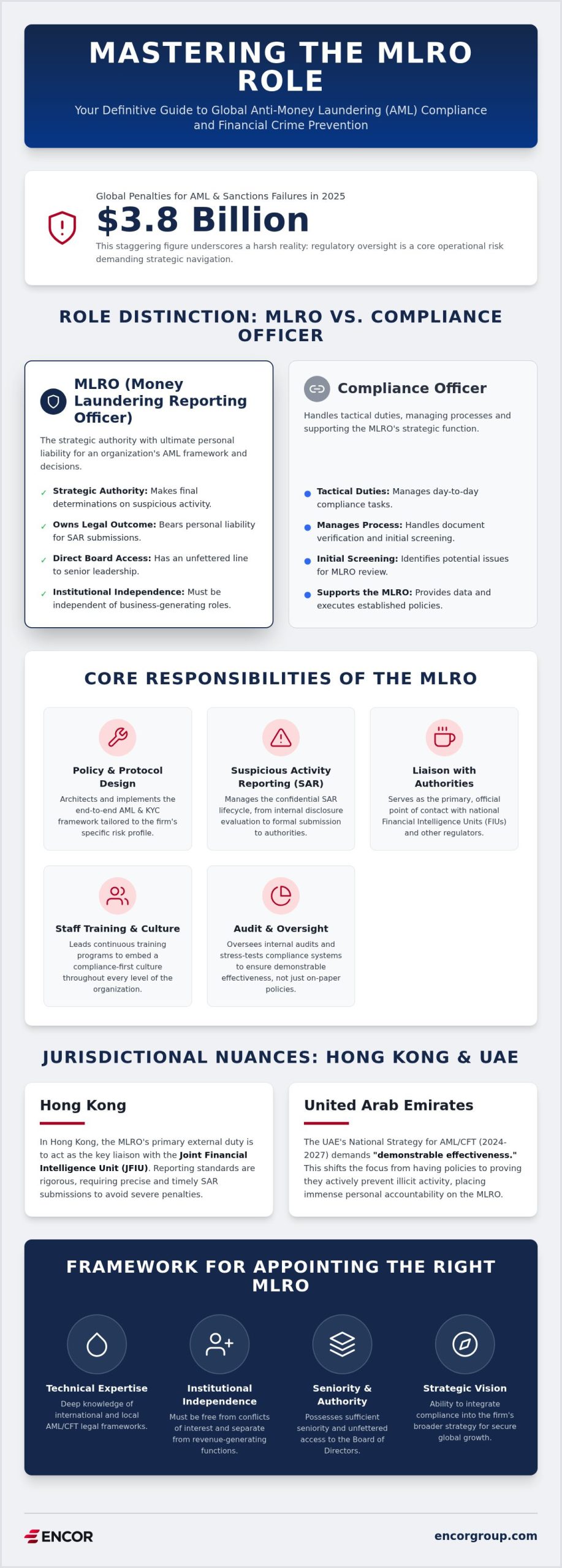
Global penalties for failures in anti-money laundering and sanctions compliance reached a staggering $3.8 billion in 2025. This figure underscores a harsh reality for international firms: regulatory oversight is no longer a peripheral concern but a core operational risk. You likely recognize that keeping pace with shifting mandates in jurisdictions like Hong Kong or the UAE is an exhausting endeavor. The pressure to appoint a qualified MLRO (Money Laundering Reporting Officer) often feels like a race against both time and the threat of severe financial repercussions. It’s a high-stakes requirement that demands more than just a titular appointment; it requires a strategic navigator.
This guide will help you master the complexities of the MLRO role to ensure your international entity remains compliant, secure, and strategically positioned for growth. We’ll provide a clear breakdown of mandatory duties, from suspicious transaction reporting to internal audit oversight. You’ll also find a robust framework for selecting the right officer to represent your firm’s interests. By the end of this article, you’ll understand how to integrate high-level compliance into your global expansion strategy with the precision and confidence your institution requires.
Key Takeaways
- Define the institutional significance of the Money Laundering Reporting Officer as the primary authority for anti-money laundering activities and financial crime prevention.
- Master the core responsibilities of an mlro, including the implementation of robust KYC policies and the management of internal investigations into suspicious financial patterns.
- Identify the specific regulatory mandates for entities in Hong Kong and the UAE to maintain compliance with the latest AML/CFT legal frameworks.
- Apply a strategic framework for appointing an officer who maintains the necessary balance between technical expertise and institutional independence.
- Integrate compliance advisory into the company formation process to facilitate seamless bank account opening and ensure long-term operational stability.
What is a Money Laundering Reporting Officer (MLRO)?
The Money Laundering Reporting Officer, commonly referred to as the mlro, serves as the central nexus for an organization’s anti-money laundering (AML) framework. This individual isn’t merely a compliance staff member but a designated officer with the authority to oversee all aspects of a firm’s anti-financial crime strategy. As global financial systems face increasingly sophisticated threats, the institutional significance of this role has transitioned from a back-office necessity to a front-line defense against terrorist financing and illicit capital flows. In 2026, the mandate for this position has expanded, requiring a professional who can navigate the intersection of international law and corporate operations with absolute precision.
The Regulatory Mandate and Institutional Accountability
The title of ‘Nominated Officer’ carries significant legal weight. In 2026, the regulatory environment in global hubs like Hong Kong and the UAE has shifted away from passive, checkbox compliance toward a model of demonstrable effectiveness. For instance, the UAE’s National Strategy for AML/CFT (2024–2027) demands that firms prove their systems actually stop illicit activity rather than just having policies on paper. To meet these standards, an mlro must possess an unfettered line of communication to the Board of Directors. This direct access ensures that compliance concerns aren’t filtered through middle management, allowing for immediate action when institutional risks are identified. Seniority is no longer optional; it’s a regulatory prerequisite that ensures the officer has the authority to challenge business decisions that may compromise the firm’s integrity.
MLRO vs. Compliance Officer: Defining Authority
While a standard compliance officer handles tactical duties like document verification and initial screening, the MLRO holds the strategic authority to make final determinations on suspicious activity. The MLRO bears the ultimate personal legal liability for the decision to submit or withhold a Suspicious Activity Report (SAR) to the relevant authorities. This distinction is critical; it’s the difference between managing a process and owning the legal outcome. Regulators are increasingly holding individuals accountable for systemic failures rather than just the entity as a whole.
In 2025, the UAE Central Bank’s decision to fine a branch manager Dh500,000 and permanently bar them from the industry illustrates the high stakes of personal accountability. The 2026 regulations reinforce this by requiring the MLRO to be independent of business-generating activities to prevent conflicts of interest. This independence ensures that the drive for corporate growth never eclipses the legal obligation to report financial irregularities. By separating these roles, an entity demonstrates to regulators that its compliance function is a robust, independent pillar of its corporate governance.
Core Responsibilities and Authority of the MLRO
The mlro functions as the strategic architect of an entity’s financial integrity. Beyond simple oversight, they are responsible for the end-to-end design of AML and Know Your Customer (KYC) protocols tailored to the specific risk profile of the business. This role demands that the officer serves as the primary liaison with national financial intelligence units (FIUs), such as Hong Kong’s JFIU or the UAE’s FIU. They don’t just follow rules; they cultivate a compliance-first culture through continuous staff training and institutional leadership. By establishing clear internal reporting lines, the officer ensures that every level of the organization understands its role in preventing financial crime.
Managing the Suspicious Activity Reporting (SAR) Lifecycle
The SAR lifecycle is a critical operational workflow managed exclusively by the MLRO. When an employee identifies a suspicious pattern, they submit an internal disclosure. The officer must then evaluate this disclosure against external intelligence and internal data to determine if it meets the threshold for a formal report. This process requires absolute confidentiality to avoid the legal pitfall of ‘tipping off’, where a client is inadvertently alerted to an investigation. Maintaining a secure, encrypted reporting log is a fundamental requirement often cited in the FCA Compliance Guide, which serves as a global benchmark for reporting standards. If an officer fails to manage this lifecycle correctly, they risk both institutional fines and personal legal consequences.
Policy Oversight and Risk-Based Customer Due Diligence
Effective compliance relies on a Risk-Based Approach (RBA) rather than a one-size-fits-all model. The MLRO designs these frameworks to prioritize resources toward high-risk areas, such as transactions involving Politically Exposed Persons (PEPs) or jurisdictions on the FATF “black list”. In hubs like Hong Kong, the use of the STREAMS 2 platform for electronic submissions became mandatory in June 2026, requiring the officer to integrate modern technology into their oversight. The MLRO ensures that KYC compliance for corporate accounts remains a continuous process by implementing periodic reviews and real-time transaction monitoring. This proactive stance is essential for navigating the complexities of international finance. For businesses seeking to establish these robust frameworks during expansion, expert compliance advisory provides the necessary strategic foundation to remain secure and operational.
Jurisdictional Nuance: MLRO Requirements in Hong Kong and the UAE
Jurisdictional nuances define the operational boundaries of an international entity. While the core objectives of an mlro remain consistent globally, the specific mandates of the Hong Kong Customs and Excise Department or the UAE’s Executive Office require specialized localized knowledge. These differences aren’t merely administrative; they’re foundational to a successful global business expansion strategy. Failure to align with local residency or reporting standards can lead to immediate licensing revocation or severe financial penalties. Navigating these requirements demands a professional who understands the intersection of global standards and local enforcement priorities.
Hong Kong: Navigating the AMLO Framework
Hong Kong’s Anti-Money Laundering and Counter-Terrorist Financing Ordinance (AMLO) dictates the standard for entities regulated by the HKMA and the Customs and Excise Department. The officer ensures the organization maintains its ‘fit and proper’ status, a designation that regulators review with increasing scrutiny. Reporting to the Joint Financial Intelligence Unit (JFIU) must be managed through the STREAMS 2 platform, which became the mandatory electronic submission channel in June 2026. This system demands precise data entry and adherence to strict timelines. The officer also oversees beneficial ownership transparency by maintaining the Significant Controllers Register, ensuring the registry remains accurate for periodic regulatory audits.
UAE: Compliance in a Rapidly Evolving Market
The UAE’s regulatory landscape has evolved rapidly following the introduction of Federal Decree Law No. 10 of 2025. This primary legislation emphasizes the demonstrable effectiveness of an entity’s AML framework. An mlro in the UAE must typically be a resident, especially for Mainland operations and specific Free Zones. They’re responsible for all suspicious activity filings via the goAML portal, which is the mandatory reporting interface for the national Financial Intelligence Unit. Beyond reporting, the officer ensures the entity adheres to Economic Substance Requirements to avoid substantial non-compliance fines. This position is also critical for maintaining corporate bank accounts in Dubai, as financial institutions require a resident compliance lead to authorize high-stakes transactions.
Selecting and Empowering the Right MLRO for Your Entity
Selecting an mlro is one of the most critical governance decisions an international entity will make. This individual must possess a rare combination of technical regulatory knowledge and the institutional seniority required to command the Board’s respect. It’s a role that demands absolute independence; an officer shouldn’t have any involvement in business-generating activities or sales targets. This separation of duties is essential to prevent conflicts of interest that could compromise the entity’s legal standing. To be effective, the officer needs more than just a title. They require a dedicated budget and access to advanced RegTech tools to monitor transactions in real-time.
The Board of Directors plays a pivotal role in this ecosystem. They must provide the necessary resources while also acting as a critical check on the officer’s findings. This relationship ensures that the compliance function is both supported and held to the highest standards of accuracy. A well-resourced compliance department is a signal of institutional stability to investors and regulators alike. When the Board actively engages with compliance reports, it reinforces a culture of integrity that permeates the entire organization.
Qualifications: Authority, Knowledge, and Experience
A deep understanding of the local financial system is a non-negotiable requirement for any candidate. In 2026, professional certifications such as those from ACAMS are considered the industry standard for verifying a professional’s expertise. However, certifications alone aren’t enough. You must verify a candidate’s track record in managing complex regulatory audits and their ability to translate legal requirements into operational workflows. Experience in high-stakes environments is the only true measure of an officer’s capability. They must be able to navigate the nuances of local enforcement while maintaining a global perspective on financial crime trends.
The Cost of Inadequate Selection: Regulatory and Reputational Risk
Weak leadership in the compliance function can lead to catastrophic failures that extend far beyond financial fines. It can erode trust with banking partners and lead to the termination of essential services. Conversely, a strong mlro significantly enhances a company’s valuation during M&A activity or global expansion. Investors view a robust AML framework as a de-risked asset that’s prepared for future scrutiny. This security also extends to operational layers, such as the integrity of international payroll solutions, where compliance failures can disrupt entire workforces. For entities looking to secure their global operations, our regulatory advisory services provide the strategic expertise needed to select and empower the right compliance leadership.
Encor Group: Strategic Advisory for Global Regulatory Integrity
Encor Group functions as the strategic navigator for enterprises entering high-regulation markets. We don’t just facilitate Hong Kong company formation; we architect the entire compliance infrastructure required for long-term viability. By integrating regulatory advisory from the outset, we ensure that your mlro has a robust framework to operate within immediately upon appointment. This proactive approach eliminates the friction often associated with cross-border setups. We provide executive-level consulting that aligns your global entity management with the highest standards of institutional integrity.
A successful compliance function requires more than just leadership; it needs accurate, timely data. Encor Group supports the mlro by providing specialized accounting and tax advisory services that serve as the foundation for internal investigations and reporting. This synergy allows the officer to focus on strategic decision-making while we handle the granular complexities of financial record-keeping. Multinational enterprises prefer our model because it replaces fragmented service providers with a single, authoritative partner committed to operational excellence.
Comprehensive Compliance Support for International Hubs
Our regional hubs in Hong Kong and the UAE provide the localized expertise necessary to navigate specific jurisdictional mandates. We bridge the gap between rigid regulatory requirements and the need for operational efficiency. One of the most significant hurdles for new entities is the documentation required for corporate bank account opening. Encor Group streamlines this process by ensuring all compliance filings are precise and transparent, meeting the stringent requirements of international financial institutions. Our presence in these hubs ensures your business remains responsive to local enforcement priorities.
Scaling with Authority: Your Partner in Global Growth
Encor Group centralizes your compliance functions to reduce the administrative burden on your leadership team. Our unified approach integrates HR, payroll, and regulatory reporting into a cohesive strategy. This centralization ensures that as your entity grows, your compliance framework scales accordingly without compromising security. It’s a method that provides the Board with the steady, calm assurance that no detail is overlooked. For businesses ready to optimize their international footprint, the next step involves a comprehensive audit of current regulatory standings. Contact Encor Group today to secure your entity’s future through strategic compliance and operational mastery.
Securing Institutional Integrity in a Global Market
The role of the mlro has transitioned from a regulatory requirement into a cornerstone of institutional stability. As global mandates in Hong Kong and the UAE become more stringent, the officer’s ability to navigate these complexities determines the long-term viability of your international operations. It’s essential to recognize that compliance isn’t a static obligation but a dynamic strategic advantage. Proper selection and the provision of adequate resources ensure that your entity isn’t just avoiding penalties but is actively building the trust required for seamless bank account openings and sustainable growth.
Encor Group provides the institutional-grade consulting necessary for multinational enterprises to scale with confidence. With a global reach across 10+ markets and deep expertise in the regulatory frameworks of HK and UAE hubs, we act as your strategic navigator in high-stakes environments. We invite you to Partner with Encor Group for Strategic Compliance and Global Expansion to secure your entity’s future. By prioritizing regulatory excellence today, you position your organization for a future defined by operational precision and global success.
Frequently Asked Questions
Is it mandatory for every business to have an MLRO?
Appointment is mandatory for entities classified as regulated persons or relevant businesses, such as financial institutions and Designated Non-Financial Businesses and Professions (DNFBPs). This includes law firms, real estate agents, and trust service providers. While a startup in a non-regulated sector may not require one, any entity handling significant capital flows or operating in high-risk jurisdictions should appoint an officer to mitigate institutional risk.
Can the CEO of a company also serve as the MLRO?
A CEO can serve as the officer in exceptionally small organizations, but regulators generally discourage this practice due to inherent conflicts of interest. The mlro must remain independent of business-generating activities to ensure that reporting decisions aren’t influenced by profit motives. For larger entities, maintaining a clear separation between executive leadership and the compliance function is a prerequisite for demonstrating effective corporate governance.
What is the difference between an MLRO and an MLCO?
The Money Laundering Reporting Officer is primarily responsible for receiving internal disclosures and submitting suspicious transaction reports to the authorities. In contrast, the Money Laundering Compliance Officer (MLCO) oversees the broader AML/CFT framework, including systems, controls, and policy implementation. While the same individual may hold both titles in smaller firms, the roles represent distinct functions of reporting versus systemic oversight.
What are the legal consequences for an MLRO who fails to report a suspicious transaction?
An officer faces severe personal legal liability, including substantial fines and imprisonment, for failing to report suspicious activity. Regulators in 2026 have increased their focus on individual accountability. For example, a failure to report can lead to permanent debarment from the financial services industry. These penalties reflect the officer’s role as a critical safeguard in the global financial system.
Does an MLRO need to be a resident of the country where the business is incorporated?
Residency requirements vary by jurisdiction, but hubs like the UAE often mandate that the officer be a resident for Mainland and specific Free Zone entities. This ensures the individual is available for immediate regulatory engagement and understands the local financial landscape. While some jurisdictions allow for non-resident appointments under strict conditions, a resident officer is typically preferred to ensure operational responsiveness and accountability.
How does the MLRO role interact with GDPR and data privacy laws?
The role operates at the intersection of mandatory reporting and data protection mandates. While GDPR protects individual privacy, AML regulations generally provide a legal basis for processing sensitive data without consent for the purpose of preventing financial crime. An effective officer ensures that data collection is proportionate and that all suspicious activity reports are handled with the highest degree of confidentiality.
What is the goAML portal, and why is it relevant to MLROs in the UAE?
The goAML portal is a specialized software solution developed by the United Nations and utilized by the UAE Financial Intelligence Unit for the electronic submission of reports. All regulated entities in the UAE must register on this platform to fulfill their legal reporting obligations. It serves as the primary secure channel for communicating suspicious activities, ensuring that data is transmitted to law enforcement in a standardized format.
How often should an MLRO review the company’s AML policies?
Policies should be reviewed at least annually to ensure they remain aligned with current regulatory standards and institutional risk profiles. However, immediate reviews are necessary following significant legal amendments, such as the UAE’s 2025 primary AML legislation. Regular audits ensure that the entity’s framework remains effective and responsive to emerging financial crime typologies, protecting the organization from systemic failures.