
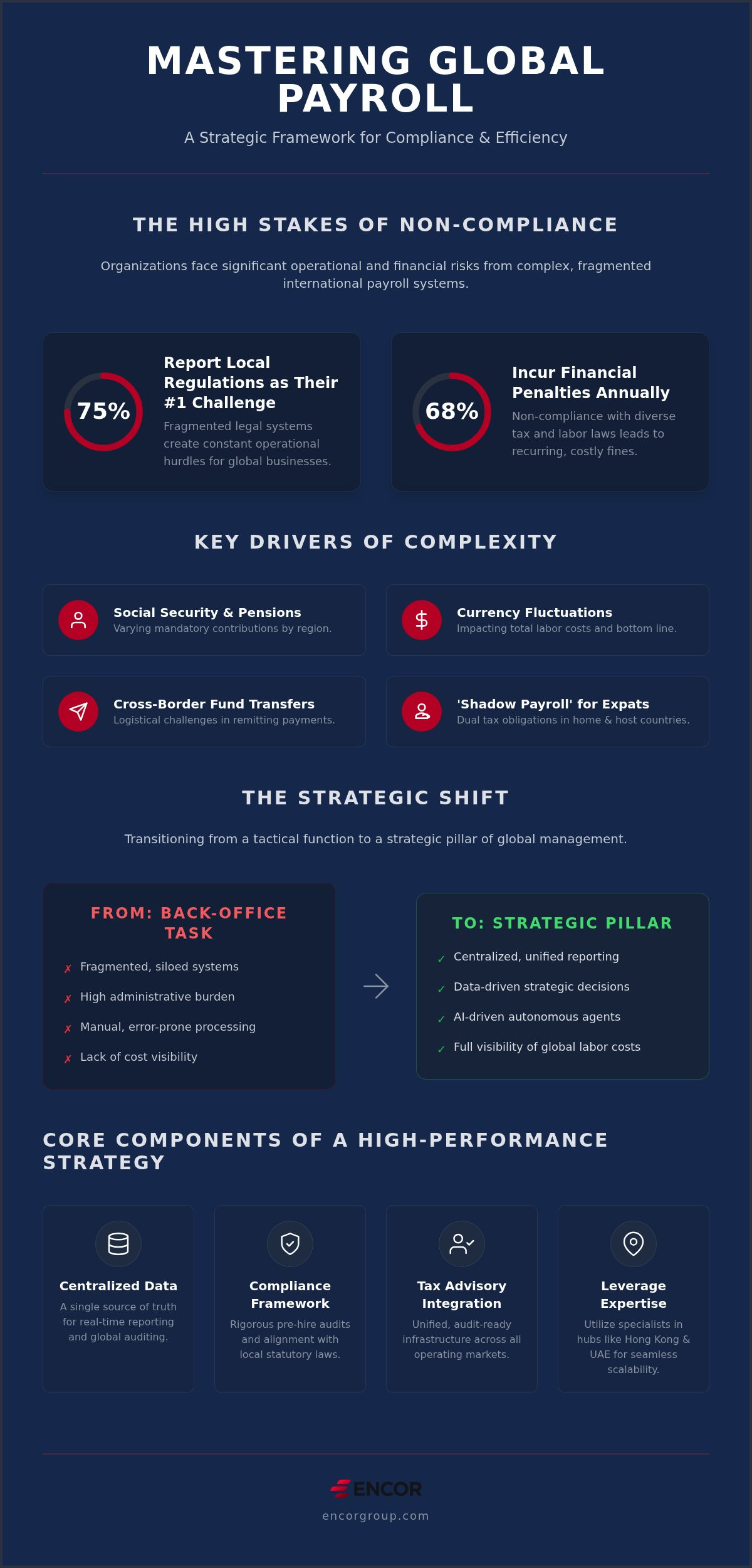
75% of organizations report that local regulations remain their primary operational challenge, and 68% incur financial penalties for non-compliance every year. Effective international payroll management is no longer a back-office administrative task; it’s a critical component of global entity management and regulatory compliance. You likely understand the complexity of managing disparate tax laws across markets like Hong Kong or the UAE, where fragmented systems often leave leadership without clear visibility into total global labor costs. This lack of transparency limits strategic decision-making and increases the risk of costly errors.
This guide provides a strategic framework to master multi-country payroll compliance and operational efficiency. You’ll learn how to replace high administrative burdens with a unified reporting system that guarantees adherence to local labor and tax regulations. We will examine the transition from manual processing to AI-driven autonomous agents and how to build the operational scalability required for seamless new market entry. By shifting your focus from transactional tasks to strategic data analysis, you can transform payroll into a pillar of corporate success.
Key Takeaways
- Transition payroll from a transactional back-office function to a strategic pillar of global entity management and human capital visibility.
- Evaluate the trade-offs between centralized and decentralized models to achieve the optimal balance of local autonomy and global reporting consistency.
- Establish a rigorous compliance framework for international payroll management through pre-hire jurisdictional audits and alignment with local statutory requirements.
- Integrate payroll operations with international tax advisory services to ensure a unified, audit-ready infrastructure across all operating markets.
- Leverage specialized expertise in strategic global hubs like Hong Kong and the UAE to facilitate seamless operational scalability and regulatory adherence.
The Strategic Importance of International Payroll Management in 2026
In 2026, the global business environment demands a transition from traditional back-office functions to integrated strategic operations. International payroll management is the centralized administration of employee compensation across multiple countries according to diverse local laws. This shift is driven by the need for strategic global entity management rather than simple transactional processing. As organizations expand into hubs like Hong Kong and the UAE, payroll accuracy becomes a direct reflection of corporate health and executive-level risk management. Modern enterprises no longer view payroll as an isolated task but as a vital data source that informs broader business strategy.
The evolving regulatory landscape, particularly regarding OECD tax standards and the Pillar Two framework, has heightened the requirement for data transparency. Payroll systems must now provide granular visibility to satisfy international tax authorities who are increasingly focused on cross-border income reporting. Errors in this domain don’t just affect individual paychecks; they trigger broader audits and jeopardize a company’s standing with regulatory bodies. Maintaining precise records is essential for mitigating the risk of financial penalties that 68% of organizations currently face annually due to non-compliance.
Beyond the Paycheck: Payroll as a Compliance Anchor
Effective payroll data acts as the primary source for corporate tax filings and economic substance reporting. It’s the evidence of a company’s physical and operational presence in a jurisdiction. International payroll management serves as a fundamental pillar of global corporate governance by ensuring that cross-border labor obligations align with broader jurisdictional compliance requirements. Inaccurate reporting or late filings can lead to the revocation of business licenses or severe reputational damage in highly regulated markets. By securing this data, companies protect their operational integrity and ensure their licensing remains in good standing.
Drivers of Complexity in Global Compensation
Managing global compensation requires navigating a web of social security requirements and mandatory pension contributions that vary significantly by region. Beyond understanding the Core Components of Payroll, such as base wages and withheld taxes, executives must account for currency fluctuations and the logistical challenges of cross-border fund transfers. These fluctuations can impact the total cost of labor and affect the company’s bottom line if not managed proactively.
Managing ‘shadow payroll’ requirements for expatriate employees remains another significant hurdle. These requirements ensure that social security and tax obligations are met in both the home and host countries, necessitating integration with international tax advisory services to maintain total compliance. Without a centralized strategy, these complexities often lead to fragmented reporting and increased administrative costs that hinder scalable growth.
Core Components of a High-Performance Global Payroll Strategy
A high-performance strategy begins with the establishment of a centralized data repository. Fragmented systems prevent leadership from obtaining a clear view of total labor costs and workforce distribution. Consolidating this information into a single source of truth allows for real-time reporting and more informed executive decision-making. Effective international payroll management requires this centralized architecture to maintain consistency across diverse jurisdictions and ensure that data remains accessible for global auditing.
Strategic alignment involves integrating payroll with international tax advisory services. This integration ensures that every compensation cycle remains compliant with the latest corporate tax obligations. When Navigating Foreign Payroll Taxes, companies must account for specific local withholding requirements that vary based on employee residency and the entity’s corporate structure. Without this synergy, businesses risk the 68% non-compliance penalty rate currently observed in the global market.
Compliance-First Architecture
Effective automation handles routine tax calculations and basic data ingestion. However, complex jurisdictions still require manual oversight by specialists who understand regional labor law nuances. Statutory reporting and year-end filing accuracy are critical for maintaining good standing with local authorities. Managing statutory benefits, such as mandatory pensions or regional insurance requirements, requires a deep understanding of both cultural expectations and legal mandates. This dual approach balances operational speed with the precision necessary for high-stakes regulatory environments.
Data Security and Global Privacy Standards
Data protection is a non-negotiable priority for any multinational enterprise. Organizations must navigate the stringent requirements of GDPR in Europe while simultaneously adhering to emerging data protection laws in Asia and the Middle East. Secure, encrypted platforms are the only acceptable standard for handling sensitive employee data. Utilizing cloud-based payroll infrastructure ensures business continuity during regional disruptions and provides a scalable foundation for future expansion. This secure framework protects the organization from the reputational and financial fallout of data breaches.
Implementing these core components requires a partner with both global reach and local precision. By aligning your operations with a professional provider, you can ensure that your international payroll management remains a driver of growth rather than an administrative bottleneck. Encor Group’s expertise in hubs like Hong Kong and the UAE provides the necessary support to bridge the gap between entity incorporation and ongoing HR operations.
Centralised vs. Localised Payroll: Evaluating Corporate Models
Choosing a model for international payroll management determines how an organization balances local agility with corporate control. The decentralized model offers high local autonomy. Each regional office manages its own providers, timelines, and reporting structures. While this allows for quick adjustments to local customs, it frequently results in fragmented data and significant compliance risk. Headquarters often lacks visibility into total labor costs, making it difficult to perform accurate global financial forecasting. Relying on disparate systems increases the likelihood of human error and inconsistent reporting standards.
The centralized model provides maximum visibility and consistency across the entire enterprise. It allows for standardized data formats and a single source of truth for all human capital costs. This approach requires significant corporate coordination and sophisticated technological integration. While it streamlines the reporting process, a purely centralized system can sometimes overlook unique local labor law nuances if it’s not supported by regional specialists. Executives often consult global payroll resources to identify which specific functions should remain at the corporate level and which require local intervention.
A hybrid model frequently emerges as the most effective solution for growing multinationals. It leverages a global partner to maintain central oversight while keeping “boots on the ground” expertise in primary hubs like Hong Kong and the UAE. This ensures that while reporting remains unified, local compliance is never sacrificed. Organizations should select their model based on their specific entity count and regional footprint. A firm with only two entities might manage with decentralized systems, but a multinational operating across multiple continents requires the structured oversight that only a centralized or hybrid approach can provide.
Operational Efficiency and Cost Management
Calculating the Total Cost of Ownership (TCO) for international payroll requires looking beyond monthly service fees. Hidden costs in localized models include excessive bank fees for cross-border transfers, multiple software licenses, and the high price of audit risks. Scaling payroll operations must align with a broader global business expansion strategy to ensure that administrative growth doesn’t outpace revenue. Centralizing these costs often reveals significant opportunities for operational optimization and vendor consolidation.
Risk Distribution in Global Operations
Centralized systems can create single points of failure if they aren’t supported by robust business continuity plans. The Corporate Secretary plays a vital role in this structure. They oversee payroll compliance as a core component of broader entity governance. Outsourcing to an integrated corporate services provider offers strategic advantages by consolidating payroll, tax, and secretarial functions. This integration reduces the risk of data silos. It ensures that compliance is managed proactively across all jurisdictions, protecting the organization from the financial penalties that 68% of companies face annually.
A Regulatory Compliance Framework for Multinationals in 2026
Establishing a robust framework for international payroll management requires a proactive approach to jurisdictional nuances. Compliance isn’t a static state but a continuous process of alignment with local mandates. Organizations must move beyond basic administration to implement a structured five-step protocol that secures their global operations. This framework ensures that every new market entry is supported by a foundation of legal and financial integrity.
- Step 1: Conduct a thorough jurisdictional labor law audit. Before initiating any hiring process, verify local regulations regarding termination notice periods, overtime thresholds, and mandatory leave entitlements.
- Step 2: Align payroll cycles with local statutory requirements. Many jurisdictions require specific payment structures, such as 13th-month pay or specific end-of-service gratuities, which must be factored into cash flow projections.
- Step 3: Establish secure bank account structures. Facilitating local currency payments through regional accounts reduces foreign exchange volatility and ensures compliance with local central bank reporting requirements.
- Step 4: Implement a robust KYC and beneficial ownership reporting process. Transparency standards in 2026 demand clear documentation of corporate structures to satisfy anti-money laundering (AML) protocols.
- Step 5: Continuous monitoring of tax treaties and social security rates. Regulatory environments are fluid; maintaining an updated registry of bilateral tax agreements prevents double taxation and ensures accurate withholding.
Managing Statutory Contributions and Benefits
Statutory obligations vary significantly between primary global hubs. In Hong Kong, employers must navigate the Mandatory Provident Fund (MPF) requirements, ensuring that both employer and employee contributions meet the legal thresholds. Conversely, the UAE requires specific pension schemes for GCC nationals while expatriate employees typically fall under end-of-service gratuity laws. In 2026, key Asian markets are implementing phased increases in mandatory employer contribution rates to address aging demographic shifts and long-term fiscal sustainability. Organizations must also account for health insurance mandates and employer liability coverage, which are often prerequisites for visa sponsorship and business license renewals.
Audit Readiness and Record Keeping
Maintaining a defensible audit trail is essential for any multinational enterprise. This process begins at the point of entry, where payroll records must align with Hong Kong company formation services to ensure that the registered entity is fully authorized to employ staff. Standardizing documentation across all jurisdictions facilitates seamless multi-country financial audits and reduces the administrative burden on internal finance teams. Accurate record-keeping protects the organization from retrospective claims and demonstrates a commitment to global corporate governance standards.
To secure your global operations against evolving regulatory risks, consult with our experts to design a compliant payroll framework tailored to your specific regional footprint.
Strategic Payroll Integration with Encor Group
Encor Group bridges the critical gap between initial entity incorporation and ongoing human capital management. For many multinationals, the transition from legal setup to operational payroll is where compliance risks often emerge due to a lack of local coordination. By integrating international payroll management with corporate secretarial and tax advisory services, we ensure a seamless transition for your global workforce. This holistic approach eliminates the need for multiple local providers, reducing the administrative burden and providing executive-level visibility into labor costs from day one. Our regional hubs serve over 10 markets, offering the stability and high standards required for high-stakes corporate operations.
Operational optimization is a direct result of this strategic integration. Executive-level consulting provides the roadmap for scaling into new territories without the typical friction of fragmented local systems. We identify redundancies in your existing processes and replace them with a unified framework that supports long-term growth. This ensures that as your organization expands, your payroll infrastructure remains a scalable asset rather than a growing liability.
Integrated HR and Recruitment Solutions
Identifying and onboarding top-tier talent in unfamiliar jurisdictions requires more than just local job boards. It demands a sophisticated understanding of regional compensation benchmarks and statutory expectations. Our integrated HR and recruitment solutions allow companies to customize compensation packages that match local market standards while maintaining internal equity. We streamline the entire employee lifecycle, from the initial recruitment phase through to compliant offboarding. This ensures that all legal and financial obligations are met at every stage, protecting the organization from retrospective claims and local labor disputes.
The Encor Advantage: Regional Expertise, Global Reach
Navigating the specific requirements of global hubs like the UAE and Hong Kong requires deep regional expertise that generic software providers cannot replicate. In the UAE, organizations must distinguish between the regulatory frameworks of various Free Zones and the Mainland, particularly regarding pension contributions and work permit regulations. Similarly, Hong Kong’s specific tax exemption and reporting standards require precise documentation to maintain compliance and optimize the entity’s tax position. Our advisors understand these nuances intimately, providing the steady, calm assurance needed to handle complex international business environments with quiet efficiency.
Scaling your international presence is more efficient with a single, trusted strategic partner that understands the intricacies of cross-border operations. We provide the proactive, globally-minded guidance necessary for high-level corporate success in 2026 and beyond. Contact our strategic advisors today for a bespoke global payroll audit to optimize your international operations and ensure total regulatory adherence across your regional footprint.
Future-Proofing Your Global Operational Infrastructure
Successful expansion depends on moving beyond fragmented, localized systems toward a unified strategy. Organizations that prioritize a centralized data repository and a compliance-first architecture mitigate the high risk of financial penalties while gaining essential visibility into global labor costs. Effective international payroll management serves as the structural foundation for sustainable growth in primary hubs like Hong Kong and the UAE. By aligning payroll with broader corporate governance, leadership ensures that cross-border operations remain both agile and audit-ready. This strategic shift transforms a back-office task into a powerful tool for workforce planning and executive decision-making.
Optimize your global operations with Encor Group’s strategic payroll solutions. Our regional hubs serve over 10 global markets, providing full integration with corporate secretarial and tax advisory services to eliminate operational silos. We maintain a proven track record in facilitating seamless expansion for enterprises entering the complex Hong Kong and UAE regulatory environments. It’s time to secure your organization’s future by transforming payroll from an administrative burden into a strategic asset for international success.
Frequently Asked Questions
What is the difference between global payroll and international payroll management?
Global payroll refers to the technical execution of payments across borders, while international payroll management encompasses the broader strategic oversight of compliance, tax advisory, and entity governance. Management involves integrating payroll data with corporate secretarial functions to ensure long-term operational stability. It’s the distinction between a transactional administrative task and a comprehensive regulatory framework that protects the organization from multijurisdictional risks.
How do I ensure compliance with GDPR when managing international payroll?
Ensuring compliance requires implementing end-to-end encryption for all employee data transfers and maintaining strict access controls within your centralized repository. You must also establish Data Processing Agreements with any third-party providers involved in the payroll cycle. Regular audits of your data retention policies ensure that sensitive information is stored only for the duration required by local statutory mandates and international privacy standards.
What are the risks of misclassifying employees as contractors in international markets?
Misclassification exposes an organization to significant financial liabilities, including retrospective social security contributions, unpaid benefits, and severe regulatory penalties. Local labor authorities in hubs like Hong Kong and the UAE utilize sophisticated audits to detect disguised employment structures. Beyond direct financial loss, companies risk reputational damage and the potential revocation of business licenses in these highly regulated jurisdictions.
How does international payroll management impact corporate tax liability?
Payroll data serves as a primary indicator of economic substance, directly influencing an entity’s corporate tax obligations and its eligibility for jurisdictional treaty benefits. Accurate international payroll management ensures that withholding taxes are calculated correctly, preventing the creation of unintended permanent establishments. This strategic alignment between HR operations and tax advisory protects the organization from double taxation and unexpected tax assessments.
What are the specific payroll requirements for a company in a UAE Free Zone?
Companies in UAE Free Zones must adhere to the Wage Protection System to ensure the timely and accurate electronic transfer of salaries. While expatriates are typically entitled to end-of-service gratuities, employers must also manage mandatory pension contributions for GCC nationals through the General Pension and Social Security Authority. These requirements vary between different Free Zones, necessitating precise local regulatory knowledge to maintain standing.
Can I manage international payroll without a local legal entity?
Managing payroll without a local legal entity typically requires utilizing an Employer of Record service to handle statutory obligations on your behalf. This model allows for rapid market entry but limits your direct control over the employee lifecycle and long-term tax strategy. For permanent operations, establishing a local entity remains the most stable method for maintaining full regulatory oversight and long-term operational autonomy.
How often should an international payroll audit be conducted?
Organizations should conduct a comprehensive international payroll audit at least annually to account for shifting tax rates and legislative updates. More frequent quarterly reviews are recommended during periods of rapid expansion or when operating in volatile regulatory environments. These audits verify that all statutory filings, social security contributions, and data privacy protocols align perfectly with the latest jurisdictional requirements and corporate standards.
What are the common challenges when paying employees in multiple currencies?
The primary challenges include managing foreign exchange volatility and navigating the high transaction fees associated with cross-border banking. Fluctuating rates can impact the total cost of labor and create inconsistencies in employee take-home pay if not managed through a structured strategy. Utilizing centralized accounts and local currency payments helps stabilize these costs and ensures compliance with regional central bank reporting mandates.