
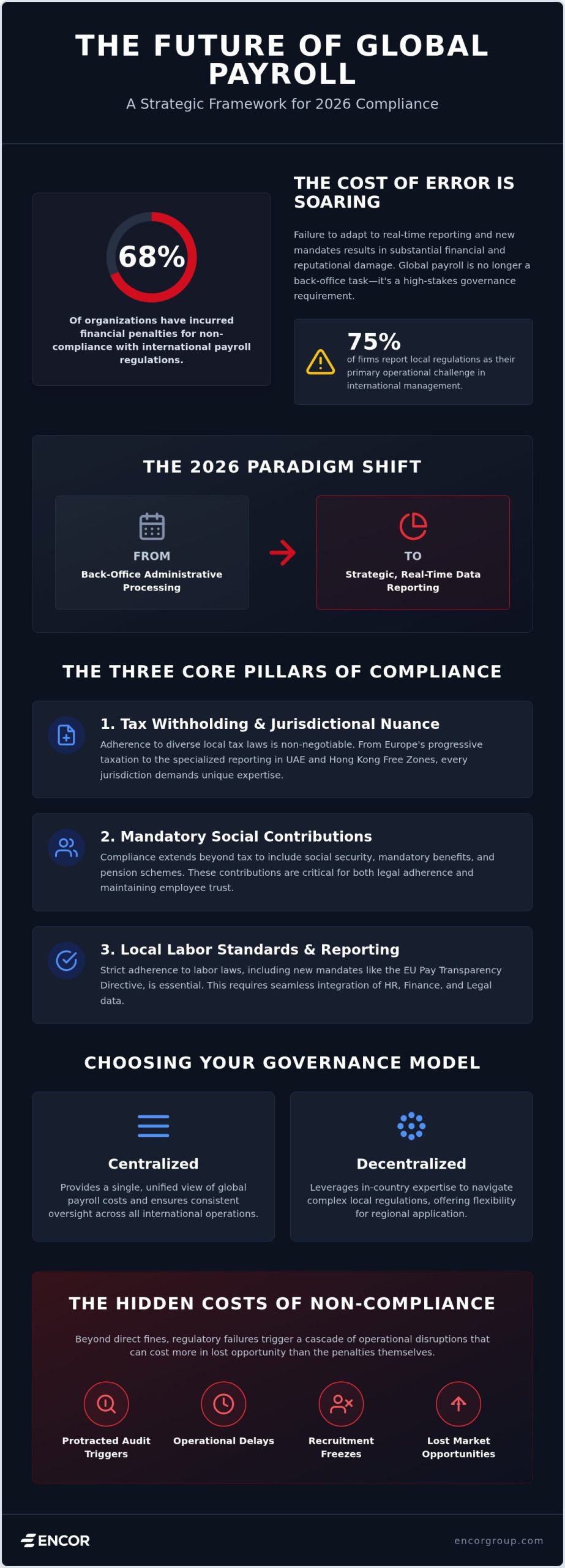
68% of organizations have incurred financial penalties for non-compliance with international payroll regulations. This statistic underscores a critical vulnerability for multinational firms: global payroll compliance is no longer a back-office processing task, but a high-stakes strategic governance requirement. When data remains fragmented across regions like the UAE and Hong Kong, the risk of hidden costs and regulatory friction increases. Failure to adapt to real-time reporting shifts or new mandates like the EU Pay Transparency Directive can result in substantial financial and reputational damage.
Managing cross-border payroll often feels like a constant battle against shifting local tax laws and the administrative burden of diverse reporting cycles. You’ve likely found that standardizing these operations is essential for maintaining a zero-penalty record while scaling into new markets with speed. This guide provides a strategic framework designed for executive-level oversight and operational excellence. We’ll examine how to centralize your global payroll costs, mitigate the complexities of local tax mandates, and implement a scalable structure that ensures compliance in even the most complex regulatory hubs.
Key Takeaways
- Understand the 2026 shift from administrative payroll processing to sophisticated strategic data reporting requirements.
- Establish a foundation for global payroll compliance by mastering the core pillars of tax withholding and mandatory social contributions.
- Compare centralized and decentralized governance models to determine which structure provides the necessary oversight for your international operations.
- Execute a high-level strategic roadmap that includes rigorous regulatory audits and updated data security protocols.
- Leverage an integrated approach that connects company formation with ongoing payroll and accounting to ensure operational excellence in key markets.
Defining Global Payroll Compliance in the 2026 Regulatory Landscape
Global payroll compliance is the rigorous adherence to the collective legal, tax, and social mandates of every jurisdiction where an organization employs staff. It represents a commitment to institutional integrity that extends far beyond the basic calculation of wages. In the 2026 regulatory environment, the definition of compliance has fundamentally shifted. It’s no longer a back-office administrative function focused on arithmetic accuracy; it’s a strategic data reporting requirement. Governments globally now demand granular, real-time transparency into corporate financial data, making proactive governance essential for maintaining a stable employer reputation and institutional confidence.
The shift toward real-time reporting means that errors are identified almost instantly by automated tax systems. This leaves no room for reactive adjustments. Organizations that fail to treat payroll as a high-stakes governance priority risk more than just fines. They risk operational friction that can stall market entry and damage relationships with local authorities. 75% of organizations now report that local regulations are their primary operational challenge in international management, according to recent industry data. Success requires a framework that anticipates changes rather than merely responding to them.
The Scope of Compliance: Beyond Local Tax
Comprehensive compliance requires understanding payroll basics while simultaneously managing the nuances of social security contributions, mandatory benefits, and strict labor law adherence. In specialized hubs like the UAE or Hong Kong, these requirements are often tied to specific entity structures or Free Zone regulations. A robust compliance chain involves the seamless integration of HR, Finance, and Legal stakeholders to ensure that every payment aligns with both local mandates and international tax structuring. This multi-disciplinary approach prevents the data silos that often lead to statutory oversights.
The Cost of Non-Compliance
The financial consequences of negligence are substantial. 68% of organizations have incurred financial penalties for non-compliance with international payroll regulations. Beyond immediate fines for late filings or incorrect withholdings, firms face “hidden costs” such as protracted audit triggers and operational delays that can freeze recruitment efforts in key markets. These disruptions often cost more in lost opportunity than the penalties themselves. For 2026 entities, a regulatory safe harbor is defined as a formalized governance framework that utilizes validated data protocols to shield an organization from maximum statutory penalties during periods of rapid legislative transition.
The Three Core Pillars of Statutory and Regulatory Compliance
Achieving 100% global payroll compliance requires a structural approach that treats every jurisdiction as a unique regulatory ecosystem. It’s not enough to simply process payments. You must align your operations with three foundational pillars: tax withholding, social contributions, and local labor standards. These pillars form the basis of effective international payroll solutions, ensuring that every transaction is defensible during an audit. When these elements aren’t integrated into your corporate governance, the risk of financial leakage and regulatory friction increases significantly.
The interaction between these pillars is complex. A change in labor law, such as the EU Pay Transparency Directive, often necessitates immediate adjustments in tax reporting and benefit disclosures. This is why a strategic framework is superior to a purely administrative one. By viewing payroll through the lens of institutional oversight, executives can maintain a centralized view of costs while respecting the granular requirements of local authorities. It’s about building a system that is both rigid in its standards and flexible in its regional application.
Tax Withholding and Jurisdictional Nuance
Tax environments vary drastically across the globe. European markets often impose heavy progressive taxation and complex reporting cycles, while hubs like Hong Kong and the UAE require specialized knowledge of Free Zone reporting and the evolving 2026 corporate tax landscape. One of the greatest challenges of international payroll is managing these nuances while correctly classifying workers. Misclassifying an employee as a contractor is a common trigger for severe penalties and back-tax liabilities. Utilizing professional tax advisory and compliance services ensures that your classification strategy remains robust across all borders, protecting the organization from avoidable litigation.
Social Security and Statutory Contributions
Social contributions represent a significant portion of the Total Cost of Employment (TCE). From mandatory pension schemes in Southeast Asia to healthcare levies in the West, these costs are highly variable and often subject to annual adjustments. For executive teams, calculating TCE accurately is vital for long-term budget forecasting. Encor Group facilitates these complex calculations during the global business expansion strategy phase. This ensures your leadership understands the full financial commitment of a new market entry before capital is deployed. Strategic oversight begins with a partner who understands the intersection of entity setup and payroll delivery, and you can secure this stability by engaging with our dedicated payroll solutions.
Labor Law and Employment Standards
The third pillar involves strict adherence to local labor codes, which govern everything from working hour limits to mandatory leave and termination protocols. In many jurisdictions, payroll data serves as the primary evidence of labor law compliance. Inaccurate record-keeping doesn’t just lead to fines; it can lead to the suspension of operating licenses. High-stakes environments require a proactive approach where employment standards are audited regularly to ensure they reflect the latest statutory updates, such as the shift toward real-time reporting mandates seen in 2026.
Governance Models: Centralized vs. Decentralized Compliance Oversight
Selecting a governance model is a pivotal decision for any multinational corporation. Organizations typically choose between decentralized execution and centralized oversight, yet both extremes present distinct operational risks. A decentralized model prioritizes local expertise, allowing regional teams to manage global payroll compliance with high precision. However, this often leads to fragmented data silos, making it nearly impossible for executive leadership to gain a consolidated view of global labor costs. Without a single source of truth, the risk of hidden costs and missed reporting deadlines increases significantly.
Conversely, the centralized model offers high visibility and standardized reporting. This approach aligns with global payroll industry standards by creating a uniform data structure across all territories. The primary risk here is local ignorance; a head office located in London or New York might overlook a specific 2026 filing requirement in a UAE Free Zone. To mitigate these risks, Encor Group utilizes a “Hybrid Hub” model. This framework combines the visibility of global entity management with specialized regional execution, ensuring that centralized data remains accurate and locally compliant.
The Case for Centralized Visibility
Centralized data prevents regional blind spots that often lead to audit triggers. When financial information is consolidated, leadership can make informed decisions regarding global recruitment and talent acquisition strategy based on real-time cost analysis. Centralized payroll reporting also facilitates bank account opening assistance by providing financial institutions with the transparent, standardized records they require for strict KYC and AML compliance. This level of transparency is essential for maintaining institutional confidence during rapid market expansion.
The Necessity of Local Execution in Hubs
High-growth hubs like Hong Kong and the UAE demand locally-informed management due to their unique regulatory structures. In the UAE, compliance involves navigating specific Free Zone requirements and the evolving 2026 corporate tax landscape. In Hong Kong, payroll must be perfectly synchronized with mandatory provident fund (MPF) contributions and annual tax filings. Effective governance relies on the following elements:
- Corporate Secretarial Services: Ensuring payroll data aligns with local registration and statutory filings.
- Integrated Formation: Utilizing Hong Kong company formation services to build a compliant foundation from day one.
- Regional Expertise: Bridging the gap between international corporate standards and local labor law nuances.
By integrating these local services into a broader governance framework, organizations ensure that their payroll operations support, rather than hinder, their global objectives. This synergy between entity setup and ongoing compliance is what defines operational excellence in 2026.
A 2026 Strategic Roadmap for Mitigating Payroll Risks
Mitigating risk in a multi-jurisdictional environment requires more than just reactive adjustments. It demands a structured, forward-looking roadmap that aligns every payroll activity with broader corporate governance. To achieve sustainable global payroll compliance, organizations must move from fragmented regional processes to a unified strategic framework. This transition begins with a rigorous assessment of existing vulnerabilities and ends with the implementation of a continuous monitoring system that adapts to legislative shifts in real time.
- Step 1: Conduct a Comprehensive Regulatory Audit. Identify gaps between current practices and the latest statutory requirements in every operating market.
- Step 2: Define Data Sovereignty and Security Protocols. Establish clear rules for how payroll data is stored and transferred, especially under 2026 transparency mandates.
- Step 3: Harmonize Global Pay Cycles. Standardize reporting timelines where legally permissible to reduce administrative friction and improve cash flow visibility.
- Step 4: Implement Continuous Monitoring. Use automated triggers to stay ahead of upcoming changes like the EU Pay Transparency Directive or Australia’s Payday Super requirements effective July 2026.
- Step 5: Partner with a Strategic Facilitator. Engage an advisor who can manage regional hub complexities in Hong Kong and the UAE with institutional precision.
Auditing and Data Sovereignty
In the 2026 regulatory landscape, data protection is inseparable from payroll delivery. New mandates require organizations to maintain strict data sovereignty, ensuring that sensitive employee information remains secure across borders while still being accessible for real-time government reporting. This creates a complex intersection between KYC compliance and payroll management. Regular compliance health checks are no longer optional; they’re the primary defense against the financial penalties that 68% of organizations currently face. These audits must verify that data protocols meet the highest international standards, protecting the firm from both regulatory fines and data breaches.
Harmonization of Global Operations
Efficiency in compliance is often found in standardization. By aligning pay cycles, firms can significantly reduce the administrative burden on central finance teams. Optimizing global business operations through structural efficiency allows leadership to focus on high-level strategy rather than regional troubleshooting. Executive-level consulting plays a critical role here, ensuring that payroll harmonization doesn’t conflict with local cultural norms or statutory labor standards. When your payroll is synchronized with your corporate strategy, it becomes a facilitator of growth rather than a bottleneck. To secure your organization’s operational stability, you should consult with our regulatory advisory experts to design a framework that scales with your ambition.
Institutional Support: Why Encor Group is the Choice for Global Compliance
Encor Group operates as a strategic navigator for multinational organizations. While many competitors focus on automated software features, we recognize that technology is merely a tool for execution. True global payroll compliance requires deep institutional knowledge and an understanding of the regulatory nuances that software cannot anticipate. Our approach integrates company incorporation, accounting, and payroll into a single, cohesive governance framework. This ensures that your operations remain stable and compliant from the moment you enter a new jurisdiction. Relying on a software-only solution often leaves gaps in regulatory advisory that lead to the very penalties we’ve discussed in previous chapters.
Having a single partner for hubs like Hong Kong and the UAE eliminates the friction caused by fragmented data. When your payroll is managed alongside your corporate secretarial and tax obligations, you gain a level of oversight that protects your employer reputation. We prioritize operational excellence and institutional trust, providing a steady hand in high-stakes international environments. Our clients value the reliability of a seasoned advisor who handles high-stakes requirements with quiet efficiency. It’s about more than processing checks; it’s about securing your firm’s standing in a global economy that demands absolute transparency.
Integrated Compliance Solutions
Our model bridges the gap between high-level strategy and granular execution. By combining professional tax advisory with local payroll processing, we ensure that tax withholdings and statutory contributions are calculated with absolute precision. This unified platform is essential for rapid global expansion, as it allows C-suite executives to maintain centralized control without losing sight of local mandates. We serve as a trusted advisor to multinational leadership, offering the strategic depth needed to navigate 2026’s complex reporting requirements. You’ll find that our integrated approach reduces the administrative burden on your finance teams while ensuring that data sovereignty protocols are strictly maintained.
Strategic Market Entry Support
Entering a market like the UAE involves navigating Free Zone regulations and specific corporate tax impacts. Encor Group facilitates this entry through specialized payroll setups that are compliant from day one. We don’t just process payments; we provide the human resources and recruitment services necessary to build and manage local teams within legal frameworks. This end-to-end support reduces the time to market and mitigates the risk of early-stage non-compliance. Our specialized hubs in Hong Kong and the UAE serve as critical regional anchors for your global payroll compliance strategy. Consult with Encor Group to optimize your global payroll compliance strategy.
Strategic Governance for the Future of International Expansion
Mastering global payroll compliance is an essential component of long-term corporate stability. As regulatory environments in 2026 demand greater real-time transparency, organizations must transition from fragmented regional processes to a unified governance framework. Success depends on the ability to harmonize global reporting standards with the granular statutory requirements of specialized hubs like Hong Kong and the UAE. By integrating payroll with entity formation and broader HR services, leadership ensures that rapid market entry doesn’t compromise institutional integrity.
Encor Group provides the strategic depth needed to navigate these complexities across 10+ global markets. Our specialized expertise in the UAE and Hong Kong regulatory frameworks allows you to focus on high-level growth. We manage the intricacies of cross-border compliance through our comprehensive HR, payroll, and recruitment integration. Establishing a robust operational foundation today ensures your organization is prepared for the high-stakes requirements of tomorrow’s global economy.
Secure Your Global Operations with Encor Group
Frequently Asked Questions
What are the primary risks of global payroll non-compliance?
The primary risks include severe financial penalties and the loss of institutional reputation. 68% of organizations have incurred fines due to international regulatory failures. Beyond immediate costs, non-compliance often triggers exhaustive audits and operational delays that can freeze recruitment in critical markets. These disruptions jeopardize your standing with local authorities and can lead to the suspension of operating licenses in high-stakes jurisdictions.
How does global payroll compliance differ between employees and contractors?
Compliance requirements shift significantly based on worker classification. For employees, companies must manage direct tax withholdings and statutory contributions like pensions or healthcare levies. Contractors typically handle their own taxes, but misclassifying them can result in massive back-tax liabilities and legal challenges. Maintaining accurate global payroll compliance requires a clear legal framework for every engagement to ensure you meet jurisdictional standards for both categories.
What role does data sovereignty play in international payroll management in 2026?
Data sovereignty mandates that sensitive employee information be managed according to the specific privacy laws of the host country. In 2026, many jurisdictions require that payroll data remain stored within local borders to ensure government access for real-time reporting. Organizations must implement secure cross-border transfer protocols that satisfy both local sovereignty laws and international transparency directives. This prevents data breaches and ensures your reporting remains defensible during regulatory reviews.
Is it better to use a single global payroll provider or multiple local providers?
A hybrid approach is often superior to choosing between a single global provider or multiple local vendors. While a single provider offers standardized reporting, they frequently lack the granular expertise required for hubs like the UAE or Hong Kong. Utilizing a strategic partner who provides centralized visibility alongside local execution ensures you maintain a global standard without missing critical regional updates. This model balances corporate oversight with the precision of local regulatory advisory.
How do Economic Substance Requirements in the UAE affect payroll compliance?
In the UAE, Economic Substance Regulations (ESR) require companies to demonstrate that their core income-generating activities occur within the country. Payroll data serves as vital evidence of this substance by proving that qualified employees are physically present and compensated locally. Failure to align your payroll with ESR requirements can result in significant fines or the inability to renew your business license. It’s a critical intersection where payroll becomes a pillar of corporate legal standing.
What are the specific payroll reporting requirements for Hong Kong entities?
Hong Kong entities must adhere to strict Mandatory Provident Fund (MPF) contributions and annual tax reporting obligations. Employers are required to file IR56B forms for all staff and maintain meticulous records of wages and employment contracts for at least seven years. These requirements are strictly enforced by the Inland Revenue Department. Integrating these tasks with your corporate secretarial services ensures that all filings are synchronized and submitted within the statutory windows to avoid automatic penalties.
How can a centralized governance model improve payroll compliance visibility?
Centralized governance models eliminate regional data silos and provide executive leadership with a single source of truth. This visibility allows for real-time analysis of global labor costs and ensures that compliance standards are applied uniformly across all territories. By standardizing data structures, organizations can identify potential risks before they escalate into audit triggers. This proactive approach supports strategic decision-making and provides the transparency required for institutional financial reporting and bank account management.
What happens if a company fails a payroll compliance audit in a foreign jurisdiction?
Failing a payroll audit typically results in immediate back-tax liabilities and heavy administrative fines. In severe cases, authorities may suspend your business license or restrict your ability to sponsor employee visas, effectively halting operations in that market. The organization will also face increased scrutiny in future cycles, making every subsequent filing a high-stakes event. Proactive global payroll compliance is the only reliable way to prevent these outcomes and protect your international investment.