
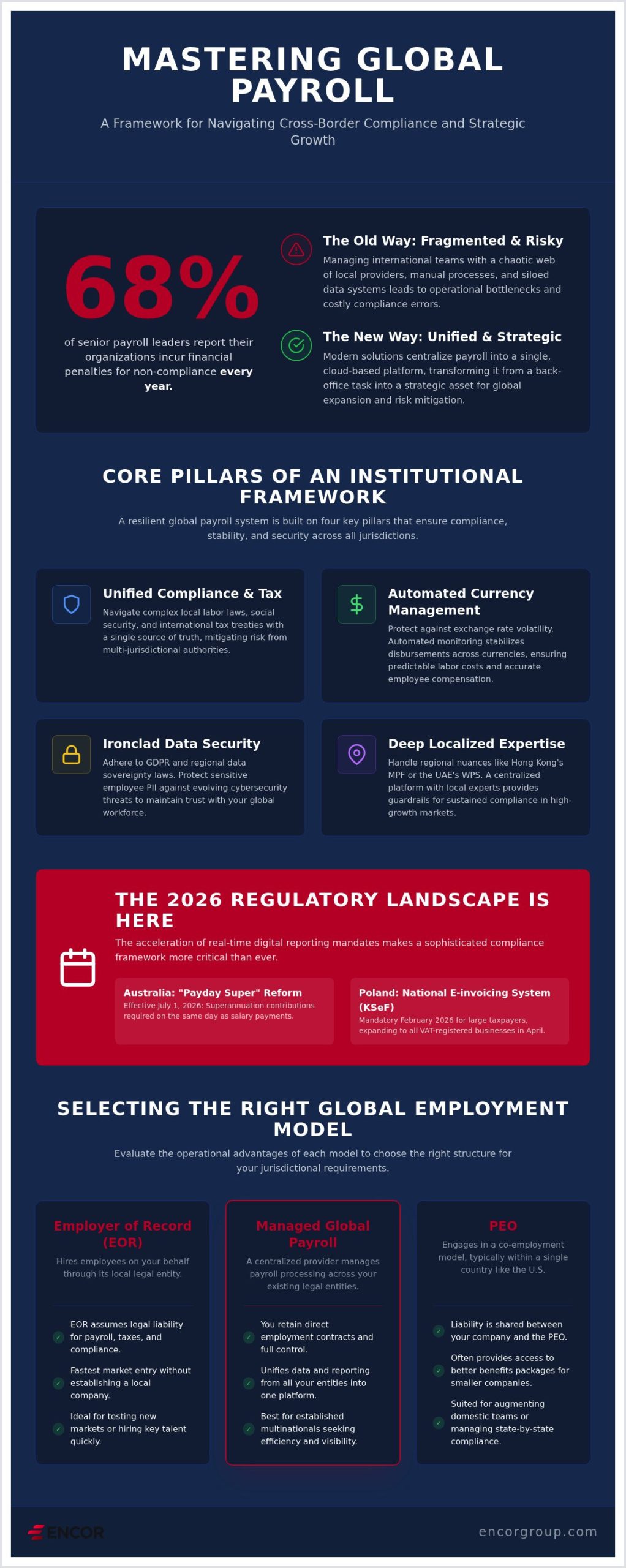
68% of senior payroll leaders report that their organizations incur financial penalties for non-compliance every year. You likely recognize that while international expansion offers immense scale, it also introduces a chaotic web of local labor laws and fragmented data. Managing these complexities through manual processes or siloed systems often leads to operational bottlenecks that threaten your strategic objectives.
You can master the intricacies of cross-border compensation by adopting a professional framework built for global compliance and excellence. This article explores how modern global payroll solutions provide a unified view of total labor costs and automate compliance monitoring. We’ll analyze the transition toward centralized platforms that integrate seamlessly with your existing HRIS and accounting systems to ensure stability during rapid growth.
Key Takeaways
- Analyze the transition from fragmented local providers to unified, cloud-based platforms that serve as a strategic asset for international scaling.
- Identify the core pillars of an institutional framework, focusing on the intersection of local labor laws and international tax advisory for cross-border teams.
- Evaluate the operational advantages of Employer of Record and PEO models to select the right structure for your specific jurisdictional requirements.
- It’s vital to follow a structured implementation roadmap when transitioning to global payroll solutions to ensure your existing systems integrate for total data visibility.
- Learn how to bridge the gap between company formation and ongoing compliance through a centralized management approach in key global markets.
Defining Global Payroll Solutions in the 2026 Regulatory Landscape
Global payroll represents a centralized operational architecture for managing employee compensation across multiple international borders. Historically, organizations relied on a fragmented network of local providers, which created data silos and increased the risk of reporting errors. Modern global payroll solutions have replaced these decentralized models with unified, cloud-based platforms that offer a single source of truth for labor costs and regulatory adherence. The market for these services continues to expand, with the global payroll outsourcing sector valued at USD 13.21 billion in 2026.
The year 2026 serves as a critical juncture for international expansion due to the acceleration of real-time digital reporting mandates. For instance, Australia’s “Payday Super” reform, effective July 1, 2026, requires employers to contribute to superannuation on the same day as salary payments. Similarly, Poland’s National E-invoicing System (KSeF) becomes mandatory for large taxpayers in February 2026, followed by all VAT-registered businesses in April. These shifts indicate that global payroll is a sophisticated multi-jurisdictional compliance framework designed to mitigate risk, rather than a mere transactional payment tool.
The Evolution of Cross-Border Compensation
The transition from manual spreadsheets to AI-driven automation has redefined how enterprises handle Defining Global Payroll Solutions. Modern systems now utilize autonomous agents to manage data entry and error detection, which is essential as remote and hybrid work models increase permanent establishment risks. Organizations must balance the need for global standardization with the rigid requirements of local jurisdictions to maintain operational integrity. It’s no longer sufficient to treat payroll as a back-office function; it has become a strategic asset that informs broader corporate strategy.
Strategic Importance for Multinational Enterprises
Consolidating payroll into a single global platform allows for precise cost optimization through unified labor data. This visibility enables executives to make informed decisions about resource allocation and expansion. By automating complex calculations and tax withholdings, businesses reduce the administrative burden on internal HR and finance departments. This efficiency ensures that employees receive consistent, timely payments regardless of their location. High-quality global payroll solutions enhance the employee experience and protect the organization from the 68% of firms that currently face annual non-compliance penalties.
Core Pillars of an Institutional Global Payroll Framework
Establishing an institutional-grade framework for cross-border compensation requires a sophisticated integration of legal, financial, and technological protocols. It isn’t merely about processing payments; it’s about building a resilient system that can withstand the scrutiny of multiple tax authorities. In the 2026 Regulatory Landscape, the stakes for accuracy are at an all-time high. Enterprises must navigate diverse social security systems and statutory benefits while maintaining strict tax compliance for both expatriate and local staff. Effective global payroll solutions mitigate these risks by incorporating real-time updates on international tax treaties and complex withholding requirements.
Managing currency fluctuations represents another vital pillar of this framework. Exchange rate volatility can erode the value of employee compensation or inflate labor costs unexpectedly. Robust systems automate exchange rate monitoring to stabilize disbursements across multiple jurisdictions, ensuring financial predictability. Security remains equally paramount. Adhering to GDPR and regional data sovereignty laws ensures that sensitive employee information stays protected against evolving cybersecurity threats. This level of oversight is essential for maintaining trust with a global workforce.
Navigating Regional Compliance Hubs
Expansion into high-growth markets requires deep localized expertise to avoid costly errors. For example, enterprises utilizing Hong Kong company formation services must immediately address Mandatory Provident Fund (MPF) contributions and annual employer tax reporting. In the Middle East, UAE Free Zone entities must adhere to the Wage Protection System (WPS), a mandatory digital mechanism that validates salary payments. These regional nuances make a centralized management strategy essential for any multinational. If you’re scaling in these complex regions, professional payroll solutions provide the necessary guardrails for sustained compliance and operational peace of mind.
Data Integrity and Institutional Security
Institutional platforms prioritize data handling through ISO-certified processes and centralized reporting. This structure facilitates global audits and provides stakeholders with the assurance that financial data is both accurate and secure. SOC 2 compliance is a non-negotiable requirement for any global payroll platform seeking to protect corporate and employee interests. Centralized reporting doesn’t just ensure security; it provides the granular data needed for global assurance and strategic planning. By maintaining high standards of data integrity, organizations can focus on their core growth objectives without the constant threat of data breaches or regulatory fines.
Comparing Models: EOR, PEO, and Managed Global Payroll
Selecting the appropriate operational model is a critical component of any global business expansion strategy. Organizations must choose between an Employer of Record (EOR), a Professional Employer Organization (PEO), or managed global payroll solutions based on their long-term objectives and local entity status. Each model offers distinct advantages regarding liability, control, and administrative burden, making strategic alignment essential for operational success.
An EOR serves as the legal employer, managing all compliance, taxes, and statutory benefits in a country where the client doesn’t have a registered entity. Conversely, a PEO operates under a co-employment agreement, sharing responsibilities for employees within an existing subsidiary. This co-employment model allows the client to retain control over day-to-day management while the PEO handles administrative tasks like insurance and workers’ compensation. For firms with established legal presences, managed payroll services provide the necessary infrastructure to outsource complex filings while retaining full employer status. Adhering to global payroll best practices ensures that regardless of the chosen model, the enterprise remains compliant with local labor standards and reporting cycles.
When to Use an Employer of Record (EOR)
Enterprises favor the EOR model for rapid market entry or testing new regions with minimal capital expenditure. It allows businesses to hire talent without the significant time and financial investment required for local incorporation. By shifting legal liability to the EOR provider, companies mitigate risks associated with local employment contracts and statutory compliance. This approach is particularly effective for small teams or temporary projects where the cost of establishing a permanent establishment outweighs the potential return.
Transitioning to Managed Payroll Services
Scalability becomes the primary driver as organizations mature and establish permanent entities in strategic hubs like Dubai or Hong Kong. Managed global payroll solutions allow these firms to maintain the primary employment relationship while outsourcing the administrative complexities of tax calculation and filing. This model integrates effectively with international payroll solutions, providing a stable foundation for long-term growth. It ensures that internal HR teams can focus on strategic talent management while external experts handle the granular details of jurisdictional compliance. Transitioning to this model often requires a thorough audit of existing local processes to ensure a seamless migration into a centralized system.
Implementation Strategy: Transitioning to Global Payroll Solutions
A successful transition to unified global payroll solutions requires a methodical, five-phase architecture. This structured approach ensures that the migration doesn’t disrupt daily operations or compromise regulatory standing. Organizations often find that the initial discovery phase is the most critical. It involves a comprehensive audit of existing localized processes to identify inconsistencies and data silos. By establishing a clear baseline, executives can better evaluate the scale of the transition and the specific jurisdictional requirements of their target markets.
Following the audit, the enterprise must select a strategic partner with deep regional hub expertise, particularly in complex jurisdictions like Hong Kong and the UAE. The integration phase then focuses on migrating legacy data into a centralized system that aligns with existing HRIS or ERP software. Before the full switch, conducting parallel run testing is essential. This involves running the new system alongside the old one for at least two pay cycles to verify that every calculation and tax filing is accurate. Finally, the framework enters a phase of continuous monitoring where labor costs are optimized through granular data analysis. Encor Group provides the expertise in 10+ international markets required to navigate these high-stakes transitions with quiet efficiency.
Mitigating Risks During Migration
Maintaining the continuity of employee payments remains the primary objective during any system switch. Any delay in disbursements can severely damage employee trust and corporate reputation. Organizations must proactively address data gaps in legacy systems, such as missing tax identification numbers or outdated address formats, before migration begins. It’s also vital to ensure that local tax authorities receive correct notifications regarding the change in processing methods. Managing these transitions with precision requires the oversight of a seasoned advisor to prevent administrative friction.
Integrating Payroll with Global Operations
Once the transition is complete, the focus shifts toward leveraging payroll data for wider business intelligence. Connecting this information to strategic workforce planning tools allows leadership to forecast labor costs with institutional confidence. Executive-level consulting plays a pivotal role here. It transforms raw data into actionable insights that drive expansion. This integration ensures that payroll isn’t just an administrative requirement but a fundamental component of the organization’s growth engine. If you’re ready to modernize your infrastructure, consider implementing robust payroll solutions to secure your international expansion roadmap.
Strategic Payroll Management with Encor Group
Encor Group functions as a strategic navigator for enterprises entering new territories. While previous sections detailed the technical requirements of global payroll solutions, the practical application requires a partner who understands the full lifecycle of an international entity. We bridge the gap between initial company formation and ongoing payroll compliance, ensuring that your operational infrastructure remains robust from day one. This end-to-end support allows leadership to focus on market penetration rather than administrative minutiae. Our expertise across 10+ international markets provides the stability needed to handle high-stakes requirements with confidence.
Our approach integrates payroll management with comprehensive tax advisory and corporate secretarial services. This synergy is vital for total compliance, as payroll data often influences corporate tax filings and regulatory reporting. By providing a single point of contact for global entity management and HR, we eliminate the friction caused by multiple vendors and fragmented communication. This centralized model ensures that no detail is overlooked during the scaling process, creating a sense of order and predictability. We provide the steady, calm assurance of a seasoned advisor who understands the complexities of international business environments.
Institutional Support for Market Leaders
We leverage our strategic hubs in Hong Kong and the UAE to provide deep local expertise and regulatory foresight. Encor Group manages the intricate requirements of UAE Free Zone regulations and Hong Kong statutory reporting with precision and quiet efficiency. Our commitment to financial transparency and excellence in regulatory reporting reassures stakeholders that the organization is operating at the highest institutional standards. We navigate the 2026 regulatory landscape by anticipating changes and implementing proactive adjustments to your payroll architecture. This proactive stance is essential for maintaining compliance in an era of real-time digital reporting and evolving labor laws.
Next Steps for Your Global Expansion
Optimizing your international operations begins with a thorough evaluation of your current structure. Our advisors consult on the ideal framework for your international team, whether you’re utilizing an EOR model or managing established subsidiaries. We ensure your payroll setup supports long-term operational excellence and integrates seamlessly with your broader business intelligence tools. This strategic alignment helps maintain a unified view of labor costs across multiple jurisdictions. Contact our advisors for a strategic review of your current global payroll solutions and take the first step toward a more resilient international presence.
Securing Your International Growth Infrastructure
Mastering cross-border compensation requires moving beyond administrative convenience toward a robust compliance architecture. You’ve seen that the 2026 regulatory landscape demands real-time digital reporting and specialized jurisdictional knowledge, particularly in high-growth hubs like Hong Kong and the UAE. Implementing unified global payroll solutions ensures that your expansion remains protected from the risks of non-compliance and fragmented data silos. By centralizing these complex functions, you transform payroll into a strategic asset that supports your broader corporate objectives.
Encor Group provides the institutional stability and regional expertise necessary to navigate these multifaceted environments. With a presence in 10+ international markets and an end-to-end corporate service platform, we bridge the gap between initial entity formation and ongoing operational excellence. Our advisors specialize in the nuances of Hong Kong and UAE compliance, offering a single point of contact for your global entity management requirements.
Optimize your global operations with Encor Group’s strategic payroll solutions.
Your international journey deserves a partner committed to precision and high-level corporate success.
Frequently Asked Questions
What is the difference between global payroll and international payroll?
Global payroll refers to a unified, centralized framework that consolidates all compensation data into a single platform for total organizational visibility. International payroll typically describes the traditional model of managing separate, disconnected payroll processes through various local providers in each country. Transitioning to global payroll solutions eliminates these data silos and provides a standardized reporting structure for multinational enterprises.
How do global payroll solutions manage different tax years in various countries?
Automated platforms utilize jurisdictional calendars to track and adjust for varying fiscal cycles across the globe. For example, while the United Kingdom’s tax year begins in April, Australia’s starts in July. These systems ensure that statutory filings and tax withholdings align precisely with each country’s specific reporting deadlines and regulatory requirements.
Is an Employer of Record (EOR) the same as a global payroll provider?
An Employer of Record (EOR) acts as the legal employer for your staff in countries where you don’t have a local entity, assuming all compliance and tax liabilities. In contrast, a global payroll provider typically manages the administration and disbursements for employees hired through your own registered subsidiaries. Choosing between these models depends on your entity status and long-term expansion strategy.
How does global payroll software ensure compliance with GDPR?
Compliance is maintained through robust data residency controls, end-to-end encryption, and restricted access protocols. These systems ensure that sensitive employee information is processed within approved jurisdictions and stored according to European data protection standards. Regular SOC 2 audits and ISO certifications further validate the platform’s commitment to institutional data security.
What are the common challenges when implementing a global payroll system?
The primary obstacles include fragmented data from legacy local systems and the complexity of integrating with existing HRIS or ERP software. Organizations often face difficulties in standardizing data across regions with different labor laws and reporting formats. A structured implementation strategy, involving a thorough audit and parallel run testing, is essential to mitigate these operational risks.
Can global payroll solutions handle payments for independent contractors?
Many global payroll solutions include specialized modules for managing and paying independent contractors across multiple borders. These platforms assist in classifying workers correctly according to local regulations to avoid misclassification penalties. Automated workflows handle invoice processing and ensure that payments are disbursed in the contractor’s local currency with full transparency.
How do global payroll providers manage currency exchange for international payments?
Providers utilize multi-currency wallets and automated exchange rate locking to protect against market volatility. By consolidating funds into a single treasury account, organizations can execute mass disbursements at competitive mid-market rates. This approach ensures that employees receive the exact amount specified in their local contracts while the enterprise maintains predictable labor costs.
What is the typical implementation timeline for a global payroll solution?
A standard implementation typically requires three to six months, depending on the number of jurisdictions and the complexity of existing data. This timeline includes the discovery phase, system configuration, and at least two cycles of parallel run testing. Rushing this process increases the risk of calculation errors, making a methodical approach necessary for institutional accuracy.