
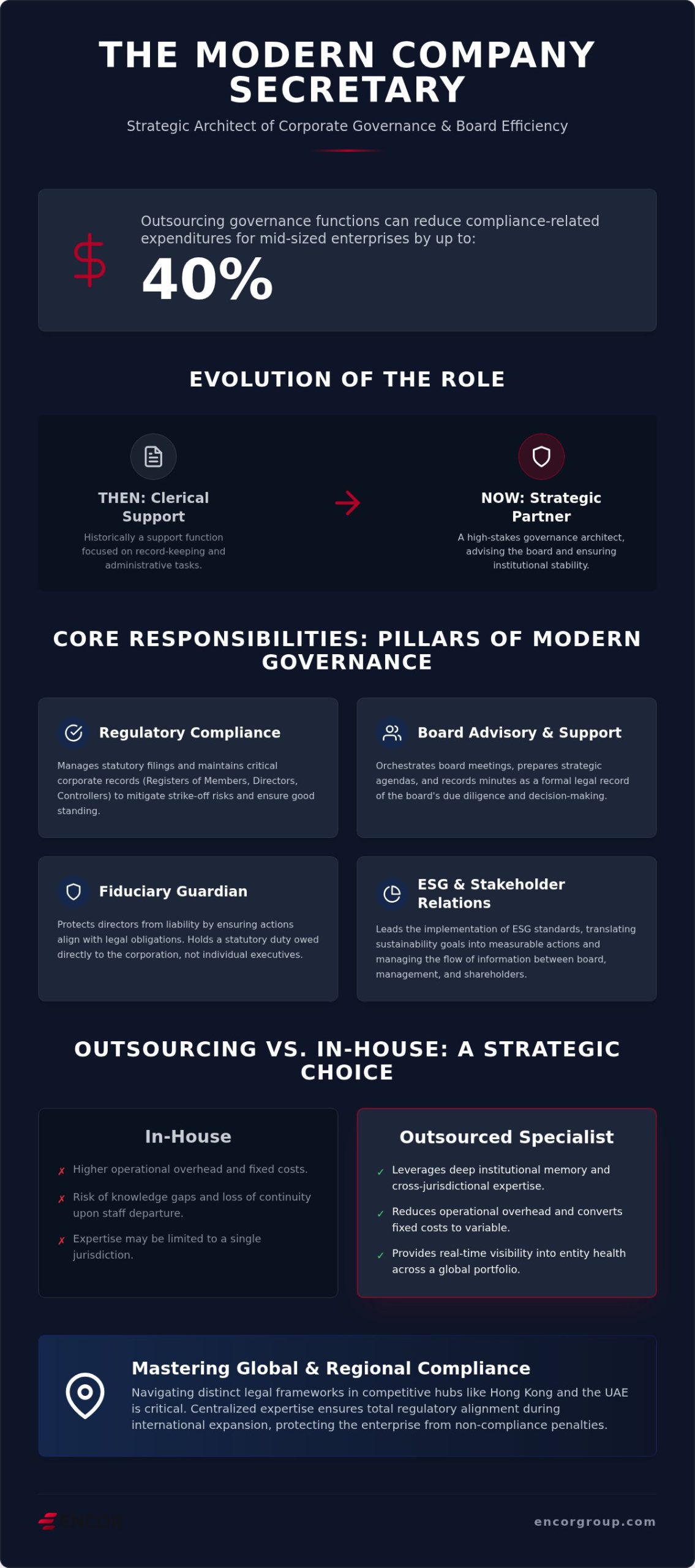
Research indicates that mid-sized enterprises can reduce compliance-related expenditures by up to 40% by outsourcing their governance functions to specialized advisors. For international firms operating in competitive hubs like Hong Kong or the UAE, the administrative burden of board management often distracts from the core objectives of strategic expansion. It’s an objective reality that directors must navigate increasingly complex foreign regulatory frameworks while mitigating the risk of significant non-compliance penalties. Maintaining total regulatory alignment is no longer a clerical function; it’s a high-stakes requirement for institutional stability and risk management.
This guide explores how a professional company secretary acts as the primary architect of regulatory compliance and board efficiency. By centralizing global governance through a single expert platform, your organization can protect directors from fiduciary liability and ensure seamless communication across borders. We’ll examine the essential roles this strategic navigator plays, the specific filing requirements for 2026, and the methods used to transform governance into a competitive advantage for your enterprise.
Key Takeaways
- Understand the evolution of the company secretary from a clerical support function to a strategic governance partner essential for board efficiency.
- Identify the critical statutory filing requirements and regulatory disclosures necessary to mitigate strike-off risks and protect directors from fiduciary liability.
- Analyze the distinct legal frameworks for corporate governance in Hong Kong and the UAE to ensure regional compliance during international expansion.
- Evaluate the strategic benefits of outsourcing secretarial functions to specialized firms to leverage institutional memory and reduce operational overhead.
- Discover how centralized compliance solutions provide real-time visibility into entity health, ensuring total regulatory alignment across multiple global jurisdictions.
Defining the Strategic Role of a Company Secretary in 2026
The modern Company Secretary serves as the primary guardian of a corporation’s governance framework. While historical perceptions often relegated this position to clerical support, the role has undergone a fundamental transformation. This shift reflects a broader global trend where corporate transparency is no longer optional but a prerequisite for market participation. By 2026, the function has evolved into a strategic advisory pillar for the Board of Directors. This professional ensures that the organization operates with the transparency and accountability demanded by modern stakeholders, including institutional investors and regulatory bodies.
This role manages the delicate equilibrium between management, the board, and shareholders. They facilitate the flow of information and ensure that board decisions align with both statutory requirements and internal bylaws. In a globalized market, this oversight is critical for maintaining operational integrity across multiple jurisdictions. Effective governance requires a neutral party who can mediate conflicting interests while prioritizing the long-term health of the enterprise.
The Institutional Importance of Governance
Robust governance directly correlates with investor confidence and total entity valuation. Institutional investors increasingly scrutinize governance structures before committing capital, seeking assurance that the entity is shielded from internal mismanagement. The secretary now leads the implementation of Environmental, Social, and Governance (ESG) standards, translating high-level sustainability goals into measurable compliance actions. This involves tracking carbon footprints, board diversity metrics, and ethical supply chain audits. The company secretary acts as the conscience of the corporation, ensuring every executive action remains ethically and legally sound.
Legal Standing and Statutory Authority
Under international corporate law, the secretary holds formal officer status, carrying significant statutory authority. This designation means they possess specific fiduciary duties owed directly to the corporation rather than to individual directors or executives. If the board’s direction conflicts with the company’s legal obligations, the secretary’s primary loyalty remains with the entity’s compliance. Regulations in 2026 mandate a digital-first approach to compliance management, requiring these officers to utilize advanced RegTech solutions for real-time reporting and risk assessment. This transition ensures that governance isn’t just a periodic review but a continuous, data-driven process. Organizations that fail to adopt these digital frameworks face increased scrutiny from regulators who now expect instant access to corporate records during audits.
Core Responsibilities: Beyond Statutory Record-Keeping
The role of the company secretary extends far beyond the basic administrative tasks often associated with corporate support. In the current regulatory environment, this professional serves as the vital link between the enterprise and government authorities. They manage the internal architecture of the company by maintaining the Register of Members, the Register of Directors, and the Register of Significant Controllers. These documents aren’t merely internal logs; they represent the legal proof of ownership and control required by law. Failure to maintain accurate records can lead to severe penalties or even the strike-off of the company from the registry. By acting as the formal channel for all regulatory disclosures, the secretary ensures that the corporation remains in good standing with local registries at all times.
Board Advisory and Meeting Logistics
Providing board members with timely, accurate information is essential for them to discharge their fiduciary duties effectively. The company secretary orchestrates the logistics of board and committee meetings, ensuring that agendas reflect strategic priorities and regulatory obligations. One of the most critical functions is the art of minute-taking. These minutes serve as a formal legal record of the board’s ‘due diligence.’ If a company faces litigation or a regulatory audit, these records demonstrate that directors acted in good faith and followed proper decision-making protocols. As corporate environments shift, the secretary also facilitates Annual General Meetings (AGMs) in hybrid or virtual formats, ensuring that shareholder rights are preserved regardless of the physical location of the participants.
Compliance and Regulatory Reporting
A robust compliance calendar is the foundation of institutional stability. The secretary manages this schedule to ensure that no statutory deadlines are missed. Under the Hong Kong Companies Ordinance, for example, firms must file an Annual Return (Form NAR1) within 42 days of their incorporation anniversary. Missing this window results in escalating late filing fees, which can reach HK$3,480 for delays exceeding nine months. Beyond these routine filings, the secretary coordinates with auditors and tax advisors to ensure the entity remains in good health. This integration prevents fragmented reporting and shields the organization from the risk of non-compliance. For enterprises operating across multiple markets, engaging professional Corporate Secretarial Services provides the specialized oversight needed to manage these complex requirements with precision.
Jurisdictional Requirements: Hong Kong vs. UAE Frameworks
Expanding into global financial hubs requires a granular understanding of local mandates. In 2026, the regulatory divide between common law jurisdictions like Hong Kong and the civil law-influenced, free-zone-heavy landscape of the UAE is pronounced. A qualified company secretary ensures that these differences don’t become operational bottlenecks. While both regions prioritize corporate transparency, the specific mechanisms for reporting and maintaining good standing vary significantly. Navigating these requirements is essential for multinational enterprises seeking to capitalize on cross-border growth without incurring unnecessary risk.
Hong Kong Company Secretary Standards
In the HKSAR, the Companies Ordinance (Cap. 622) mandates that every private company appoint a secretary. This individual must be a local resident or, more commonly for international firms, a licensed corporate service provider. Since 2018, the Significant Controllers Register (SCR) has remained a focal point of compliance. The secretary must maintain this register at the registered office address to identify persons with significant control, aiding in global anti-money laundering efforts. Failure to keep this register updated or accessible for inspection by law enforcement can lead to criminal prosecution for the company and its officers.
For many, choosing Hong Kong company formation services provided by a professional firm is superior to appointing an individual. Professional firms offer continuity; they don’t take leave or resign, preserving the institutional memory of the entity. They also provide the required registered office address, ensuring that all statutory books remain centrally located and compliant with HKSAR standards.
Compliance in UAE Free Zones
The UAE presents a more fragmented landscape. While the UAE Federal Decree Law on Commercial Companies sets the baseline for mainland entities, free zones like IFZA, DMCC, and Meydan have their own specific regulations. In 2026, the role is heavily impacted by Economic Substance Requirements (ESR). Entities must demonstrate substance, including adequate personnel and physical presence, within the jurisdiction. The secretary plays a vital role in documenting these activities to satisfy the Federal Tax Authority.
Secretarial duties now intersect with UAE Corporate Tax compliance. For businesses with a financial year ending December 31, 2025, the corporate tax return and payment are due by September 30, 2026. A secretary ensures that the corporate documents required for maintaining bank accounts and tax registrations are current. This prevents account freezes and ensures the entity remains in good standing with both the free zone authority and financial institutions. Centralizing these functions allows for a more structured approach to the UAE’s maturing regulatory environment.
The Decision Framework: In-house vs. Outsourced Secretarial Services
Choosing between an internal hire and an external firm is a strategic decision that directly impacts an entity’s bottom line and risk profile. For a multinational enterprise, the cost-to-benefit ratio often favors a professional service provider. Research indicates that mid-sized companies can save approximately 30% to 40% on compliance-related costs by outsourcing their secretarial functions. An in-house company secretary in Hong Kong, for example, commands an average monthly salary of approximately HK$70,000. This figure doesn’t include the additional expenditures for benefits, office infrastructure, or professional indemnity insurance. By contrast, an outsourced model provides access to a full team of experts for a fraction of the cost of a senior full-time hire.
Relying on a single internal staff member creates a significant vulnerability for the corporation. If that individual leaves the organization, they take critical institutional memory and specific compliance knowledge with them. This turnover risk can lead to missed deadlines and regulatory penalties during the transition period. Professional firms mitigate this by maintaining centralized records and standardized processes. They ensure continuity regardless of individual personnel changes, providing a stable foundation for corporate governance that remains unaffected by internal HR shifts.
Cost Efficiency and Resource Allocation
Recalibrating resource allocation is easier when you don’t have the overhead of recruitment, benefits, and ongoing training for specialized roles. As businesses expand into new markets, they require a scalable solution that doesn’t necessitate a new hire for every jurisdiction. It’s often beneficial to integrate these duties with international payroll solutions to create a unified administrative structure. This centralization reduces the burden on internal management and ensures that both governance and employee compliance remain aligned with local laws without duplicating effort.
Expertise and Multi-Jurisdictional Support
Managing entities in disparate jurisdictions like Hong Kong and the UAE requires specialized knowledge of two very different legal systems. A single partner with specialized hubs in both markets offers a level of multi-jurisdictional support that an in-house team rarely matches. This approach ensures that ‘best practice’ governance standards are applied consistently across the entire group. Staying ahead of rapid regulatory changes, such as the 2026 tax updates in the UAE, becomes the responsibility of the partner rather than the board. This proactive oversight allows directors to focus on growth while the company secretary handles the intricacies of local compliance. To secure your entity’s standing across global markets, explore our comprehensive Corporate Secretarial Services today.
Institutional Excellence: Encor Group’s Global Secretarial Solutions
Encor Group provides a centralized compliance architecture designed specifically for high-growth international entities. We recognize that precision in regulatory environments is a fundamental requirement for institutional stability. Our model utilizes specialized hubs serving over 10 markets, ensuring that global standards are applied with local expertise. By leveraging advanced digital tools, we provide board members and executives with real-time visibility into entity health and filing status. This approach eliminates the opacity often associated with cross-border operations, allowing leadership to focus on strategic objectives rather than administrative minutiae. We prioritize reliability and precision, handling high-stakes requirements with the quiet efficiency expected of a premier advisory partner.
Our commitment to excellence extends beyond the core functions of a company secretary. We offer a holistic service suite that integrates tax advisory, accounting, and bank account opening assistance into a single, unified workflow. This prevents the fragmentation often seen when managing multiple vendors across different time zones. We act as a strategic navigator for your organization, ensuring that every corporate action remains compliant with the evolving standards of 2026. Whether you’re managing a complex holding structure or a single regional entity, our integrated solutions provide the steady assurance needed to protect your directors and maintain your corporate standing.
Scaling with Authority via Encor Group
Our global business expansion strategy incorporates mandatory secretarial support as a proactive pillar of growth. We don’t just react to regulatory changes; we anticipate them. Our team develops customized governance frameworks for multinational executive teams, ensuring that internal protocols align with both local laws and global best practices. This personalized approach allows for:
- The implementation of institutional-grade compliance standards across all regional subsidiaries.
- Seamless integration of secretarial duties with our payroll and human resources solutions.
- Direct access to a team of experts well-versed in the intricacies of the Hong Kong Companies Ordinance and UAE free zone regulations.
Next Steps for Global Compliance
Securing your organization’s future begins with a rigorous assessment of your current governance structure. Many international firms discover legacy gaps in their statutory records during rapid expansion periods. Transitioning your company secretary function to a professional global platform ensures these risks are mitigated before they escalate into penalties. To move forward, we recommend the following actions:
- Conduct a comprehensive compliance audit for all existing international entities to identify potential vulnerabilities.
- Centralize your statutory record-keeping through our secure, digital-first management portal.
- Contact our consultants to schedule a tailored governance assessment and discover how our solutions can protect your enterprise.
Strategic Governance as a Catalyst for Global Growth
The evolution of the company secretary into a strategic governance partner marks a significant shift in how international enterprises manage regulatory risk. Maintaining institutional integrity in 2026 demands more than basic record-keeping; it requires a proactive approach to fragmented legal frameworks in hubs like Hong Kong and the UAE. By centralizing these complex functions, your organization ensures total alignment with statutory mandates while shielding directors from fiduciary liability. This transition allows your leadership team to prioritize expansion and operational excellence without the constant distraction of administrative oversight.
Encor Group acts as a trusted elite consultant for firms navigating the intricacies of cross-border operations. Our specialized hubs in Hong Kong and the UAE provide institutional-grade compliance across 10+ global markets. We offer the precision and strategic depth necessary to handle high-stakes requirements with quiet efficiency. It’s time to transform your governance framework into a competitive advantage for your enterprise. Secure your global compliance with Encor Group’s professional secretarial services. We look forward to facilitating your continued success in the international arena.
Frequently Asked Questions
Is a company secretary the same as a personal assistant?
No, a company secretary is a senior corporate officer with distinct statutory responsibilities, whereas a personal assistant manages administrative tasks for an individual. The secretary’s role involves ensuring the corporation adheres to all legal and regulatory mandates. This officer holds a fiduciary duty to the entity and possesses the authority to sign legal documents and certify corporate records.
Can a director also serve as the company secretary?
A director can serve in both capacities in many jurisdictions, but specific restrictions apply to prevent conflicts of interest. In Hong Kong, for example, a sole director of a private company is prohibited from acting as the secretary. This ensures a system of checks and balances within the corporate governance framework. Large multinational entities typically separate these roles to maintain professional oversight and operational transparency.
What are the penalties for failing to appoint a company secretary?
Failure to appoint a secretary in jurisdictions where the role is mandatory leads to significant legal consequences and financial penalties. In Hong Kong, the company and every responsible officer are liable to prosecution and fines for non-compliance with the Companies Ordinance. Beyond immediate fines, the entity risks being struck off the register, which results in the freezing of corporate assets and the loss of limited liability protection for directors.
Does a private company need a company secretary in 2026?
Yes, the requirement remains a legal mandate for all private companies in jurisdictions such as Hong Kong. While some regions have simplified their administrative requirements, the global trend in 2026 favors increased transparency and structured governance. Even where not strictly mandatory, international enterprises appoint a company secretary to manage the complexities of cross-border compliance and to meet the due diligence requirements of financial institutions.
What qualifications are required to be a professional company secretary?
Professional secretaries typically hold specialized certifications from recognized bodies, such as the Hong Kong Chartered Governance Institute (HKCGI). In many jurisdictions, the individual must be a resident or hold specific professional designations as a lawyer or accountant. For corporate service providers in Hong Kong, a valid Trust or Company Service Provider (TCSP) license is a mandatory requirement to ensure the firm meets rigorous regulatory standards.
How does a company secretary assist with corporate bank account opening?
The secretary facilitates the account opening process by preparing and certifying the necessary corporate documentation required by financial institutions. This includes drafting board resolutions, providing certified true copies of the articles of association, and ensuring the company’s Certificate of Good Standing is current. Their involvement reassures banks that the entity is in total compliance with local laws and anti-money laundering regulations.
What is the difference between a corporate secretary and a company secretary?
These terms are largely interchangeable and refer to the same strategic governance role. The term “corporate secretary” is more frequently utilized in North American markets, while “company secretary” is the standard nomenclature in Commonwealth jurisdictions like Hong Kong and the United Kingdom. Both roles focus on board efficiency, regulatory disclosures, and the maintenance of statutory registers to protect the organization’s legal standing.
Can an outsourced firm act as our company secretary in Hong Kong?
Yes, an outsourced professional firm can act as your secretary, provided they hold a valid TCSP license issued by the Registrar of Companies. This is the preferred model for international enterprises as it ensures continuity and access to a team of experts. Outsourcing provides a higher level of institutional memory and technical proficiency than relying on a single internal staff member, especially when navigating the evolving HKSAR regulatory landscape.