
In 2026, a corporate bank account is no longer a standard utility you simply purchase. It’s a high-stakes regulatory hurdle that requires strategic institutional advocacy to clear. You’ve likely experienced the friction of intrusive KYC requests and approval timelines that can stretch into several months. These delays often stem from the complexities of managing non-resident directors or meeting the latest FinCEN Beneficial Ownership Information requirements. Securing professional corporate bank account opening assistance is now a necessity for enterprises that value operational speed and regulatory precision.
This guide provides a roadmap to help you secure a fully operational account in a Tier-1 jurisdiction while reducing your internal administrative burden. We’ll show you how to navigate the 2026 compliance landscape, including the recent shift toward AI-powered risk assessment and the updated Customer Due Diligence rules. You’ll learn the exact methodology for integrating your banking needs with existing corporate structures to ensure long-term stability. By the end of this article, you’ll understand how to position your company as a low-risk, high-value client for the world’s leading financial institutions.
Key Takeaways
- Understand the transition of global banking from a commodity to a strategic privilege and how to meet the heightened institutional standards of 2026.
- Learn how professional corporate bank account opening assistance mitigates the risk of application rejection by navigating complex KYC and UBO disclosure requirements.
- Evaluate the specific strategic advantages of Tier-1 jurisdictions, such as Hong Kong and the UAE, to align your banking infrastructure with your corporate goals.
- Master the documentation process by developing a robust Business Profile and transparent Source of Wealth records that satisfy stringent anti-money laundering frameworks.
- Discover the value of a pre-compliance audit to identify and resolve application weaknesses before they reach the bank’s desk, ensuring a more efficient approval process.
The Evolving Landscape of Corporate Banking Compliance in 2026
Global banking has undergone a fundamental transformation. It’s no longer a standard utility available to any entity with a certificate of incorporation; for multinational enterprises, banking is now a hard-earned privilege. In this environment, corporate bank account opening assistance has evolved into a specialized compliance service. It’s designed to prepare firms for the rigorous scrutiny of Tier-1 institutions that prioritize risk mitigation over client acquisition. The era of “banking as a commodity” has ended, replaced by an era where financial access is granted only to those who can prove total transparency and operational legitimacy.
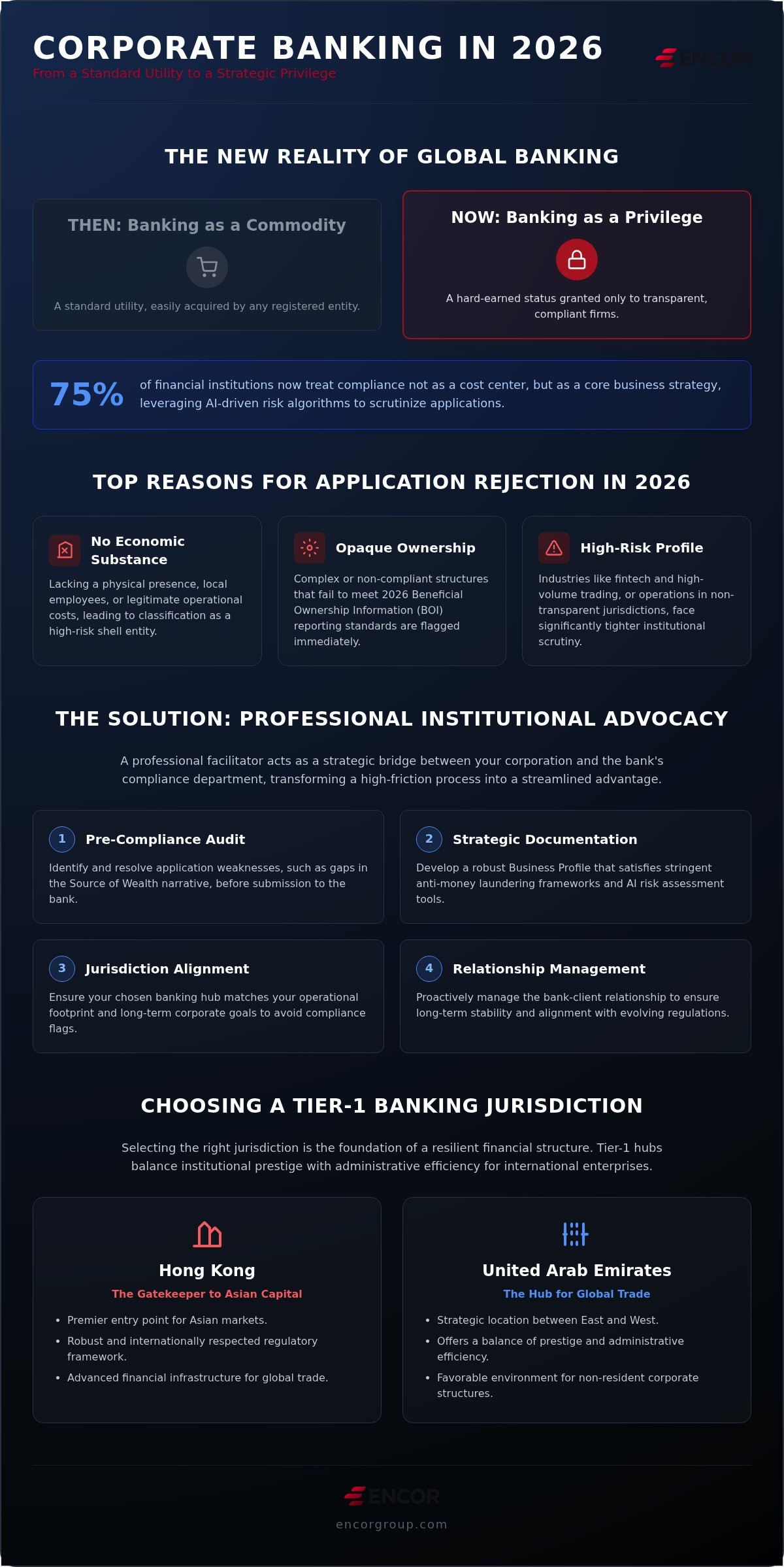
The 2026 regulatory environment is defined by the full implementation of the Corporate Transparency Act and heightened Know Your Customer (KYC) regulations. Banks now view compliance as a primary business strategy. Recent industry reports indicate that 75% of financial institutions treat compliance training and systems as a core goal rather than a cost center. This shift means that “do-it-yourself” applications frequently face immediate rejection. Without professional oversight, these applications often lack the sophisticated documentation required by modern AI-driven risk algorithms, leading to permanent “blacklisting” within specific banking groups.
Why Banks Reject International Corporate Applications
Banks prioritize risk containment above all else. A primary cause for rejection is the lack of “economic substance” in the company’s jurisdiction of incorporation. If a firm cannot demonstrate a physical presence, local employees, or legitimate operational costs, banks often categorize it as a high-risk shell entity. Additionally, opaque ownership structures that fail to comply with 2026 Beneficial Ownership Information (BOI) reporting standards are flagged immediately. High-risk industries, including fintech and high-volume trading, face even steeper hurdles as banks tighten their institutional appetite to protect against cyber threats and liquidity shocks.
The Role of a Professional Facilitator
A facilitator serves as a strategic bridge between your corporate structure and the bank’s compliance department. By pre-vetting documents against current institutional standards, they ensure that your application aligns with a bank’s specific risk tolerance. This process involves identifying potential weaknesses, such as gaps in the “Source of Wealth” narrative, before they become grounds for rejection. Institutional Advocacy is the proactive management of the bank-client relationship to ensure long-term operational stability and compliance alignment. This level of professional intervention transforms a high-friction administrative task into a streamlined strategic advantage for your business.
Strategic Selection: Choosing the Right Banking Jurisdiction
Jurisdiction selection is the foundation of a resilient corporate financial structure. In 2026, global banking hubs are categorized by their regulatory rigor and their alignment with international tax transparency standards. Choosing the wrong jurisdiction often results in operational friction, limited currency options, or sudden account closures. Professional corporate bank account opening assistance ensures that your entity is positioned in a jurisdiction that supports its long-term growth objectives rather than one that invites unnecessary scrutiny. The choice of a hub must be a calculated decision based on your company’s primary markets and transaction volumes.
The 2026 tier-ranking places jurisdictions like Hong Kong and the UAE at the forefront for international transaction banking, a sector that McKinsey reports generates approximately $1.3 trillion in annual revenue. While traditional Western hubs remain stable, they often impose rigid Customer Identification Program requirements that can be difficult for non-resident structures to satisfy without a local physical presence. Consequently, businesses are increasingly looking toward hubs that offer a balance of institutional prestige and administrative efficiency. You must match your banking hub to your operational footprint to avoid being flagged as a high-risk entity by automated compliance algorithms.
Hong Kong: The Gatekeeper to Asian Capital
Hong Kong remains the premier entry point for capital flowing into and out of Mainland China. Its robust common law framework provides a level of legal certainty that is unmatched in the region. However, banks in this jurisdiction have significantly increased their requirements for “Business Substance.” Applicants must demonstrate a genuine economic link to the territory, which often involves having local directors, employees, or a physical office. Utilizing professional Hong Kong company formation services is a critical prerequisite, as the quality of the initial incorporation directly influences the success of the banking application.
UAE and Dubai: The Middle East’s Financial Hub
The UAE has solidified its position as a global trade nexus by offering specialized Free Zone banking access. These accounts are ideal for international trade, providing multi-currency capabilities and tax efficiencies. It’s vital to distinguish between Mainland and Free Zone banking; Mainland accounts generally require a higher level of local operational activity but offer broader access to the domestic market. In 2026, most UAE banks require at least one signatory to hold a valid residency visa, a factor that must be planned for during the incorporation phase. For those seeking to optimize their global structure, consulting with experts in compliance and regulatory advisory can prevent costly jurisdictional errors.
While Tier-1 hubs are essential for institutional credibility, digital-first “Neo-banks” have emerged as viable alternatives for specific corporate use cases. These platforms offer rapid onboarding and superior digital interfaces, though they may lack the comprehensive trade finance tools found in traditional institutions. By the end of 2025, 90% of global cross-border messages are expected to be ISO 20022-native, a standard that these digital platforms have adopted aggressively to ensure seamless integration with modern corporate structures.
The Core Components of a Successful Banking Application
A successful banking application is a meticulously curated presentation of your company’s institutional legitimacy. In the current regulatory environment, you’re not merely filling out forms; you’re building a comprehensive case for why a Tier-1 bank should accept your business as a client. Professional corporate bank account opening assistance focuses heavily on the creation of a robust Business Profile. This document serves as the primary sales tool for your enterprise, detailing your operational history, management expertise, and market position. It allows compliance officers to move beyond basic identification and understand the strategic value of your corporate activities.
Transparency regarding the “Source of Wealth” and “Source of Funds” is the most critical hurdle in the 2026 application process. These are distinct requirements that require separate sets of evidentiary support. The Source of Wealth describes the historical accumulation of the beneficial owner’s total assets over time, while the Source of Funds identifies the specific origin of the capital intended for the initial deposit. In 2026, simple bank statements are no longer sufficient. You must provide audited financial statements, personal tax returns, or executed legal contracts that definitively substantiate the legitimacy of your capital. Failure to provide this level of detail is the most common reason for application suspension.
Counterparty transparency has also become a mandatory requirement for institutional onboarding. Banks demand a detailed list of primary suppliers and anticipated clients to assess the risk of your transaction network. They use this data to cross-reference your business activities against internal risk databases and global sanctions lists. Providing realistic transaction volume projections is essential, as it helps the bank establish a baseline for your account’s “normal” activity. This proactive disclosure reduces the likelihood of future account freezes triggered by automated monitoring systems that flag unexpected high-volume transfers.
Documenting Corporate Governance
Corporate governance standards for 2026 require board resolutions to be explicit and highly specific. These resolutions must detail the exact powers granted to signatories and the specific banking products requested by the firm. Banks increasingly prefer limited Power of Attorney (PoA) structures, as broad or vague PoAs are often viewed as a security risk. High-quality corporate secretarial services significantly enhance the credibility of your application. They ensure that all statutory records are current and that the company’s governance framework meets the rigorous standards expected by institutional compliance departments.
Financial Transparency and Projections
A 12-month projected cash flow statement is now a standard component of the modern banking dossier. This projection must be grounded in documented reality, reflecting the supplier and client lists provided elsewhere in the application. Compliance officers look for logical consistency between your stated business model and your financial forecasts. If your firm has an existing accounting history through subsidiaries, providing these records can expedite the process. A clean track record of fiscal responsibility and regulatory compliance provides the bank with the necessary confidence to approve your new corporate financial infrastructure.
Navigating KYC and AML Frameworks in 2026
The bank’s demand for extensive personal data is often the primary point of friction for executive teams. In 2026, this level of scrutiny is not a discretionary “service feature” but a mandatory gatekeeper function. Financial institutions face unprecedented pressure from regulators to prevent illicit capital flows, especially as the global Corporate Digital Banking market is projected to reach $28.16 billion by 2032. Obtaining professional corporate bank account opening assistance allows you to manage these intrusive requests with institutional poise. It ensures that your data is presented in a format that satisfies the bank’s internal risk algorithms while protecting your corporate dignity.
Anti-Money Laundering (AML) triggers are the most frequent cause of application delays or summary rejections. These triggers are often set off by inconsistencies in your corporate narrative or a lack of clarity regarding non-resident directors. When a bank’s automated system identifies a high-risk profile, the application is moved to a manual review queue, which can add months to the process. Professional facilitators mitigate these risks by conducting a pre-submission audit, identifying potential red flags such as unclear transaction patterns or missing links in the corporate ownership chain.
UBO and Beneficial Ownership Reporting
The 2026 standard for Ultimate Beneficial Owner (UBO) disclosure is rooted in total transparency. Banks strictly enforce the 25% ownership threshold; any individual holding this percentage or more must undergo full KYC verification. This includes providing proof of residential address, certified passport copies, and detailed professional biographies. Managing these requirements requires a delicate balance between individual privacy and regulatory necessity. For a deeper analysis of these requirements, refer to our guide on KYC Compliance for Corporate Accounts. Maintaining full transparency from the outset is the only way to avoid the suspicion that leads to rejection.
Managing the Interview and Verification Process
The compliance interview is the final hurdle before account activation. In 2026, these interviews are increasingly conducted via secure digital platforms utilizing biometric verification. You must be prepared to answer technical questions regarding your “Economic Substance” and the specific logic behind your chosen jurisdiction. Common red flags include vague answers about your primary revenue streams or an inability to name your top three suppliers. Professional representation during these queries ensures that your responses remain aligned with the documentation provided in your initial dossier. If you are concerned about meeting these stringent standards, Encor Group’s compliance advisory provides the strategic preparation necessary to navigate the verification phase successfully.
The KYC journey concludes with a final risk rating assigned by the bank’s committee. This rating determines not only your approval but also the future monitoring frequency of your account. By anticipating the bank’s needs and providing a comprehensive, transparent application, you position your firm as a low-risk partner. This proactive approach secures your financial infrastructure and prevents the administrative burden of constant, post-opening compliance queries.
Encor Group: Institutional Advocacy for Global Banking
Encor Group operates at the intersection of regulatory compliance and institutional banking. By maintaining specialized hubs in Hong Kong and the UAE, we provide executive-level corporate bank account opening assistance that reflects the specific requirements of Tier-1 jurisdictions. Our role is to act as a strategic navigator, ensuring that your corporate structure is not just compliant, but optimized for the scrutiny of global financial institutions. We leverage our deep knowledge of international business environments to bridge the trust gap between your enterprise and the bank’s compliance department.
Our methodology centers on a rigorous “Pre-Compliance” audit designed to identify application weaknesses before they reach the bank’s desk. This proactive approach addresses the primary causes of rejection discussed in previous sections, such as undocumented economic substance or opaque ownership narratives. By resolving these issues during the preparation phase, we significantly reduce the administrative burden on your internal teams and accelerate the path to account activation. We treat banking as a fundamental component of your broader global business expansion strategy, ensuring your financial infrastructure supports your long-term scaling objectives.
Our End-to-End Methodology
The process begins with precise jurisdiction selection based on your company’s tax profile and operational footprint. Our qualified secretaries handle the meticulous preparation and certification of all required documentation, ensuring board resolutions and UBO disclosures meet 2026 standards. We maintain direct liaisons with bank relationship managers, facilitating a professional dialogue that expedites processing. This high-level advocacy ensures that your application receives the attention it requires, moving beyond automated queues and into the hands of decision-makers who understand your business model.
Beyond the Account Opening
Securing an account is only the first step in establishing a resilient financial infrastructure. We integrate your banking setup with international payroll solutions to streamline cross-border employee compensation and operational spending. Our ongoing support includes the management of annual reviews and compliance updates, which are essential for maintaining multi-currency accounts in a volatile regulatory environment. This comprehensive oversight ensures that your global trade optimization remains uninterrupted by sudden compliance queries or account freezes.
Establishing a corporate banking relationship in 2026 requires more than just paperwork; it requires a partner with global competence and strategic depth. Contact Encor Group for a Strategic Banking Consultation to secure your corporate financial infrastructure and clear the path for your international growth.
Securing Your Corporate Financial Future in 2026
The global banking environment has shifted toward a model of rigorous institutional scrutiny. Success in this landscape requires more than just submitting documentation; it demands a strategic alignment with the specific risk tolerances of Tier-1 banks. By prioritizing jurisdiction selection and maintaining absolute transparency in beneficial ownership reporting, your enterprise can secure the stable financial infrastructure necessary for cross-border operations. Professional corporate bank account opening assistance transforms these high-friction regulatory hurdles into a streamlined process, ensuring your application meets the sophisticated standards of 2026 compliance frameworks.
Encor Group provides the institutional advocacy required to navigate these complexities across more than 10 global markets. Our specialized relationships with Tier-1 banks and integrated approach to compliance and tax advisory ensure your corporate structure is positioned for long-term operational success. We invite you to Secure Your Global Corporate Banking Infrastructure with Encor Group and establish a resilient foundation for your international expansion. A secure financial infrastructure is the essential prerequisite for sustainable global growth.
Frequently Asked Questions
How long does it typically take to open a corporate bank account with professional assistance?
Opening an account with professional assistance usually takes between 4 to 12 weeks, depending on the jurisdiction and the complexity of your corporate structure. While traditional applications can stretch into several months, expert guidance streamlines the documentation phase to prevent repetitive queries from compliance departments. This timeline accounts for the initial pre-compliance audit, document certification, and the bank’s internal committee review process.
Can a non-resident open a corporate bank account in Hong Kong or the UAE?
Yes, non-residents can open corporate accounts in these jurisdictions provided they demonstrate sufficient economic substance and meet local regulatory requirements. In Hong Kong, banks typically require evidence of a physical office or local operations. In the UAE, at least one company signatory often needs to hold a residency visa to satisfy institutional risk profiles. Professional corporate bank account opening assistance ensures these residency-related hurdles are addressed during the incorporation stage.
What are the minimum deposit requirements for international corporate accounts in 2026?
Minimum deposit requirements vary by institution but generally range from $10,000 to over $100,000 for Tier-1 corporate banking. Some premium hubs or private banking divisions may require higher balances to maintain a low-risk status. These funds must be supported by clear Source of Wealth documentation to comply with 2026 anti-money laundering standards. It’s vital to verify the specific threshold with your chosen bank before initiating the transfer.
Do I need to physically travel to the bank to open a corporate account?
Physical travel is becoming less mandatory as banks adopt secure digital onboarding and biometric verification platforms. In 2026, many Tier-1 institutions allow for remote interviews via encrypted video conferencing. However, some jurisdictions or specific high-value account types may still require a one-time physical meeting with a relationship manager. We advise clients on the specific attendance requirements of their target bank to ensure seamless scheduling and compliance.
What is ‘Economic Substance’ and why do banks care about it?
Economic substance refers to the genuine operational presence of a company within its jurisdiction of incorporation. Banks prioritize this to ensure that the entity isn’t a shell company used for tax evasion or illicit capital movement. Evidence of substance includes local payroll records, a registered office address, and documented business activity within the region. Entities lacking substance face significantly higher rejection rates during the compliance review process.
Why was my corporate bank account application rejected without a specific reason?
Banks often issue summary rejections without detailed explanations to protect their internal risk-scoring methodologies and prevent tipping off. Common reasons include inconsistencies in the Source of Wealth narrative, industry-specific risk flags, or failure to meet 2026 Beneficial Ownership Information standards. Utilizing corporate bank account opening assistance helps identify these invisible red flags during a pre-compliance audit, allowing you to resolve issues before the final submission.
Can Encor Group help with accounts for high-risk industries or complex holding structures?
Encor Group specializes in managing complex applications for multinational enterprises and entities with multi-layered holding structures. While we don’t provide direct banking services, our institutional advocacy focuses on presenting high-risk profiles in a transparent, compliant manner that aligns with a bank’s specific risk appetite. This involves detailed documentation of corporate governance and a robust explanation of the business model to mitigate institutional concerns.
What is the difference between a traditional bank and a digital corporate payment platform?
Traditional banks offer a full suite of institutional services, including trade finance, credit facilities, and physical branches, but have more stringent onboarding requirements. Digital corporate payment platforms focus on rapid onboarding and superior digital interfaces for wholesale payments. While digital platforms are excellent for operational liquidity, traditional Tier-1 banks remain the standard for establishing long-term institutional credibility and securing complex financial infrastructure.