

A Hong Kong profit tax exemption isn’t a loophole or a matter of chance; it’s a structural pillar of a territorial system that now demands institutional-grade documentation to defend. While the Inland Revenue Department issued approximately 270,000 Profits Tax Returns for the 2025/26 year of assessment, many global enterprises remain hesitant to claim their rightful status. This hesitation often stems from a justified fear of IRD audits or confusion regarding the shifting definitions of “source of profit” under modern international standards.
It’s understandable that the introduction of the Inland Revenue (Amendment) Bill 2026 and the complexities of the Foreign-Sourced Income Exemption (FSIE) regime have created a climate of uncertainty for multinational groups. You’ll learn how to master these complexities and secure your tax position legally. This guide provides a strategic roadmap for navigating the territorial principle, ensuring your offshore claims withstand scrutiny, and aligning your operations with 2026 compliance requirements. We’ll examine the specific economic substance rules now required for funds and the impact of Pillar Two on your global tax strategy.
Key Takeaways
- Define the parameters of the territorial basis of taxation to determine precise tax liability under the Inland Revenue Department’s “source concept.”
- Optimize fiscal efficiency through the two-tiered profits tax regime while ensuring strict adherence to anti-avoidance protocols for connected entities.
- Implement the rigorous procedural standards required to successfully substantiate a Hong Kong profit tax exemption for offshore activities.
- Adapt corporate structures to meet 2026 global compliance mandates, including BEPS 2.0 Pillar Two and mandatory Economic Substance Requirements.
- Leverage institutional-level tax advisory to navigate the complexities of cross-border operations and maintain long-term regulatory stability.
The Territorial Principle: The Foundation of Hong Kong Profit Tax Exemption
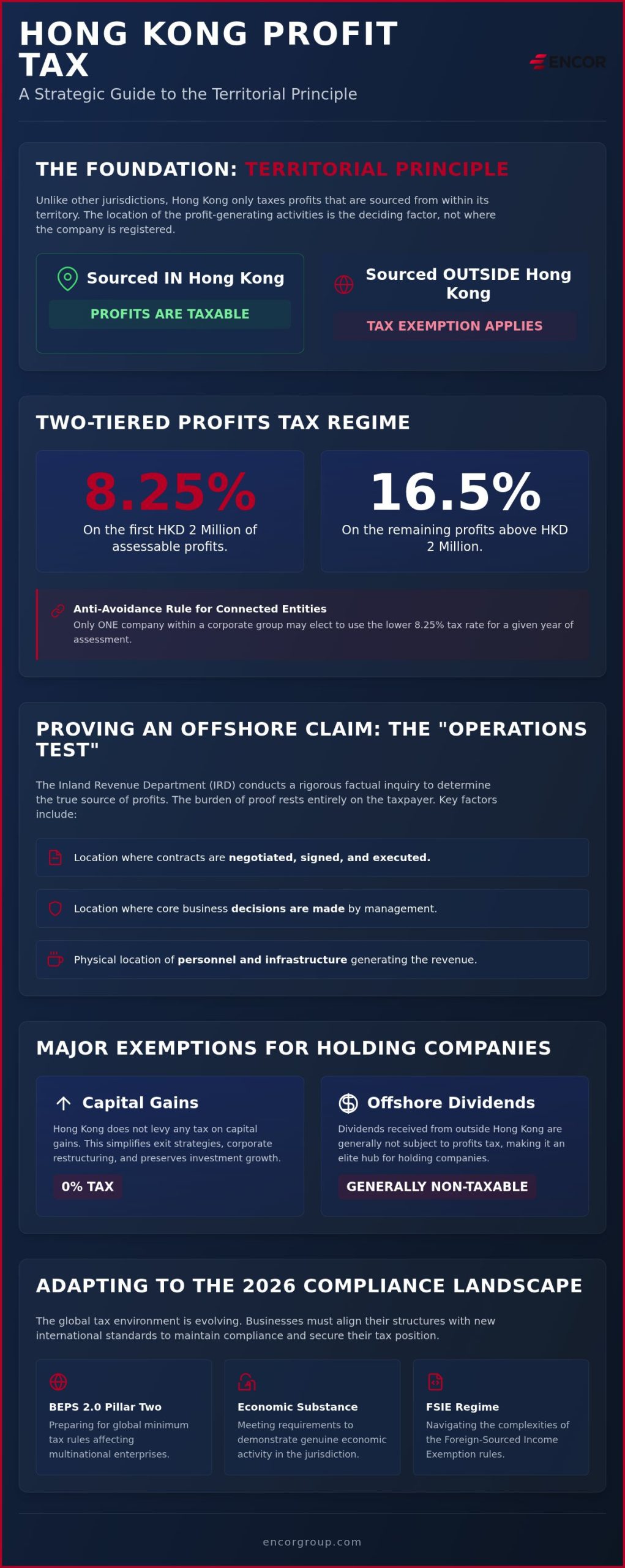
Hong Kong maintains a distinctive tax framework built upon the territorial principle. Unlike jurisdictions that tax global income based on corporate residency, Hong Kong levies tax only on profits arising in or derived from the region. This fundamental distinction serves as the legal basis for a Hong Kong profit tax exemption. The Inland Revenue Department (IRD) focuses on the geographical location of the profit-generating activities rather than the entity’s registration location. This approach provides a predictable environment for enterprises that operate across borders while maintaining a central hub in Asia.
Determining tax liability hinges on the “Source Concept.” This involves a rigorous factual inquiry into the specific transactions that yield profit. The legal framework governing Hong Kong Profits Tax dictates that if a business’s operations are conducted outside the territory, the resulting income remains non-taxable. For multinational enterprises, this creates a significant strategic advantage. It allows for the accumulation of capital without the erosion typical of worldwide taxation systems. However, as the digital economy evolves, the IRD has refined its scrutiny to ensure that offshore claims reflect genuine external activity rather than mere accounting entries.
The “Operations Test” for Determining Source
The IRD applies the “operations test” to identify the physical location of profit-making transactions. In 2026, this scrutiny extends beyond mere physical presence to encompass where core commercial decisions are finalized. Key factors include the location where contracts are negotiated, signed, and performed. For businesses providing digital services or remote management, the IRD evaluates the infrastructure and personnel involved. If the primary revenue-generating activities occur outside Hong Kong, the enterprise can successfully claim a Hong Kong profit tax exemption. It’s vital to document these processes meticulously, as the burden of proof rests entirely on the taxpayer.
Capital Gains and Dividend Income Exemptions
Hong Kong serves as an elite hub for holding companies due to its treatment of passive income. The jurisdiction doesn’t levy tax on capital gains, which simplifies exit strategies and corporate restructuring. Additionally, offshore dividends are generally non-taxable, provided they meet specific compliance criteria. This absence of capital gains tax ensures that investment growth is preserved. It positions Hong Kong as a stable environment for long-term asset management and international expansion. By centralizing holding structures here, groups can optimize their fiscal depth while maintaining access to global markets.
Strategic Tax Regimes: Two-Tiered Rates and Industry-Specific Exemptions
Hong Kong’s fiscal framework offers more than just the territorial principle; it provides a structured system of tiered rates and targeted incentives designed to support corporate growth. While the standard corporate tax rate is 16.5%, the two-tiered profits tax regime significantly reduces the burden for small to mid-sized operations and regional headquarters. This structure is a central component of the Hong Kong profit tax exemption landscape, allowing companies to retain more capital for reinvestment. These benefits are not limited to general commerce, as specific sectors like shipping, aircraft leasing, and fund management enjoy additional preferential treatments that reinforce the city’s status as a global financial hub.
Navigating the Two-Tiered Profits Tax
Under this regime, the tax rate for the first HKD 2 million of assessable profits is reduced to 8.25%, with subsequent profits taxed at the standard 16.5%. It’s a straightforward benefit, but the Inland Revenue Department (IRD) maintains strict oversight to prevent groups from fragmenting operations to multiply the relief. A connected entity is defined as a company that is controlled by the same person or entity as another, meaning only one company within a corporate group may elect to use the lower tax rate for a given year. Misalignment in this selection can lead to unnecessary tax leakage or compliance inquiries. Engaging with expert tax advisory ensures your group selects the most beneficial entity for these tiered rates.
Incentives for Innovation and Intellectual Property
Technology and IP-heavy firms find significant value in Hong Kong’s innovation-friendly tax policies. The government provides enhanced tax deductions for qualifying Research and Development (R&D) expenditures, offering a 300% deduction for the first HKD 2 million spent and a 200% deduction for the remainder. Additionally, the “Patent Box” regime provides a lower tax rate for profits derived from qualifying intellectual property, such as patents and copyrighted software. These incentives are most effective when integrated during the initial stages of Hong Kong company formation services, allowing tech firms to build a tax-efficient foundation from day one.
The 2026 legislative landscape has also expanded the Unified Fund Tax Exemption (UFE) regime. This expansion includes “funds-of-one” with a minimum asset value of HKD 240 million and broadens the scope of qualifying investments to include private credit and virtual assets. To maintain compliance while claiming these exemptions, businesses must consult the Inland Revenue Department guidance on locality of profits. This documentation is essential for proving that profit-generating activities align with statutory requirements. By leveraging these strategic regimes, enterprises can achieve a high degree of fiscal depth while remaining fully compliant with evolving international standards.
Navigating the Offshore Claim: Criteria for Non-Taxable Income
A Hong Kong profit tax exemption is not a default status granted upon incorporation. It’s a formal claim that must be substantiated through a rigorous administrative process. The Inland Revenue Department (IRD) operates on the principle that all profits arising in the territory are taxable unless proven otherwise. Consequently, the “Offshore Claim” is a matter of fact determined by the specific circumstances of each transaction. It requires a proactive stance from the taxpayer, as the IRD carefully scrutinizes every application to ensure it aligns with current territorial tax laws. The burden of proof rests entirely with the enterprise to demonstrate that its income-generating activities occurred outside the region.
The process begins with the issuance of the Profits Tax Return (PTR). On April 1, 2026, the IRD issued approximately 270,000 returns, signaling the start of the annual compliance cycle for the 2025/26 year of assessment. When filing this return, an enterprise must explicitly indicate its intention to claim offshore status for specific portions of its income. This is not a one-time event; it’s an ongoing requirement that demands consistent documentation. Determination timelines vary significantly. It’s common for the IRD to issue follow-up inquiries months after the initial filing, and final determinations can take several years if the case involves complex cross-border structures.
Step-by-Step: Securing an Offshore Status
Achieving a successful claim requires a methodical approach that begins well before the tax deadline. Following these steps ensures your enterprise is prepared for IRD scrutiny.
- Step 1: Establish a robust corporate structure during Hong Kong business registration to ensure the entity is positioned for offshore operations from the outset.
- Step 2: Implement accounting systems that clearly segregate onshore and offshore revenue streams. Mixing these funds complicates the audit process and increases the risk of a claim being rejected.
- Step 3: File the PTR alongside a formal offshore claim. This must be supported by a certified audit that verifies the geographical source of the income.
- Step 4: Respond promptly to IRD questionnaires. These documents often require granular detail regarding specific transactions and management activities.
The Evidence Portfolio: What the IRD Demands
The success of a Hong Kong profit tax exemption claim depends entirely on the quality of the evidence portfolio. The IRD expects a comprehensive trail of documentation that proves no core profit-generating activities occurred within Hong Kong borders. This includes communication logs, such as emails and meeting minutes, that show contracts were negotiated and concluded abroad. If your business involves physical goods, you must provide shipping documents, bills of lading, and logistics records that track the movement of products outside the territory. Banking records are equally critical; the IRD will review payment trails to confirm that funds were processed in a manner consistent with offshore operations. Without this institutional-grade documentation, even legitimate offshore activities may be deemed taxable.
Compliance Infrastructure: Documenting Substance in 2026
The global tax environment has transitioned from a focus on legal form to a demand for economic substance. In 2026, the implementation of BEPS 2.0 and Pillar Two represents a significant shift for multinational enterprise (MNE) groups operating in Hong Kong. While the 15% global minimum tax primarily targets groups with consolidated revenue exceeding €750 million, its underlying principles influence the Inland Revenue Department’s (IRD) approach to all entities. Smaller enterprises must still navigate these standards to defend their Hong Kong profit tax exemption claims, particularly concerning foreign-sourced passive income. Proactive risk management is no longer optional; it’s a requirement for maintaining a reputable corporate profile and avoiding “Tax Haven” labels in an era of mandatory e-filing and global transparency.
Substance Requirements for Offshore Claims
The Foreign-Sourced Income Exemption (FSIE) regime has codified the necessity for economic substance within the territorial system. To qualify for exemptions on dividends, interest, or equity-disposal gains, companies must demonstrate they have an adequate number of qualified employees and incur sufficient operating expenditure in Hong Kong. For the 2025/26 year of assessment, Hong Kong companies claiming exemptions under the FSIE regime must satisfy specific economic substance thresholds involving local employment and expenditure to avoid the reclassification of passive income as taxable. For certain fund structures, the IRD defines adequate substance as maintaining a minimum of two full-time qualified employees and incurring at least HKD 2 million in annual local operating expenditure. These metrics are strictly monitored through Hong Kong audit and assurance services, which provide the independent verification the IRD requires.
The Strategic Role of the Company Secretary
Maintaining statutory records is a critical component of a successful tax strategy. A company’s internal documentation must accurately reflect its management and control locations to support offshore claims. Utilizing a Hong Kong corporate compliance checklist allows directors to ensure that every board resolution and meeting minute aligns with their stated tax positions. This centralizes compliance efforts and prevents administrative penalties that could jeopardize the entity’s standing. Strategic alignment between secretarial services and tax advisory ensures that the corporate infrastructure supports long-term fiscal efficiency. Effective corporate governance acts as the first line of defense during an IRD audit, providing the necessary paper trail to substantiate the geographical source of profits.
For institutional-grade support in managing these complex requirements, engage our compliance and regulatory advisory services to secure your global enterprise’s fiscal framework.
Institutional Advisory: Optimizing Fiscal Depth with Encor Group
Professional tax advisory serves as the essential bridge between theoretical eligibility and realized fiscal savings. While the territorial principle offers a clear path to a Hong Kong profit tax exemption, the administrative reality involves high-stakes requirements that demand precision. Encor Group operates as a strategic navigator for global enterprises, providing the institutional depth required to manage Inland Revenue Department (IRD) scrutiny and international compliance standards. Our global presence in 10+ markets allows us to view your Hong Kong operations through a wider lens, ensuring that local tax positions don’t conflict with broader corporate objectives.
We position ourselves as a trusted elite consultant, valued for our ability to handle complex cross-border requirements with quiet efficiency. This involves more than just filing returns; it requires a proactive approach to operational optimization. By integrating tax advisory with corporate secretarial services, we ensure that every board resolution and statutory filing serves as a pillar of your tax defense. This level of coordination is vital in an era where transparency and economic substance are the primary benchmarks of regulatory success. Our commitment to excellence ensures that your enterprise maintains a stable and composed presence in the Asian market.
Customized Tax Structuring for Multinationals
We design corporate structures that transcend local borders to facilitate seamless international growth. By aligning your Hong Kong entity with operations in the UAE or the European Union, we maximize the benefits of Double Taxation Agreements (DTAs) to enhance global efficiency. This strategic alignment ensures that profits are not eroded by redundant taxation across different jurisdictions. Our support extends to critical operational milestones, including corporate bank account opening assistance, which is fundamental to establishing a functional offshore presence. These services are integrated into a comprehensive global business expansion strategy that prioritizes long-term stability and operational excellence.
Next Steps: Securing Your 2026 Tax Position
Securing a favorable tax position in 2026 requires immediate and methodical action. We recommend that directors initiate a comprehensive tax health check to identify potential vulnerabilities in their current documentation and substance levels. Our consultants provide a detailed analysis of Hong Kong profit tax exemption viability, taking into account the latest IRD stances and the impact of the Inland Revenue (Amendment) Bill 2026. This assessment serves as the foundation for institutional-grade compliance and fiscal optimization. Contact Encor Group to begin the process of transitioning your Hong Kong entity toward a more secure and tax-efficient future.
Securing Your Fiscal Future in a Transparent Global Economy
The landscape of international taxation in 2026 demands a shift from passive compliance to proactive strategic management. Successfully securing a Hong Kong profit tax exemption is no longer merely an administrative filing; it’s the result of a meticulously documented operational structure that satisfies both the territorial principle and modern economic substance requirements. You’ve seen how the Inland Revenue Department’s scrutiny of offshore claims has intensified alongside the implementation of BEPS 2.0 and Pillar Two. Maintaining your competitive advantage requires an institutional-grade infrastructure that aligns your corporate secretarial records with your tax positions.
Encor Group provides the global expertise necessary to navigate these high-stakes requirements with precision. With a presence in 10+ international markets, we offer end-to-end compliance that spans from initial incorporation to complex audits. Our advisors specialize in the navigation of BEPS 2.0 and Pillar Two, ensuring your enterprise remains resilient in a shifting regulatory environment. Optimize your fiscal strategy with Encor Group’s Hong Kong tax advisory services. We’re committed to facilitating your long-term corporate success through operational excellence and strategic depth. Your journey toward global expansion is supported by our steady, expert guidance.
Frequently Asked Questions
Is Hong Kong a tax haven for global businesses in 2026?
Hong Kong isn’t a tax haven; it’s a compliant international financial hub that adheres to global transparency standards. The region has implemented the Foreign-Sourced Income Exemption (FSIE) regime and mandatory e-filing for large MNE groups as of April 1, 2026. These regulations ensure that tax benefits are tied to genuine economic substance and international cooperation rather than secrecy or lack of regulation.
Can I get 100% tax exemption for my Hong Kong company?
A full exemption is available for profits sourced outside the territory, but it’s not automatic. For the 2025/26 year of assessment, the government also enacted a one-off 100% profits tax reduction capped at HKD 3,000 per case. To secure a total Hong Kong profit tax exemption on larger revenues, you must successfully lodge an offshore claim supported by comprehensive documentation of your activities.
What is the difference between onshore and offshore profit in Hong Kong?
Onshore profit is income derived from business activities conducted within Hong Kong’s borders, while offshore profit comes from operations outside the territory. The Inland Revenue Department applies the “operations test” to determine the geographical source. If core functions like contract negotiation and service delivery happen abroad, the profit is considered offshore and may qualify for non-taxable status under the territorial principle.
How much does it cost to file an offshore tax claim in Hong Kong?
There’s no fixed government fee for filing an offshore claim, but businesses must budget for professional service costs. These include specialized tax advisory and the mandatory certified audit required to substantiate the claim. The total investment depends on the complexity of your transactions and the volume of evidence needed to meet the IRD’s rigorous institutional-grade documentation standards.
Do I need a physical office in Hong Kong to claim tax exemption?
A physical office isn’t strictly required for all offshore claims, but economic substance rules have become more stringent. Under the FSIE regime, companies receiving foreign-sourced passive income must show they have qualified employees and local operating expenditure. For certain funds, this involves maintaining at least two full-time employees and incurring a minimum of HKD 2 million in annual local operating expenses.
What happens if the IRD rejects my offshore profit tax exemption claim?
If the IRD rejects your claim, your profits will be taxed at the standard two-tiered rates. This results in an 8.25% tax on the first HKD 2 million and 16.5% on the remainder for corporations. You have a one-month window to lodge a formal objection. This process often requires providing additional evidence or clarifying the specific mechanics of your cross-border transactions.
How does the 15% global minimum tax affect Hong Kong tax exemptions?
The 15% global minimum tax under Pillar Two specifically targets large multinational enterprises with consolidated revenues over €750 million. For these entities, the Hong Kong profit tax exemption may be offset by top-up taxes to meet the global minimum. Smaller enterprises and those not part of a large MNE group generally remain unaffected and continue to benefit from the traditional territorial tax framework.
Can a Hong Kong company with tax exemption still open a bank account?
Yes, companies with offshore status can open bank accounts, though they undergo intensive “Know Your Customer” (KYC) scrutiny. Banks require clear evidence of the business’s operational logic and its compliance with international tax standards. Demonstrating a transparent corporate structure and providing a well-documented business plan are essential steps to successfully navigating the account opening process with major institutional banks.