

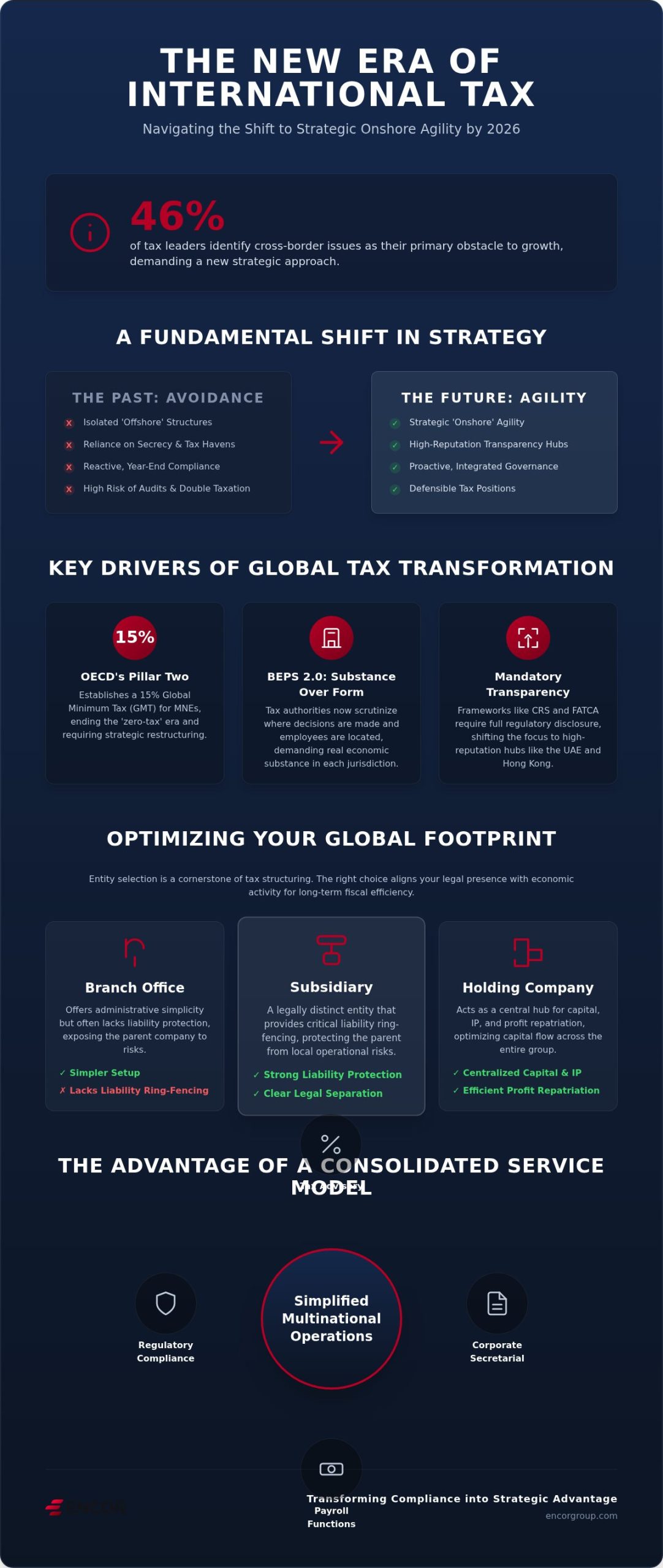
In 2026, the era of ‘offshore’ tax avoidance is officially over, replaced by a mandate for ‘onshore’ strategic agility within high-reputation jurisdictions. You likely recognize that the global tax landscape is not a collection of isolated rules; it’s a highly integrated web of compliance requirements. With 46% of tax leaders identifying cross-border issues as their primary obstacle to growth, the need for specialized international tax advisory services has never been more critical. Managing the transition to the OECD’s Pillar Two and the new Domestic Minimum Top-up Tax (DMTT) requires a steady, authoritative hand to prevent the erosion of your global margins.
We understand that navigating the interplay between the UAE’s corporate tax regime and Hong Kong’s territorial system presents a significant challenge for multinational entities. This article provides a comprehensive strategic framework designed to help you secure a tax-efficient corporate structure and achieve seamless compliance across multiple borders. We will analyze the specific operational requirements for 2026, including the implementation of Pillar Two global minimum tax rules and the optimal use of double taxation treaties. By the end of this guide, you will have the clarity needed to transform tax compliance from a regulatory burden into a strategic advantage for your international operations.
Key Takeaways
- Understand the transition from traditional tax planning to Strategic Structural Agility to maintain compliance with BEPS 2.0 and Pillar Two global minimum tax standards.
- Discover how to optimize your global footprint by strategically selecting between branch, subsidiary, and holding company structures for long-term fiscal efficiency.
- Compare the distinct fiscal advantages of Hong Kong and the UAE to identify the most effective hub for your corporate expansion and profit repatriation strategies.
- Learn how to evaluate international tax advisory services based on jurisdictional depth and their ability to integrate accounting with cross-border regulatory compliance.
- Explore the benefits of a consolidated service model that aligns tax advisory with corporate secretarial and payroll functions to simplify multinational operations.
The Evolving Landscape of International Tax Advisory Services in 2026
The global tax environment in 2026 is defined by a fundamental shift away from traditional tax planning toward what we define as ‘Strategic Structural Agility’. In previous decades, tax strategies often prioritized isolated offshore structures to minimize liabilities. Today, the focus has pivoted toward operational optimization where fiscal efficiency is deeply integrated into the corporate supply chain. Comprehensive international tax advisory services now serve as a critical component of global governance rather than a mere year-end compliance function. This transformation is driven by the final implementation of Global Minimum Tax (GMT) frameworks, which have effectively signaled the end of the ‘zero-tax’ era for large and mid-sized multinational enterprises (MNEs).
Effective tax management requires a proactive stance. Reactive organizations find themselves trapped in costly audit cycles or facing double taxation due to outdated structures. Modern advisory focuses on aligning a firm’s legal presence with its actual economic activity, ensuring that every entity adds value while maintaining a defensible tax position. This approach relies on a deep understanding of international taxation principles, including the nuances of residence-based systems versus territorial regimes. It’s a complex environment where waiting for an audit to justify your structure is a high-risk strategy that most boards can’t afford.
From Tax Havens to Strategic Transparency Hubs
The decline of traditional offshore jurisdictions has accelerated, giving way to high-reputation midshore hubs such as Hong Kong and the UAE. Transparency requirements, specifically the Common Reporting Standard (CRS) and FATCA, have stripped away the veil of secrecy that once characterized global asset protection. Success in 2026 is found in jurisdictions that offer robust legal frameworks alongside transparent reporting. Strategic Transparency is the practice of maintaining full regulatory disclosure while utilizing legitimate jurisdictional advantages to protect corporate assets and optimize capital flow.
The Impact of BEPS 2.0 on Mid-Market Global Expansion
The OECD’s Pillar Two initiative has fundamentally altered the math of international expansion. While the 15% global minimum tax primarily targets large MNEs, its principles have trickled down to mid-market firms through increased scrutiny of ‘Substance Over Form’. Tax authorities now look beyond legal documents to examine where management decisions are actually made and where employees are physically located. Professional international tax advisory services are essential to mitigate the risk of permanent establishment (PE) claims, which can arise from something as simple as a remote executive’s activities in a foreign market. Ensuring that each international office has sufficient economic substance isn’t just a recommendation; it’s a prerequisite for operational stability.
Core Pillars of Professional International Tax Structuring
Professional international tax structuring is the architecture that supports sustainable global growth. It requires a dual focus on inbound strategies for local market entry and outbound strategies for global capital efficiency. Expert international tax advisory services provide the technical depth needed to align these strategies with specific jurisdictional requirements. Integrating international tax structuring into your broader expansion plan ensures that tax obligations don’t become an after-the-fact liability that erodes profit margins.
Entity selection remains a cornerstone of this framework. A branch office might offer administrative simplicity, but it often lacks the liability ring-fencing provided by a subsidiary. Conversely, a holding company structure can serve as a centralized hub for capital allocation, intellectual property management, and efficient profit repatriation through dividends and royalties. Deciding on the right vehicle requires a precise understanding of the OECD’s framework for international tax, which dictates how profits are attributed to different parts of a global enterprise.
Transfer Pricing and Global Value Chain Alignment
In 2026, tax authorities demand rigorous documentation of arm’s length transactions. It’s no longer sufficient to simply follow a formula; your transfer pricing policies must mirror your actual operational substance. This means aligning profit allocation with where your key functions, assets, and risks reside. Many firms now utilize Advanced Pricing Agreements (APAs) to gain certainty from tax authorities and mitigate the risk of double taxation before an audit even begins. Ensuring your global value chain is audit-ready is a primary goal of modern international tax advisory services.
Double Taxation Avoidance Agreements (DTAAs)
Treaty networks are essential tools for optimizing withholding tax rates on cross-border payments. However, the Multilateral Instrument (MLI) updates in 2026 have introduced stricter ‘Limitation on Benefits’ (LOB) clauses. These provisions ensure that treaty benefits are only available to entities with genuine economic presence, preventing ‘treaty shopping.’ Navigating these complexities is simplified when you partner with a strategic navigator at Encor Group to review your eligibility across diverse markets. By leveraging a network of over 100 double taxation treaties, particularly in hubs like the UAE, businesses can significantly reduce the friction of international capital movement.
Strategic Hub Analysis: Hong Kong vs. UAE for Global Entities
The most resilient global structures in 2026 often bridge the EMEA and APAC regions by utilizing the Hong Kong-UAE corridor. While high-level discussions often center on U.S. international tax regulations, executives looking for operational excellence in the East prioritize these two premier hubs. Each offers a distinct fiscal depth that, when managed through professional international tax advisory services, creates a robust defense against jurisdictional risk. Relying on a single jurisdiction is no longer a viable strategy for MNEs seeking long-term stability.
Hong Kong’s Territorial Tax and Profit Exemptions
Hong Kong remains the primary gateway to Asia, particularly for firms adopting a ‘China Plus One’ strategy. Its territorial tax system only levies tax on income sourced within the city, leaving foreign-sourced profits potentially exempt. For the 2025/2026 assessment year, a 100% reduction in profits tax, capped at HKD 3,000, has been proposed to support business continuity. To maintain these exemptions, companies must demonstrate that their core income-generating activities occur outside the territory. Utilizing outsourced accounting services in Hong Kong is a critical step in documenting this offshore status. The two-tiered system, with an 8.25% rate on the first HKD 2 million of profit, provides a highly competitive entry point for expanding enterprises.
UAE Corporate Tax and Economic Substance Standards
The UAE has transitioned into a sophisticated tax environment with its 0% and 9% two-tier corporate tax system. For financial years starting on or after January 1, 2025, large multinational groups must also navigate the 15% Domestic Minimum Top-up Tax. Success in this region depends on distinguishing between Qualifying Income and Non-Qualifying Income within Free Zones. A ‘Qualifying Free Zone Person’ can still achieve a 0% rate, provided they meet strict Economic Substance Regulations (ESR). Following a detailed UAE corporate tax compliance checklist helps holding companies manage their local presence requirements and avoid penalties for non-compliance.
A multi-hub approach isn’t just about tax rates; it’s about regulatory resilience. By distributing operations between Hong Kong and the UAE, MNEs can leverage over 100 double taxation treaties while maintaining access to diverse capital markets. This dual-presence strategy, supported by international tax advisory services, ensures that a regulatory shift in one region won’t destabilize the entire global corporate structure. It’s about building a framework that can withstand the dual forces of multilateral coordination and national policy divergence.
Evaluating International Tax Advisory Partners: A Selection Framework
Selecting a partner for international tax advisory services is a high-stakes decision that dictates the long-term stability of your global operations. In a landscape defined by Pillar Two and increased transparency, a generalist approach is no longer sufficient. You require a partner that offers more than just a global logo; you need a firm with deep, localized expertise in the hubs where you actually operate. This selection framework ensures that your choice aligns with the rigorous demands of the 2026 regulatory environment.
- Step 1: Jurisdictional Depth. Prioritize firms with a physical presence and proven track record in specific corridors, such as the Hong Kong-UAE route, rather than generalists who outsource local knowledge.
- Step 2: Service Integration. Evaluate how the firm connects tax advisory with accounting and corporate secretarial functions. Fragmented services often lead to compliance gaps.
- Step 3: Regulatory Standing. Verify the firm’s 2026 certifications. In the UAE, for example, ensure your advisor is registered and compliant with the latest Federal Tax Authority requirements.
- Step 4: Proactive Alerts. Analyze their communication systems. A reliable partner provides real-time alerts on legislative shifts, such as new DMTT registration deadlines, before they impact your bottom line.
- Step 5: Scalability. Ensure the advisory model can support your next market entry without requiring a complete overhaul of your existing corporate structure.
The Importance of Integrated Compliance Management
Siloed tax advice is a primary cause of operational friction for multinational enterprises. When tax strategies are divorced from daily accounting or legal secretarial duties, the risk of data inconsistency rises. Effective international tax advisory services bridge this gap by aligning fiscal planning with your broader global business expansion strategy. This integrated approach reduces the administrative burden on CFOs, allowing them to focus on value creation rather than chasing documentation across different providers. It’s about creating a single, reliable source of truth for your global compliance data.
Technological Proficiency in Tax Reporting
By 2026, digital reporting is the standard for almost every major tax authority. Your partner must utilize secure data portals that allow for real-time compliance tracking and seamless document management across borders. These systems don’t just improve efficiency; they provide the audit-ready transparency that modern regulators demand. A firm’s tech stack is as vital to its success as its foundational tax knowledge. Secure, cloud-based infrastructure ensures that your sensitive financial data is protected while remaining accessible to your global management team.
Secure your global operations by partnering with the experts at Encor Group for comprehensive advisory and setup services.
The Encor Group Advantage: Strategic Navigation for Global Success
Encor Group provides the institutional-grade depth required to manage complex cross-border requirements with absolute precision. Our ‘Four Hub’ model ensures that clients receive localized expertise across 10+ markets, creating a seamless bridge between high-level strategy and granular operational execution. Unlike firms that offer purely theoretical advice, we facilitate the physical and legal setup of your global entities. We’ve built our reputation on the steady, calm assurance that comes from understanding the intricacies of the world’s most demanding business environments. Professional international tax advisory services must be backed by a commitment to operational excellence, and we deliver that stability through every stage of your corporate journey.
Consider the case of a multinational enterprise scaling its operations from Europe into the Hong Kong-UAE corridor. By utilizing our integrated international tax advisory services, the firm successfully aligned its profit allocation with actual economic substance, avoiding the common pitfalls of double taxation. We managed the transition by integrating tax structuring with local payroll and accounting, ensuring the enterprise remained compliant with both UAE Corporate Tax and Hong Kong Profit Tax regimes from day one. This holistic approach doesn’t just solve immediate problems; it builds a foundation for long-term global growth.
Comprehensive Support Beyond Tax Advisory
Financial and human capital are the lifeblood of any global structure, and their management shouldn’t be siloed. Our services extend into corporate bank account opening assistance to ensure your entities are fully functional upon incorporation. Managing a global team also requires international payroll solutions that account for local social security and withholding requirements. By providing dedicated corporate secretarial support and registered office addresses, we ensure your business maintains a high-reputation standing in every jurisdiction. This comprehensive support model allows your leadership to focus on market expansion while we handle the underlying regulatory burden.
Initiating Your Strategic Tax Review
Every engagement begins with a methodical structural gap analysis. We don’t believe in one-size-fits-all solutions. Our team customizes every framework to the specific nuances of your industry, whether you’re navigating the UAE’s Free Zone exemptions or Hong Kong’s territorial tax system. This proactive assessment identifies potential liabilities before they manifest as audit risks. We guide you through the complexities of BEPS 2.0 and the Domestic Minimum Top-up Tax with quiet efficiency and strategic depth. Contact Encor Group today for a strategic international tax consultation to secure your global future.
Future-Proofing Your Global Corporate Structure
Navigating the global fiscal landscape of 2026 requires a shift from traditional tax planning to a model of strategic transparency and operational agility. Success in this environment is predicated on aligning your corporate presence with actual economic activity and leveraging the unique advantages of premier hubs like Hong Kong and the UAE. By moving beyond siloed compliance toward an integrated framework, your organization can effectively mitigate the risks of double taxation and permanent establishment claims. Professional international tax advisory services are no longer an optional support function; they’re a foundational requirement for any enterprise seeking stable, long-term expansion.
Encor Group provides the institutional depth needed to manage these complexities across 10+ global markets. With specialized hubs in the UAE and Hong Kong, we offer integrated compliance and payroll solutions that bridge the gap between high-level strategy and granular execution. We invite you to secure your global expansion with Encor Group’s strategic tax advisory and transform regulatory challenges into a competitive advantage. Your international growth deserves the steady guidance of a seasoned strategic navigator.
Frequently Asked Questions
What are the primary benefits of hiring an international tax advisory firm in 2026?
Hiring international tax advisory services provides a strategic framework for navigating the complexities of the 15% global minimum tax and multi-jurisdictional reporting. These services ensure that your corporate structure remains tax-efficient while adhering to the transparency requirements of 2026. Expert advisors identify structural gaps that could lead to double taxation, providing a level of institutional confidence that internal teams often lack when entering new markets like the UAE or Hong Kong.
How does the UAE corporate tax affect Free Zone companies?
UAE corporate tax applies a 0% rate on Qualifying Income for Free Zone entities that maintain adequate substance and meet specific regulatory conditions. If an entity earns non-qualifying income, it’s subject to the standard 9% tax rate on taxable income exceeding AED 375,000. For large multinational groups, the 15% Domestic Minimum Top-up Tax may also apply, necessitating a rigorous review of Free Zone exemptions to ensure continued fiscal efficiency.
Can a small business benefit from international tax structuring?
Small businesses with cross-border revenue or international contractors benefit from structuring by preventing accidental permanent establishment claims. Even at a smaller scale, establishing a clear legal framework for intellectual property or service fees reduces the risk of tax audits. Effective structuring ensures that as the business scales, it doesn’t face retroactive liabilities or complex restructuring costs that could’ve been avoided through early strategic planning.
What is the difference between tax evasion and strategic tax planning?
Tax evasion is the illegal non-payment or underpayment of taxes through deception or concealment of income. In contrast, strategic tax planning uses legal frameworks and double taxation treaties to optimize a company’s fiscal position. Strategic planning is built on transparency and full disclosure to authorities, ensuring that the business utilizes available incentives and jurisdictional advantages while remaining fully compliant with international standards like CRS and FATCA.
How often should a multinational company review its international tax structure?
Multinational companies should conduct a formal review of their tax structure at least once per year. This frequency is necessary to account for annual updates to the Multilateral Instrument and changes in local tax laws, such as the UAE’s 2026 registration deadlines. More frequent reviews are required during periods of rapid expansion, significant mergers, or when entering jurisdictions with evolving economic substance requirements to maintain operational excellence.
What are Economic Substance Requirements (ESR) and do they apply to my business?
Economic Substance Requirements mandate that companies engaged in specific activities, such as holding company or distribution services, demonstrate a genuine physical presence and local expenditure. These rules apply to your business if you operate in low or no-tax jurisdictions like the UAE. Failure to meet ESR standards can result in significant financial penalties or the spontaneous exchange of information with foreign tax authorities, jeopardizing your global standing.
How does Hong Kong’s territorial tax system work for offshore income?
Hong Kong’s territorial system only levies profits tax on income derived from or arising in Hong Kong. Foreign-sourced profits are generally exempt from tax, provided the company can demonstrate that the core income-generating activities were conducted outside the territory. This requires meticulous documentation and professional accounting to prove that management and control functions didn’t occur within Hong Kong, ensuring the entity qualifies for the offshore profit tax exemption.
What role does transfer pricing play in international tax compliance?
Transfer pricing ensures that transactions between connected entities within a multinational group are conducted at “arm’s length,” mirroring market rates. This is a central component of professional international tax advisory services, as it prevents the artificial shifting of profits to low-tax jurisdictions. Proper documentation of these transactions is essential to satisfy tax authorities and mitigate the risk of double taxation during cross-border audits in a post-BEPS environment.