

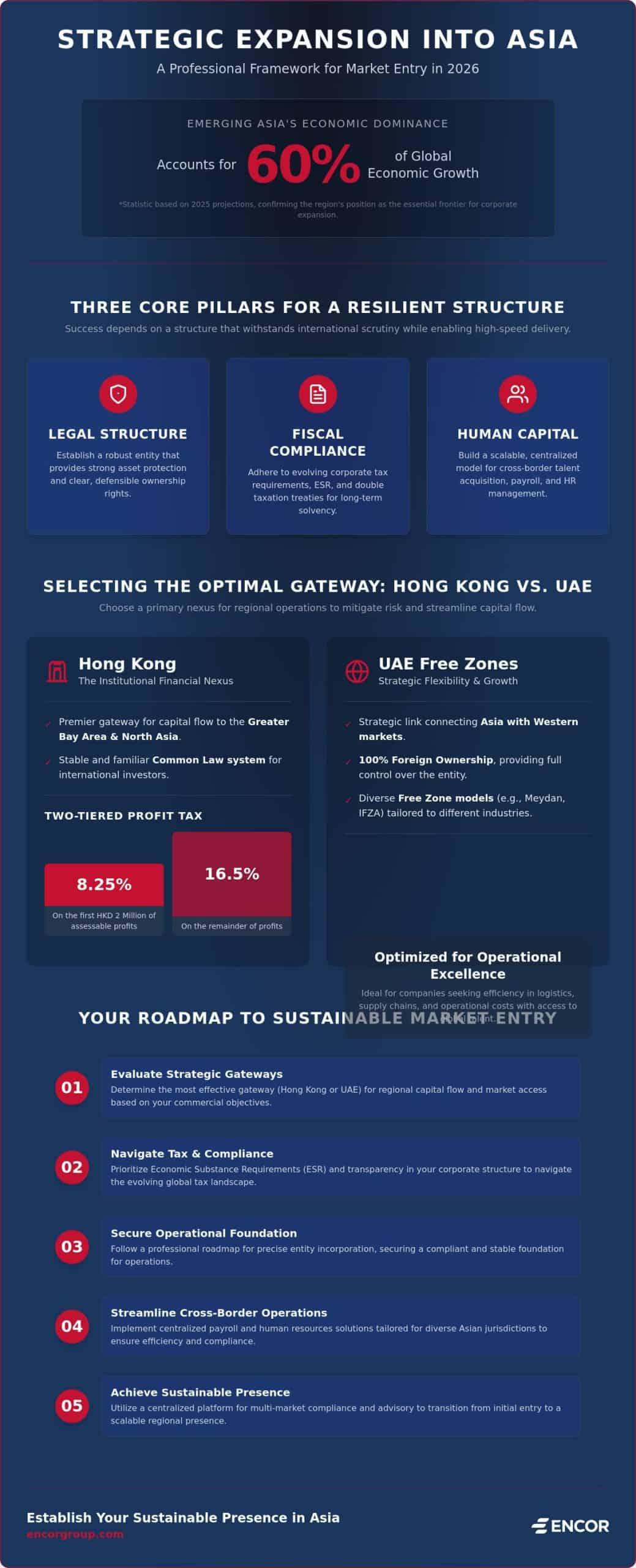
Emerging Asia accounted for 60% of global economic growth in 2025, a statistic that confirms the region’s position as the essential frontier for corporate expansion. While the opportunity is undeniable, many leadership teams find that initial momentum stalls when faced with opaque regulatory requirements and the complexities of securing reliable corporate banking. Learning how to expand business to Asia requires more than just market interest; it demands a calculated strategy that prioritizes structural integrity and local compliance from the outset.
We recognize that establishing a foothold in diverse markets creates significant operational pressure, particularly when managing cross-border payroll and talent acquisition. This roadmap provides a professional framework to master these complexities by identifying the optimal regional hubs and tax structures for 2026. You’ll gain clear criteria for selecting your corporate nexus, a roadmap for compliant tax positioning, and a scalable model for regional HR operations that ensures long-term stability.
Key Takeaways
- Evaluate the strategic advantages of Hong Kong and the UAE to determine the most effective gateway for regional capital flow and market access.
- Navigate the evolving global tax landscape by prioritizing Economic Substance Requirements (ESR) and transparency in your corporate structure.
- Secure a compliant operational foundation by following a professional roadmap on how to expand business to Asia, focusing on precise entity incorporation.
- Streamline cross-border operations through the implementation of centralized payroll and human resources solutions tailored for diverse Asian jurisdictions.
- Transition from initial market entry to a sustainable regional presence by utilizing a centralized platform for multi-market compliance and advisory.
The Strategic Landscape of Asian Business Expansion in 2026
Asia’s economic dominance is no longer a future projection; it’s the current reality of the global marketplace. The Economy of Asia serves as the primary engine for global growth, accounting for the majority of the world’s GDP increase even as geopolitical dynamics shift. In 2026, strategic expansion refers to the deployment of a digital-first operational model that adheres to heightened global tax transparency standards. It’s an era where “regulatory arbitrage”-the pursuit of the lowest possible oversight-has been replaced by “operational excellence.” Success now depends on building a structure that can withstand rigorous international scrutiny while maintaining high-speed delivery.
Executives evaluating how to expand business to Asia must align their growth plans with three core pillars:
- Legal Structure: Establishing an entity that provides robust asset protection and clear ownership rights.
- Fiscal Compliance: Adhering to evolving corporate tax requirements and double taxation treaties to ensure long-term solvency.
- Human Capital: Building a scalable model for talent acquisition and cross-border payroll management.
Why Asia Requires a Hub-First Strategy
The Asian market remains highly fragmented, characterized by diverse legal systems, varying levels of digital maturity, and distinct regulatory environments. Attempting to enter multiple markets simultaneously without a centralized administrative gateway often leads to operational paralysis. A hub-first strategy mitigates this risk by establishing a primary nexus for regional operations. Hong Kong remains the premier gateway for capital flow and access to North Asia, while the UAE serves as the strategic link connecting Asia with Western markets. Modern multinationals now view high-standard compliance not as a burden, but as a competitive advantage that secures access to global banking and top-tier partnerships.
Defining Your Expansion Objectives
Clarity of purpose dictates the optimal corporate structure. Most firms fall into one of three categories: market-seeking (accessing local consumer bases), resource-seeking (securing specialized talent or supply chains), or efficiency-seeking (optimizing logistics and operational costs). Your choice of jurisdiction must reflect these commercial goals. For instance, a firm focused on regional distribution will prioritize different regulatory features than a fintech company focused on capital mobility. A market entry strategy represents a calculated equilibrium between local operational autonomy and centralized corporate control. When you understand how to expand business to Asia through this lens, the complexity of the region becomes a manageable set of strategic choices. Firms that embed a robust global business expansion strategy into their planning from the outset are far better positioned to navigate these choices with institutional confidence.
Selecting the Optimal Gateway: Hong Kong vs. UAE
Determining how to expand business to Asia requires a comparative analysis of jurisdictions that offer the most robust institutional support. Executives must choose between the established financial depth of Hong Kong and the strategic geographic flexibility of the United Arab Emirates. Both hubs serve as critical entry points, yet they cater to different commercial objectives and operational scales. Selecting the wrong jurisdiction can lead to administrative friction; selecting the right one provides a seamless nexus for regional capital and trade flow.
Hong Kong: The Institutional Financial Nexus
Hong Kong remains the premier gateway for capital flow, particularly for firms targeting the Greater Bay Area and North Asia. Its Common Law system provides a familiar and stable legal framework for international investors. Maintaining compliance here requires rigorous adherence to corporate secretarial standards and the maintenance of a registered office address. Effective April 1, 2026, the fee for a one-year Business Registration Certificate increases to HKD 2,350 due to the reinstated levy. Despite this adjustment, the two-tiered profit tax system remains highly attractive. It taxes the first HKD 2 million of assessable profits at 8.25%, with the remainder at 16.5%. For those looking at broader regional strategies, the U.S. International Trade Administration’s guide to Japan market entry offers a useful parallel for understanding the regulatory rigor required in mature Asian economies.
UAE Free Zones: Strategic Flexibility and Growth
The UAE offers a distinct set of advantages through its Free Zone models, such as Meydan or IFZA. These zones allow for 100% foreign ownership and serve as a strategic link connecting Asia with Europe and Africa. The UAE’s corporate tax regime is designed for growth; it applies a 9% rate only on taxable income exceeding AED 375,000. For large multinational enterprises with global revenues over €750 million, a 15% effective minimum tax applies under OECD Pillar Two rules, effective from January 1, 2025. This shift toward global transparency reinforces the UAE’s status as a high-standard jurisdiction for international entity management.
The banking environments in both regions are sophisticated but demand high levels of documentation and transparency. Successful entry depends on aligning your corporate structure with local presence requirements from day one. Navigating the nuances of Hong Kong company formation or UAE incorporation is more than an administrative task; it’s a foundational strategic move. Whether you prioritize the capital mobility of Hong Kong or the logistical reach of the UAE, your choice will define your operational capacity for the next decade.
Navigating Regulatory Complexity and Fiscal Compliance
Executives often cite regulatory opacity as the primary barrier when determining how to expand business to Asia. In 2026, the global shift toward transparency means that compliance is no longer a back-office function but a core strategic pillar. Maintaining structural integrity while scaling across borders requires a proactive approach to evolving standards. This regulatory evolution aligns with broader geopolitical shifts, as noted in the Brookings Institution analysis of U.S. Asia strategy, which emphasizes the necessity for high-standard economic engagement and transparent governance.
Maintaining structural integrity requires a deep understanding of Economic Substance Requirements (ESR). Regulators in jurisdictions like the UAE and Hong Kong now demand proof of genuine commercial activity rather than mere legal presence. This means your hub must demonstrate “substance” through local expenditures, physical offices, and qualified personnel. Failing to meet these standards doesn’t just result in fines; it can lead to the revocation of business licenses and the loss of corporate banking facilities. It’s a high-stakes environment where precision is the only safeguard.
Integrating accounting and bookkeeping into your expansion roadmap ensures that financial data is captured accurately from the first transaction. This visibility is essential for managing regional cash flows and satisfying local tax authorities. Professional tax advisory plays a critical role here, helping firms navigate the intricacies of cross-border tax planning. By aligning your corporate structure with double taxation treaties, you can avoid the “tax trap” where income is taxed in both the source and resident jurisdictions. Understanding these fiscal nuances is a common pitfall for those learning how to expand business to Asia without expert guidance. Engaging strategic business consulting international specialists ensures your structure is built to withstand the scrutiny of evolving global tax standards, including the shift toward Net CFC Tested Income and OECD Pillar Two compliance. A well-constructed global business expansion strategy framework addresses these tax complexities proactively, ensuring your structure remains resilient as international standards continue to evolve.
The Compliance Checklist for Global Entities
Regulatory reporting is a continuous cycle, not an annual event. Your compliance checklist must prioritize the following actions to maintain institutional trust:
- Annual Return Filing: Timely submission of financial statements and company details to local registries.
- KYC Compliance: Maintaining updated documentation to support corporate bank account opening assistance and ongoing banking reviews.
- Audit and Assurance: Engaging in regular audits to verify financial health and demonstrate transparency to regulators and stakeholders.
International Tax Structuring for Efficiency
Tax treaties are the most effective tools for optimizing your regional fiscal position. These agreements provide a framework for lower withholding taxes on dividends, interest, and royalties. However, firms must carefully manage “Permanent Establishment” (PE) risk. A PE risk arises when your business activities in a country are sufficient to trigger a local tax liability, even without a formal subsidiary. Fiscal depth is the capacity of a corporate structure to withstand intense international tax scrutiny through transparent reporting and verified economic substance. Building this depth from day one ensures that your expansion remains sustainable as you scale into new markets.
Operational Execution: A Step-by-Step Roadmap to Market Entry
Moving from strategic selection to physical presence requires a methodical execution of administrative and operational milestones. Many executives underestimate the time required for entity activation, leading to delays in market entry. Learning how to expand business to Asia effectively means viewing the setup process as a sequence of interdependent phases. Each step must be completed with precision to ensure the final structure is both compliant and scalable.
A successful landing follows a five-stage professional roadmap:
- Step 1: Feasibility and Hub Selection. Utilize a data-driven approach to choose your primary jurisdiction based on the criteria established in previous sections. Analyze trade flows, tax treaty networks, and proximity to your target customer base.
- Step 2: Legal Entity Incorporation. Execute the specifics of Hong Kong or UAE setup. This involves preparing articles of association, appointing directors, and securing the necessary business licenses.
- Step 3: Financial Infrastructure. Secure corporate bank accounts and establish accounting protocols. This phase is often the most significant bottleneck and requires meticulous documentation.
- Step 4: Human Capital and Payroll. Implement HR solutions for the initial landing team. This includes drafting employment contracts that comply with local labor laws and setting up regional payroll systems.
- Step 5: Ongoing Governance. Manage corporate secretarial duties and annual compliance. Establishing a routine for annual filings and regulatory reporting prevents future legal friction.
Banking and Financial Setup
Securing a corporate bank account is a critical hurdle in the expansion process. Financial institutions in Asia and the Middle East maintain rigorous due diligence standards. To overcome these hurdles, firms must provide clear evidence of their business model and ownership structure. Utilizing bank account opening assistance can streamline this process by ensuring all documentation meets institutional requirements. A registered office address also plays a vital role here; it serves as a physical anchor that satisfies banking “substance” requirements and provides a reliable point of contact for local regulators. Establishing robust bookkeeping and payroll solutions from day one ensures that your financial data remains audit-ready and transparent.
Managing International Payroll and HR
Human capital is the engine of regional growth, yet navigating local labor laws requires specialized knowledge. A global talent acquisition strategy must account for the nuances of local employment regulations in each jurisdiction. For small executive teams, outsourced payroll solutions offer a significant advantage by reducing administrative overhead while ensuring compliance. This allows leadership to focus on market growth rather than the complexities of statutory contributions and tax withholdings. Managing cross-border teams effectively requires an integrated approach to HR and recruitment services that can scale as your regional footprint expands. Establishing a sustainable presence in Asia requires a methodical approach to these five stages. For a seamless transition, consider partnering with a firm that provides Operations Optimization and integrated corporate services to guide your journey of how to expand business to Asia.
Establishing a Sustainable Presence with Encor Group
Encor Group serves as the strategic nexus for organizations determining how to expand business to Asia with minimal operational friction. Our centralized platform facilitates end-to-end business setup across more than 10 markets, supported by four primary regional hubs that provide a stable base for cross-border activities. By integrating essential functions under a single institutional umbrella, we eliminate the administrative fragmentation that typically characterizes cross-border expansion. This unified model allows executive teams to maintain a clear overview of their regional footprint while we manage the granular complexities of local compliance and entity management. Our acquisition of FastLane Group in March 2026 further strengthens our capabilities in Greater China, ensuring that our clients have access to the most sophisticated accounting and corporate services available in the region.
Why Institutional Expertise Matters
The risks associated with a DIY approach to expansion are substantial and often difficult to reverse. Misaligned tax structures or inadvertent regulatory omissions can lead to severe financial penalties, frozen corporate banking facilities, and long-term reputational damage. Professional corporate services provide the necessary safeguard against these pitfalls. Our deep expertise in the Hong Kong and UAE markets ensures that every aspect of your entry, from Hong Kong company formation to UAE Free Zone incorporation, meets the highest institutional standards. We don’t just provide administrative support; we deliver strategic business consulting international expertise that secures the long-term value of your international growth. This includes proactive tax advisory and compliance to ensure your structure remains resilient against evolving global transparency requirements and Economic Substance Requirements (ESR).
Take the Next Step in Your Global Journey
A sustainable regional presence requires a foundation built on precision and compliant operations. Once your initial entity is activated, the focus must shift to ongoing operational optimization and human capital management. It’s our role as a trusted advisor to manage the multifaceted requirements of accounting, bookkeeping, and regional payroll solutions. We also provide specialized human resources and recruitment services to help you build the landing teams necessary for success. This allows you to focus your internal resources on market capture and commercial scaling rather than administrative maintenance. The complexities of the current environment demand a partner with global reach and deep local knowledge. We invite you to Consult with Encor Group on Your Asia Expansion Strategy to ensure your journey of how to expand business to Asia is executed with institutional excellence.
Establishing Institutional Stability in the Asian Market
The transition from opportunistic market entry to institutional stability defines successful expansion in 2026. A strategic foothold in the region depends on the precise selection of a primary hub. Whether you leverage the capital mobility of Hong Kong or the logistical reach of the UAE, the decision must align with your long-term commercial objectives. Establishing a compliant legal and fiscal foundation is the only method to ensure resilience against shifting global standards.
Mastering how to expand business to Asia requires the integration of multifaceted HR, tax, and compliance requirements into a single, scalable operational model. Encor Group facilitates this journey by serving as a strategic navigator across 10+ markets through four established regional hubs. Our specialized expertise in Hong Kong and UAE regulatory frameworks ensures that your expansion remains secure. This allows your leadership to focus on market growth while we handle the complex operational details with institutional precision.
Partner with Encor Group to Scale Your Business Across Asia and establish your organization’s presence in the world’s most dynamic economic landscape. We’re ready to facilitate your regional success with quiet efficiency and global competence.
Frequently Asked Questions
What is the most business-friendly country in Asia for a new startup?
Hong Kong and the UAE are consistently ranked as the most business-friendly jurisdictions for startups entering the region. Hong Kong offers a two-tiered tax system and a familiar Common Law framework, while the UAE provides 100% foreign ownership in its Free Zones. Both hubs prioritize ease of incorporation and provide robust access to regional venture capital. Choosing between them depends on whether your primary target is the North Asian market or the link between Asia and Europe.
How long does it typically take to incorporate a company in Hong Kong or the UAE?
Incorporation in Hong Kong typically takes 1 to 2 business days for electronic submissions, whereas UAE Free Zone incorporation generally requires 1 to 3 weeks. The UAE timeline often depends on the specific Free Zone selected and the complexity of the business activity. It’s essential to account for additional time required for post-incorporation tasks such as visa processing and bank account opening, which can extend the total operational readiness timeline by several weeks.
Do I need a local partner to expand my business to Asia in 2026?
What are the main challenges of managing international payroll in Asia?
The primary challenges include navigating diverse statutory contribution requirements, varying tax residency rules, and complex local labor laws across fragmented markets. Managing cross-border payments also introduces currency exchange risks and fluctuating transfer fees. To streamline operations, many businesses utilize an omni-channel payment platform like Strictly to manage online and mobile transactions efficiently. Many firms utilize outsourced payroll solutions to ensure compliance with local regulations while maintaining a centralized reporting structure. This approach mitigates the risk of legal friction and ensures timely disbursements to regional landing teams.
Is it possible to open a corporate bank account in Asia without visiting in person?
Yes, it’s possible to open a corporate bank account in certain Asian jurisdictions without a physical visit, though it remains a rigorous process. Digital banks and specific institutional providers in Hong Kong and the UAE offer remote onboarding options supported by video verification and certified documentation. However, traditional banks often prefer or require an in-person meeting with directors to satisfy high-level KYC and due diligence standards. Professional bank account opening assistance is recommended to navigate these requirements.
What are the economic substance requirements for companies in the UAE?
Economic Substance Requirements in the UAE mandate that companies performing “Relevant Activities” must demonstrate a genuine commercial presence within the country. This includes conducting core income-generating activities locally, maintaining adequate physical assets, and employing a sufficient number of qualified personnel in the UAE. Firms must also ensure that local operating expenditures are proportionate to their activities. Adherence to ESR is critical for maintaining tax residency status and avoiding significant administrative penalties.
How can I optimize my tax liability when expanding to multiple Asian markets?
Optimizing tax liability requires a strategy centered on utilizing double taxation treaties and establishing a compliant regional hub. By routing operations through a jurisdiction like Hong Kong, which has an extensive network of over 45 tax treaties, you can often reduce withholding taxes on cross-border payments. Professional tax advisory is essential to manage permanent establishment risks and ensure that your corporate structure aligns with global transparency standards while learning how to expand business to Asia efficiently.
What role does a corporate secretary play in Asian business compliance?
A corporate secretary acts as the primary liaison between the company and local regulators, ensuring all statutory filings and governance duties are met. In jurisdictions like Hong Kong, appointing a qualified corporate secretary is a mandatory legal requirement for all incorporated entities. Their role includes maintaining statutory registers, filing annual returns, and ensuring the board adheres to local corporate law. This institutional oversight is vital for maintaining the good standing of your regional entities.