

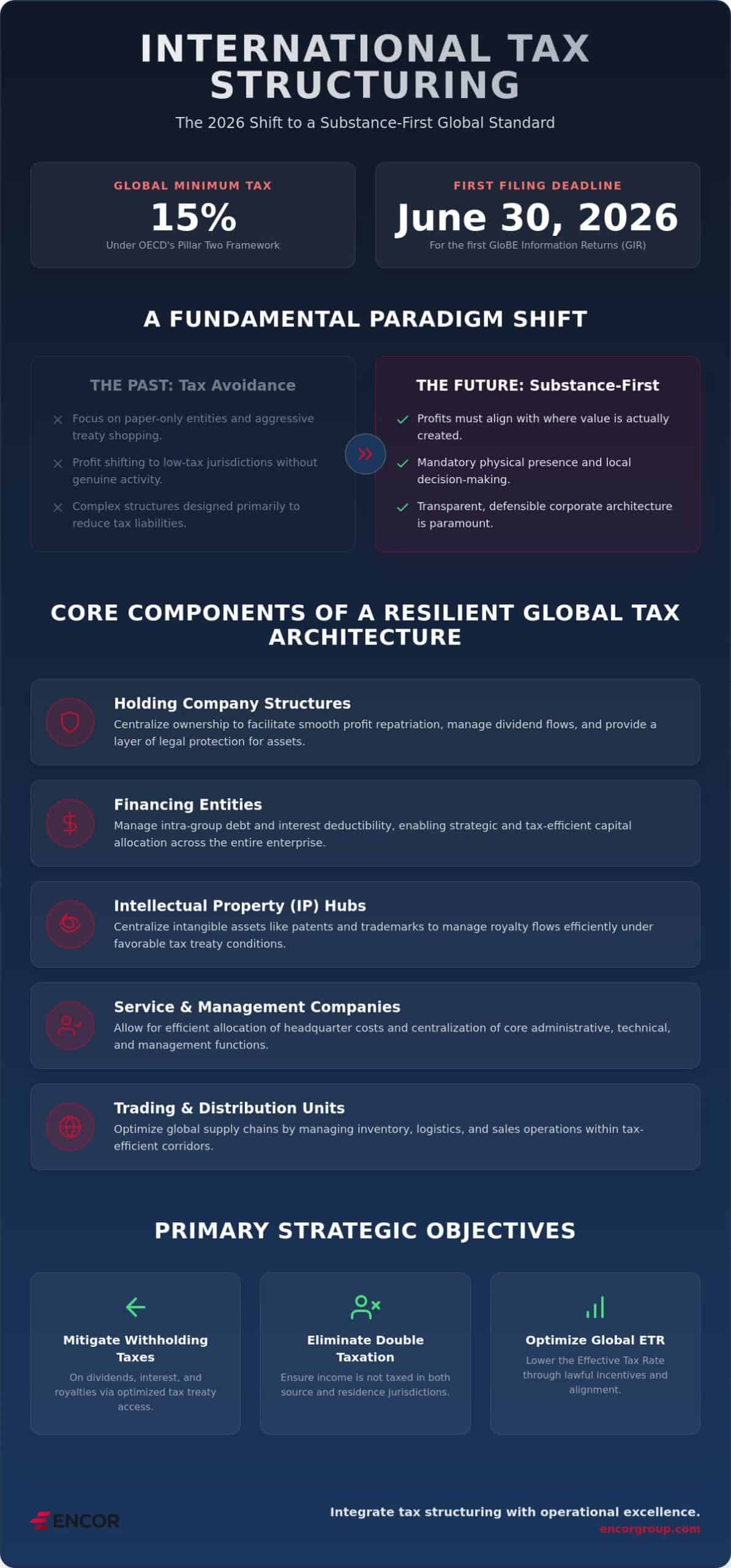
The era of profit shifting through paper-only entities has officially ended, replaced by a global tax regime that prioritizes operational substance over traditional tax planning. As the June 30, 2026, deadline for the first GloBE Information Returns approaches, multinational groups must reconcile their operations with a 15% global minimum tax. You recognize that managing conflicting tax laws across jurisdictions is no longer a simple administrative task; it’s a high-stakes strategic necessity. Robust international tax structuring now requires the precise alignment of corporate architecture with genuine economic activity to prevent aggressive audits and preserve capital.
This article provides a clear roadmap for mastering cross-border tax complexities while ensuring long-term fiscal efficiency. You’ll gain the insights needed to select optimal jurisdictional hubs and satisfy the latest global reporting standards with confidence. We examine the transition from GILTI to Net CFC Tested Income (NCTI), the integration of substance requirements in regions like the UAE, and the specific frameworks required to maintain a competitive edge in the modern global economy.
Key Takeaways
- Shift from traditional tax avoidance to a substance-first model to ensure long-term compliance with evolving global regulations.
- Optimize fiscal outcomes by strategically utilizing holding company structures and financing entities to manage global profit repatriation.
- Compare the strategic benefits of Hong Kong’s territorial system against the UAE’s corporate tax framework for establishing regional headquarters.
- Master the complexities of international tax structuring by aligning corporate architecture with the “Core Income Generating Activities” (CIGA) requirements.
- Ensure operational excellence by integrating tax planning with physical business setup and robust regulatory reporting standards.
The Evolution of International Tax Structuring in 2026
International tax structuring represents the strategic arrangement of a multinational enterprise’s legal and operational framework to optimize fiscal outcomes. This process relies on fundamental international taxation principles that define how different countries exercise their right to tax cross-border income. In 2026, the focus has shifted from the aggressive avoidance tactics of the previous decade toward a substance-first approach. Tax authorities now demand that profits align strictly with where value is actually created, making physical presence and local decision-making the new benchmarks for legitimacy.
Effective international tax structuring acts as a critical prerequisite for a successful global business expansion strategy. It ensures that a company can scale into new markets without incurring unexpected liabilities or administrative bottlenecks. Central to this effort is the strategic use of tax treaties, which facilitate cross-border trade by providing clear rules for the prevention of double taxation. These bilateral agreements offer the legal certainty necessary for long-term investment in foreign jurisdictions while protecting the flow of capital from punitive tax treatment.
The Shift Toward Transparency: BEPS 2.0 and Beyond
The OECD’s Base Erosion and Profit Shifting (BEPS) framework has transitioned from a theoretical proposal to a rigid compliance reality. The implementation of Pillar Two establishes a 15% global minimum tax for multinational groups with annual revenues of at least €750 million. With the first GloBE Information Return (GIR) deadline set for June 30, 2026, even mid-market enterprises must evaluate their global footprint. Tax transparency now serves as the decisive factor in selecting entity locations, which is why firms like CiDATax SRL assist enterprises in meeting these standards across Italy, the UK, and the US to avoid increased scrutiny or potential blacklisting.
Strategic Objectives of a Modern Tax Architecture
A sophisticated tax framework provides a stable foundation for growth by addressing several key fiscal priorities:
- Mitigation of withholding taxes on cross-border payments of dividends, interest, and royalties through optimized treaty access.
- Elimination of double taxation by ensuring that income is not taxed in both the source and residence jurisdictions.
- Optimization of the global effective tax rate (ETR) through the lawful use of incentives and efficient jurisdictional alignment.
By achieving these objectives, a business can reinvest saved capital into core operations and expansion. Modern international tax structuring is not about hiding profits; it is about creating a logical, transparent, and defensible corporate architecture that withstands the scrutiny of global regulators.
Core Components of an Efficient Global Tax Architecture
Developing a resilient global tax architecture requires more than just selecting a low-tax jurisdiction. It involves a multi-layered blueprint where each entity serves a specific operational and fiscal purpose. A well-designed international tax structuring framework integrates five core components to protect assets and ensure that capital moves efficiently across borders. These building blocks prevent profit erosion and provide the stability needed for long-term growth.
- Holding Company Structures: These entities centralize ownership and facilitate the smooth repatriation of profits while providing a layer of legal protection.
- Financing Entities: By managing intra-group debt and interest deductibility, these units allow for strategic capital allocation across the enterprise.
- Intellectual Property (IP) Hubs: Centralizing the protection and exploitation of intangible assets ensures that royalty flows are managed under favorable treaty conditions.
- Service and Management Companies: These units allow for the efficient allocation of headquarter costs and the centralization of core administrative functions.
- Trading and Distribution Units: These optimize the global supply chain by managing inventory, logistics, and sales in tax-efficient corridors.
Holding Companies and Profit Repatriation
Holding companies act as an essential buffer for dividend flows between subsidiaries and the ultimate parent. When you select a jurisdiction, you should prioritize regions with extensive double tax treaty networks and robust participation exemptions. These exemptions often allow dividends and capital gains to be received tax-free, provided specific ownership thresholds are met. However, the concept of “beneficial ownership” has become a critical gatekeeper in modern treaty claims. Authorities now look beyond legal title to determine who actually controls and benefits from the income. If an entity lacks the autonomy to manage its own funds, treaty benefits may be denied. Staying informed on U.S. international tax policy and similar global standards is vital for maintaining the integrity of these structures.
Transfer Pricing and Value Chain Alignment
In 2026, the Arm’s Length Principle remains the non-negotiable standard for all intra-group transactions. You must ensure that the prices charged between related entities mirror what independent parties would agree upon in a competitive market. Documentation isn’t just a compliance checkbox; it’s your primary defense during a tax audit. Profits must align with the location of Significant People Functions (SPF), which refers to the individuals who actually manage risks and perform key decision-making roles. Relying on outsourced accounting services in Hong Kong can provide the rigorous record-keeping required to support these transfer pricing positions. For enterprises seeking to refine their global footprint, engaging a specialist in tax advisory and compliance ensures that your operational reality matches your tax filings.
Strategic Hub Selection: Hong Kong vs. UAE for Tax Optimization
Choosing a jurisdictional base for regional operations requires a granular analysis of how local tax laws interact with global standards. In 2026, the decision typically centers on Hong Kong and the United Arab Emirates. Both regions offer sophisticated legal frameworks and extensive Double Taxation Agreement (DTA) networks, yet they operate on fundamentally different fiscal principles. While Hong Kong maintains its traditional territorial tax system, the UAE has transitioned to a federal corporate tax regime that balances competitive rates with international compliance requirements. Successful international tax structuring depends on matching your specific business model—whether it’s high-volume trading or decentralized service delivery—to the unique regulatory strengths of these two powerhouses.
Both hubs have proactively aligned their domestic legislation with the OECD BEPS framework to ensure they remain viable choices for multinational enterprises. This alignment provides executives with the regulatory stability needed for long-term capital commitment. While both jurisdictions are highly efficient, the selection process must evaluate the specific nature of your income streams and the physical location of your key decision-makers.
Hong Kong: The Gateway for Asia-Pacific Expansion
Hong Kong remains a premier destination for businesses targeting the Asia-Pacific market due to its two-tiered profits tax system. Under this regime, the first HKD 2 million of assessable profits are taxed at a reduced rate of 8.25%, with the remaining profits subject to a 16.5% rate. Its territorial tax principle is a significant differentiator; only profits sourced within Hong Kong are subject to local taxation. For 2026, the offshore income exemption remains a vital tool for companies with global operations, provided they meet the revised economic substance requirements. This makes Hong Kong an ideal hub for holding Chinese or Southeast Asian subsidiaries while centralizing regional management functions.
The UAE: A Multi-Zone Powerhouse for Global Trade
The UAE has evolved into a highly regulated yet attractive tax environment. It features a standard corporate tax rate of 9% on taxable income exceeding AED 375,000. For smaller operations, the Small Business Relief remains available until December 31, 2026, allowing companies with revenue below AED 3 million to elect for 0% tax treatment. Free Zone entities can still access a 0% rate on qualifying income by maintaining status as a Qualifying Free Zone Person (QFZP). This flexibility makes the UAE a neutral, efficient hub for East-West trade. You should consult the UAE corporate tax compliance checklist to ensure your operations meet the necessary substance and reporting criteria to benefit from these exemptions.
Navigating Compliance: Economic Substance and Reporting
The era of the “shell company” has officially concluded. In 2026, the validity of any international tax structuring arrangement depends on the “Core Income Generating Activities” (CIGA) test. Regulators no longer accept passive entities that exist only on paper; they demand proof that profits are generated through genuine local operations. This shift requires a meticulous alignment of your corporate structure with the physical reality of your business. If an entity claims tax benefits in a jurisdiction, it must demonstrate that the key decisions and primary activities driving its income occur within those borders.
To pass the CIGA test, you must ensure your entities meet specific operational benchmarks. These include maintaining a physical office space, employing a sufficient number of qualified personnel, and incurring adequate local operating expenditures. Furthermore, the presence of local directors who possess the authority to make independent strategic decisions is now a baseline requirement. Failure to satisfy these criteria triggers severe consequences, including significant financial penalties and the spontaneous exchange of information between tax authorities. Such transparency can lead to aggressive audits in your home jurisdiction and lasting reputational damage in the global marketplace.
The stakes for non-compliance have never been higher. With the June 30, 2026, deadline for the first GloBE Information Returns (GIR) under Pillar Two, multinational groups must provide unprecedented levels of data to tax administrators. Securing expert Compliance & Regulatory Advisory services is the most effective way to ensure your global footprint remains defensible and compliant with these evolving standards.
Automatic Exchange of Information (AEOI) and CRS
Global tax transparency is now enforced through the Common Reporting Standard (CRS) and the Automatic Exchange of Information (AEOI). These frameworks require financial institutions to identify and report the beneficial ownership of accounts to local tax authorities, who then share that data with their international counterparts. Banking institutions have become the primary gatekeepers of fiscal integrity. If your corporate profile lacks clarity or fails to meet documentation standards, you’ll likely face significant banking friction, including account freezes or the termination of services.
Managing Global Entity Compliance
Maintaining a robust legal structure across multiple regions requires centralized corporate secretarial services. Multinational groups must manage a complex calendar of annual filing requirements, including the July 31, 2026, CRS reporting deadline for jurisdictions like the Cayman Islands and the May 31, 2026, deadline for the British Virgin Islands. Modern international tax structuring relies on advanced compliance technology to monitor these deadlines in real-time. This digital oversight ensures that every subsidiary remains in good standing, preventing administrative lapses that could jeopardize your entire tax architecture.
Encor Group: Integrating Tax Structuring with Operational Excellence
Theoretical tax planning often collapses during the implementation phase because it ignores the logistical requirements of modern regulation. In 2026, a structure without an operational backbone is a significant liability. International tax structuring fails when there’s a disconnect between the high-level tax blueprint and the day-to-day reality of the business. Encor Group bridges this gap by integrating strategic advisory with tangible business setup, ensuring that your corporate architecture is both fiscally efficient and operationally sound. We don’t just provide a plan; we execute the physical and administrative framework required to sustain it.
A critical component of proving economic substance involves the management of human capital. By utilizing international payroll solutions, your enterprise can provide concrete evidence of local employment and genuine economic activity. This documentation is essential for satisfying the “Core Income Generating Activities” (CIGA) tests that global tax authorities now use to validate tax residency. Encor Group serves as a strategic partner for high-stakes expansion, providing the precision necessary to align your global footprint with the rigorous standards of the modern economy.
From Incorporation to Ongoing Advisory
Encor Group provides end-to-end support in the world’s most efficient business hubs, including Hong Kong and the UAE. We recognize that securing a corporate bank account often represents the final and most difficult hurdle in any international tax structuring project. Our team provides dedicated Bank Account Opening Assistance to ensure your capital remains mobile and accessible from day one. Beyond the initial setup, we offer ongoing Corporate Secretarial Services and Accounting and Bookkeeping to keep your structure legally robust. This continuous oversight ensures your business remains future-proof as global regulations continue to shift.
The Strategic Advantage of a Global Partner
A fragmented approach to global operations creates unnecessary risk and administrative friction. By partnering with Encor Group, you gain access to multi-market hubs that allow for centralized control and consistent compliance standards across your entire group. Our Operations Optimization services help you refine your physical footprint to match your fiscal objectives, ensuring that every entity adds value to the bottom line. We provide executive-level consulting for those who require a sophisticated, globally-minded approach to corporate success.
Contact Encor Group for a Strategic Tax Structuring Consultation to secure your enterprise’s global future and ensure total regulatory compliance.
Securing Your Enterprise’s Global Future
The transition toward a substance-first regulatory environment marks a permanent shift in how multinational entities must operate. Success in 2026 requires more than a passive presence; it demands a corporate architecture where profits are strictly aligned with genuine economic activity and local decision-making. By mastering the core components of international tax structuring, your organization can mitigate the risks of aggressive audits while optimizing its global effective tax rate. Whether you’re leveraging the territorial advantages of Hong Kong or the multi-zone flexibility of the UAE, your fiscal strategy must be backed by rigorous operational execution.
Encor Group provides the strategic depth needed to navigate these high-stakes requirements. With a presence in over 10 markets globally and dedicated hubs in Hong Kong and the UAE, we offer a unique integration of HR, tax advisory, and compliance services. We ensure your structure remains resilient against evolving global standards and banking friction. Consult with Encor Group on Your International Tax Strategy to build a defensible and efficient framework for your global expansion. Your journey toward cross-border excellence starts with a partner who understands the complexities of the modern economy.
Frequently Asked Questions
What is the difference between tax planning and international tax structuring?
Tax planning focuses on the short-term optimization of specific liabilities, while international tax structuring involves the foundational design of a multinational group’s legal and operational framework. Structuring establishes the permanent entities and jurisdictional hubs that determine how income flows across borders. Effective structuring provides the long-term stability required for planning to succeed without triggering regulatory scrutiny. It creates the architecture that supports all subsequent fiscal decisions.
How does OECD Pillar Two affect small and medium-sized enterprises (SMEs)?
OECD Pillar Two primarily targets multinational groups with consolidated annual revenues exceeding €750 million. While most SMEs fall below this threshold, they aren’t entirely immune to its effects. Many jurisdictions are implementing domestic minimum top-up taxes that may eventually influence broader tax policy. Additionally, larger clients often require SME suppliers to demonstrate tax transparency and compliance with global standards to maintain their own reporting integrity within the supply chain.
Can I still use a Hong Kong company for tax-exempt offshore income in 2026?
You can still utilize the offshore income exemption in Hong Kong provided your company satisfies the Foreign-Sourced Income Exemption (FSIE) regime requirements. In 2026, this means demonstrating adequate economic substance through local employees and operating expenditures. The territorial tax principle remains a core feature of the jurisdiction, but the era of passive, paper-only offshore claims has ended in favor of a substance-first approach.
What are Economic Substance Requirements (ESR) and do they apply to my UAE company?
Economic Substance Requirements (ESR) mandate that companies performing “Relevant Activities” maintain a genuine physical presence in the jurisdiction. In the UAE, standalone ESR filings for years ending after December 31, 2022, are no longer required. However, these requirements are now integrated into the Corporate Tax framework. Maintaining substance is a critical prerequisite for Free Zone entities seeking to qualify for the 0% tax rate as a Qualifying Free Zone Person.
How do double taxation agreements (DTAs) prevent me from paying tax twice?
Double Taxation Agreements (DTAs) function as bilateral treaties that allocate taxing rights between two countries to prevent the same income from being taxed twice. These agreements typically employ either the “credit method,” where tax paid in one country offsets liability in another, or the “exemption method.” They provide the legal certainty necessary for cross-border investment by capping withholding taxes on dividends, interest, and royalties.
Why is a holding company better than owning foreign subsidiaries directly?
A holding company centralizes ownership, allowing for more efficient profit repatriation and risk management than direct ownership of multiple subsidiaries. It acts as a strategic gateway for accessing favorable tax treaties and participation exemptions. This structure also provides a layer of legal protection, insulating the parent company from the specific liabilities of individual operating units while simplifying the process of global capital allocation.
What role does transfer pricing play in international tax structuring?
Transfer pricing ensures that transactions between related entities are conducted at “arm’s length,” mirroring prices found in an open market. It’s a fundamental pillar of international tax structuring because it dictates where profits are recorded within a global group. Authorities now use transfer pricing documentation to verify that income aligns with the location of Significant People Functions (SPF) and actual value creation rather than artificial profit shifting.
How often should a multinational company review its tax structure?
A multinational company should conduct a comprehensive review of its tax structure at least once per year. More frequent assessments are necessary when significant regulatory milestones occur, such as the June 30, 2026, GloBE Information Return deadline. Rapid changes in domestic laws or the expansion into new markets also require proactive adjustments to ensure the corporate architecture remains compliant and fiscally optimized for long-term growth.