
Establishing a private limited company is frequently dismissed as a bureaucratic formality, yet it remains the most robust institutional vehicle for scalable international expansion. While the complexity of cross-border regulations often deters ambitious founders, the structural integrity of this entity provides the necessary foundation for global operations. You likely recognize that protecting personal assets and establishing a credible corporate presence are non-negotiable requirements for long-term success.
This guide clarifies the strategic advantages of the private limited company, ensuring you can leverage its legal protections to facilitate seamless growth across borders. We’ll examine the specific frameworks for choosing between regional variants and provide a precise roadmap for compliance. You’ll gain insights into the latest regulatory shifts, including the updates to the MCA V3 portal and the expanded definition of small companies effective December 2025, allowing you to maintain operational excellence with institutional confidence.
Key Takeaways
- Understand the legal framework of a private limited company to establish a robust shield for personal assets through defined liability limits.
- Leverage incorporation in strategic jurisdictions such as Hong Kong or the UAE to enhance corporate credibility and facilitate international bank account opening.
- Compare structural variations across global hubs to determine the most effective entity type for your specific cross-border operational requirements.
- Establish a clear roadmap for mandatory compliance, including statutory record maintenance and annual filing obligations to ensure uninterrupted business continuity.
Defining the Private Limited Company: An Institutional Framework
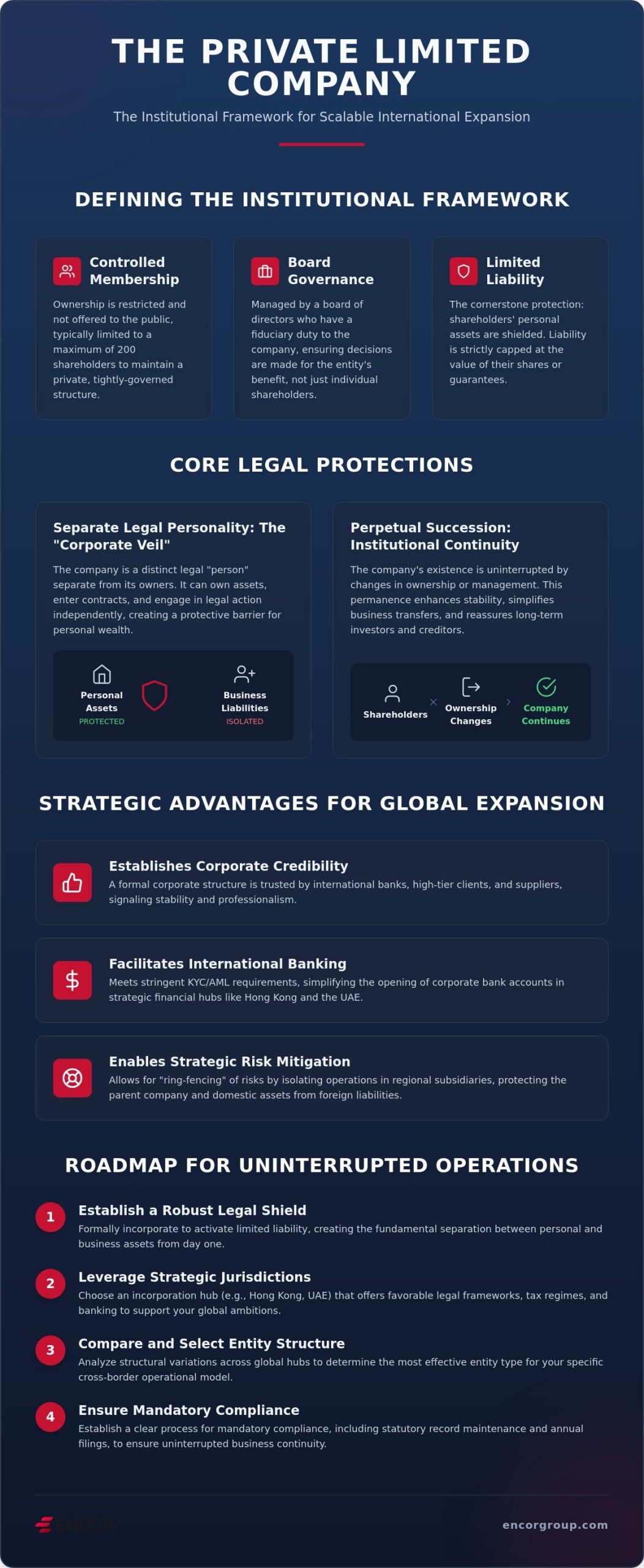
A private limited company is a distinct legal vehicle endowed with its own rights, duties, and liabilities. Unlike public corporations, this structure maintains a restrictive approach to ownership; shares aren’t offered to the general public and are instead traded privately among a controlled group of stakeholders. This exclusivity allows for tighter governance while providing the operational benefits of a formalized corporate body. A private limited company is a separate legal entity from its shareholders and directors, ensuring that the business exists as an independent “person” under the law. The “limited” designation refers specifically to the liability of its members, which is strictly capped at the value of their shares. This means that if the business faces insolvency, the shareholders’ personal wealth remains protected beyond their initial investment.
Several core characteristics define this institutional framework:
- Controlled Membership: Most jurisdictions limit the number of shareholders, typically to 200, to maintain the private nature of the entity.
- Board Governance: The company is managed by a board of directors who owe fiduciary duties to the entity itself, rather than to individual shareholders.
- Capital Structure: While there’s often no minimum paid-up capital requirement in modern hubs, the share capital remains the foundational measure of ownership and liability.
The Doctrine of Separate Legal Personality
The cornerstone of corporate law is the principle that a company exists as a person in its own right. This legal fiction, often termed the “corporate veil,” creates a definitive boundary between the business and its stakeholders. Because the entity possesses its own legal personality, it can acquire property, execute binding contracts, and initiate or defend legal proceedings independently. For entrepreneurs, this separation is the primary mechanism for risk management. It ensures that business liabilities don’t jeopardize personal assets, provided the directors adhere to statutory governance standards. This structural autonomy provides the stability required for sophisticated cross-border operations.
Perpetual Succession and Institutional Continuity
A private limited company enjoys uninterrupted existence, a concept known as perpetual succession. Changes in shareholders or directors through retirement, resignation, or death don’t terminate the entity’s legal status. This continuity is a critical asset when negotiating long-term debt or seeking venture capital, as it reassures creditors and investors of the company’s permanence. It also simplifies the process of business transfers. Because the company owns the assets and contracts, ownership can be transitioned through the transfer of shares rather than the liquidation of the business itself. This framework facilitates seamless succession planning and institutional growth across multiple generations.
Strategic Advantages for Global Business Expansion
Expanding operations into international markets requires more than just a viable product; it demands a corporate structure that global stakeholders trust. A private limited company serves as this foundation, providing the institutional credibility necessary to engage with international banks, specialized suppliers, and high-tier clients. By incorporating in strategic hubs like Hong Kong or the UAE, entrepreneurs can leverage favorable tax regimes and sophisticated legal frameworks. These jurisdictions are specifically designed to facilitate cross-border capital flow and operational efficiency, making them ideal for companies with global ambitions.
Securing corporate banking facilities is a common hurdle for expanding firms. However, the structured nature of this entity type simplifies the process when supported by professional secretarial services. Banks prioritize transparency and clear governance, both of which are inherent to a properly managed private limited company. Utilizing specialized bank account opening assistance ensures that the entity meets stringent KYC and AML requirements without delaying market entry. This professional support is often the difference between a seamless launch and months of administrative delays.
Risk Mitigation and Asset Protection
Operating globally introduces diverse regulatory and financial risks. By utilizing a private limited company structure, founders can isolate these risks within specific regional subsidiaries. This ring-fencing protects the parent company and its domestic assets from the liabilities of international branches. The advantages of limited liability provide a safety net that encourages bold expansion strategies. It allows leadership to test new markets without jeopardizing the entire organization’s financial stability. When a subsidiary faces legal or financial challenges, the parent entity’s exposure is strictly limited to the capital invested in that specific branch.
Fiscal Depth and Capital Raising
Scalability depends on the ability to access capital efficiently. This structure facilitates equity financing by allowing the issuance of different share classes, such as preferred or non-voting shares. This flexibility attracts a diverse range of investors while maintaining management control. Additionally, it enables the implementation of global employee share schemes, which is essential for talent acquisition in competitive markets. The ability to repatriate profits through optimized tax planning further enhances the fiscal depth of the organization. This ensures that capital is available where it’s needed most, whether for reinvestment in emerging markets or distribution to stakeholders. The private limited company doesn’t just hold assets; it acts as a sophisticated engine for capital management and long-term value creation.
Structural Variations: Comparing Global Incorporation Hubs
Selecting a jurisdiction requires a granular understanding of regional variations. While the core concept of a private limited company remains consistent, the administrative and capital requirements vary significantly between global hubs. For instance, a Public Limited Company (PLC) necessitates higher minimum share capital and rigorous public disclosure; whereas a private structure offers confidentiality and lower maintenance costs. In many jurisdictions, the term Limited Liability Company (LLC) is used interchangeably with the private limited company, though the tax treatment can differ, particularly in the United States. It’s essential to evaluate these nuances before committing to a specific region.
- Minimum Share Capital: Strategic hubs like Hong Kong and the UAE have largely abolished minimum paid-up capital requirements, facilitating easier market entry.
- Director Residency: Some regions mandate at least one local resident director, while others, like the UAE Free Zones, allow 100% foreign management.
- Shareholder Limits: Most private structures limit shareholders to 200, which distinguishes them from public entities that can offer shares to the general population.
The Hong Kong Private Limited Company
The Hong Kong Companies Ordinance provides a highly efficient framework for international trade. It’s the gold standard for Asia-Pacific entry due to its territorial tax system and absence of capital gains tax. Utilizing Hong Kong company formation services allows entrepreneurs to establish a presence in a premier financial center with minimal friction. Hong Kong doesn’t mandate local director residency, though it requires a local registered office and a qualified company secretary to maintain statutory compliance. This proximity to mainland China remains a decisive factor for firms targeting the Greater Bay Area.
UAE Free Zone Incorporation
UAE Free Zone incorporation offers a distinct strategic advantage through 100% foreign ownership and complete repatriation of capital. This structure is particularly effective for businesses targeting Middle Eastern and African markets from a Dubai base. While both Hong Kong and UAE entities provide robust legal protections, the UAE requires specific licenses tailored to the business activity. Reporting standards also differ; UAE Free Zones often have specific audit requirements that vary by the individual zone’s regulations. In contrast, other major markets have introduced their own modernization efforts; for example, the India MCA V3 portal launched in July 2025 now handles all digital filings. Understanding these regional differences ensures your entity remains compliant while maximizing its operational reach.
Regulatory Compliance and Governance Standards
Maintaining the “limited” status of a private limited company depends on unwavering adherence to statutory governance. While some view these requirements as administrative friction, they serve as essential proof of an entity’s legitimacy during due diligence or capital raising. Regulatory bodies mandate a specific cycle of filings to ensure transparency and accountability. Failure to meet these deadlines can lead to significant penalties or the disqualification of directors. Institutional trust is built on this foundation of transparency.
Key obligations typically include:
- Annual Profit Tax Returns: Comprehensive reporting of global or territorial income to the relevant tax authorities.
- Audited Financial Statements: Independent verification of accounts, which is a mandatory requirement in jurisdictions like Hong Kong.
- Annual Returns: Regular updates to the registrar regarding share capital, directorships, and registered office addresses.
- Statutory Registers: Accurate maintenance of records for members, directors, and significant controllers.
- AML and KYC Standards: Adhering to anti-money laundering and Know Your Customer protocols to maintain banking relationships.
For organizations operating across multiple time zones, staying ahead of these requirements is critical. Reviewing a compliance checklist for global entities provides the necessary foresight to manage these obligations effectively. This proactive approach prevents the administrative bottlenecks that often hinder international growth.
The Strategic Role of the Corporate Secretary
In many premier hubs, appointing a corporate secretary is a mandatory legal requirement. This officer doesn’t perform simple clerical duties; they act as the strategic interface between the company and government regulators. They ensure that board resolutions and corporate governance practices align with international standards. By managing statutory filings and maintaining the register of significant controllers, they protect the entity’s standing. This professional oversight is vital for maintaining the corporate veil and ensuring the private limited company remains a separate legal entity in the eyes of the law.
Financial Transparency and Reporting
Financial integrity is the bedrock of corporate bank account maintenance. Robust accounting practices don’t just satisfy tax authorities; they reassure lenders and investors of the company’s stability. In hubs like the UAE, entities must also navigate Economic Substance Requirements (ESR). These regulations ensure that companies claiming tax benefits have a genuine operational presence in the jurisdiction. Proper compliance in these areas prevents the “limited” status from being challenged by creditors or regulators. It’s the most effective way to secure the long-term institutional stability of your global enterprise.
Maintain your entity’s institutional integrity with our specialized compliance and regulatory advisory services.
Executing Your Global Strategy with Encor Group
Successfully establishing a private limited company is the foundational step toward institutional growth. However, the true value of this structure is realized through precise execution and disciplined entity management. Encor Group provides the end-to-end support required to navigate these complexities, serving as a strategic partner for your global business expansion strategy. We handle the technical nuances of incorporation while ensuring that your corporate structure remains agile and compliant across multiple jurisdictions.
One of the most significant barriers to entry is the corporate bank account opening process. Our team offers specialized assistance, leveraging established relationships and a deep understanding of KYC requirements to facilitate seamless account activation. This ensures that your capital is accessible and your operations remain uninterrupted. We bridge the gap between regulatory expectations and operational needs, allowing you to deploy resources with institutional confidence.
Centralizing Entity Management
Managing subsidiaries in different global hubs often leads to administrative fragmentation. By centralizing your entity management through Encor Group, you reduce administrative friction and ensure that governance standards remain consistent across all regions. Our centralized compliance and corporate secretarial support provide a unified view of your global footprint. This approach eliminates the inconsistencies that often arise when dealing with multiple localized providers. It ensures that every branch of your private limited company adheres to the same high standards of corporate integrity.
Optimizing Global Operations
Operational excellence requires integrated solutions that go beyond simple incorporation. Our international payroll solutions are designed to integrate naturally with your corporate structure, ensuring compliance with local labor laws and tax regulations. We also provide tailored tax advisory to optimize your fiscal position for 2026 and beyond, focusing on long-term sustainability and profit repatriation. This comprehensive support includes human resources and international recruitment services, ensuring you have the talent necessary to execute your vision in new markets.
Expansion doesn’t have to be a source of institutional risk. With the right advisor, your corporate structure becomes a definitive competitive advantage. Contact Encor Group today to schedule a strategic consultation on your private limited company setup and global operational requirements.
Strategic Foundations for Global Scale
The transition from a domestic enterprise to a global player requires more than operational agility; it demands a robust institutional framework. Establishing a private limited company provides the necessary legal shield and fiscal depth to navigate complex international markets with confidence. By isolating operational risks and adhering to high governance standards, you ensure your business remains a credible partner for global financial institutions and high-tier clients.
Success in jurisdictions like Hong Kong and the UAE depends on precise regulatory alignment and proactive entity management. Encor Group brings institutional-grade compliance support and deep expertise in these specific regulatory frameworks to your expansion strategy. With a presence in 10+ international markets, we provide the steady guidance required to maintain your corporate integrity across borders. Consult with our global incorporation experts at Encor Group to secure your corporate future. We’re committed to facilitating your seamless transition into the world’s most dynamic economic hubs.
Frequently Asked Questions
What is the minimum number of directors for a private limited company?
Most jurisdictions require at least one or two directors to establish a private limited company. In Hong Kong, a single director is sufficient, provided they are a natural person. In India, the law mandates a minimum of two directors. This requirement ensures that the board maintains a basic level of oversight and accountability for the entity’s strategic decisions, ensuring the business adheres to all local regulatory compliance standards.
Can a foreigner own 100% of a private limited company?
Foreign nationals can own 100% of the shares in a private limited company in premier hubs such as Hong Kong and UAE Free Zones. These jurisdictions have removed local ownership requirements to attract international investment and professional talent. This allows global entrepreneurs to maintain full control over their operations and capital without the need for a local sponsor, facilitating seamless profit repatriation and strategic management.
What is the difference between a private limited company and an LLC?
The primary difference lies in regional nomenclature and tax treatment. In the United Kingdom and Hong Kong, the private limited company is the standard corporate vehicle. In the United States, the Limited Liability Company (LLC) is more common. While both offer asset protection, the “Ltd” structure is generally more rigid in its reporting and governance requirements compared to the flexible operating agreements and pass-through taxation typically associated with an LLC.
How long does it take to incorporate a private limited company in Hong Kong?
Incorporation in Hong Kong is remarkably efficient, typically taking between 24 and 48 hours for electronic applications. If the application is submitted via the e-Registry portal, the Certificate of Incorporation is often issued within one working day. This rapid processing time allows businesses to establish their legal presence and begin operational activities almost immediately, provided all necessary KYC documentation and director identification have been correctly prepared and submitted.
Are shareholders personally liable for the debts of a private limited company?
Shareholders are not personally liable for the debts of a private limited company beyond the amount they have invested in their shares. The company exists as a separate legal entity, meaning its liabilities belong solely to the corporation. This protection remains intact as long as shareholders and directors comply with statutory governance and don’t engage in fraudulent trading or provide personal guarantees for corporate debt, ensuring personal assets remain shielded.
Is a company secretary mandatory for all private limited companies?
A company secretary is a mandatory regulatory requirement in jurisdictions such as Hong Kong and India. In Hong Kong, the secretary must be a local resident or a licensed trust and company service provider. Their role is to manage the company’s interface with regulators and ensure that all board resolutions and statutory filings meet strict legal standards. This professional oversight is essential for maintaining the entity’s “limited” status and legal integrity.
What are the annual filing requirements for a private limited company in 2026?
For 2026, companies must typically submit an annual return, a profit tax return, and audited financial statements. In jurisdictions like India, filings are now managed through the MCA V3 portal, which launched in July 2025. Additionally, companies must maintain updated beneficial ownership information in their statutory registers to comply with evolving global anti-money laundering standards. This rigorous reporting ensures the entity remains in good standing with international financial institutions.
How does a private limited company protect my intellectual property?
The corporate structure allows the entity to own intellectual property in its own name, separate from the founders. This centralization simplifies the process of licensing trademarks, patents, and copyrights to international partners. It also ensures that the IP remains a corporate asset, protecting it from personal disputes or the individual liabilities of the shareholders. This separation is critical for maintaining institutional value and securing long-term investment for the business.