
International expansion is no longer just about market entry; it is a high-stakes exercise in jurisdictional arbitrage where a single misstep can cap your growth before operations begin. Most executives recognize that the administrative burden of company formation often feels like a barrier to entry rather than a strategic asset. You likely face the persistent challenges of opaque regulatory requirements in foreign markets and the mounting difficulty of securing corporate banking facilities for new entities.
This guide provides the institutional framework required to master these complexities. It ensures your international entities are compliant, optimized for tax efficiency, and fully operational from the moment of inception. We will examine the critical factors in selecting jurisdictions such as Hong Kong and the UAE, where 2026 regulatory shifts demand a more sophisticated approach to economic substance and digital transparency. You’ll gain the clarity needed to integrate banking, payroll, and compliance into a seamless global structure that supports long-term corporate success.
Key Takeaways
- Align your company formation strategy with overarching business objectives to secure a competitive advantage in international markets.
- Assess the distinct regulatory environments of Hong Kong and the UAE to identify the optimal jurisdiction for your specific fiscal requirements.
- Establish rigorous compliance protocols using corporate secretarial and tax advisory services to mitigate multi-jurisdictional risks.
- Transition effectively from incorporation to active operations by prioritizing corporate bank account opening and integrated payroll solutions.
- Leverage the expertise of a global partner to streamline the management of fragmented compliance and operational requirements across multiple hubs.
The Strategic Landscape of Global Company Formation in 2026
In the current fiscal environment, company formation serves as the fundamental architecture for a successful global business expansion strategy. It’s no longer a mere administrative checkbox; it’s a deliberate choice that defines a corporation’s operational ceiling. Executives are shifting away from simple domestic incorporation toward the selection of strategic international hubs that offer stability, tax optimization, and access to sophisticated capital markets. This transition is often driven by a need to secure supply chains and protect profit margins in an increasingly volatile global economy where value pools are shifting toward Asia and the Middle East.
The global landscape in 2026 demands a heightened focus on transparency and regulatory agility. As jurisdictions align with international standards, the role of an international entity has evolved into a tool for mitigating geopolitical and financial risks. By establishing a presence in well-regulated environments like Hong Kong or the UAE, businesses can insulate themselves from localized economic volatility. This approach ensures they remain compliant with increasingly stringent cross-border reporting requirements. Proactive entity management allows organizations to pivot quickly when trade policies or tax treaties shift unexpectedly.
Beyond Incorporation: Building Institutional Value
Structuring an entity correctly from the outset is vital for facilitating future capital raising and M&A activity. Institutional investors and potential acquirers scrutinize the process of incorporation and subsequent governance to ensure no hidden liabilities exist. Aligning your entity type with long-term operational goals ensures that the corporate vehicle doesn’t become a bottleneck during scaling or restructuring phases. Company formation is a vehicle for cross-border capital flow and operational legitimacy.
The Evolving Regulatory Environment
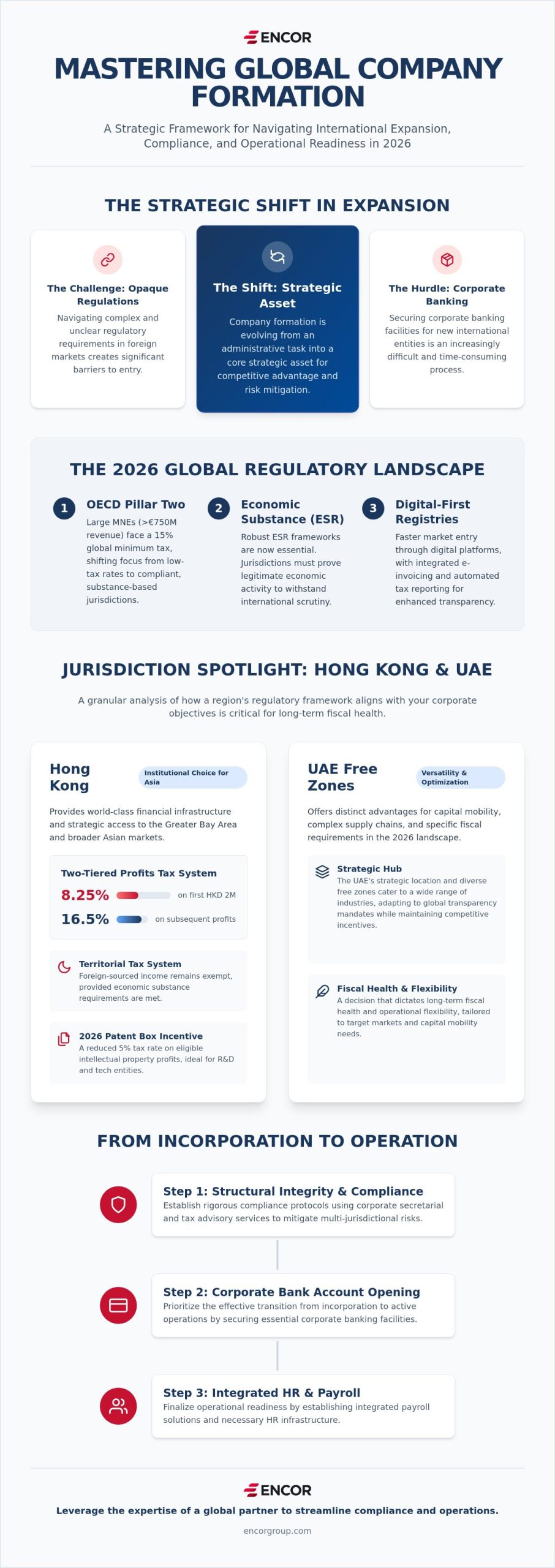
The implementation of global minimum tax standards, such as OECD Pillar Two, has fundamentally altered jurisdiction selection for multinational enterprises. Large organizations with revenues exceeding EUR 750 million must now navigate a 15% domestic minimum top-up tax in many regions. Jurisdictions are no longer evaluated solely on low tax rates but on their ability to provide robust Economic Substance Requirements (ESR) frameworks that withstand international scrutiny. Simultaneously, digital-first registries are streamlining the timeline for company formation. These platforms allow for faster market entry while integrating with accounting software for mandatory e-invoicing and automated tax reporting. This digital integration is essential for maintaining transparency in a compliance-first era.
Selecting the Optimal Jurisdiction: Hong Kong, UAE, and Beyond
Selecting a jurisdiction is a decision that dictates the long term fiscal health and operational flexibility of a multinational enterprise. It requires a granular analysis of how a specific region’s regulatory framework aligns with your corporate objectives. While many providers focus on domestic structures, global expansion demands a more sophisticated approach. The choice between premier hubs like Hong Kong and the UAE often hinges on your target markets, the complexity of your supply chain, and your specific requirements for capital mobility. Each jurisdiction offers distinct advantages in the 2026 landscape, particularly as they adapt to global transparency mandates while maintaining competitive incentives.
Hong Kong: The Institutional Choice for Asian Hubs
For organizations targeting the Greater Bay Area and broader Asian markets, Hong Kong company formation services provide access to a world class financial infrastructure. The city’s two tiered profits tax system remains a significant draw; the first HKD 2 million of assessable profits is taxed at 8.25%, with subsequent profits at 16.5%. Its territorial tax system ensures that foreign sourced income remains exempt, provided economic substance requirements are met. Additionally, the 2026 Patent Box incentive offers a reduced 5% tax rate on eligible intellectual property profits, making it an ideal hub for technology and R&D focused entities. The government fee for incorporation via electronic submission is HKD 1,720, complemented by a Business Registration Certificate fee of HKD 2,350 as of April 2026.
UAE Free Zones: Versatility and Fiscal Optimization
The Middle East offers a different but equally compelling value proposition. Strategic company formation in the UAE allows businesses to leverage a tiered corporate tax system where income up to AED 375,000 is taxed at 0%. Beyond this threshold, a competitive 9% rate applies. UAE Free Zones are particularly advantageous for foreign investors, offering 100% ownership and zero personal income tax. A significant development in 2026 is the Dual Licensing regime, which permits Free Zone companies to operate on the mainland without a separate onshore entity. This flexibility, combined with Small Business Relief for entities with revenues under AED 3 million, positions the UAE as a primary gateway for expansion into Africa and Europe.
Final selection must account for more than just tax rates. You must evaluate the strength of a jurisdiction’s tax treaty network, the availability of specialized talent, and the historical ease of corporate banking. In 2026, the UAE’s recognition of virtual business activities and AI driven contracts provides a modern legal standing that traditional jurisdictions are still working to match. Navigating these nuances requires the steady hand of a strategic navigator who understands the granular details of each market. For those seeking to optimize their global footprint, consulting with a seasoned advisor ensures that your chosen structure supports both immediate operations and future institutional growth.
Structural Integrity: Ensuring Long-Term Compliance and Governance
Successful company formation is merely the opening move in a complex global strategy. The true challenge lies in the sustained maintenance of structural integrity across multiple legal systems. It’s about achieving “Good Standing” through a rigorous approach to governance that transcends basic administrative tasks. Executives often underestimate the ongoing commitment required after they Register your business. Without a disciplined framework, the risk of bank account suspension or regulatory investigation increases significantly. Precision at this stage is what separates a high-performing entity from a liability.
Corporate Secretarial Services as a Governance Pillar
Corporate secretarial services serve as the primary pillar of institutional governance. In high-compliance hubs, a company secretary isn’t just a facilitator; they’re a statutory necessity. They hold the legal responsibility for managing share registers, recording board minutes, and ensuring all statutory filings are accurate. Precision is non-negotiable. In Hong Kong, for instance, the annual return (Form NAR1) must be filed within 42 days of the incorporation anniversary. Missing this window results in escalating fines and potential prosecution. Proactive secretarial support ensures these deadlines are met, protecting the entity’s reputation and operational continuity.
Tax and Accounting Standards for Global Entities
Global entities demand financial records that are both locally compliant and audit-ready for international scrutiny. This requires aligning local bookkeeping with global consolidated reporting standards. It’s a multifaceted process. In the UAE, the transition to mandatory e-invoicing using certified software by July 2026 adds another layer of complexity for operational entities. Professional tax advisory is essential for navigating Profit Tax Exemptions and leveraging Double Taxation Agreements (DTAs). These treaties are critical for optimizing fiscal depth. They ensure that profits aren’t eroded by redundant taxation across different jurisdictions.
Managing fragmented compliance across ten or more markets is a common objection for expanding firms. The administrative burden following company formation can distract from core commercial activities. A centralized governance partner provides the institutional confidence needed to operate at scale. By integrating bookkeeping, tax advisory, and secretarial duties into a single workflow, organizations ensure their global footprint remains a source of value. This methodical approach allows leadership to focus on growth while the underlying structure remains secure and compliant.
Operationalizing the Entity: Banking, HR, and Payroll
Receiving a certificate of incorporation is a significant milestone, but it doesn’t equate to a functional business. This “Day 2” transition often reveals the gap between legal company formation and commercial readiness. You must move quickly from a registered name to a live operation with the capacity to move capital and compensate staff. Without these operational pillars, the entity remains a dormant shell. Precision matters here. A failure to operationalize correctly can lead to missed contracts and degraded trust with local stakeholders.
Navigating Corporate Bank Account Opening
Banking is frequently the longest lead-time item in the expansion process. Some providers oversimplify this by suggesting that obtaining a tax identification number is the final step. In reality, foreign-owned entities face rigorous Know Your Customer (KYC) protocols and deep scrutiny regarding Beneficial Ownership reporting. Financial institutions in hubs like Hong Kong or the UAE require exhaustive documentation, including comprehensive business plans and proof of source of wealth. Professional introductions and meticulous file preparation are essential to avoid the delays that often stall new market entries. We ensure your application meets the high standards expected by global tier-one banks.
Human Capital and Payroll Infrastructure
Establishing a compliant presence requires a robust international payroll solutions framework from the outset. You can’t risk non-compliance with local labor laws or tax withholding requirements. Recruitment and HR management for multinational teams involve navigating diverse regulatory standards and cultural nuances. Executive-level HR consulting helps optimize these global operations, ensuring your leadership team is supported by a compliant administrative backbone. This methodical approach to company formation guarantees that your human capital is managed with the same precision as your legal structure.
To ensure your new entity is ready for immediate operation across multiple jurisdictions, partner with Encor Group for comprehensive banking and payroll support.
Partnering for Excellence: The Encor Group Advantage
Navigating the transition from company formation to full operational scale requires more than just administrative support; it demands a partnership rooted in strategic depth and institutional-grade precision. Managing multiple service providers across different time zones often leads to fragmented compliance and operational bottlenecks. Encor Group addresses this by providing a centralized platform that consolidates diverse service categories into a single, unified workflow. This approach ensures that your global footprint remains cohesive, secure, and fully aligned with your overarching corporate objectives. It’s a methodical way to ensure no detail is overlooked during high-stakes expansion.
Our four regional strategic hubs provide the localized expertise necessary to handle complex requirements with quiet efficiency. Whether you’re establishing a presence in Hong Kong or the UAE, you benefit from a consistent level of professional gravity and global standards. This end-to-end integration means that every facet of your expansion—from initial incorporation and tax advisory to recruitment and payroll—is handled by a team that understands the interconnected nature of international business environments. We don’t just facilitate entry; we build the foundation for sustained excellence.
A Global Platform for Strategic Growth
Encor Group serves more than 10 international markets, offering a robust infrastructure for multinational enterprises seeking reliable cross-border facilitators. By providing a single point of contact for global entity management, we eliminate the friction typically associated with multi-market expansion. This centralized model allows for better oversight and faster decision-making for your executive team. Encor Group acts as a strategic navigator for multinational enterprises, ensuring seamless movement through complex regulatory waters.
Next Steps: Initiating Your Expansion
Every successful market entry begins with a clear, well-defined roadmap. We prioritize a preliminary strategic consultation to understand the nuances of your business model and your specific long-term goals. This allows us to customize a formation roadmap that addresses your unique requirements for tax optimization, talent acquisition, and operational scalability. A proactive approach at this stage prevents the structural misalignments that can hinder future growth. Contact Encor Group today for a professional assessment of your expansion needs and take the first step toward a secure global presence.
Mastering the Future of Global Corporate Expansion
Executing a global growth strategy requires a shift from viewing company formation as an administrative hurdle to recognizing it as a foundational asset. Success in 2026 depends on your ability to select jurisdictions that offer both fiscal optimization and robust regulatory standing. By prioritizing institutional governance and ensuring your entities are operationally ready with banking and payroll from the outset, you protect your organization against fragmented compliance risks. It’s this methodical approach that ensures your international presence is a driver of value rather than a source of liability.
Encor Group provides the strategic depth needed to navigate high-stakes regulatory environments with confidence. With a global footprint serving more than 10 international markets, we offer comprehensive end-to-end corporate services tailored to your specific objectives. We don’t just help you enter a market; we help you lead it. Consult with Encor Group’s Strategic Advisors for Your Global Expansion to begin your journey toward a seamless and compliant international setup. Your vision for global growth deserves a partner committed to precision and excellence.
Frequently Asked Questions
How long does the company formation process typically take in Hong Kong vs. the UAE?
Incorporation in Hong Kong is highly efficient, with electronic submissions to the Companies Registry often processed within 24 hours. UAE Free Zone setups typically require between three to seven working days, depending on the specific jurisdiction and the complexity of the license. These timelines refer strictly to the legal registration and exclude the additional time required for secondary operational steps like bank account opening.
What are the minimum substance requirements for an international company in 2026?
Minimum substance requirements in 2026 demand that entities demonstrate a physical presence and local economic activity to satisfy international transparency standards. This includes maintaining a registered office, employing qualified personnel, and incurring adequate operational expenditure within the jurisdiction. Regulators in Hong Kong and the UAE now strictly enforce these rules to ensure that foreign sourced income remains compliant with global tax mandates.
Can a foreigner own 100% of a company in the UAE?
Yes, foreign investors can maintain 100% ownership of their entities within UAE Free Zones. Legislative changes have also expanded this privilege to many Mainland commercial activities, removing the previous requirement for a local majority shareholder in most sectors. This flexibility makes the UAE a primary choice for multinational enterprises seeking full control over their regional operations and capital mobility.
Is a physical office address mandatory for company registration in most international hubs?
A registered office address is a statutory requirement in most premier international hubs. While many jurisdictions allow for a registered address provided by a corporate service provider, it must be a physical location where legal documents can be served. In 2026, demonstrating economic substance may require more than just a mailing address, particularly for entities seeking to leverage specific tax treaty benefits.
What are the ongoing annual compliance costs for a Hong Kong entity?
Annual compliance costs for a Hong Kong entity consist of mandatory government fees and professional service charges for governance maintenance. The Business Registration Certificate fee is HKD 2,350 as of April 2026, and the annual return filing fee is HKD 105. Additionally, companies must budget for statutory audits and tax filing services to ensure they remain in “Good Standing” with the Inland Revenue Department.
How difficult is it to open a corporate bank account for a newly formed international company?
Opening a corporate bank account is often the most complex phase following the company formation process. Banks enforce rigorous KYC and Anti-Money Laundering protocols that require exhaustive documentation regarding beneficial owners and business models. Success depends on meticulous file preparation and professional introductions to ensure the application meets the high institutional standards of global tier-one financial institutions.
What is the difference between a Registered Agent and a Corporate Secretary?
A Registered Agent serves as the official point of contact for receiving legal documents and government notices on behalf of the company. In contrast, a Corporate Secretary holds a broader governance role, ensuring the entity complies with statutory requirements, manages board minutes, and maintains share registers. In jurisdictions like Hong Kong, the appointment of a qualified Corporate Secretary is a legal necessity for all entities.
Do I need to be physically present in the jurisdiction to complete the company formation?
Physical presence is generally not required to complete the legal company formation in Hong Kong or the UAE. Most incorporation procedures are handled electronically through authorized corporate service providers who act as your local representative. However, some financial institutions may require a physical meeting with authorized signatories during the bank account opening process to satisfy their internal security and identity verification protocols.