

The traditional six-week lead time for a business visa is no longer a prerequisite for entering the Chinese market. As of July 2026, the strategic expansion of china visa free policies has transformed short-term entry from a logistical hurdle into a tactical advantage for global executives. You likely recognize that while these exemptions offer unprecedented speed, the distinction between national unilateral entries and regional transit rules remains a source of operational risk. Non-compliance at the border can jeopardize sensitive market entry timelines and corporate reputation.
This guide clarifies the current framework, including the 30-day unilateral exemptions for 50 countries and the expanded 240-hour transit visa-free (TWOV) protocols. You’ll gain a precise understanding of how to utilize these frameworks to accelerate your market entry and operational due diligence. We’ll examine the specific requirements for 65 ports of entry and outline a strategy for using these short-term stays to facilitate your long-term corporate setup.
Key Takeaways
- Identify the strategic differences between 30-day unilateral exemptions and the 240-hour transit framework to optimize your 2026 travel schedule.
- Master the technical mechanics of the 144-hour TWOV and current china visa free policies to ensure seamless border compliance during multi-city itineraries.
- Evaluate regional entry programs in Hainan and the Greater Bay Area as specialized corridors for sector-specific market research and due diligence.
- Utilize short-term entry windows to execute critical operational tasks like bank account due diligence and partner validation before committing to a full-scale presence.
- Transition from the scouting phase to a permanent market position by leveraging Hong Kong’s proximity and institutional links for long-term entity management.
China Visa-Free Policies 2026: A Strategic Overview for Executives
The 2026 fiscal year marks a definitive shift in how the People’s Republic of China manages cross-border mobility. To stimulate foreign direct investment (FDI), the central government has transitioned from a strict stance of diplomatic reciprocity to a more aggressive, unilateral openness. For multinational enterprises, these updated china visa free policies represent a paradigm shift in operational agility. Executives can now bypass the traditional administrative delays associated with consular applications, allowing for immediate, high-stakes market scouting and partner due diligence.
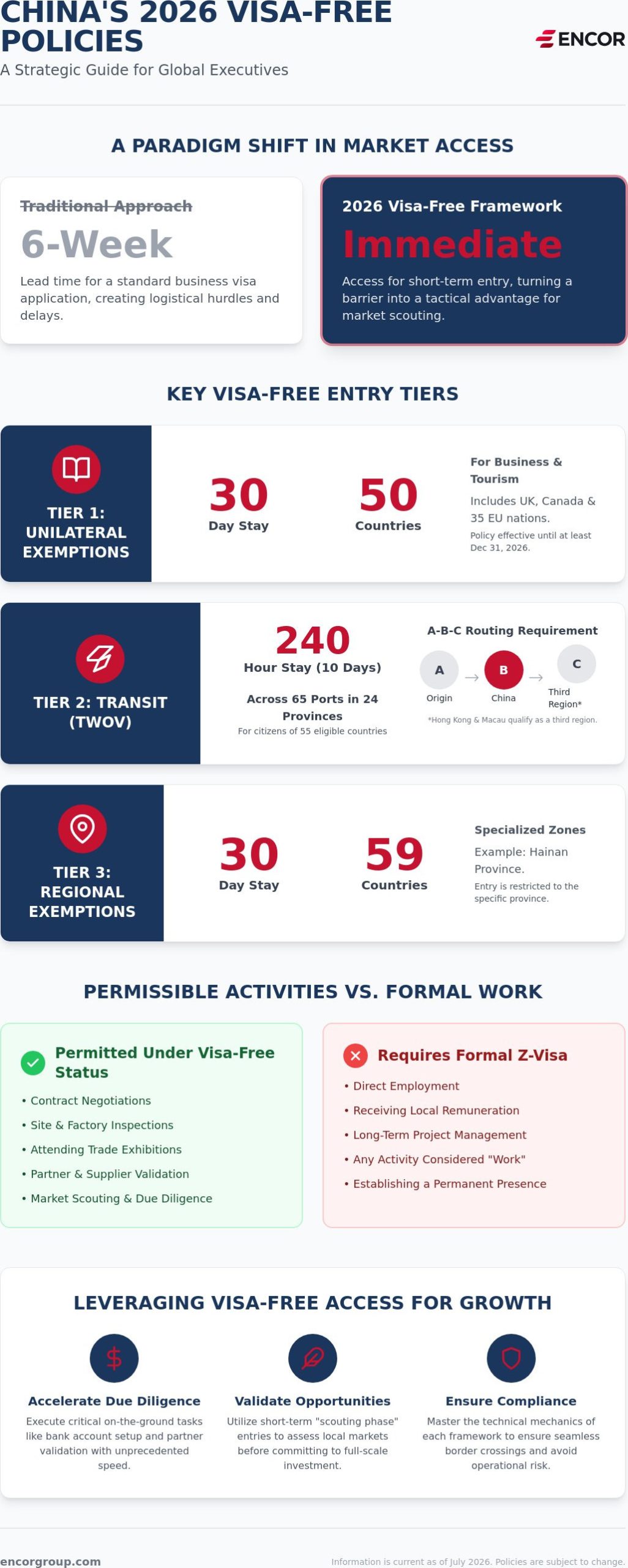
While these policies facilitate entry for “business meetings,” it’s vital to distinguish this from “work.” Permissible activities under visa-free status include contract negotiations, site inspections, and attending trade exhibitions. Engaging in direct employment or long-term project management still requires a formal Z-visa or similar authorization. Understanding the current Visa policy of mainland China is now a foundational requirement for any global expansion strategy. Using these windows for the “scouting phase” allows leadership to validate local opportunities before committing to the formal establishment phase managed by corporate service providers.
The Evolution of China’s Entry Framework
The National Immigration Administration (NIA) has streamlined entry protocols to support China’s 2026 economic objectives. Previously, visa exemptions were largely confined to small-scale bilateral agreements. Today, the framework prioritizes the ease of movement for key economic partners across Europe, Asia, and the Americas. This evolution significantly reduces the friction of global mobility. It enables leadership teams to respond to market opportunities with the same speed they would apply to domestic operations. Reciprocity is no longer the primary bottleneck for market entry.
Identifying Your Eligibility Tier
Strategic planning depends on identifying which entry tier applies to your jurisdiction and travel intent. The 2026 framework is categorized into three primary levels of access:
- Tier 1: Unilateral Exemptions. Citizens of 50 countries, including the United Kingdom, Canada, and 35 European nations, enjoy a 30-day visa-free stay for business and tourism. This policy remains in effect until at least December 31, 2026.
- Tier 2: Transit Without a Visa (TWOV). This tier covers 55 countries and allows for stays of up to 240 hours across 65 designated ports in 24 provinces. This is a critical tool for multi-leg regional tours.
- Tier 3: Regional Exemptions. Specialized zones like Hainan Province offer 30-day visa-free entry for citizens of 59 countries. These are restricted to the province but offer a streamlined path for regional industry engagement.
Unilateral Exemptions and the 144-Hour Transit Framework
The 2026 expansion of china visa free policies has introduced a dual-track system that serves distinct corporate needs. For citizens of 50 nations, including recent additions like the United Kingdom and Canada, a unilateral 30-day entry window is now standard. This provision allows for comprehensive market entry activities such as factory visits, trade fair attendance, and high-level contract signings without a prior visa application. These stays are strictly limited to non-remunerative business engagements. If your travel involves multiple regional hubs, the transit framework offers a separate, high-velocity entry path.
The core of the Transit Without a Visa (TWOV) system is the ‘A-B-C’ routing requirement. Your itinerary must originate in Country A, stop at a designated Chinese port (B), and depart to a distinct third country or region (C). Crucially, Hong Kong and Macau are categorized as third-party regions for these purposes. This allows executives to fly from London to Shanghai and then depart to Hong Kong to qualify for the exemption. You must possess a confirmed onward ticket and any necessary entry permits for your final destination to pass boarding checks.
Mastering the 240-Hour Transit Without a Visa (TWOV)
While historically limited to 144 hours, the 2026 regulations now permit stays of up to 240 hours (10 days) across 65 ports in 24 provinces. This extended window facilitates deep-dive operational due diligence across major economic clusters like the Yangtze River Delta. You must remain within the specific administrative region of your entry port throughout the duration of your stay. To avoid airline boarding denials, you must ensure your departure from China is to a country or territory different from the one you occupied immediately before arrival.
The APEC Business Travel Card (ABTC) Advantage
The APEC Business Travel Card remains the gold standard for frequent regional travellers, functioning as a multi-entry equivalent to a 60 or 90-day business visa. Recent 2026 updates have digitized the system, enabling virtual card acceptance at major immigration checkpoints for faster processing. This tool is reserved for senior executives and business owners who demonstrate a clear need for recurring regional mobility. It’s a vital component of a broader global business expansion strategy, providing the stability that unilateral exemptions cannot match for long-term planning.
Regional Visa-Free Programs: Hainan, Shanghai, and the GBA
While national china visa free policies provide broad access, regional frameworks offer specialized entry corridors tailored to specific economic hubs. These programs often bypass standard transit requirements, providing longer durations of stay or simplified documentation for targeted groups. Shanghai’s cruise ship program, for example, allows organized groups of at least two people to stay for up to 15 days when entering via coastal ports. This is a strategic option for corporate networking events or industry summits hosted on maritime vessels where the port of entry and departure remain consistent.
Hainan: The Gateway for Strategic Investment
Hainan Province operates the most liberal entry regime in the country to support its status as a Free Trade Port. Citizens from 59 countries are eligible for a 30-day visa-free stay, which is significantly longer than the standard 240-hour transit window. This duration is ideal for conducting deep-dive due diligence or exploring the province’s unique corporate tax incentives for foreign entities. You should be aware that this policy restricts your movement to Hainan alone; you cannot travel to the mainland under this specific exemption. It serves as a dedicated environment for international enterprises looking to validate market potential before committing to a full-scale establishment.
The Pearl River Delta and the GBA Framework
The Greater Bay Area (GBA) utilizes a specific 144-hour policy for foreign nationals who are already in Hong Kong or Macau. If you’re part of a tour group organized by a registered travel agency in these regions, you can enter Guangdong province for six days of business or tourism. This is a vital link for companies with existing Hong Kong operations. If you require even faster access to the tech hubs of Shenzhen, the ‘Shenzhen 5-Day VOA’ (Visa on Arrival) remains a reliable fallback. It allows for rapid entry at specific land borders, though it is subject to daily quotas and specific nationality restrictions. This regional flexibility ensures that your operational timelines aren’t delayed by centralized visa processing.
Regional compliance is paramount in these zones. High-surveillance environments in the GBA and Shanghai mean that even minor overstays can lead to significant penalties or future entry bans. You must ensure your departure port and itinerary align with the specific regional requirements of your entry permit. These regional programs aren’t just travel conveniences; they’re strategic tools for targeted market engagement in China’s most productive economic clusters.
Operationalizing Visa-Free Access for Market Entry
Strategic use of china visa free policies allows leadership teams to execute critical scouting maneuvers before committing to long-term capital expenditure. The 15-day or 30-day unilateral entry windows provide sufficient time for completing the physical components of Hong Kong company formation, including in-person bank account due diligence and meetings with corporate secretarial advisors. By utilizing these exemptions, you can validate the local operational environment without the administrative burden of securing a pre-approved invitation letter from a mainland sponsor for every individual trip.
The ‘Scout and Scale’ strategy leverages the 144-hour TWOV stay for rapid-response validation. This timeframe is ideal for visiting manufacturing facilities in the Pearl River Delta or meeting potential joint venture partners in Shanghai. Once these initial benchmarks are met, the data gathered informs a more robust global business expansion strategy. This methodical approach ensures that your permanent market entry is based on verified on-the-ground intelligence rather than remote market analysis. Transitioning from a temporary visitor to a registered entity requires precise coordination between travel access and corporate establishment.
Risk Management and Compliance Standards
Compliance begins with a clear distinction between business and work. Visa-free entry permits meetings, negotiations, and inspections, but it doesn’t allow for the provision of services or direct employment. If your stay involves technical troubleshooting or hands-on labor, you risk violating entry terms. Stay durations are calculated precisely; the countdown for your permitted stay typically begins at midnight on the day following your arrival. Overstaying these limits, even by a few hours, can result in substantial fines, detention, and a multi-year ban on future entry. Maintaining a strict departure schedule is non-negotiable for corporate travellers.
Due Diligence Checklist for Short-Term Entry
Even when a formal visa isn’t required, maintaining an internal dossier of supporting documents is essential for regulatory transparency. You should carry a letter of invitation from your local partner and proof of confirmed accommodation to facilitate the mandatory registration process. All foreign visitors are legally required to register their temporary residence with the local Public Security Bureau (PSB) within 24 hours of arrival. While hotels handle this automatically, those staying in private residences or corporate apartments must complete this registration in person at the local police station to avoid compliance failures.
If your scouting phase confirms the viability of a permanent presence, our specialists can assist with Hong Kong company formation to anchor your regional operations.
Scaling Beyond Travel: Establishing Corporate Presence
The strategic application of china visa free policies serves as a high-velocity entry mechanism, yet it remains a strictly temporary solution. While a 30-day stay facilitates initial partner selection and physical site inspections, it doesn’t provide the legal foundation required for sustained commercial operations or local revenue generation. For enterprises committed to long-term growth, the scouting phase must eventually transition into a robust global entity management framework. Establishing a permanent corporate presence ensures your business can legally hire local talent, execute long-term contracts, and maintain a compliant tax profile.
Operational maturity requires more than just physical access; it demands a comprehensive administrative foundation. As your mainland activities scale, the focus inevitably shifts from travel logistics to the complexities of international payroll solutions and localized HR compliance. Encor Group bridges the gap between your initial market entry and full-scale institutional stability. We handle the rigorous demands of corporate secretarial services, accounting, and tax advisory, allowing your leadership team to focus exclusively on market capture and strategic growth.
The Hong Kong-Mainland China Synergy
Hong Kong continues to serve as the primary institutional gateway for this transition. Its unique proximity to the Greater Bay Area and its sophisticated legal environment make it the ideal headquarters for China-bound ventures. The ease of travel between Hong Kong and mainland economic hubs under current china visa free policies allows executives to maintain rigorous oversight of mainland operations without the immediate need for complex long-term residency permits. This regional synergy is further enhanced by the Hong Kong-China double taxation treaty, which provides a strategic advantage in optimizing capital flow and reducing the fiscal burden on cross-border transactions.
Institutional Support for Global Expansion
Managing compliance across multiple jurisdictions is a high-stakes requirement that demands seasoned expertise and quiet efficiency. Our team ensures that your corporate structure remains resilient and fully aligned with both local and international regulatory standards. Once you have validated your market potential through short-term scouting trips, the next logical step is to formalize your presence with a partner that understands the intricacies of cross-border operations. You can scale your business with Encor Group’s strategic consulting to ensure your transition from a temporary visitor to a permanent market leader is seamless and professional.
Strategic Implementation of China Entry Frameworks
The 2026 expansion of china visa free policies has successfully reduced the friction of initial market entry. By utilizing the 30-day unilateral exemptions or the 240-hour TWOV system, your leadership team can execute on-the-ground due diligence with unprecedented speed. These frameworks are tactical tools for the scouting phase. They don’t replace the need for a robust institutional foundation. Sustaining a competitive advantage in the region requires a transition from temporary access to a structured corporate presence that can support long-term operations.
Encor Group provides the stability required for this transition. With strategic hubs in Hong Kong and the UAE and expertise in over 10 global markets, we deliver institutional-grade compliance management that supports your high-stakes objectives. We manage the complexities of incorporation and regulatory advisory so you can focus on market growth. This steady oversight ensures your expansion remains compliant and efficient as you scale.
Scale your global operations with Encor Group’s strategic expansion services and secure your position in the world’s most dynamic economic clusters.
Frequently Asked Questions
Can I attend business meetings in China under the 144-hour visa-free transit policy?
Yes, you can attend business meetings, negotiations, and exhibitions under this framework. While the policy is often associated with tourism, it is a legitimate tool for short-term corporate engagements. You must ensure your activities don’t cross into “work,” which involves direct employment or project management. The current china visa free policies permit these scouting activities provided you maintain a confirmed onward ticket to a third country.
Which countries have unilateral visa-free access to China in 2026?
As of July 2026, 50 countries enjoy unilateral visa-free access for stays up to 30 days. This list includes 35 European nations, such as Germany, France, and Italy, along with the United Kingdom and Canada, which were added earlier this year. Business travellers from these regions can enter for commercial purposes without an invitation letter or prior consular application, significantly increasing operational agility for multinational enterprises.
Does Hong Kong count as a third country for the 240-hour TWOV requirement?
Yes, Hong Kong, Macau, and Taiwan are categorized as “third countries or regions” for the purpose of Transit Without a Visa (TWOV) routing. To qualify for the 240-hour (10-day) exemption, your itinerary must follow an A-B-C pattern. For example, a flight path from Singapore to Shanghai and then to Hong Kong satisfies the requirement. This makes Hong Kong a strategic transit hub for executives managing mainland operations.
What happens if I overstay my visa-free period in China?
Overstaying a visa-free period is a serious compliance failure that results in immediate penalties. You’ll likely face fines of 500 RMB per day, up to a maximum of 10,000 RMB. In more severe cases, authorities may impose 5 to 15 days of administrative detention. Beyond financial costs, an overstay record often leads to future entry denials and can jeopardize your company’s standing with the National Immigration Administration.
Is police registration required if I am entering China visa-free for only 3 days?
Yes, police registration is mandatory for all foreign nationals within 24 hours of entry, regardless of the stay’s duration. If you’re staying at a hotel, the staff will complete this process automatically during check-in. However, if you’re occupying a private residence or a corporate apartment, you must visit the local Public Security Bureau (PSB) in person. Failure to register is a violation of china visa free policies and can result in fines.
Can I travel to other cities in China during my 240-hour transit stay?
You are generally restricted to the administrative region or province of your entry port. For example, if you enter via Shanghai, you can typically travel within the Yangtze River Delta area, including Jiangsu and Zhejiang provinces. However, you cannot travel to Beijing or other non-contiguous regions. You must verify the specific geographic boundaries of your entry port’s permit at the border to ensure total compliance with regional movement restrictions.
Do I need an invitation letter for a 30-day unilateral visa-free entry?
No, a formal invitation letter is not required for the initial border crossing under the unilateral exemption policy. You only need a valid passport from an eligible country. While not mandatory for entry, carrying a letter from your local partner is recommended. This document provides supporting evidence for your business intent and simplifies the mandatory temporary residence registration process at the local police station after you arrive.
Can I apply for a longer business visa (M-Visa) while inside China on a visa-free entry?
No, you cannot convert a visa-free entry into a formal M-Visa or any other long-term permit while remaining inside the country. Visa-free status is intended for short-term stays and lacks the administrative track for domestic conversion. If your scouting phase indicates a need for a longer stay, you must exit China and apply for the appropriate business visa at an overseas Chinese embassy or consulate.