
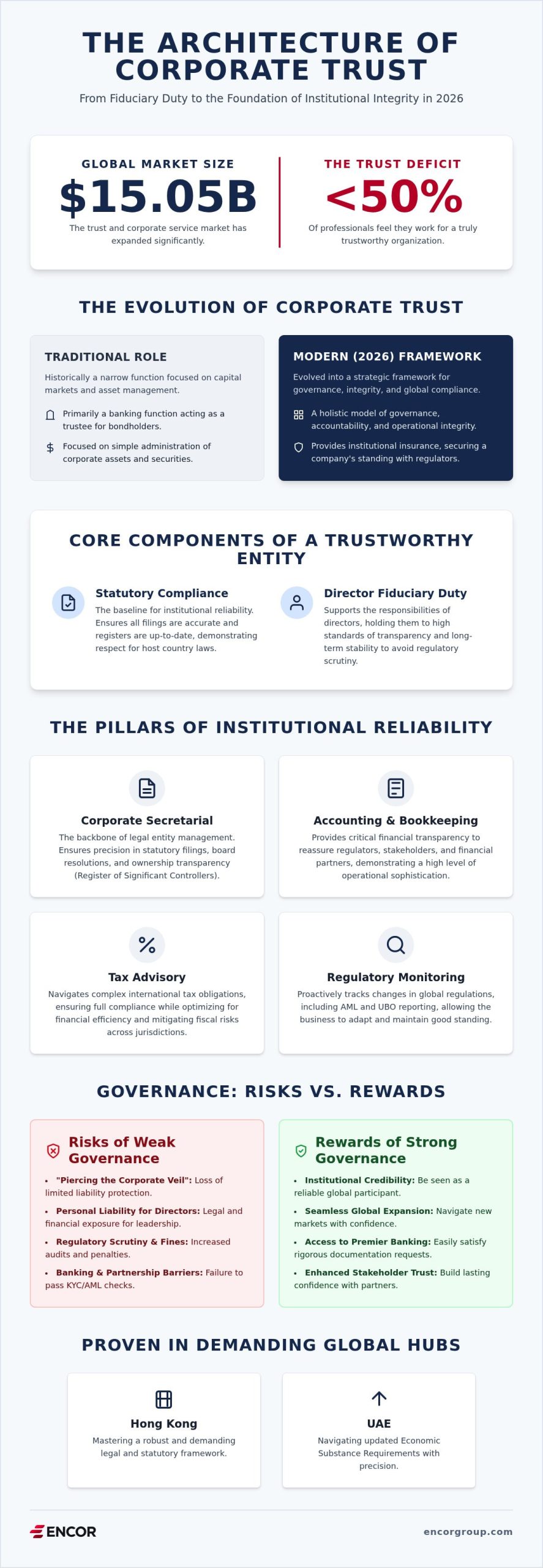
Recent 2026 data reveals that while the global trust and corporate service market has expanded to $15.05 billion, fewer than 50% of professionals believe they work for a truly trustworthy organization. This disconnect highlights a critical vulnerability for firms operating across international borders. Establishing a robust foundation of corporate trust is no longer a secondary concern. It’s the strategic institutional insurance required to maintain global market access and regulatory favor.
You’re likely aware that managing an international entity often feels like a constant battle against fragmented regulations and shifting beneficial ownership requirements. Maintaining bank-grade records isn’t just about administrative diligence; it’s about protecting your directors from personal liability and ensuring operational continuity. This guide demonstrates how corporate trust serves as the foundational architecture for international compliance, regulatory standing, and operational integrity in 2026. We’ll examine the strategic governance frameworks required for seamless reporting in global hubs like Hong Kong and the UAE, ensuring your business maintains its competitive edge through precise, proactive management.
Key Takeaways
- Understand how corporate trust has transitioned from a fiduciary obligation into the foundational architecture for institutional integrity in 2026.
- Identify the critical governance pillars, such as secretarial services and financial transparency, that sustain a company’s standing with international regulators.
- Explore regional benchmarks for excellence, specifically focusing on Hong Kong’s legal framework and the UAE’s updated Economic Substance Requirements.
- Master the complexities of ultimate beneficial ownership reporting and anti-money laundering compliance to mitigate personal liability for directors.
- Learn how a centralized approach to entity management can streamline operations across multiple global jurisdictions.
What is Corporate Trust? From Fiduciary Duty to Institutional Integrity
Traditionally, the term described a financial institution acting as a trustee for bondholders or managing corporate assets. While that definition remains relevant in capital markets, What is Corporate Trust? in the modern era has evolved into something far more comprehensive. It’s the strategic framework that ensures an organization operates with institutional integrity across multiple jurisdictions. This evolution reflects a shift from simple asset management to a holistic model of governance and accountability.
Corporate trust isn’t merely a banking function; it’s the connective tissue between a legal entity and global regulators. It represents a verified record of a company’s existence, its governance, and its commitment to statutory obligations. In 2026, distinguishing between banking trusts and corporate secretarial trust services is essential. While banking trusts handle securities and debt, secretarial trust focuses on the operational integrity of the company itself. It’s the assurance that a business is “in good standing” in every market where it operates, providing a layer of institutional insurance for stakeholders.
The Core Components of a Trustworthy Entity
Statutory compliance serves as the baseline for institutional reliability. It’s the evidence that a company respects the laws of its host country. The corporate secretary plays a central role here, acting as the primary liaison between the business and the state. They ensure that every filing is accurate and every register is up to date. This diligence supports the fiduciary responsibilities of directors. Regulators in 2026 hold directors to high standards of transparency, requiring them to demonstrate that the entity is managed with a focus on long-term stability. Without these core components, the internal architecture of the business begins to erode, inviting regulatory scrutiny.
Why Institutional Trust Matters for Global Expansion
Expanding into hubs like Hong Kong or the UAE requires more than just a business plan. You need institutional credibility to navigate local systems. Verified corporate records are the primary requirement for successful bank account opening assistance. Banks in 2026 require exhaustive documentation to satisfy KYC and AML protocols; without a history of institutional integrity, these doors remain closed.
Maintaining this level of trust also protects the entity’s legal structure. Sloppy record-keeping can lead to “piercing the corporate veil,” where the separation between the company and its owners is ignored. This exposes directors to personal liability. By prioritizing a robust governance framework, businesses build lasting credibility with international partners and stakeholders. This ensures they’re seen as reliable participants in the global economy, capable of handling high-stakes requirements with quiet efficiency.
The Pillars of Institutional Reliability and Governance
Establishing Institutional Reliability and Governance requires more than a passive commitment to ethical standards. It demands a structured approach to entity management where every administrative action reinforces corporate trust. In the global marketplace, four specific pillars support this architecture: corporate secretarial services, accounting, tax advisory, and proactive regulatory monitoring. Each function serves as a layer of defense against operational friction and legal exposure.
Professional secretarial support acts as the primary backbone of legal entity management. It’s the mechanism that translates statutory requirements into documented compliance. This isn’t just about filing paperwork; it’s about maintaining the legal health of the organization. Similarly, accounting and bookkeeping provide the financial transparency necessary to reassure regulators and stakeholders alike. When these elements work in unison, the business demonstrates a level of sophistication that invites growth and investment.
The Strategic Value of Professional Secretarial Support
Precision in managing annual returns and statutory filings is a non-negotiable standard for global firms. Professional secretarial teams maintain the Register of Significant Controllers with absolute accuracy, ensuring that ownership transparency meets the rigorous demands of 2026 regulations. Board resolutions and minutes must also be drafted to meet international audit standards. These documents aren’t just internal records. They are the evidence of sound decision-making that banks and authorities demand during high-stakes reviews.
Financial Transparency as a Trust Mechanism
There’s a direct correlation between meticulous bookkeeping and the favor an entity receives from regulatory bodies. Incomplete or erratic financial records signal a lack of control, which can lead to intrusive investigations. Utilizing international tax advisory services allows businesses to navigate cross-border obligations without compromising their integrity. This strategic alignment ensures that tax positions are optimized while remaining fully compliant with local laws.
Audit readiness is the ultimate test of corporate trust. A business that maintains its records in a constant state of verification is one that can pivot quickly in response to market opportunities. This level of preparedness reduces the risk of reputational damage and ensures that the “corporate veil” remains intact. If your current structure lacks this level of rigor, exploring professional compliance advisory can bridge the gap between basic existence and institutional excellence.
Regional Benchmarks: Corporate Trust in Hong Kong and the UAE
Global trade hubs compete not just on tax rates but on the strength of their regulatory frameworks. Hong Kong and the UAE have positioned themselves as centers of excellence by codifying high standards of corporate trust. While the legal definition of a corporate trustee typically centers on the management of third-party assets, these jurisdictions apply that same level of fiduciary rigor to general corporate governance. This approach attracts foreign direct investment by offering a predictable environment where legal rights are protected and obligations are clearly defined.
Hong Kong continues to represent the gold standard for corporate governance in Asia. Its legal system, rooted in common law, provides a level of institutional stability that’s difficult to replicate. The Companies Ordinance sets out mandatory duties for directors, including the requirement to act in good faith and maintain accurate statutory records. Engaging Hong Kong company formation services is the first step in aligning a new entity with these rigorous standards. By meeting filing deadlines and maintaining transparency, businesses leverage Hong Kong’s global reputation to secure favorable standing with international banks and partners.
Hong Kong’s Regulatory Environment
Compliance in Hong Kong isn’t a passive activity. It requires active management of statutory duties, such as the timely filing of annual returns and the maintenance of a Significant Controllers Register. These requirements ensure that the “trust” between the state and the entity remains intact. Firms that ignore these deadlines face significant penalties and risk their standing in one of the world’s most stable financial environments. Leveraging this reputation allows enterprises to operate with a level of credibility that simplifies cross-border transactions and attracts high-tier stakeholders.
The UAE’s Evolving Compliance Landscape
The UAE’s compliance landscape has undergone a significant transformation. The introduction of federal corporate tax and updated 2026 Economic Substance Requirements (ESR) means that “paper companies” aren’t a viable option for serious investors. Whether a firm chooses UAE Free Zone incorporation or a mainland structure, it must demonstrate genuine economic activity. Maintaining a registered office address is now a critical component of this substance. It’s a physical signal of a company’s commitment to the region and its compliance with local law. These regulations ensure that corporate trust in the Middle East is built on verifiable local operations rather than mere administrative existence.
In 2026, the reporting standards in these two hubs reflect a global trend toward transparency. Hong Kong relies on its established statutory framework to ensure accountability. Conversely, the UAE uses a combination of tax registration and ESR filings to monitor corporate activity. Both regions have strengthened their Ultimate Beneficial Ownership (UBO) disclosure requirements, with the UAE imposing a late tax registration penalty of AED 10,000. This comparative analysis shows that while their methods differ, their goal is identical: creating an environment where institutional integrity is the primary driver of commercial success.
Risk Mitigation: Navigating Global Regulatory Complexity in 2026
The regulatory environment in 2026 is defined by a relentless drive toward transparency. For multinational enterprises, corporate trust is the primary mechanism used to mitigate risk in an era of heightened scrutiny. Regulators now utilize sophisticated data-sharing protocols to monitor beneficial ownership and financial flows across borders. This shift means that a lapse in one jurisdiction can quickly trigger investigations in another. Maintaining a high standard of institutional integrity is no longer just a best practice; it’s a survival strategy for global market access.
Protecting an organization from regulatory “blacklisting” requires a proactive approach to record-keeping. In 2026, the global trust and corporate service market is projected to reach $15.05 billion, driven largely by the need for expert navigation through these complexities. Digital compliance tools are revolutionizing this space. AI-based monitoring and digital trust platforms now allow for real-time reporting, reducing the manual effort involved in multi-jurisdictional filings and ensuring that every record is audit-ready at a moment’s notice.
Managing the KYC/AML Burden
Standardizing documentation for corporate bank account opening assistance is a critical first step for any expanding firm. Banks in 2026 don’t just look at who owns a company; they analyze the entire governance structure and the validity of its records. Proactive risk assessment for international entity management requires a constant audit of verified corporate documents. High-stakes transactions, such as mergers or large-scale acquisitions, can stall or fail if the underlying trust data is incomplete or outdated. Organizations must maintain bank-grade records to ensure they remain attractive to financial institutions and partners.
Economic Substance and Operational Reality
The era of “paper companies” has effectively ended. To maintain corporate trust, businesses must demonstrate Core Income-Generating Activities (CIGA) within the jurisdictions where they claim tax residency. This is particularly relevant in hubs like the UAE, where enhanced verification procedures for ultimate beneficial ownership are now the standard. Aligning your global business expansion strategy with these operational realities ensures that growth doesn’t come at the cost of structural compliance. Demonstrating real substance, such as local management and physical presence, is the only way to satisfy modern regulatory expectations. For organizations seeking to fortify their global standing, Encor Group’s compliance advisory provides the strategic navigation required to manage these complexities with institutional confidence.
Securing Your Global Standing with Encor Group
Encor Group serves as a strategic navigator for enterprises requiring sophisticated entity management across 10+ international markets. Our end-to-end approach to corporate secretarial and compliance services ensures that every administrative action reinforces your firm’s corporate trust. By centralizing these functions, we eliminate the operational silos that often lead to regulatory friction. Our regional hubs in Hong Kong and the UAE serve as centers of excellence, providing the deep local knowledge necessary to manage high-stakes requirements with quiet efficiency and institutional confidence.
The synergy between HR, payroll, and corporate governance is a defining feature of our service model. When these functions are managed by a single partner, the risk of data inconsistency is significantly reduced. This unified oversight provides a clear, audit-ready record that satisfies both internal stakeholders and external regulators. We prioritize precision and stability, allowing your leadership to focus on expansion while we manage the underlying structural complexities. This single-partner approach reduces administrative friction and ensures that your global operations remain seamless and secure.
Integrated Solutions for Global Success
A robust governance framework requires the seamless integration of various operational pillars. Combining incorporation with ongoing international payroll solutions ensures that your entity meets both corporate and employment law standards simultaneously. We develop customized compliance roadmaps tailored to the specific demands of your target markets, whether you’re entering the UAE mainland or a Hong Kong trade zone. The Encor advantage lies in our ability to provide high-level consulting with a results-oriented focus, ensuring that your global footprint is built on a foundation of institutional excellence.
Next Steps for International Entities
Securing your global standing begins with a clear understanding of your current compliance health. We recommend conducting a comprehensive gap analysis of your corporate records to identify potential vulnerabilities before they become regulatory liabilities. Transitioning to a professional corporate services provider is a strategic move that protects your directors and ensures long-term stability in a volatile economic environment.
Contact Encor Group to schedule a strategic consultation on your 2026 expansion. We’ll provide the expert guidance needed to fortify your corporate trust and navigate the complexities of international business with the steady assurance of a seasoned advisor. By partnering with us, you gain access to an international reach and a commitment to precision that transforms compliance from a burden into a competitive advantage.
Establishing Institutional Excellence for 2026
Operating within the global regulatory landscape in 2026 requires more than mere administrative diligence. It demands a strategic commitment to corporate trust as the primary driver of market access and long-term stability. By prioritizing verified records and a robust governance framework, enterprises protect themselves against personal liability and ensure seamless reporting in critical hubs like Hong Kong and the UAE. Institutional integrity is no longer a secondary concern. It’s the foundational architecture that allows a business to scale with confidence across international borders.
Encor Group provides the strategic navigation necessary to manage these complexities with institutional confidence. We’re operational in 10+ global markets, offering specialized expertise in the specific regulatory frameworks of Hong Kong and the UAE. Our end-to-end approach integrates compliance with HR and payroll, reducing structural risk and administrative friction for your leadership team. Secure your institutional foundation with Encor Group’s strategic corporate services. We look forward to facilitating your next phase of global growth with precision and excellence.
Frequently Asked Questions
What is the primary difference between a corporate trust and a business trust?
A corporate trust refers to a suite of fiduciary services provided to corporations, such as acting as a trustee for bondholders or ensuring governance standards. In contrast, a business trust is a specific legal entity where trustees hold and manage assets for beneficiaries, often used as an alternative to a corporation or partnership. While the former focuses on institutional integrity and debt management, the latter is a structural choice for asset protection and operation.
Why do I need a professional corporate secretary for my international entity?
Professional secretarial services ensure that your organization remains in good standing with local regulators by managing statutory filings and annual returns with absolute precision. They act as the essential liaison between your business and the state, maintaining vital records like the Register of Significant Controllers. Without this oversight, international entities often face severe penalties, administrative friction, and the potential loss of their limited liability protections.
How does corporate trust impact my ability to open a business bank account?
Financial institutions in 2026 utilize corporate trust as a primary metric for risk assessment during the onboarding process. Banks require exhaustive, verified documentation to satisfy their KYC and AML protocols. An entity that demonstrates a high level of institutional integrity through meticulous record-keeping and professional governance is far more likely to secure bank account opening assistance without delays or rejections.
What are the key compliance requirements for a Hong Kong company in 2026?
Hong Kong companies must adhere to the Companies Ordinance, which includes the mandatory filing of annual returns and the maintenance of a Significant Controllers Register. Additionally, the Hong Kong Monetary Authority has implemented strict licensing regimes for stablecoin issuers as of early 2026. Businesses must also ensure their Trust or Company Service Provider (TCSP) is properly licensed to avoid statutory violations and maintain their standing in the Asian market.
How does the UAE’s Economic Substance Requirement (ESR) affect corporate trust?
The UAE’s ESR mandates that companies demonstrate genuine economic activity through Core Income-Generating Activities (CIGA) within the region. This requirement prevents the use of “paper companies” and ensures that corporate trust is built on operational reality. Failure to comply or provide accurate UBO documentation can result in significant fines, including a penalty of AED 10,000 for late corporate tax registration, which damages an entity’s reputation with Middle Eastern regulators.
Can Encor Group assist with beneficial ownership reporting across multiple countries?
Yes, Encor Group specializes in centralized entity management across 10+ global markets, including major hubs like Hong Kong and the UAE. We provide end-to-end support for ultimate beneficial ownership (UBO) reporting, ensuring that your disclosures are consistent and compliant across every jurisdiction where you operate. This proactive approach reduces the risk of regulatory “blacklisting” and simplifies the complexity of multi-country reporting requirements.
What are the risks of maintaining corporate records in-house without professional oversight?
In-house record management often leads to missed filing deadlines and inaccurate statutory registers, which can trigger intrusive regulatory audits. The most significant risk is the “piercing of the corporate veil,” where poor administrative diligence allows creditors or authorities to hold directors personally liable for company debts. Professional oversight mitigates these risks by ensuring that every board resolution and filing meets international audit standards.
How often should a global entity conduct a compliance audit of its corporate trust framework?
A global entity should conduct a comprehensive compliance audit at least once per year to account for shifting international standards. However, if your business operates in high-growth or volatile environments, it’s advisable to perform a gap analysis bi-annually. Regular reviews ensure that your governance pillars, such as tax advisory and secretarial records, remain aligned with the latest 2026 regulatory updates and economic substance requirements.