
The assumption that offshore jurisdictions prioritize opacity over operational substance is no longer compatible with the global regulatory landscape. As of April 2026, the British Virgin Islands has transitioned to a “legitimate-interest” access regime for beneficial ownership, signaling a definitive shift toward institutional-grade transparency. For the sophisticated executive, establishing a bvi company is no longer about seeking a hidden corner of the globe; it’s about utilizing a premier corporate vehicle that balances tax neutrality with rigorous international compliance standards.
You’re likely aware that navigating evolving Economic Substance requirements and managing global transparency can create significant operational friction. This guide provides a strategic overview of the BVI corporate framework, focusing on how to achieve structural efficiency and asset protection within this modern environment. We’ll examine the current filing requirements, the benefits of tax neutrality, and the precise methods for integrating BVI entities with onshore hubs like Hong Kong and the UAE to ensure seamless operational flexibility and high-level corporate governance.
Key Takeaways
- Understand the strategic value of tax neutrality and structural efficiency for international special purpose vehicles in the 2026 regulatory environment.
- Identify the core differences between various corporate vehicles under the BVI Business Companies Act to select the optimal structure for asset protection.
- Navigate complex compliance requirements, including the BOSS Act and Economic Substance (ES) reporting, to maintain institutional-grade standing.
- Learn how a bvi company serves as a critical component in a global expansion strategy when integrated with onshore hubs like Hong Kong and the UAE.
- Master the 2026 incorporation timeline and the rigorous KYC and AML documentation standards required for modern cross-border operations.
The Strategic Role of the BVI Business Company in 2026
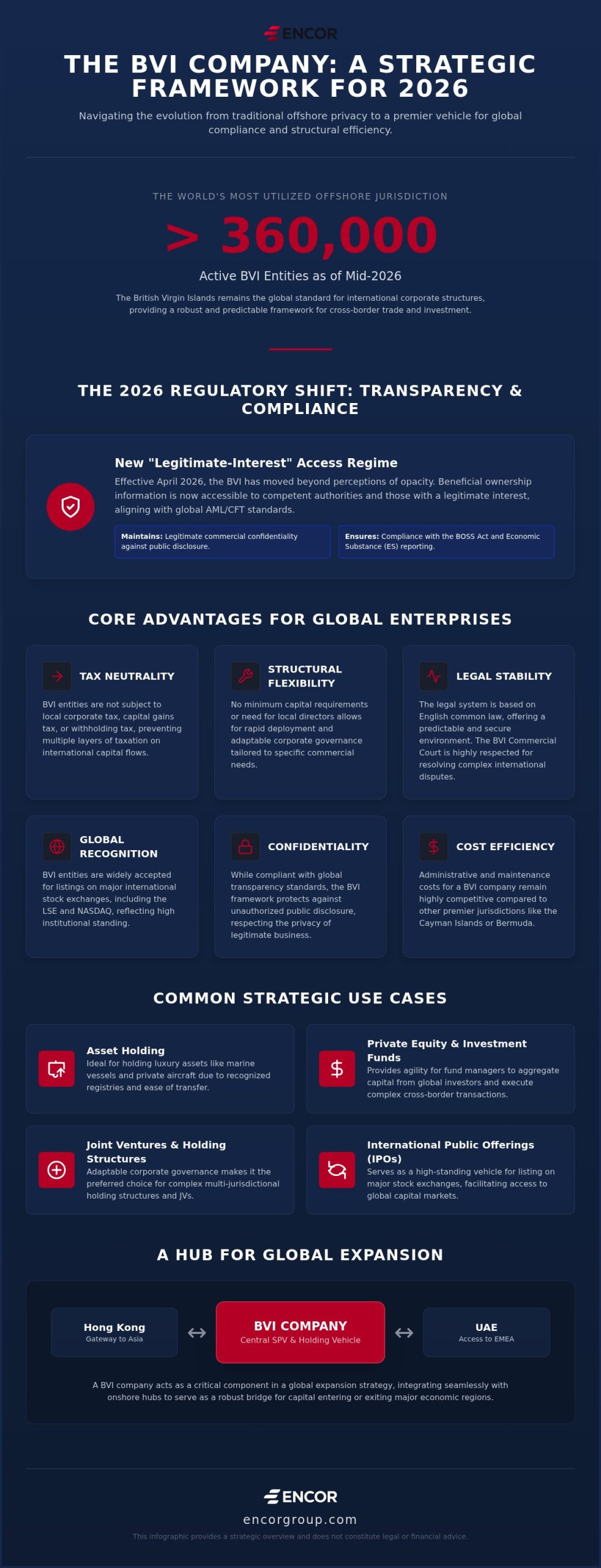
The British Virgin Islands remains the world’s most utilized offshore corporate jurisdiction, hosting over 360,000 active entities as of mid-2026. The BVI Business Companies Act provides the statutory foundation for these vehicles, prioritizing operational efficiency and legal certainty. A bvi company serves as a neutral platform for international trade and investment, ensuring that capital flows aren’t subject to multiple layers of taxation. This tax neutrality is indispensable for Special Purpose Vehicles (SPVs) that aggregate capital from diverse global investors to fund specific projects or acquisitions.
The jurisdiction’s legal framework is rooted in English common law, offering a predictable environment for dispute resolution. The BVI Commercial Court is recognized for its sophistication, handling high-value international litigation with a level of expertise that mirrors the High Court in London. This legal stability, combined with the territory’s long-standing political calm, reinforces its reputation as a secure hub for institutional capital. In an era of shifting global alliances, the BVI’s adherence to the rule of law provides a necessary anchor for cross-border operations.
Core Advantages for Global Enterprises
Structural flexibility is a hallmark of the BVI framework. There are no requirements for local directors or minimum capital amounts, allowing for rapid deployment of capital. While the BVI has adopted a “legitimate-interest” access regime for beneficial ownership information as of April 1, 2026, it continues to protect commercial confidentiality against unauthorized public disclosure. This balance ensures compliance with global AML standards while respecting the privacy of legitimate business operations. Additionally, the administrative costs associated with maintaining a bvi company remain highly competitive when compared to other top-tier jurisdictions like the Cayman Islands or Bermuda.
Common Use Cases: From Asset Holding to Investment Funds
BVI entities are frequently integrated into a broader global business expansion strategy. They are the vehicle of choice for holding luxury assets, such as marine vessels and private aircraft, due to the jurisdiction’s recognized registries and ease of transfer. In the private equity sector, BVI structures provide the necessary agility for fund managers to execute complex cross-border transactions. Many enterprises also utilize BVI vehicles for listing on international stock exchanges, including the LSE and NASDAQ, benefiting from the jurisdiction’s high institutional standing. When paired with hong kong company formation services, these structures offer a robust bridge for capital entering or exiting Asian markets.
The BVI Business Companies Act (Official Text) provides a modern and highly adaptable framework for corporate governance. Unlike jurisdictions that impose rigid templates, the BVI allows companies to tailor their Memorandum and Articles of Association to meet specific commercial objectives. This flexibility is a primary reason why a bvi company remains the preferred choice for complex joint ventures and multi-jurisdictional holding structures. Every entity must appoint a licensed Registered Agent within the territory. This agent acts as the official liaison with the Registry, ensuring that all statutory filings and beneficial ownership records remain current. It’s important to understand that the agent isn’t merely a mailbox; they’re a critical compliance gatekeeper responsible for maintaining the non-public BOSSs records.
Companies Limited by Shares and Guarantee
The company limited by shares is the most prevalent structure for international trade. It offers shareholders clear liability protection, limited strictly to the amount unpaid on their shares. For entities engaged in non-profit activities or charitable international initiatives, the company limited by guarantee provides an alternative where members act as guarantors rather than equity holders. Hybrid structures also exist, allowing for a combination of shares and guarantees. These are often used in sophisticated estate planning or for organizations that require distinct classes of membership with varying rights and obligations. It’s a level of versatility that isn’t easily matched by onshore corporate registries.
Specialized Structures: Segregated Portfolio Companies (SPC)
For investment managers and insurance providers, the Segregated Portfolio Company (SPC) offers an institutional-grade solution for risk management. An SPC allows a single legal entity to create multiple “portfolios,” each with its own segregated assets and liabilities. If one portfolio faces a legal claim, the assets of other portfolios remain protected. This is particularly efficient for multi-class investment funds where different strategies are housed under one umbrella. Additionally, Restricted Purpose Companies can be incorporated with specific limitations on their corporate capacity. These are frequently utilized in structured finance transactions where lenders require “bankruptcy remote” vehicles. They don’t allow for activities outside their stated purpose, providing creditors with a high degree of certainty.
Managing these diverse structures requires a deep understanding of local regulations. Professional compliance and regulatory advisory services are essential to ensure that the chosen vehicle continues to align with global standards while meeting its specific operational goals.
Navigating the 2026 BVI Compliance Landscape
The regulatory profile of the British Virgin Islands has undergone a significant transformation to align with modern global standards. While some skeptics question if a bvi company remains a secure option, the jurisdiction’s proactive adoption of international tax transparency standards proves its resilience. The BVI is no longer a “grey-list” territory; it’s a compliant partner that actively participates in the exchange of tax information. This commitment is reflected in the OECD Peer Review of BVI, which validates the territory’s adherence to high-level exchange protocols. By prioritizing institutional reputation, the BVI ensures that entities registered there maintain credibility with global banking institutions and onshore regulators.
Economic Substance Requirements for 2026
Compliance with Economic Substance (ES) remains a non-negotiable pillar for maintaining a bvi company. Entities engaged in “relevant activities,” including banking, insurance, fund management, and intellectual property business, must demonstrate they’re managed and controlled within the BVI. This involves passing the Core Income Generating Activities (CIGA) test, which requires adequate physical presence, local expenditure, and qualified personnel. For companies with a financial year ending December 31, 2025, the ES declaration must be filed by June 30, 2026. Failure to meet these standards leads to severe financial penalties and risks the entity being struck off the register. Such an outcome can result in the forfeiture of assets to the Crown, making timely filing a priority for every director.
Beneficial Ownership and Global Transparency
The Beneficial Ownership Secure Search System (BOSSs) remains the central repository for significant shareholder information. As of April 1, 2026, the BVI transitioned to a “legitimate-interest” framework. This regime permits access to beneficial ownership data only to third parties who can demonstrate a valid legal or compliance-based need, such as law enforcement or regulatory bodies. It’s a strategic middle ground that protects commercial privacy while preventing the jurisdiction from being used for illicit purposes. Directors and significant shareholders must report any changes to beneficial ownership within 30 days of the change. Utilizing specialized international tax advisory services is the most effective way to manage these reporting cycles and ensure that cross-border structures remain fully compliant with both BVI law and global tax initiatives.
The Incorporation Process and Ongoing Maintenance
Establishing a bvi company in 2026 is a structured process that demands rigorous adherence to KYC (Know Your Customer) and AML (Anti-Money Laundering) standards. The BVI Financial Services Commission requires high levels of transparency regarding the source of funds and the identity of all beneficial owners. Essential documentation includes certified copies of passports, proof of residential address, and professional reference letters. These documents are submitted to a licensed Registered Agent, who conducts the primary due diligence before filing with the Registry of Corporate Affairs. This professional gatekeeping ensures the jurisdiction maintains its status as a premier hub for institutional-grade business.
Step-by-Step Incorporation Framework
The standard timeline for incorporation is approximately three to five business days once the Registered Agent approves the compliance package. The first step involves name reservation. The proposed name must be unique and include a suffix such as “Limited” or “Ltd.” Approval is typically granted within 24 hours. Next, the first directors and shareholders are officially appointed. A minimum of one director and one shareholder is required, and these roles can be held by the same person or by corporate entities. Finally, the Registered Agent files the Memorandum and Articles of Association. Upon approval, the Registry issues the Certificate of Incorporation, officially bringing the entity into existence.
Annual Maintenance and Statutory Duties
Maintaining a bvi company requires vigilant management of statutory deadlines to avoid penalties. Annual government fees are determined by the company’s authorized share capital. Entities with up to 50,000 shares pay a renewal fee of US$550, while those exceeding this threshold pay US$1,350. Payment deadlines depend on the date of incorporation. Companies formed between January 1 and June 30 must settle their fees by May 31 each year. Those incorporated in the second half of the year have until November 30. Missing these dates results in immediate late penalties and the eventual striking off of the company.
Statutory registers must be maintained at the office of the Registered Agent. This includes the Register of Directors, Register of Members, and Register of Charges. Additionally, the Economic Substance Declaration for the 2025 financial year must be filed by June 30, 2026. For new companies formed after March 31, 2026, a US$125 fee applies to beneficial ownership filings, which must be completed within 30 days of incorporation. Neglecting these duties leads to significant operational restrictions. Engaging professional corporate secretarial services ensures that your entity remains in good standing while you focus on global operations.
Strategic Integration: BVI as a Hub for Global Expansion
A bvi company shouldn’t be viewed as a standalone entity but as a foundational element of a comprehensive global business expansion strategy. Its primary utility lies in its ability to facilitate cross-border capital movement while providing a stable environment for asset holding. By positioning a BVI entity at the apex of a corporate group, enterprises can effectively manage risk and consolidate ownership across diverse markets. This institutional-grade structure provides the necessary gravitas for engaging with international investors and financial institutions.
Multi-Hub Structuring: BVI, HK, and UAE
The multi-hub approach is particularly effective for businesses targeting the Asia-Pacific and Middle Eastern corridors. For example, a BVI holding company can seamlessly interface with hong kong company formation services to establish a regional headquarters. This headquarters then benefits from Hong Kong’s extensive network of double taxation treaties. Similarly, BVI structures are often paired with UAE Free Zone entities to manage intellectual property or trading operations in the Gulf. This arrangement optimizes capital flows and ensures that intellectual property is held in a jurisdiction with a highly developed legal framework. Centralizing these operations allows for more efficient accounting and compliance management across the entire group.
As the group expands, managing human capital becomes increasingly complex. High-growth enterprises utilize centralized international payroll solutions to ensure compliance with local labor laws while maintaining a unified corporate structure. This level of operational integration minimizes administrative overlap. It also reduces the risk of regulatory oversight by ensuring all subsidiaries adhere to a single, high-standard compliance framework. This synergy is what separates a simple offshore setup from a sophisticated global enterprise.
Encor Group: Your Strategic Navigator
Success in international markets requires more than just incorporation. It demands a partner who understands the intricacies of cross-border regulation and the practicalities of bvi company management. Encor Group provides the institutional-grade support necessary to navigate the shifting compliance landscape. We offer end-to-end assistance, moving beyond basic secretarial tasks to provide executive-level consulting and proactive monitoring of Economic Substance and BOSS Act requirements. Our expertise ensures your structure remains resilient against global transparency shifts. To secure your position in the global market, consult with Encor Group for your BVI incorporation strategy and leverage our international reach for your corporate success.
Securing Your Position in the Global Market
The British Virgin Islands remains a cornerstone of international finance by evolving alongside global transparency standards. Success in 2026 requires more than a basic registration; it demands a sophisticated understanding of Economic Substance mandates and the new “legitimate-interest” access regime. By integrating your bvi company into a multi-hub structure involving Hong Kong or the UAE, you create a resilient platform for asset protection and long-term operational growth.
Managing these multifaceted complexities requires a partner with deep institutional knowledge and a global perspective. Encor Group serves more than 10 international markets, providing the strategic depth needed for complex cross-border compliance and regulatory advisory. Our institutional-grade corporate secretarial services ensure your entity remains in good standing while you focus on high-level expansion and capital optimization. Partner with Encor Group for Strategic BVI Incorporation to navigate the intricacies of modern offshore management with absolute confidence. Your international journey deserves a foundation built on precision, reliability, and global expertise.
Frequently Asked Questions
What are the main benefits of a BVI company in 2026?
The primary benefits of a BVI company include tax neutrality, structural flexibility, and access to a sophisticated common law legal system. In 2026, these entities remain the premier choice for international special purpose vehicles because they aggregate capital without adding extra tax layers. They provide high levels of commercial confidentiality while staying fully aligned with modern global transparency and compliance standards.
How long does it take to incorporate a BVI company?
Incorporation typically takes three to five business days once the Registered Agent has approved the full KYC and compliance package. This timeline includes name reservation and the formal filing of the Memorandum and Articles of Association. The total duration depends largely on how quickly beneficial owners provide certified identification and proof of address documents required for due diligence.
Do I need a local director for a BVI Business Company?
No, there’s no requirement to appoint a local director for a BVI Business Company. Directors can be of any nationality and reside anywhere in the world. Additionally, the role of director can be filled by an individual or a corporate entity. This offers significant structural flexibility for international holding groups and private equity funds managing cross-border assets.
What is the BOSS Act and how does it affect my BVI company?
The BOSS Act governs the Beneficial Ownership Secure Search System, a non-public database where significant shareholder information is stored. Since April 1, 2026, the BVI has operated under a “legitimate-interest” access regime. This means that while the register isn’t public, third parties with a verified legal or compliance interest can apply to access an entity’s ownership data through the authorities.
Can a BVI company open a corporate bank account in Hong Kong or the UAE?
Yes, a bvi company can open corporate bank accounts in Hong Kong or the UAE, provided it meets the specific due diligence requirements of those jurisdictions. Banks in these hubs often require proof of economic substance or a clear commercial connection to the region. Utilizing professional secretarial support to manage these applications significantly improves the likelihood of a successful account opening.
What are the Economic Substance requirements for a BVI holding company?
Pure equity holding companies are subject to a reduced economic substance test compared to other relevant activities. To comply, the entity must have adequate employees and premises for holding or managing those equity participations. It must also be managed and directed within the BVI. Annual reporting to the Registered Agent is mandatory to confirm these requirements are met and to avoid penalties.
What happens if a BVI company is struck off the register?
A company that’s struck off the register loses its legal capacity to trade, initiate legal proceedings, or deal with its assets. If an entity remains struck off for a continuous period, it’s eventually dissolved, and its assets vest in the Crown. Restoring a company requires the payment of all outstanding fees and penalties, and it often necessitates a formal court application.
How much are the annual government fees for a BVI company?
Annual government renewal fees are US$550 for companies authorized to issue up to 50,000 shares. For companies with a higher share capital, the fee increases to US$1,350. These fees must be paid to the Registered Agent by May 31 or November 30, depending on the company’s incorporation date. Timely payment is essential to ensure the bvi company remains in good standing.