

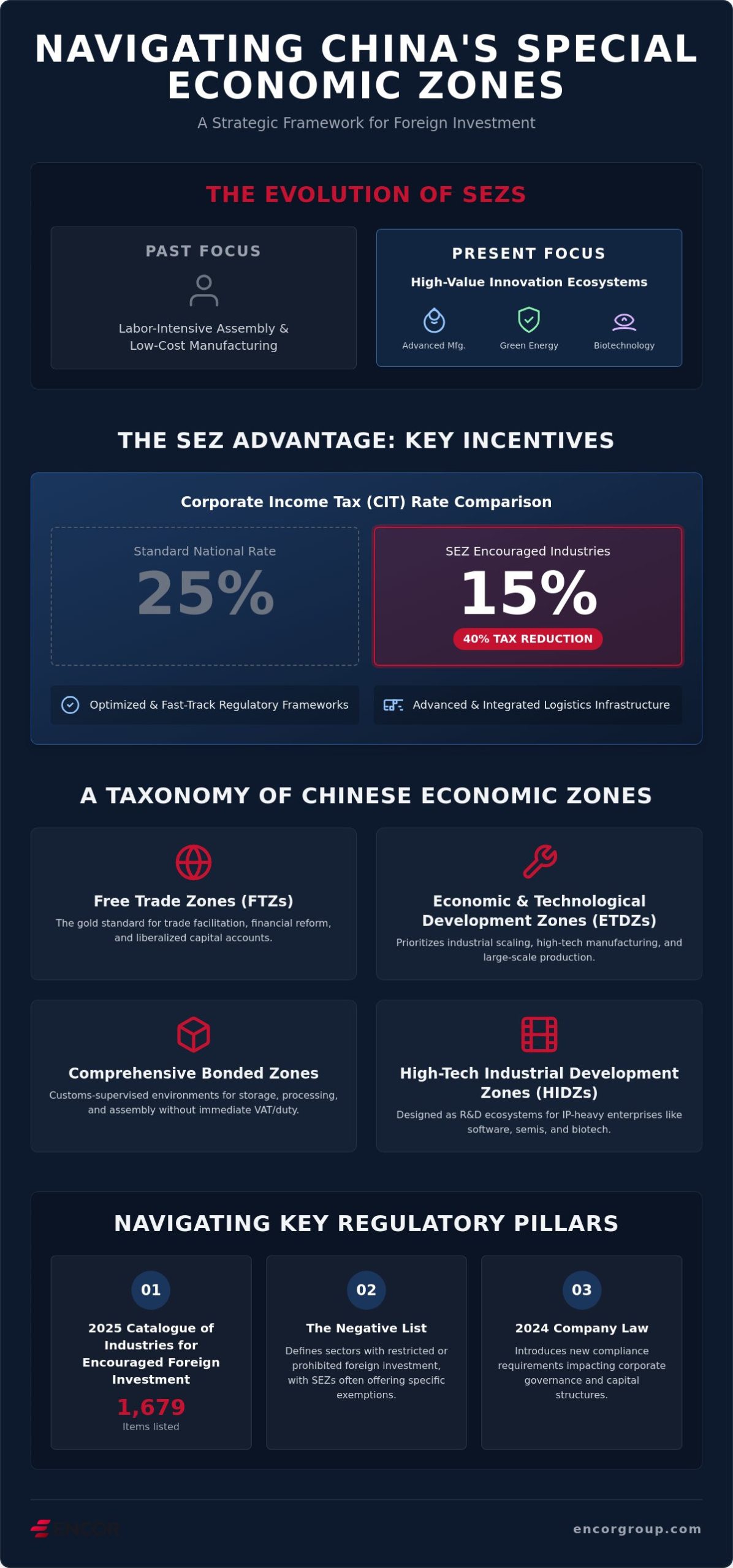
Selecting a special economic zone china is no longer a matter of simple proximity to a port. It’s a high-stakes strategic decision where the wrong choice leads to regulatory friction and missed fiscal opportunities. The 2025 Catalogue of Industries for Encouraged Foreign Investment, which now includes 1,679 items, has transformed these zones into precision-engineered ecosystems for high-tech, green energy, and advanced manufacturing.
You likely recognize that navigating China’s complex tax structures and the 2024 Company Law requires more than just a local presence; it demands a sophisticated understanding of regional incentives. This guide provides a comprehensive framework for aligning your corporate structure with the specific benefits of various hubs. We’ll examine the 15% corporate income tax rates available in zones like the Hainan Free Trade Port, provide a data-backed comparison of regional hubs, and outline a compliance roadmap to ensure your operations remain resilient against regulatory volatility. By the end of this analysis, you’ll have the strategic clarity needed to integrate these specialized zones into your global operational goals with confidence and precision.
Key Takeaways
- Identify the shift from generic manufacturing to specialized innovation ecosystems within the modern special economic zone china.
- Evaluate the specific fiscal advantages, such as the 15% Corporate Income Tax rate, available in premier hubs like Hainan and Qianhai.
- Master the compliance requirements of the 2026 Negative List and the 2024 Company Law to mitigate regulatory volatility.
- Optimize global corporate structures by leveraging the synergy between Mainland economic zones and international hubs like Hong Kong.
The Strategic Evolution of Special Economic Zones in China
The strategic role of the special economic zone china has undergone a significant transformation since its inception. While the history of China’s Special Economic Zones initially centered on labor-intensive assembly, the current framework prioritizes high-value industrial sectors. It’s clear that as China transitions into its 15th Five-Year Plan (2026-2030), these zones serve as critical nodes for “Dual Circulation,” a strategy designed to strengthen domestic markets while maintaining deep integration with global supply chains.
For multinational enterprises, SEZs represent more than just tax incentives. They’re regulatory laboratories where the Chinese government tests market-oriented reforms before a national rollout. This includes streamlining administrative procedures and liberalizing capital accounts. Selecting the correct zone is now a requirement for firms seeking to align with China’s focus on high-quality development and technological self-reliance.
From Low-Cost Manufacturing to Innovation Hubs
The evolution is most visible in Shenzhen. This region has successfully transitioned from a low-end electronics hub into a global center for research and development. The 2026 landscape emphasizes sectors defined in the 2025 Catalogue of Industries for Encouraged Foreign Investment, such as generative artificial intelligence, green energy, and biotechnology. Specifically, the government is incentivizing the production of nucleic acid-based pharmaceuticals and intelligent testing equipment. The modern special economic zone china is a precision-regulated ecosystem for foreign direct investment. This shift ensures that foreign capital supports the national transition toward a sophisticated, tech-driven economy.
Why SEZs Remain Essential for Foreign Investors
Despite broader market liberalization, SEZs provide distinct advantages that remain unavailable in other regions. These zones offer preferential policies that effectively bypass certain mainland restrictions found in the standard Negative List. Investors benefit from:
- Optimized Regulatory Frameworks: Access to fast-track incorporation and specialized corporate secretarial services.
- Advanced Infrastructure: Integrated logistics networks that reduce the cost of moving high-value goods.
- Incentivized Tax Structures: Corporate income tax rates as low as 15% for encouraged industries, compared to the standard 25% national rate.
Strategic proximity to key Asian markets remains a primary driver. By positioning operations within these hubs, firms secure a foothold in the world’s most dynamic supply chains while benefiting from a stable, predictable legal environment tailored to international standards.
A Taxonomy of Chinese Economic Zones: FTZs, ETDZs, and Bonded Areas
Understanding the taxonomy of a special economic zone china is essential for operational efficiency. China utilizes a tiered system of zones, each designed for specific industrial outputs and regulatory exemptions. These hubs aren’t interchangeable; a mismatch between your business model and the zone’s primary function can lead to unnecessary compliance costs. Successful market entry requires navigating the legal landscape of Chinese SEZs to understand how different jurisdictions interpret national mandates and provide localized incentives.
Free Trade Zones (FTZs) represent the gold standard for trade facilitation and financial reform. They offer the highest level of liberalization for capital accounts and currency exchange. Conversely, Economic and Technological Development Zones (ETDZs) prioritize industrial scaling and high-tech manufacturing. For firms focused on logistics, Comprehensive Bonded Zones provide a customs-supervised environment where goods can be stored, processed, and assembled without immediate VAT or duty obligations. Finally, High-Tech Industrial Development Zones (HIDZs) function as ecosystems for IP-heavy enterprises, offering specialized support for software, semiconductors, and biotechnology.
Comparing Incentives Across Different Zone Types
Incentives vary significantly based on the zone’s designation and the industry’s alignment with the 2025 Catalogue of Industries for Encouraged Foreign Investment. While the standard Corporate Income Tax (CIT) rate is 25%, qualified firms in encouraged sectors within specific zones can access a reduced 15% rate. Small Low-Profit Enterprises might see effective rates as low as 5%. Beyond tax, most national-level zones utilize a “Single Window” system. This integrated platform streamlines government approvals, reducing administrative delays for environmental permits and construction licenses. Industrial tenants also frequently negotiate land use rights and utility subsidies that aren’t available in standard municipal districts.
Selecting the Right Zone for Your Business Model
Your operational requirements dictate the optimal zone type. Cross-border e-commerce firms should prioritize FTZs to benefit from expedited customs clearance and flexible payment settlement rules. Software and semiconductor firms find more value in HIDZs, where the concentration of talent and R&D grants is highest. It’s also vital to distinguish between national-level and provincial-level zones. National zones typically offer more stable policy environments and superior infrastructure, though provincial zones may provide more aggressive, albeit less permanent, localized subsidies. Engaging a professional compliance and regulatory advisory ensures your entity selection aligns with these complex and evolving incentives.
Regional Analysis: Selecting the Optimal Hub for Your Industry
Selecting a special economic zone china is a decision that dictates long-term fiscal health and supply chain resilience. While earlier development phases focused on geographic convenience, the current landscape demands a focus on regional industrial clusters. Shanghai Pudong New Area, for instance, functions as the institutional gateway for financial services. It provides a stable environment for multinational banks and asset managers through deep integration with global capital markets. In contrast, the western hubs of Chengdu and Chongqing are emerging as critical nodes for the “Belt and Road” initiative. These regions attract investment in electronics and automotive manufacturing through reduced land costs and specialized logistics corridors that connect directly to Central Asia and Europe.
The 2025 Catalogue of Industries for Encouraged Foreign Investment has further refined these regional specializations. It’s no longer enough to be in a zone; your business must align with the specific industrial priorities of that region to unlock the full suite of incentives. This includes access to specialized talent pools, local R&D grants, and streamlined customs procedures tailored to specific product categories like semiconductors or pharmaceutical components.
Shenzhen and the Greater Bay Area Synergy
The Greater Bay Area (GBA) integrates the industrial strength of Shenzhen and Zhuhai with the global financial reach of Hong Kong. This connectivity allows for a seamless transition between product development and international market entry. Enterprises often leverage Hong Kong company formation services to create a robust holding structure that manages their mainland activities. This strategic alignment provides access to specialized talent acquisition grants and technology transfer incentives that are unique to the GBA ecosystem. By utilizing Hong Kong as a financial conduit, firms can optimize their global cash flow while maintaining a direct presence in China’s most innovative R&D centers.
Hainan: The Zero-Tariff Frontier in 2026
The Hainan Free Trade Port is rapidly evolving into a zero-tariff frontier. As the island prepares for island-wide customs closure by 2026, it offers a unique regulatory environment for luxury goods, healthcare, and aviation. The 2025 Catalogue specifically highlights Hainan as a priority for green energy and high-end manufacturing. Key fiscal benefits include a 15% Corporate Income Tax rate for qualified firms and a 15% cap on Individual Income Tax for high-level talent. These incentives, combined with the removal of equipment tariffs for self-use, position Hainan as a critical entry point for firms seeking to minimize import costs while accessing the vast Chinese consumer market.
Navigating Regulatory Compliance and Operational Setup
Entering a special economic zone china requires a precise understanding of the 2026 Negative List for Foreign Investment. This document determines which sectors are prohibited or restricted for foreign capital. While the manufacturing sector is now largely unrestricted nationwide, certain high-value service sectors still require specific joint-venture structures or shareholding caps. Compliance in 2026 requires real-time monitoring of both national laws and zone-specific administrative orders. The new Company Law, which became effective July 1, 2024, has further tightened rules regarding capital commitments and corporate governance. Foreign firms must now ensure their registered capital is fully paid within a five-year window, a shift that demands careful financial planning during the initial setup phase.
The Incorporation Roadmap
The process begins with name pre-approval from the State Administration for Market Regulation (SAMR). Once approved, firms receive a Unified Social Credit Code, which serves as the primary identifier for tax, social security, and customs. Opening capital accounts involves strict coordination with the State Administration of Foreign Exchange (SAFE). These accounts are necessary for injecting registered capital and managing currency conversion. Local administrative committees within the SEZ often play a decisive role. They provide preliminary project approvals and verify that the business model aligns with the zone’s specific industrial focus. This local oversight ensures that only firms contributing to the zone’s strategic goals receive the full suite of operational benefits.
Ongoing Compliance and Risk Management
Post-incorporation, firms must adhere to a rigorous schedule of tax reporting and annual statutory audits. The introduction of the 2026 VAT Law has created a stricter framework for invoicing and exemptions, requiring robust internal accounting systems. Managing IP protection within these zones involves registering trademarks and patents with the China National Intellectual Property Administration (CNIPA). Additionally, the Cybersecurity Law mandates strict protocols for cross-border data transfer. Firms must conduct security assessments if they handle critical data or large volumes of personal information. Utilizing professional corporate secretarial services is essential for maintaining good standing and ensuring all filings meet both national and local standards. To mitigate operational risks during this complex transition, consider engaging our compliance and regulatory advisory team to secure your market position.
Integrating China SEZ Operations into a Global Corporate Structure
Establishing a presence in a special economic zone china is a tactical beginning, but long-term success depends on how that entity interacts with your broader global architecture. Most mature enterprises don’t view these zones as isolated islands. Instead, they integrate them into a multi-hub strategy that leverages the strengths of different jurisdictions. This ensures that the fiscal benefits gained within the zone aren’t lost to inefficiencies in the wider corporate structure.
Global cash flow optimization often involves utilizing the UAE and Hong Kong as intermediary hubs. These jurisdictions provide the liquidity and regulatory stability necessary to support mainland operations. Centralizing these disparate functions through international entity management ensures that compliance standards remain uniform across all markets. This approach prevents the fragmentation of corporate governance. It allows for a more agile response to regional regulatory shifts and ensures that the 15% corporate income tax incentives mentioned earlier are fully utilized within a compliant global framework.
The Hong Kong-Mainland Connection
Hong Kong remains the primary gateway for capital injection into mainland SEZs. The city’s robust legal system and absence of foreign exchange controls make it an ideal holding location. Significant tax advantages exist under the Comprehensive Double Taxation Agreement (DTA) between Hong Kong and Mainland China. For instance, the withholding tax on dividends can be reduced from the standard 10% to 5%, provided the holding company meets specific substance requirements. Managing the resulting regional teams requires international payroll solutions that can handle the nuances of both Hong Kong’s MPF system and the mainland’s social security contributions. This setup creates a secure financial bridge between global headquarters and mainland production or R&D centers.
The Role of Encor Group in Your Expansion
Encor Group acts as the strategic navigator for firms entering these complex environments. We provide executive-level consulting to ensure your hub selection aligns with your operational optimization goals. Our support extends beyond simple incorporation. We facilitate bank account opening assistance and manage the intricacies of registered office addresses. Success in a special economic zone china also requires the right leadership. We offer strategic recruitment services to help you build localized executive teams that understand both global corporate standards and the specific administrative landscape of the zone. By partnering with a seasoned advisor, you ensure your expansion is both proactive and deeply committed to long-term corporate success.
Strategic Alignment for Long-Term Market Leadership
Navigating a special economic zone china requires more than just an entry strategy; it demands ongoing operational precision. The 2026 landscape prioritizes innovation in high-tech sectors while tightening governance through the 2024 Company Law and the updated Negative List. It’s clear that success depends on selecting the optimal hub and integrating mainland operations with international financial centers like Hong Kong to optimize global cash flow and tax efficiency.
As a strategic advisor serving 10+ global markets, Encor Group offers deep expertise in multi-hub corporate structuring along with comprehensive compliance and HR support. We handle high-stakes requirements with quiet efficiency. Consult with Encor Group for your China expansion strategy to ensure your operations are resilient and perfectly aligned with your long-term corporate goals. Securing your market position in this evolving environment is a calculated step toward sustainable global growth and operational excellence.
Frequently Asked Questions
What is the primary difference between a Special Economic Zone and a Free Trade Zone in China?
Special Economic Zones are broad geographic regions designed for comprehensive economic development and industrial scaling, whereas Free Trade Zones focus specifically on trade liberalization and financial reform. While SEZs like Shenzhen provide a wide range of incentives for manufacturing and R&D, FTZs serve as testing grounds for customs convenience and capital account liberalization. Choosing between them depends on whether your priority is domestic market production or international trade facilitation.
Are there still tax incentives for foreign companies in Chinese SEZs in 2026?
Yes, qualified enterprises operating in encouraged industries within a special economic zone china can access a preferential Corporate Income Tax rate of 15%. This represents a significant reduction from the standard 25% national rate. Specific regions also offer additional benefits, such as the Hainan Free Trade Port’s 15% individual income tax cap for high-end talent and various exemptions on import duties for self-use equipment and raw materials.
How does the “Negative List” affect my ability to invest in a China SEZ?
The Negative List serves as the definitive guide for restricted or prohibited sectors for foreign investment, effectively acting as a gatekeeper for market entry. If your industry isn’t included on this list, you receive national treatment and can operate under the same regulatory framework as domestic companies. For sectors that remain restricted, you must comply with specific requirements, such as forming a joint venture or adhering to capped foreign shareholding percentages.
Can a foreign company own 100% of a business in a Chinese Special Economic Zone?
Foreign investors can maintain 100% ownership in most sectors through a Wholly Foreign-Owned Enterprise (WFOE) structure. By 2026, China has removed all foreign investment restrictions in the manufacturing sector nationwide. While many service and technology sectors are also fully open, it’s vital to verify your specific business activity against the most recent Negative List to ensure no industry-specific ownership caps or partnership requirements apply to your entity.
What are the most industry-specific SEZs in China for the technology sector?
Shenzhen remains the global benchmark for hardware innovation and electronics R&D, while the Shanghai Pudong New Area leads in integrated circuits and biotechnology. For software development and the digital economy, High-Tech Industrial Development Zones in Hangzhou and Beijing offer the highest concentration of specialized talent and research grants. Each hub provides a unique ecosystem tailored to specific sub-sectors within the broader technology industry.
How long does it typically take to incorporate a business in a China SEZ?
Incorporation in a special economic zone china typically requires 4 to 8 weeks to complete all administrative and regulatory milestones. This timeframe includes obtaining name pre-approval, securing the Unified Social Credit Code, and finalizing capital account openings with the State Administration of Foreign Exchange. While “Single Window” systems have streamlined the process, the total duration can fluctuate based on the specific licensing requirements of your industry and the zone’s administrative workload.
Do I need a local partner to set up in a Chinese Special Economic Zone?
A local partner is unnecessary for any business activity classified as “permitted” or “encouraged” under the current foreign investment catalogue. You’re free to establish a WFOE to maintain total operational and financial control over your mainland entity. Local partners are only a legal requirement if your specific business falls into a “restricted” category on the Negative List that explicitly mandates a joint venture or a Chinese majority shareholder.
How do SEZs in China compare to Free Zones in the UAE or Hong Kong?
Chinese SEZs prioritize access to the domestic consumer market and integrated manufacturing supply chains, while UAE and Hong Kong zones function primarily as international trade and financial gateways. Although UAE Free Zones often offer a 0% corporate tax rate, Chinese zones provide a competitive 15% rate alongside direct proximity to the world’s most extensive production clusters. This makes China the preferred choice for firms targeting domestic scale rather than just offshore trade.