
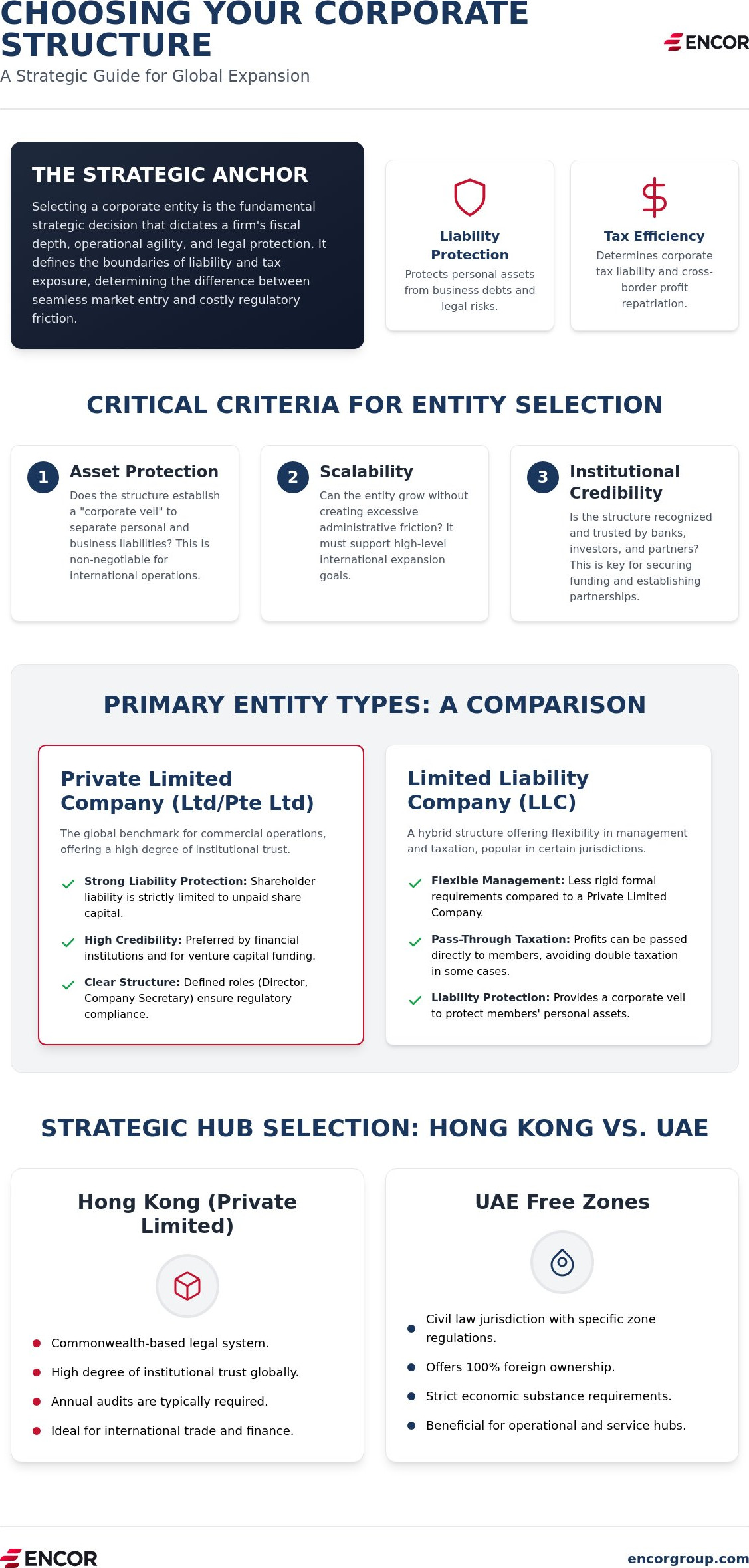
The selection of a corporate structure is not a secondary administrative task. It is the fundamental strategic anchor that dictates a firm’s fiscal depth and operational agility. For an international enterprise, the entity type meaning extends far beyond basic registration; it defines the precise boundaries of legal protection and tax exposure. Choosing the right entity type is often the definitive factor between seamless market entry and costly regulatory friction.
Investors and executives correctly identify that cross-border complexities and the risk of double taxation represent significant barriers to sustainable growth. This guide offers a comprehensive framework for defining and selecting a corporate structure that maximizes liability protection while ensuring long-term tax efficiency. You will gain a clear understanding of global entity types and the specific advantages of establishing hubs in jurisdictions like Hong Kong or the UAE. We provide the strategic insight necessary to minimize personal liability and prepare your organization for high-level international scalability.
Key Takeaways
- Define the strategic entity type meaning to establish a robust foundation for liability protection and tax efficiency.
- Analyze the distinct benefits of Hong Kong and UAE Free Zones as strategic hubs for international trade and operational excellence.
- Establish a clear framework for choosing an entity type based on specific capital requirements and long-term scalability goals.
- Compare Private Limited and LLC structures to ensure your corporate framework supports institutional growth and international funding needs.
- Integrate your entity selection with essential compliance services and payroll solutions to maintain seamless global operations.
The Strategic Meaning of Entity Type in Global Commerce
An entity type is the legal and fiscal framework that defines a business’s standing in any jurisdiction. When we analyze entity type meaning, we refer to the specific classification that determines how a company interacts with regulators, tax authorities, and creditors. Choosing entity type is the primary pillar of a global expansion strategy. It isn’t merely an administrative box to check. It’s a strategic decision that affects operational agility and long-term viability.
Institutional credibility depends heavily on this choice. Established partners and financial institutions look for structures that signify stability and professional oversight. A well-chosen entity structure provides a clear signal to the market that the organization operates under a recognized regulatory framework. Because global regulations vary, executives should consult a list of legal entity types by country to understand the available options in their target markets. This selection influences several key areas:
- The ability to secure institutional funding and venture capital.
- The complexity of annual reporting and audit requirements.
- The speed at which a business can enter new international markets.
- The perception of the brand among local suppliers and government bodies.
The chosen structure dictates the complexity of ongoing compliance. A Private Limited Company in Hong Kong requires annual audits, whereas a UAE Free Zone entity might have different economic substance requirements. These reporting obligations are baked into the entity’s foundation. High-level expansion requires a structure that scales without creating excessive administrative friction.
Legal Liability and Personal Asset Protection
The distinction between incorporated and unincorporated business forms is critical for risk management. Unincorporated forms often leave owners personally liable for business debts. This is unacceptable for serious ventures. Incorporated entities establish a “corporate veil,” a legal separation that protects personal assets from corporate liabilities. For multinational enterprises, this protection is non-negotiable. Operating across borders introduces diverse legal risks. A robust corporate structure ensures that a failure in one market doesn’t jeopardize the entire global operation.
Fiscal Implications and Tax Residency
The fiscal framework of a business is inextricably linked to its classification. Your choice determines corporate tax liability, the necessity of VAT registration, and the ease of cross-border profit repatriation. Certain structures facilitate more efficient movement of capital between a parent company and its subsidiaries. Tax Residency is the legal status of an entity that determines which jurisdiction has the primary right to tax its global income based on its place of effective management or incorporation. Selecting the wrong structure can lead to double taxation or missed opportunities for treaty benefits.
Primary Entity Types for International Business Operations
Selecting a framework requires an understanding of how different jurisdictions categorize businesses. While the entity type meaning varies by region, most global hubs offer variations of incorporated structures. Choosing entity type involves a trade-off between administrative ease and the depth of liability protection. For an international enterprise, the choice typically narrows to a Private Limited Company, a Limited Liability Company, or a branch structure.
The Private Limited Company (Ltd/Pte Ltd)
The Private Limited Company remains the global benchmark for commercial operations. It provides a clear separation of assets, where shareholder liability is strictly limited to the amount of unpaid share capital. This structure is the primary choice for Hong Kong company formation services due to its high degree of institutional trust and ease of share transfer. Maintenance requires specific administrative appointments, including at least one director and a company secretary, ensuring the entity meets local regulatory standards. These roles are essential for maintaining the company’s good standing and satisfying the requirements of global financial institutions.
While the Ltd structure is common in Commonwealth-based systems, other jurisdictions offer the Limited Liability Company (LLC). This model often provides more flexible management structures and pass-through tax options. When you choose a business structure, the LLC is frequently favored for its operational simplicity, particularly in the United States. However, for international scalability, the Private Limited structure often offers superior recognition among global banks and investors.
Branch Offices and Subsidiaries
A branch office is an extension of the parent company, meaning the parent remains legally responsible for all liabilities incurred by the branch. In contrast, a subsidiary is a separate legal entity. Subsidiaries are generally safer because they isolate risk within a specific market. If a subsidiary faces litigation or debt, the parent’s assets remain protected. Tax reporting also differs significantly. Branches usually involve consolidated reporting with the parent company, while subsidiaries file separate returns in their host country. This distinction is vital for firms looking to manage their global tax exposure effectively.
Specialized structures, such as UAE Free Zone entities, offer unique regulatory statuses. These zones allow 100% foreign ownership and provide specific exemptions from certain taxes and customs duties. They are ideal for trade and logistics firms that require a strategic foothold in the Middle East without the complexities of mainland incorporation. For businesses navigating these complex jurisdictional differences, engaging a professional advisor for compliance and regulatory advisory ensures that your chosen structure aligns with your long-term expansion goals.
Representative offices serve as a final alternative for those not ready for full incorporation. These offices are restricted to non-commercial activities, such as market research or liaison work. They are useful for testing a new market’s potential without the administrative burden of a full corporate setup, though they cannot generate revenue or sign contracts directly.
Critical Criteria for Choosing an Entity Type
Choosing entity type requires a forward-looking analysis that extends beyond immediate tax benefits. Executives must evaluate how a structure aligns with their long-term capital requirements and operational capacity. A framework that seems efficient at the startup phase may become a significant bottleneck during rapid international expansion. This selection process involves weighing institutional credibility against the inevitable administrative burden of high-transparency jurisdictions.
Scalability is a primary driver in this decision. A structure must support cross-border growth without requiring a complete legal overhaul every time the business enters a new market. For example, a Private Limited Company is often chosen for its ability to issue various share classes, which is essential for attracting venture capital or private equity. Your exit strategy should also influence the foundation you build today. Whether the goal is an eventual acquisition or an initial public offering, the entity must meet the rigorous due diligence standards of global auditors and investment banks.
Funding and Investment Readiness
Global institutional investors generally prefer standardized corporate forms, such as the Private Limited Company. These structures offer a predictable legal environment for share issuance and ownership transfers. The ability to create different share classes allows founders to maintain control while offering equity incentives to attract top-tier talent. In some jurisdictions, regulatory hurdles for transferring ownership can be significant. A structure that facilitates easy equity movement is vital for firms anticipating multiple funding rounds or strategic mergers.
Administrative and Compliance Overhead
The entity type meaning in a daily operational context is defined by its compliance requirements. Every jurisdiction imposes a specific level of oversight that dictates the cost of maintenance. For instance, in Hong Kong, the on-time filing fee for an annual return is HK$105, but late penalties can escalate quickly to HK$3,480. Maintaining compliance across multiple markets requires robust corporate secretarial services to manage these deadlines and avoid unnecessary friction with local regulators.
Audit requirements represent another significant factor in the total cost of ownership. While some structures offer audit exemptions for smaller enterprises, larger multinational entities must prepare for comprehensive annual reviews. Managing beneficial ownership reporting and Know Your Customer (KYC) standards is now a global necessity. In the UAE, new companies must file their Ultimate Beneficial Ownership (UBO) register within 60 days of license issuance. Any failure to maintain these standards can result in severe operational disruptions, making it essential to choose a structure that your internal team or external advisors can manage with precision.
Strategic Hub Selection: Hong Kong and UAE Entity Frameworks
Hub selection is the point where theoretical entity type meaning translates into tangible fiscal results. For a multinational organization, choosing entity type is inseparable from the jurisdiction in which that entity resides. Hong Kong and the United Arab Emirates represent two of the most sophisticated frameworks for cross-border operations, each offering distinct advantages for capital flow and regulatory efficiency. These jurisdictions provide the structural stability required to execute a high-level global business expansion strategy.
Hong Kong as a Strategic Midshore Hub
Hong Kong utilizes a territorial tax system that is highly advantageous for international trade. Under this two-tiered regime, the first HKD 2 million of assessable profits is taxed at 8.25%, with remaining profits taxed at 16.5%. This clarity allows for precise financial forecasting. The Private Limited structure is the standard here, managed through the Hong Kong Companies Registry. Maintenance is methodical. As of April 2026, the annual business registration certificate fee is HK$2,350. Companies must also file an annual return (Form NAR1) within 42 days of their incorporation anniversary. This institutional depth ensures that Hong Kong remains a primary gateway for Asian market entry.
UAE Free Zones: Tax Neutrality and 100% Ownership
The UAE offers a bifurcated system consisting of Mainland and Free Zone entities. Free Zone structures are particularly effective for international logistics and service providers because they allow 100% foreign ownership and provide a stable environment for tax optimization. In 2026, the UAE corporate tax rate remains 0% on taxable income up to AED 375,000, with a 9% rate applied above this threshold. Specialized zones like Meydan and IFZA offer tailored regulatory status for specific industries. However, compliance is strict. New entities must file their Ultimate Beneficial Ownership (UBO) register within 60 days of license issuance. Economic Substance Regulations (ESR) also require a notification within six months of the financial year-end. These requirements reinforce the UAE’s reputation as a transparent and professional global hub.
Selecting between these frameworks depends on your primary trade routes and capital requirements. Hong Kong offers unparalleled access to Chinese and Asian capital markets, while the UAE serves as a neutral, tax-efficient corridor for EMEA operations. If you are ready to establish a strategic foothold in these markets, Encor Group provides expert UAE Free Zone incorporation and Hong Kong setup services to ensure your entity is compliant from day one.
Aligning Entity Structure with Institutional Growth Objectives
High-stakes corporate expansion requires a transition from basic registration to strategic operational alignment. The entity type meaning in a mature corporate context shifts from a question of how to start to how to scale. Choosing entity type is therefore an exercise in aligning legal structures with the firm’s overarching human capital and financial goals. Professional advisory is essential at this stage to ensure the chosen framework supports rapid deployment without creating administrative bottlenecks.
Centralizing Global Entity Management
Managing multiple international subsidiaries often leads to operational friction. Centralizing this management under a single strategic partner ensures consistency across diverse regulatory environments. A structured approach to entity selection reduces the typical delays associated with corporate bank account opening. Banks prioritize entities that demonstrate clear ownership structures and robust local compliance. Standardizing accounting and bookkeeping across these subsidiaries allows for consolidated financial reporting, which is a prerequisite for institutional transparency and audit readiness. Efficient ongoing maintenance relies on corporate secretarial services to manage statutory filings and maintain the company’s good standing in every jurisdiction.
The relationship between corporate structure and human resources is often overlooked. Your entity type dictates your ability to hire and manage a global workforce. Integrating your setup with international payroll solutions ensures that your HR operations remain compliant with local labor laws from the moment of market entry. This alignment prevents the legal and financial risks associated with misclassified workers or non-compliant tax withholdings. A well-chosen structure facilitates seamless talent acquisition and retention across borders.
The Encor Group Methodology
Encor Group employs a methodical approach to global expansion. We tailor entity choices to specific market entry requirements, ensuring that every structure provides long-term regulatory resilience and tax efficiency. Our process moves beyond the initial setup phase into full operational optimization. We analyze your institutional objectives to determine whether a Hong Kong Limited company or a UAE Free Zone entity provides the most effective path for your capital flow. This strategic navigator approach ensures that your global footprint is built on a foundation of precision and excellence.
Institutional success in 2026 depends on the ability to handle high-stakes requirements with quiet efficiency. Moving from a fragmented setup to a centralized, optimized operation is the next logical step in your professional journey. Initiating a strategic consultation allows you to refine your global footprint and ensure your entity structure remains an asset rather than a liability. Contact Encor Group to begin the process of operations optimization and secure your organization’s international future.
Securing Your Global Operational Foundation
Establishing a corporate structure defines the trajectory of an international enterprise. This guide has examined the entity type meaning as a fundamental framework for liability protection and tax efficiency. Choosing entity type with precision ensures that your organization maintains the institutional credibility required to access global capital and navigate cross-border regulations. Whether you establish a presence in Hong Kong or a UAE Free Zone, your decision dictates the operational agility of your firm.
Encor Group provides the strategic depth necessary for high-stakes expansion. We offer end-to-end support from initial incorporation to international payroll solutions, backed by a proven track record in 10+ international markets. Our specialized expertise in Hong Kong and UAE regulatory frameworks allows you to expand with confidence. Consult with Encor Group for Strategic Entity Selection and secure a resilient foundation for your global footprint.
Your international success depends on a stable and calculated corporate framework.
Frequently Asked Questions
What is the most common entity type for international business expansion?
The Private Limited Company (Ltd) is the global benchmark for international expansion. This structure provides a distinct legal personality, separating corporate liabilities from personal or parent company assets. It is favored by institutional investors because it facilitates easy share transfers and offers a predictable regulatory framework for raising capital in multiple jurisdictions.
How does entity type affect my ability to open a corporate bank account?
Financial institutions prioritize incorporated entities that demonstrate a clear entity type meaning aligned with global transparency standards. Banks often reject applications from unincorporated forms or complex offshore structures due to increased Know Your Customer (KYC) risks. Selecting a Private Limited Company or an LLC in a reputable jurisdiction significantly reduces the friction encountered during the bank account opening process.
Can I change my business entity type after incorporation?
Changing a business structure is possible but involves significant administrative complexity and cost. Most jurisdictions require a formal conversion process or the dissolution of the existing entity followed by the re-incorporation of a new one. Choosing entity type correctly during the initial planning phase is vital to avoid these operational disruptions and the potential tax consequences associated with transferring assets between structures.
What are the main differences between a subsidiary and a branch office?
A subsidiary is a separate legal entity owned by a parent company, providing a corporate veil that protects the parent’s assets from the subsidiary’s liabilities. A branch office is merely an extension of the parent company, meaning the parent remains legally responsible for all debts and legal obligations incurred by the branch. Subsidiaries are generally preferred for risk management in high-stakes international markets.
Why is a Private Limited Company preferred for Hong Kong business setup?
Hong Kong’s Private Limited structure offers a robust legal framework combined with a highly efficient territorial tax system. This entity type allows businesses to benefit from tiered profits tax rates of 8.25% on the first HKD 2 million and 16.5% thereafter. The structure is internationally recognized by creditors and banks, making it the primary vehicle for firms seeking a strategic gateway into Asian markets.
Do I need a local partner to form an entity in a UAE Free Zone?
No, UAE Free Zone entities allow for 100% foreign ownership without the requirement for a local Emirati partner. This is a primary distinction from Mainland entities, which may have different ownership requirements depending on the activity. Free Zones provide a tax-efficient environment with 0% corporate tax on income up to AED 375,000, making them ideal for international trade and logistics operations.
How does entity selection impact international payroll compliance?
The chosen entity type dictates the specific tax withholding and social security obligations a company must fulfill in a foreign jurisdiction. For instance, an incorporated subsidiary is viewed as a local employer, requiring full compliance with local labor laws and payroll reporting standards. Proper entity selection ensures that payroll operations can be implemented without the risk of misclassification or regulatory penalties.
What is the role of a corporate secretary in maintaining an entity?
A corporate secretary ensures that the entity remains in good standing by managing all statutory compliance requirements. This role involves filing annual returns, maintaining the register of directors and shareholders, and ensuring the company adheres to local corporate governance standards. In jurisdictions like Hong Kong, appointing a qualified corporate secretary is a mandatory requirement for maintaining a Private Limited Company.