
U.S. businesses currently face over $7 billion in annual payroll tax penalties, a figure that underscores the escalating financial risk of regulatory oversight in a fragmented global market. Maintaining a robust compliance checklist for global entities is no longer a peripheral administrative task. It’s a central strategic requirement for any multinational organization seeking to protect its bottom line and operational integrity.
You’re likely managing a fragmented landscape of regional data while contending with shifting corporate tax rates in the UAE and evolving annual return deadlines in Hong Kong. This article provides a definitive, institutional-grade framework designed to consolidate your multinational obligations and ensure your subsidiaries maintain a zero-penalty status throughout 2026. We’ll examine critical updates to global tax structures, new EU AI transparency mandates, and the precise operational shifts required to centralize your international reporting and payroll management.
Key Takeaways
- Understand the critical shift toward real-time reporting and digital transparency to maintain continuous alignment with global tax authorities.
- Identify mandatory corporate secretarial and filing requirements, including Annual General Meeting protocols, to ensure your subsidiaries remain in good standing.
- Utilize a comprehensive compliance checklist for global entities to manage IFRS-compliant bookkeeping and meet divergent corporate tax deadlines across major jurisdictions.
- Align international employment contracts and payroll processes with local labor laws and statutory benefit requirements to mitigate the risk of costly regulatory penalties.
- Implement a centralized management framework and automated compliance calendar to transition from fragmented local vendors to a unified, efficient operational model.
The Strategic Importance of Global Regulatory Compliance in 2026
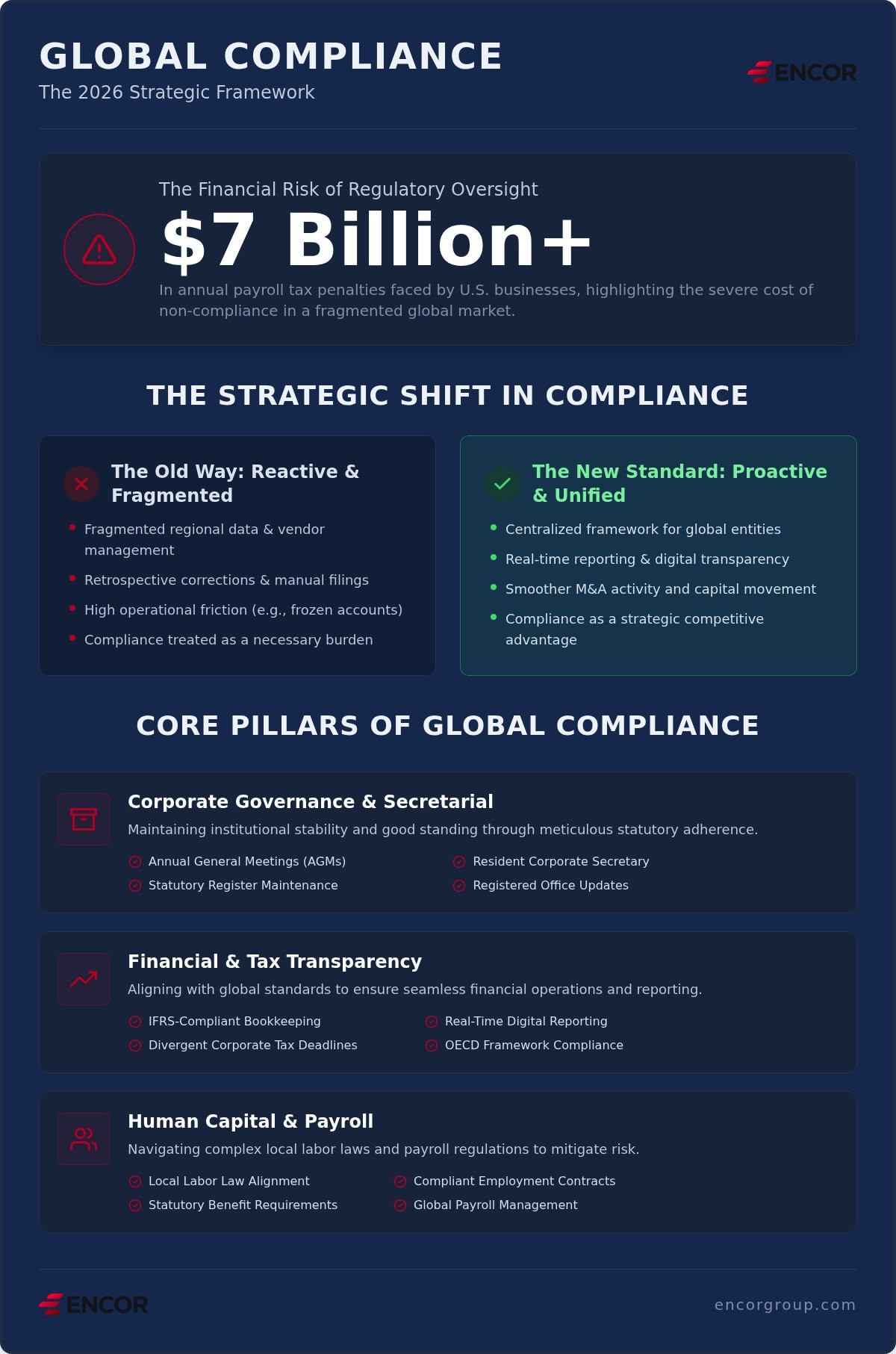
Global entity compliance is defined as the continuous, proactive alignment with statutory, tax, and labor regulations across every jurisdiction where a firm operates. In 2026, this function has evolved from a back-office necessity into a core pillar of corporate strategy. Maintaining a robust compliance checklist for global entities ensures that multinational operations remain agile and resilient against shifting geopolitical requirements. Without this structured approach, organizations risk more than just fines; they face fundamental disruptions to their business model. With U.S. businesses paying over $7 billion in annual payroll tax penalties, the financial stakes of oversight are undeniable.
Tax authorities globally have transitioned toward digital transparency and real-time reporting protocols. This shift means that data silos between regional subsidiaries are no longer sustainable. Authorities now demand immediate access to transactional data, leaving no room for the retrospective corrections that were common in previous decades. When compliance isn’t integrated into daily operations, it creates significant operational friction. This friction often manifests as frozen bank accounts or stalled expansion plans. Good Standing is the vital status that confirms an entity’s legal and financial health, serving as the primary prerequisite for all cross-border capital movement.
The Evolving Landscape of International Transparency
The OECD’s latest frameworks have standardized global reporting, making it nearly impossible for multinational enterprises to rely on “set and forget” incorporation strategies. Modern regulatory environments require a dynamic Regulatory Compliance Overview to manage high-stakes requirements with precision. Adopting a sophisticated global business expansion strategy allows leaders to treat compliance as a proactive risk management tool rather than a reactive burden. This approach is essential for navigating the complexities of 2026’s interconnected markets where transparency is the default expectation.
Risk Mitigation vs. Strategic Advantage
Forward-thinking executives view a compliance checklist for global entities as a strategic due diligence asset rather than a simple tool for penalty avoidance. A clean compliance record directly accelerates the opening of corporate bank accounts and facilitates smoother M&A activity. Investors and financial institutions prioritize entities that demonstrate institutional stability and meticulous record-keeping. The institutional cost of reactive compliance, which includes back wages and emergency legal filings, far outweighs the investment in proactive advisory services. By prioritizing operational excellence, firms turn regulatory adherence into a competitive advantage that supports sustainable, long-term growth.
Corporate Governance: Essential Secretarial and Filing Requirements
Corporate governance requires a methodical approach to statutory maintenance that extends far beyond simple administrative filing. While many organizations focus heavily on U.S. state requirements, a comprehensive compliance checklist for global entities must prioritize the specific secretarial mandates of international hubs like Hong Kong and the UAE. In Hong Kong, the appointment of a resident Corporate Secretary is a mandatory legal requirement. This professional serves as the primary liaison between the entity and the Companies Registry. This role is vital. It ensures the timely execution of Annual General Meetings (AGMs), which must occur within six months of the company’s financial year-end. Accurate documentation of these meetings is non-negotiable for maintaining corporate transparency.
The maintenance of statutory registers is equally critical for institutional stability. Companies must keep up-to-date records of directors, members, and significant controllers to satisfy local transparency laws. Any change to the registered office address must be reported immediately. This location is the official point for the legal service of process; it’s the address where authorities send formal notices. Failing to update this information leads to missed legal deadlines and potential default judgments. Organizations seeking to streamline these requirements often benefit from professional Corporate Secretarial Services to ensure no deadline is overlooked.
Hong Kong and UAE Statutory Filings
In Hong Kong, the Annual Return (Form NAR1) must be filed within 42 days of the anniversary of incorporation. This filing, alongside the annual business registration renewal, is central to the Hong Kong company formation services lifecycle. Conversely, the UAE requires distinct renewal processes depending on whether the entity is situated in a Free Zone or the Mainland. Free Zone entities must renew their licenses and lease agreements annually. These renewals often require audited financial statements to maintain operational status. Common pitfalls include failing to reconcile these renewals with the specific requirements of the relevant Free Zone authority, which can lead to immediate license suspension.
Beneficial Ownership and Economic Substance (ESR)
Transparency requirements in 2026 have intensified the focus on beneficial ownership. The Register of Significant Controllers is now a standard component of any compliance checklist for global entities. It requires businesses to identify and record individuals with ultimate control. These measures align with the G20/OECD Principles of Corporate Governance, which advocate for increased corporate accountability. In the UAE, entities must also navigate Economic Substance Requirements (ESR) by demonstrating that their “relevant activities” are supported by adequate local presence and expenditure. Failing these substance tests can result in significant financial penalties; it’s a risk that proactive firms avoid through rigorous internal audits and strategic advisory.
Financial Transparency: Tax and Accounting Compliance Standards
Financial transparency is the bedrock of international trust and regulatory standing. Maintaining high-quality financial records across multiple jurisdictions requires more than basic bookkeeping; it demands a rigorous adherence to International Financial Reporting Standards (IFRS) or local Generally Accepted Accounting Principles (GAAP). A robust compliance checklist for global entities must prioritize these divergent standards to ensure that consolidated reporting is both accurate and audit-ready. For instance, while the UAE has implemented a 9% corporate tax rate for specific income thresholds, Hong Kong continues to utilize its two-tiered profit tax system. Managing these varying rates and their respective filing deadlines is essential for avoiding the steep penalties associated with late or inaccurate submissions.
Indirect tax management adds another layer of complexity to the 2026 landscape. VAT and GST reconciliation must be performed with precision, especially for entities engaged in both digital and physical trade across borders. Tax authorities have also increased their scrutiny of transfer pricing. Intercompany agreements are no longer treated as mere formalities. They must reflect “arm’s length” pricing and be supported by exhaustive documentation to prevent the erosion of the tax base. This ensures that profits are taxed where the economic activity actually occurs, protecting the organization from aggressive tax audits.
Audit and Assurance Requirements
Statutory audits are mandatory in several key jurisdictions, including Hong Kong, where every limited company must undergo an annual review by a certified public accountant. This requirement isn’t just a regulatory hurdle. It’s a critical tool for maintaining investor confidence and securing credit lines with global financial institutions. Financial controllers should prepare for these audits by maintaining a centralized repository of the following documents:
- Certified bank statements and reconciliation reports for all active accounts.
- Intercompany agreements and transfer pricing documentation.
- Fixed asset registers and depreciation schedules.
- Board minutes approving significant financial transactions or investments.
A proactive approach to audit preparation reduces the time and cost associated with the final review. It also demonstrates institutional stability to external stakeholders.
International Tax Advisory and Treaty Benefits
Strategic tax planning involves leveraging Double Taxation Agreements (DTAs) to optimize global fiscal depth. These treaties are designed to prevent the same income from being taxed in two different countries, significantly reducing the effective tax rate for multinational organizations. Managing withholding tax obligations on cross-border dividends and royalties is equally important, as these obligations vary significantly by treaty and jurisdiction. It’s clear that effective tax advisory shouldn’t exist in a vacuum. It must be integrated with optimizing global business operations to ensure that your corporate structure remains both tax-efficient and operationally lean.
Human Capital Compliance: Navigating Global HR and Payroll Regulations
Managing human capital across borders requires a meticulous understanding of localized labor statutes that vary significantly by region. A definitive compliance checklist for global entities is incomplete without a rigorous framework for HR and payroll. In 2026, the average cost of non-compliance with payroll regulations has reached $845 per employee annually. This figure includes fines, back wages, and administrative penalties. Employers must navigate diverse social security contributions and statutory benefits that range from mandatory pension schemes in Hong Kong to comprehensive medical insurance requirements in the UAE. Precision in these areas is vital for maintaining the institutional stability discussed in previous sections.
Employment contract standards also demand strict alignment with local laws. Organizations must clearly distinguish between fixed-term and indefinite contracts, as misclassification often leads to severe litigation risks. In India, for example, the consolidated labor codes now mandate that wages constitute at least 50% of total remuneration. Managing remote and expatriate teams adds further complexity. Organizations must ensure that every staff member possesses the correct work permits and that their presence doesn’t inadvertently create a permanent establishment tax risk for the parent company. Legal authorization is the only way to protect your global talent pool from deportation or work stoppages.
Global Payroll Frameworks
Centralizing payroll operations is the most effective way to ensure consistent tax withholding and reporting across multiple jurisdictions. Utilizing international payroll solutions allows firms to automate complex calculations and stay ahead of real-time reporting mandates, such as Germany’s digital payroll requirements. In the Middle East, specific attention must be paid to End of Service benefits, or gratuity. These payments are calculated based on the employee’s length of service and final salary. They require accurate accrual on the balance sheet to avoid sudden liquidity strains during offboarding. Consistent reporting across all subsidiaries ensures a unified view of global financial obligations.
Talent Acquisition and Labor Law
Compliance begins at the recruitment stage. Many jurisdictions enforce local hiring quotas or specific anti-discrimination laws that dictate how job descriptions are written and how interviews are conducted. The EU Pay Transparency Directive, effective June 2026, now requires salary range disclosure in job postings and prohibits asking candidates about their salary history. HR systems must also be fully compliant with data privacy regulations like GDPR or India’s Digital Personal Data Protection Act. Termination protocols and severance requirements must be followed to the letter. Failing to adhere to mandatory notice periods or severance calculations can result in costly labor tribunal cases that damage corporate reputation. To ensure your workforce management remains fully compliant with these evolving standards, you should engage with professional Human Resources and Payroll Services.
Implementing a Centralised Global Entity Management Framework
The final stage in mastering international operations is the transition from a decentralized network of local vendors to a unified, global corporate service provider. While localized support was once the standard, the regulatory complexities of 2026 demand a more integrated approach. Relying on disparate vendors often results in data silos, inconsistent reporting, and a higher probability of missed deadlines. A centralised framework allows for the standardisation of reporting formats across all international subsidiaries, providing the C-suite with a clear, real-time view of the organization’s global health. This shift isn’t just about administrative convenience; it’s a strategic move that enhances operations optimization and reduces the risk profile of the entire multinational group.
Establishing a comprehensive compliance checklist for global entities requires the implementation of a dedicated Compliance Calendar. This tool should feature automated alerts for all statutory, tax, and labor deadlines across every jurisdiction. By leveraging executive-level consulting to audit existing structures, leaders can identify efficiency gaps that frequently occur in high-growth environments. This proactive auditing ensures that the corporate structure remains lean and that all entities are prepared for the digital transparency mandates discussed in earlier sections. A unified view of global obligations is the only way to guarantee a zero-penalty status across all subsidiaries.
Selecting a Global Corporate Service Partner
Choosing the right partner is a critical decision for any multinational enterprise. The primary criteria for selection must include a strong regional presence in key markets like Hong Kong and the UAE, deep technical expertise in local statutes, and a track record of institutional reliability. An “End-to-End” service model, which covers everything from incorporation and bank account opening assistance to ongoing payroll and tax advisory, provides the most stability. Encor Group serves as a strategic navigator in this space, offering the steady, calm assurance required to handle high-stakes requirements with quiet efficiency. This partnership allows internal teams to focus on core growth while ensuring the administrative foundation remains impeccable.
Next Steps for C-Suite Leaders
Your immediate priority should be conducting a 2026 “Compliance Health Check” for all existing entities. This involves a thorough review of Economic Substance and Beneficial Ownership filings to ensure absolute accuracy. Any discrepancies in these filings can lead to the “operational friction” mentioned previously, potentially halting capital movement or damaging banking relationships. Once the audit is complete, you can begin the process of consolidating your global obligations under a single management framework. To ensure your operations are fully optimized and penalty-proof, Consult with Encor Group for a Strategic Compliance Audit today.
Future-Proofing Your Global Corporate Infrastructure
The global regulatory environment in 2026 demands a shift from reactive administration to proactive, strategic oversight. Success requires more than just meeting local deadlines; it necessitates a unified view of your entire corporate footprint. By integrating your compliance checklist for global entities into a centralized management framework, you eliminate operational friction and ensure your subsidiaries remain in good standing across all jurisdictions. This approach protects your capital movement and strengthens your institutional reputation with financial partners.
Encor Group provides the stability and strategic depth required to navigate these complexities with precision. With regional hubs serving 10+ global markets and specialized expertise in Hong Kong and UAE regulatory frameworks, we deliver the institutional-grade compliance and tax advisory your organization needs to thrive. Secure your global operations with Encor Group’s institutional advisory services.
Maintaining excellence in cross-border operations is a continuous journey. With the right framework and a trusted advisor, your organization is well-positioned to achieve sustainable, penalty-free growth in any market.
Frequently Asked Questions
What are the most common compliance pitfalls for global entities in 2026?
The most common pitfalls include fragmented data management and failing to adapt to real-time digital reporting mandates. Organizations often struggle with inconsistent payroll tax withholding, which contributes to the $7 billion in annual IRS penalties. Using a comprehensive compliance checklist for global entities helps prevent these oversights by centralizing regional deadlines and ensuring data consistency across subsidiaries.
How do Economic Substance Requirements (ESR) affect entities in the UAE?
Economic Substance Requirements mandate that UAE entities performing “relevant activities” maintain an adequate local footprint. This includes demonstrating local expenditure, physical presence, and management control within the jurisdiction. Failing to meet these substance thresholds results in significant financial penalties and potential license revocation for both Free Zone and Mainland companies.
Is a corporate secretary mandatory for all international subsidiaries?
A corporate secretary is a mandatory legal requirement in jurisdictions like Hong Kong, though requirements vary across other global regions. This officer serves as the official liaison between the company and the government registry. They ensure that all statutory records remain accurate and that the entity meets its mandatory annual general meeting protocols and filing timelines.
What is the “Good Standing” status, and why is it critical for global banking?
Good Standing is a legal status confirming that an entity has fulfilled all its statutory filing and fee obligations with the local registry. It’s critical for global banking because financial institutions require a Certificate of Good Standing to authorize cross-border capital movements and credit line renewals. Without this status, an organization’s financial operations can be halted immediately by its banking partners.
How often should a multinational company review its transfer pricing documentation?
Multinational companies should review their transfer pricing documentation annually or whenever a significant intercompany transaction occurs. In 2026, tax authorities have increased their scrutiny of these agreements to ensure they reflect arm’s length pricing. Regular reviews prevent the risk of aggressive tax audits and ensure that intercompany agreements are supported by exhaustive documentation.
What are the specific annual filing requirements for a Hong Kong company?
Hong Kong companies must file an Annual Return (Form NAR1) within 42 days of their incorporation anniversary. They’re also required to renew their Business Registration and submit audited financial statements to the Inland Revenue Department. These filings are essential for maintaining the entity’s legal standing and ensuring it remains compliant with local profit tax regulations.
Can centralized payroll solutions reduce regulatory risk across multiple borders?
Centralized payroll solutions significantly reduce regulatory risk by standardizing tax withholding and reporting across multiple borders. They help mitigate the average non-compliance cost of $845 per employee by ensuring real-time data accuracy and alignment with local labor laws. This centralization is a core component of any compliance checklist for global entities seeking operational efficiency and zero-penalty status.
What happens if a global entity fails to report beneficial ownership information?
Failing to report beneficial ownership information leads to severe financial penalties and potential criminal liability for directors. Tax authorities and banks use the Register of Significant Controllers to ensure transparency and combat financial crime. Non-compliance typically results in immediate account freezes, the loss of the entity’s Good Standing status, and significant reputational damage.