

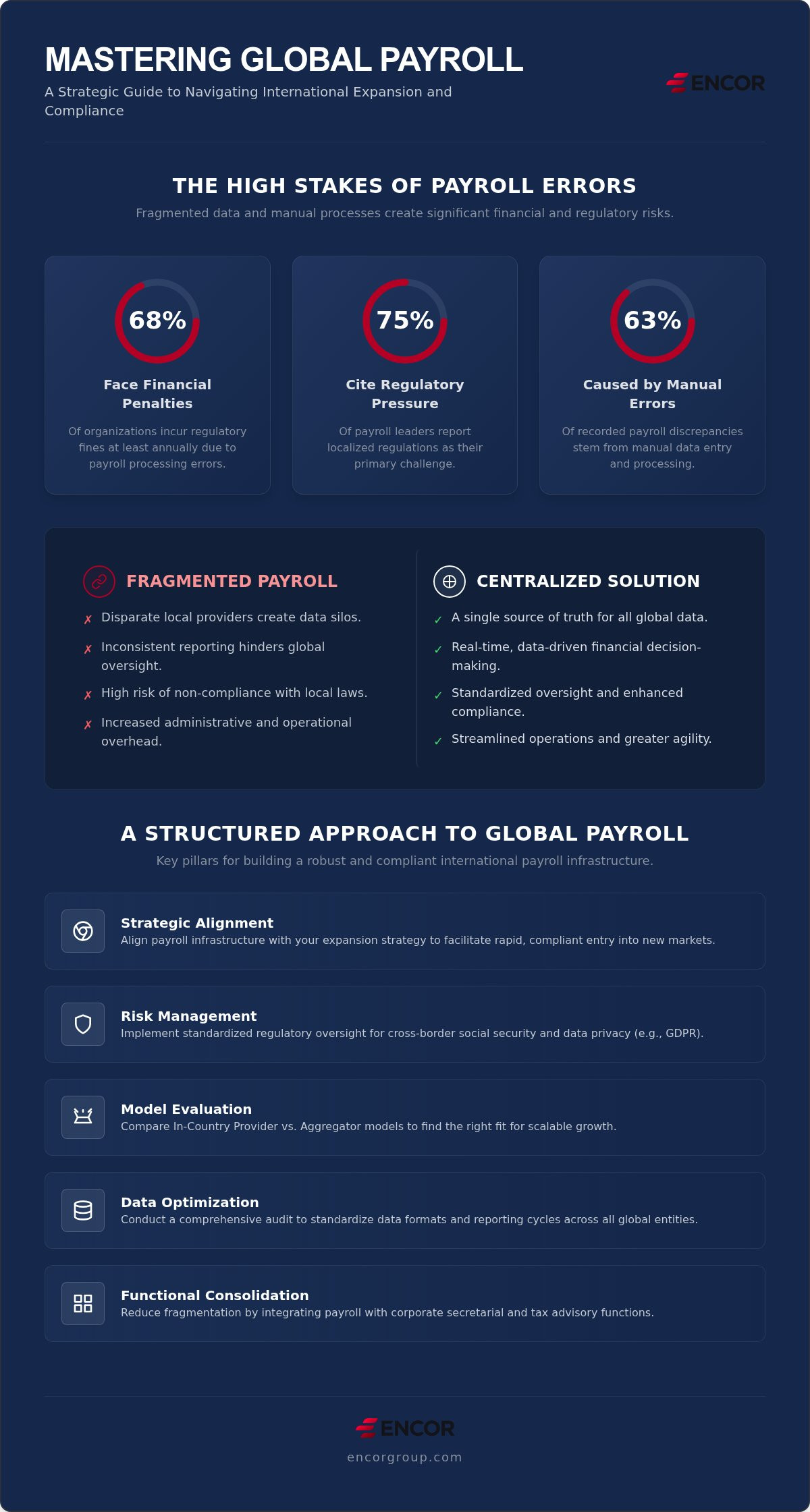
Recent data indicates that 68% of organizations incur regulatory financial penalties at least once or twice a year due to processing errors. For executives managing international expansion, these risks are compounded by fragmented data across disparate local providers and the increasing complexity of cross-border executive compensation. Implementing robust global payroll services is no longer a secondary administrative task. It’s a critical pillar of institutional stability and operational excellence in a landscape where 75% of payroll leaders report localized regulations as their primary pressure point.
You likely recognize the difficulty of maintaining oversight when tax laws and reporting requirements shift across multiple jurisdictions. This guide outlines how to master international payroll management by adopting a structured approach to regulatory compliance. You’ll learn to establish a single source of truth for your global data, mitigating the risk of manual errors which currently account for over 63% of recorded payroll discrepancies. We will examine the transition toward real-time data validation and show how to integrate these solutions seamlessly with your existing accounting and tax advisory functions.
Key Takeaways
- Align your payroll infrastructure with your broader expansion strategy to facilitate rapid, compliant entry into new international markets.
- Manage the risks associated with cross-border social security and data privacy by implementing standardized regulatory oversight across all jurisdictions.
- Compare the operational depth of the In-Country Provider model against the centralized reporting capabilities of the Aggregator model to ensure scalable growth.
- Optimize your global payroll services by conducting a comprehensive audit to standardize data formats and reporting cycles across all international entities.
- Reduce administrative fragmentation by consolidating payroll management with your existing corporate secretarial and tax advisory functions.
The Strategic Role of Global Payroll in International Expansion
Executives often view payroll as a back-office utility. This perspective overlooks its function as a strategic driver for international growth. While foundational payroll concepts focus on the calculation of gross pay and statutory deductions, a sophisticated approach to global payroll services integrates these administrative tasks into a broader framework of corporate governance. Efficiency in this area directly dictates your speed-to-market. Companies that centralize their payroll functions can deploy teams into new jurisdictions with greater agility than those hindered by fragmented, local-only providers.
Operating with siloed data across multiple countries creates institutional vulnerabilities. Fragmented management leads to inconsistent reporting and increases the likelihood of non-compliance with local labor laws. Centralized payroll provides a single source of truth. This visibility allows leadership to make data-driven decisions regarding human capital costs and resource allocation. It transforms payroll from a transactional necessity into a transparent tool for financial oversight, ensuring that every dollar spent on international talent is accounted for and optimized.
Aligning Payroll with Global Entity Management
Payroll doesn’t exist in a vacuum; it’s inextricably linked to corporate secretarial services and entity maintenance. To maintain maximum compliance, your payroll data must align with your statutory filings and corporate records. This integration is a core component of a successful global business expansion strategy. By centralizing these functions, you ensure that every international entity remains in good standing while supporting a unified view of your multinational workforce. This proactive alignment prevents the administrative friction that often stalls growth in new markets.
The Financial Impact of Operational Optimization
Standardizing workflows across international borders reduces administrative overhead significantly. When you move away from managing multiple local vendors, you eliminate redundant communication and manual data entry errors. This operational optimization allows your finance teams to focus on high-value tasks like tax advisory and cross-border fiscal planning. Strategic use of payroll data can reveal insights into regional tax incentives or liabilities that a localized approach would likely miss, turning a compliance requirement into a source of competitive intelligence.
Choosing between global and local providers requires a thorough cost-benefit analysis. While local providers offer deep regional knowledge, they often lack the technical infrastructure to support consolidated reporting. Modern global payroll services bridge this gap. They provide the necessary local expertise while delivering the centralized visibility required for institutional excellence. This balance is vital for maintaining fiscal discipline during rapid scale-up phases, allowing you to manage costs without sacrificing the precision required for international compliance.
Navigating Regulatory Complexity Across Multiple Jurisdictions
Managing a multinational workforce requires a sophisticated understanding of localized labor laws and social security mandates. The regulatory landscape is shifting away from retrospective reporting toward real-time, transaction-level data validation. Initiatives like Australia’s “Payday Super” reform, effective July 2026, and the EU Pay Transparency Directive illustrate this trend. Organizations must ensure their global payroll services provide the architecture necessary to support these high-stakes requirements without compromising operational speed. Success in these environments depends on maintaining strict data privacy standards, particularly when managing cross-border transfers under GDPR or similar regional frameworks.
Compliance also intersects with local tax residency and economic substance requirements. In many jurisdictions, payroll data serves as primary evidence of a company’s physical presence and operational activity. Failure to align payroll with these broader corporate standards can trigger audits or jeopardize an entity’s legal standing. Selecting the right global payroll services involves evaluating a provider’s ability to handle these multifaceted compliance pillars across diverse legal systems. Utilizing a partner for compliance and regulatory advisory ensures your payroll remains a stable component of your international governance structure.
Payroll Compliance in Hong Kong: A Strategic Overview
Hong Kong remains a primary hub for global enterprises, yet its payroll requirements demand precision. Employers must navigate the Mandatory Provident Fund (MPF) schemes, ensuring correct contributions for all relevant employees within statutory timelines. The IR56B form serves as the mandatory annual employer’s return of remuneration and pensions, providing the Inland Revenue Department with the specific data required to assess an employee’s final tax liability. For maximum efficiency, companies should integrate these duties with their Hong Kong company formation services to ensure a seamless transition from incorporation to active employment management.
The UAE Regulatory Framework: Free Zones and Beyond
The United Arab Emirates utilizes a unique electronic salary transfer system known as the Wage Protection System (WPS). This mandate requires companies to pay wages through authorized banks or financial institutions, allowing the Ministry of Human Resources and Emiratisation to monitor payments in real time. Beyond monthly salaries, employers must accurately calculate gratuity pay, which is a statutory end-of-service benefit based on the employee’s length of service and contract type. Managing these obligations requires specialized knowledge of the specific regulations governing various UAE Free Zones, as each jurisdiction may have distinct compliance nuances that affect your overall payroll strategy.
Evaluating Global Payroll Models: Outsourcing vs. In-House
Organizations must select a delivery model that aligns with their long-term growth trajectory. The traditional In-Country Provider (ICP) model involves contracting local firms in each jurisdiction. While this offers deep regional knowledge, it creates significant administrative friction as your footprint expands. Consolidating data from multiple independent ICPs requires substantial manual effort. This fragmentation increases the risk of data silos and processing errors, which account for over 63% of global payroll discrepancies according to industry data. For enterprises scaling rapidly, the lack of a unified interface becomes a bottleneck to operational efficiency.
The Aggregator model attempts to solve this by utilizing a single software interface that sits atop various local providers. This centralizes reporting and provides a cleaner user experience for finance teams. However, it can sacrifice local depth. The central hub often lacks direct control over local execution, leading to communication delays when complex regulatory issues arise. A more sophisticated choice for expanding enterprises is a hybrid approach. This model combines high-level institutional consulting with localized execution, ensuring that your global payroll services provide both the technical scale of an aggregator and the nuanced compliance of a local expert.
The Case for Managed Payroll Services
Shifting the management of payroll to a professional corporate service provider mitigates the risk of institutional non-compliance. Managed services provide 100% visibility into global employment costs and tax liabilities through standardized reporting. This model also enhances data security by leveraging enterprise-level infrastructure and protocols. It protects sensitive employee information against the vulnerabilities often found in smaller, local providers. By outsourcing these functions, leadership teams can refocus on strategic expansion while the provider handles the high-stakes requirements of cross-border compensation.
Employer of Record (EOR) vs. Direct Payroll
For rapid entry into markets where a legal entity hasn’t yet been established, an Employer of Record (EOR) provides a functional shortcut. It’s an effective short-term solution but often becomes cost-prohibitive as headcount grows. Mature organizations typically transition from EOR models to direct payroll as their international entities solidify. This transition requires a robust framework for international payroll solutions that can scale alongside the business. Direct payroll management offers greater control over the employee experience and long-term fiscal planning, making it the preferred choice for sustainable international growth.
Implementation Framework: Centralizing Your Global Payroll
Transitioning from a decentralized model to centralized global payroll services requires a methodical, multi-stage framework. It’s not merely a technical migration but a strategic realignment of corporate governance. Organizations must first decide between a “Big Bang” implementation, where all jurisdictions go live simultaneously, or a phased rollout. While a unified launch offers immediate consolidation, a phased approach allows for the refinement of workflows in lower-risk markets before expanding to complex regions. This deliberate pace ensures that operational stability remains uncompromised during the transition. Establishing clear lines of communication between HR, Finance, and your global provider is essential to manage this shift effectively.
Step 1: Regulatory and Operational Audit
A successful migration begins with an exhaustive audit of existing local processes. This stage identifies historical inaccuracies and latent compliance gaps that could contaminate the new system. You must map local statutory benefits, such as the UAE’s Wage Protection System mandates or Hong Kong’s MPF requirements, to a central reporting framework. Vetting the data security standards of your proposed solution is equally vital. Ensuring that the solution meets international protocols protects the organization against the reputational and financial damage associated with data breaches. This proactive step is crucial, as 68% of organizations currently incur regulatory penalties due to processing errors that an audit could reveal.
Step 2: Data Consolidation and Integration
Once the audit is complete, the focus shifts to migrating employee records into a secure, centralized management platform. This process requires standardizing data formats and reporting cycles to ensure a single source of truth across all international entities. Integration with existing ERP and accounting systems is essential to eliminate manual data entry, which is the source of 63.6% of global payroll errors. Before the final go-live, executing a “Shadow Payroll” process is a critical safeguard. Running the new system in parallel with the old one for at least one cycle allows you to verify accuracy and resolve discrepancies without affecting employee compensation. To ensure your transition meets the highest standards of institutional excellence, consider engaging a specialist for operations optimization during your payroll centralization.
Encor Group: Institutional Excellence in Global Payroll
Most providers treat payroll as an isolated technical task. Encor Group approaches global payroll services as a specialized component of a broader institutional framework. By integrating payroll with end-to-end business setup and tax advisory, we ensure that every administrative function supports your overarching commercial objectives. This strategic depth is essential for multinational enterprises optimizing for operational excellence in high-stakes environments. Our regional hubs serve 10+ markets, providing the localized precision required to manage complex cross-border requirements with quiet efficiency.
Choosing an institutional consultant over a simple software vendor provides a distinct advantage in risk mitigation. We don’t just process payments; we provide a comprehensive governance structure that aligns your human capital management with your legal and fiscal obligations. This proactive stance is vital for maintaining stability during rapid expansion phases, where manual errors or compliance gaps can lead to significant financial penalties. Our role is to act as a strategic navigator, handling high-stakes requirements so your leadership can focus on growth.
Comprehensive HR and Recruitment Solutions
International growth depends on the quality of your human capital. Through our Human Resources & Recruitment Services, we help organizations identify and hire top-tier talent tailored to specific regional needs. We manage the intricacies of executive compensation and localized benefit packages, ensuring your structures remain competitive while adhering to the mandates discussed in previous sections. Strategic HR consulting ensures the long-term success of your multinational teams, providing the stability required to scale effectively across diverse jurisdictions without the friction of fragmented management.
Seamless Integration with Corporate Services
Centralizing your payroll with our Accounting and Bookkeeping and Corporate Secretarial Services significantly reduces institutional risk. This holistic approach ensures that your payroll data remains perfectly aligned with your tax filings and statutory records, creating a single source of truth for your entire operation. You gain direct access to executive-level consulting for complex international requirements, moving beyond the limitations of standard software platforms. It’s a model built for scale, stability, and high standards. If you’re ready to scale your operations with the support of a dedicated institutional partner, Contact Encor Group for a strategic consultation.
Mastering the Future of Global Expansion
Establishing robust global payroll services is a foundational requirement for any enterprise seeking sustainable international growth. Centralizing these functions eliminates the manual errors that lead to institutional risk while providing the transparency required for high-level executive decision-making. By moving away from fragmented local providers and adopting a structured, institutional framework, your organization secures a single source of truth that aligns perfectly with broader entity management and fiscal planning.
Success in complex jurisdictions like Hong Kong and the UAE depends on a partner that offers more than technical processing. Encor Group provides strategic advisory across 10+ international markets, delivering end-to-end corporate and compliance support. Our deep expertise in regional regulatory frameworks ensures that your expansion remains compliant and efficient at every stage of the journey. We handle the high-stakes requirements of cross-border operations so you can focus on strategic innovation.
Optimize Your Global Operations with Encor Group to ensure your multinational teams are supported by the highest standards of institutional excellence. Your journey toward international market leadership starts with precise, scalable infrastructure.
Frequently Asked Questions
What are the primary benefits of global payroll services for multinationals?
The primary benefits include centralized data visibility, mitigated regulatory risk, and enhanced operational efficiency. By utilizing global payroll services, organizations can consolidate fragmented data into a single source of truth. This allows finance teams to monitor employment costs in real time and ensures that compensation strategies align with broader corporate governance goals. It transforms a transactional necessity into a strategic tool for international oversight.
How does global payroll ensure compliance with local tax laws in multiple countries?
Compliance is maintained through the integration of localized tax engines and the expertise of regional specialists. These systems automatically adjust for updates in tax codes, such as the 2026 Social Security wage base changes in the United States or the 15% employer National Insurance rate in the United Kingdom. This proactive approach prevents the processing errors that lead to financial penalties for 68% of global organizations.
What is the difference between a global payroll aggregator and a local provider?
A global aggregator utilizes a single technical interface to manage multiple in-country providers, while a local provider offers direct expertise within a single jurisdiction. Aggregators offer superior consolidated reporting and a unified user experience for multinational headquarters. Conversely, local providers may offer deeper regional knowledge but often lack the infrastructure required for seamless data integration across a sprawling global footprint.
Can global payroll services manage benefits and social security across different regions?
Yes, comprehensive global payroll services are designed to manage complex statutory benefits and social security requirements, such as Hong Kong’s MPF or the UAE’s gratuity calculations. The system maps these localized requirements to a central framework, ensuring that all contributions are calculated accurately. This ensures that multinational teams receive their localized benefit packages without creating administrative friction for the central HR department.
How long does it typically take to implement a centralized global payroll solution?
Implementation timelines vary depending on the number of jurisdictions and the complexity of existing data, but a standard transition typically requires three to six months. This period includes a thorough regulatory audit, data consolidation, and at least one cycle of “Shadow Payroll” testing. A phased rollout may extend this timeline but often provides greater stability for enterprises with large-scale international operations.
Is global payroll suitable for companies without a local legal entity?
Direct global payroll management typically requires a local legal entity; however, companies without one can utilize an Employer of Record (EOR) model. The EOR acts as the legal employer for tax and compliance purposes while the company manages the employee’s daily tasks. As organizations mature and establish their own entities, they often transition from EOR models to direct payroll to gain greater fiscal control.
How is data security managed in international payroll transfers?
Data security is managed through enterprise-level encryption, multi-factor authentication, and strict adherence to international standards like GDPR and SOC 2. Providers secure the transmission of sensitive records between regional hubs and the central platform to prevent unauthorized access. This high-level infrastructure protects the organization from the reputational and financial risks associated with cross-border data breaches and unauthorized data exposure.
What are the common pitfalls to avoid when selecting a global payroll provider?
Common pitfalls include prioritizing lower service fees over compliance depth and failing to verify a provider’s integration capabilities with existing ERP systems. Organizations should also avoid providers that lack direct expertise in key expansion markets like the UAE or Hong Kong. Selecting a partner based solely on software features without considering their strategic advisory capacity often leads to long-term operational friction and compliance gaps.