
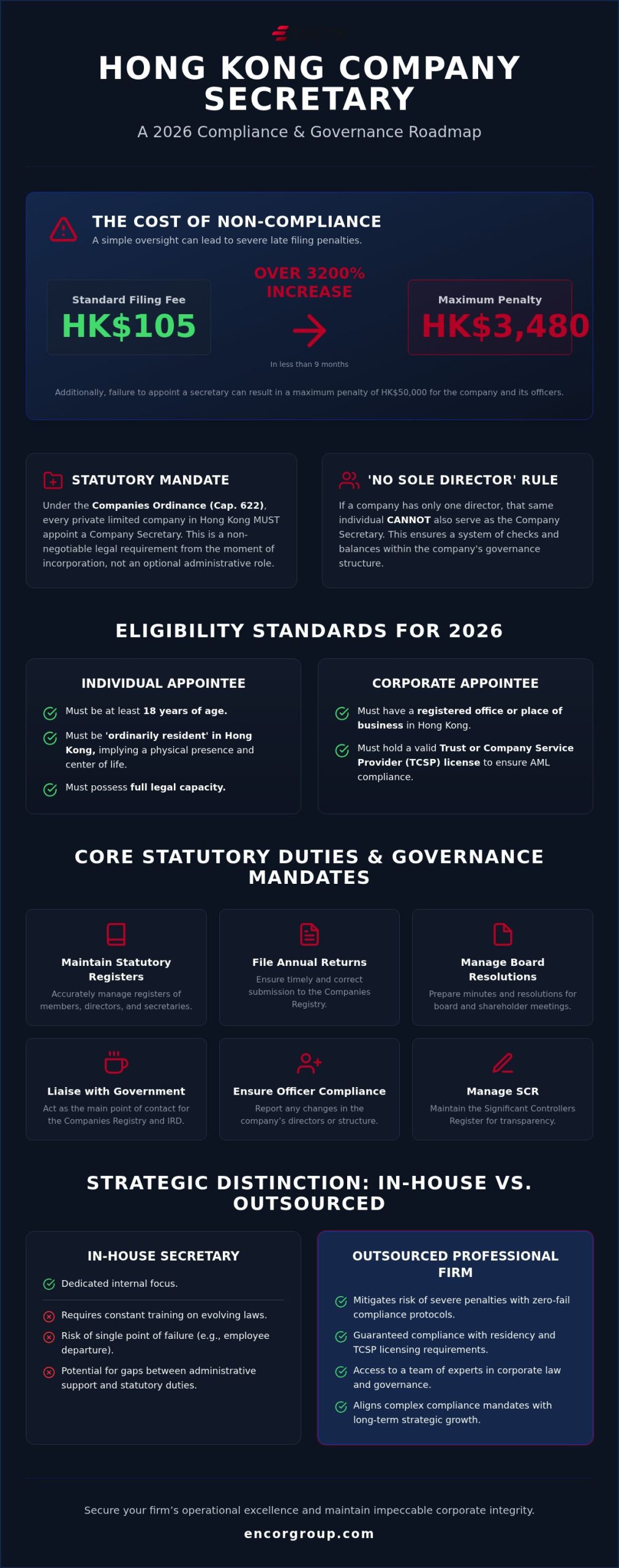
A simple administrative oversight in Hong Kong can escalate from a standard HK$105 filing fee to a HK$3,480 penalty in less than nine months. The complexity of the Companies Ordinance often creates a precarious gap between basic administrative support and the rigorous execution of statutory duties. Failing to master the Hong Kong company secretary requirements places an entity at risk of significant late filing penalties and regulatory scrutiny. It’s a challenge that requires precise navigation to ensure that administrative actions align perfectly with legal mandates.
This strategic reference provides a comprehensive analysis of the statutory mandates for 2026. You’ll gain a clear understanding of eligibility criteria, residency mandates, and the essential role of TCSP licensing in maintaining corporate integrity. We’ll examine the framework governing these officers and provide a roadmap for selecting a partner that ensures zero-fail compliance. This guide covers everything from the reinstatement of the PWIF levy to the nuances of the Significant Controllers Register, equipping you with the knowledge to secure your firm’s operational excellence.
Key Takeaways
- Identify the mandatory nature of the company secretary role under the Companies Ordinance (Cap. 622) and why it remains distinct from standard clerical support.
- Navigate the 2026 residency standards and legal capacity requirements for both individual and corporate secretarial appointees.
- Implement a robust governance framework for managing statutory registers and the Significant Controllers Register to ensure total regulatory transparency.
- Analyze how professional secretarial services mitigate the risk of severe late filing penalties while fulfilling all Hong Kong company secretary requirements.
- Learn to leverage integrated corporate services to align complex compliance mandates with long-term strategic growth and operational excellence.
The Statutory Framework: Understanding the Mandatory Appointment
Under the Companies Ordinance (Cap. 622), every private limited company in Hong Kong must appoint a company secretary. This isn’t a mere administrative preference; it’s a statutory mandate that defines the legal existence of the firm. While some confuse the role with clerical or secretarial support, the reality is far more complex. The secretary serves as the primary officer responsible for ensuring the company complies with all legal obligations. They act as the central liaison between the entity and government bodies like the Companies Registry and the Inland Revenue Department. Compliance with Hong Kong company secretary requirements begins early. You must designate this officer at the exact moment of Hong Kong company formation to ensure the application is valid.
The role demands a deep understanding of corporate law and governance standards. Many professionals in this field are members of the Hong Kong Chartered Governance Institute (HKCGI), reflecting the high level of expertise required to manage an entity’s legal standing. It’s about more than just filing forms. It’s about protecting the company’s license to operate in a global market. A qualified secretary ensures that every board resolution, share transfer, and annual filing meets the exact standards expected by the Registry. Fulfilling all Hong Kong company secretary requirements is a prerequisite for maintaining a ‘good standing’ status with the Registry.
The ‘No Sole Director’ Restriction
A critical nuance of the Ordinance is the restriction on sole directors. If a company has only one director, that individual cannot also serve as the company secretary. This rule exists to maintain a system of checks and balances. It ensures that at least two distinct parties are involved in the high-level governance of the firm. For single-member companies, this necessitates the appointment of an external professional or a second individual who meets the residency criteria. This separation of powers prevents the consolidation of authority and reduces the risk of internal governance failures. It’s a fundamental requirement that prevents a single individual from having total control over both the management and the statutory oversight of the business.
Consequences of Non-Compliance
Ignoring these mandates leads to severe institutional friction. Government authorities monitor compliance through the annual return process and periodic audits. If a company fails to maintain a secretary, it risks prosecution and substantial fines. Beyond legal penalties, non-compliance often triggers red flags during bank reviews. Financial institutions require proof of valid corporate officers to maintain active accounts and satisfy KYC protocols. Failure to appoint a secretary according to 2026 guidelines can result in a maximum penalty of HK$50,000 for the company and its officers. Additionally, missing the 42-day deadline for filing the Annual Return can result in a penalty up to HK$3,480, which is a significant increase from the standard HK$105 fee.
Eligibility and Residency Standards for 2026
The criteria for appointing a company secretary are strictly codified to maintain the integrity of the Hong Kong financial system. According to the Companies Ordinance (Cap. 622), an appointee can be either a natural person or a body corporate. For individuals, the baseline requirements include being at least 18 years of age and possessing full legal capacity. Most importantly, an individual secretary must be ‘ordinarily resident’ in Hong Kong. This means they must have a physical presence and a demonstrable center of life within the territory. Meeting these Hong Kong company secretary requirements is not optional; it’s the foundation of a company’s legal standing.
Corporate appointees offer a layer of institutional stability that individuals often cannot match. A corporate secretary must have a registered office or a place of business in Hong Kong. More crucially, any entity providing these services as a business must hold a valid Trust or Company Service Provider (TCSP) license. This regulatory oversight ensures that the provider adheres to strict Anti-Money Laundering (AML) protocols. You can verify a provider’s credentials through the TCSP License Register. Meeting the Hong Kong company secretary requirements through a licensed firm ensures that your entity remains compliant with both local and international governance standards.
The TCSP Licensing Requirement
The TCSP licensing regime represents a high standard of regulatory scrutiny. Licensed firms undergo rigorous ‘fit and proper’ tests and must maintain robust internal controls. For international businesses, partnering with a licensed provider mitigates the risk of non-compliance with evolving global standards. These firms are subject to ongoing inspections, ensuring they remain updated on the latest statutory changes. If you’re seeking a partner that balances these mandates with operational efficiency, exploring professional corporate secretarial services is a prudent strategic move.
Residency and Physical Presence
The ‘ordinarily resident’ test for individuals has become more nuanced in the current business climate. It requires more than just a local mailing address. The individual must habitually live in Hong Kong, which can be problematic for directors who travel extensively or reside primarily overseas. Appointing a ‘nominee’ individual who lacks a professional infrastructure is a significant risk. These individuals often lack the resources to handle complex filings or respond to government inquiries promptly. A lack of physical presence or professional oversight can lead to missed deadlines and the severe penalties mentioned in previous sections. Choosing a corporate secretary eliminates the uncertainty surrounding an individual’s residency status and ensures uninterrupted compliance.
Core Statutory Duties and Governance Mandates
Executing the role of a secretary requires more than passive oversight. It demands the active management of an entity’s statutory records. These records include the Register of Members, the Register of Directors, and the Register of Company Secretaries. These documents serve as the definitive legal evidence of a company’s structure and ownership. Any discrepancies in these registers can lead to significant delays during corporate actions, such as share transfers or debt financing. Fulfilling the Hong Kong company secretary requirements involves ensuring these books are kept at the registered office and remain available for inspection by authorized parties at all times.
The annual compliance cycle centers on the filing of the Annual Return (Form NAR1). This document must be submitted to the Companies Registry within 42 days of the company’s incorporation anniversary. While the standard filing fee is a modest HK$105, the consequences of missing this window are severe. As previously noted, late penalties escalate rapidly, reaching HK$3,480 for delays exceeding nine months. The secretary also manages the logistical aspects of corporate governance, including the coordination of board and shareholder meetings. They are responsible for drafting precise minutes and resolutions that accurately reflect the decisions of the officers and investors.
The Significant Controllers Register (SCR)
A primary focus for 2026 is the maintenance of the Significant Controllers Register. The secretary must take reasonable steps to identify the individuals or legal entities that exercise ultimate control over the company. This duty includes issuing notice letters to potential controllers and recording their particulars in a specific format. The secretary often acts as the Designated Representative, serving as the point of contact for law enforcement and regulatory bodies seeking to inspect SCR data. Integrating these tasks into Hong Kong corporate compliance checklists is essential for mitigating risks associated with financial transparency mandates.
Event-Driven Filings and Notifications
Beyond recurring annual duties, the secretary must manage event-driven notifications. Any change in the company’s structure requires immediate reporting to the Registry. This includes the allotment of new shares, capital increases, or the transfer of existing shares between parties. If there’s a change in directors or their personal particulars, the secretary must file Form ND2A or ND2B within 15 days of the change. They also ensure the timely renewal of the Business Registration Certificate (BRC). For 2026, this includes managing the reinstated HK$150 PWIF levy. Adhering to these Hong Kong company secretary requirements ensures that the public record remains accurate and that the company avoids the risk of prosecution for administrative negligence.
Strategic Distinction: Internal vs. Outsourced Secretarial Services
Choosing between an internal appointee and a professional firm is a decision that directly impacts an entity’s risk profile. While an internal employee may satisfy the basic Hong Kong company secretary requirements regarding residency, they often lack the specialized legal depth required to navigate the evolving Companies Ordinance. Professional firms offer institutional continuity. They don’t take sick leave or resign unexpectedly, ensuring that statutory deadlines are never missed. This expertise is vital when aligning corporate records with international tax structuring strategies. A professional secretary ensures that the substance of the company’s operations is accurately reflected in its legal documentation, which is essential for territorial tax claims.
The cost-benefit analysis favors outsourcing for most global enterprises. The predictable fees of a service provider represent a small fraction of the potential costs associated with non-compliance. Beyond the statutory fines discussed in earlier sections, the loss of “good standing” can disrupt global supply chains and investor relations. Professional firms utilize automated deadline management systems to eliminate the risk of human error. This proactive approach transforms the role from a mere compliance checkbox into a strategic asset that supports long-term expansion.
Mitigating Jurisdictional Risk
A professional secretary acts as a guardian of the company’s reputation during global audits. They ensure that all secretarial records are perfectly aligned with audit and assurance requirements. This alignment is critical during corporate bank account opening, where financial institutions demand impeccable statutory books. If you’re ready to secure your entity’s standing and streamline your governance, you should engage a TCSP licensed provider to manage your secretarial mandates.
Technological Integration in 2026
The landscape of corporate governance has shifted toward a digital-first model. Modern secretarial firms leverage the e-Registry portal to facilitate faster processing and lower government fees for their clients. Secure client portals now handle document execution and record keeping, providing a transparent audit trail for all corporate actions. This shift emphasizes the importance of data privacy and cybersecurity in secretarial work. A professional provider invests in high-level encryption to protect sensitive corporate data, a standard that internal administrative staff can rarely replicate. Adhering to modern Hong Kong company secretary requirements now involves mastering these digital tools to maintain operational efficiency and data integrity.
Institutional Compliance with Encor Group
Encor Group provides an institutional-grade solution for entities looking to master Hong Kong company secretary requirements. We view compliance not as a burden but as a strategic advantage that facilitates cross-border growth. Our model integrates secretarial mandates with essential operational services like payroll solutions and HR management. This synergy ensures that your company’s legal standing and human capital management are perfectly aligned. By centralizing these functions, we eliminate the communication gaps that often lead to administrative errors and regulatory friction.
Our support begins at the point of incorporation and extends through every stage of the corporate lifecycle. We handle the intricacies of TCSP licensing and statutory management so your leadership can focus on market expansion. For international enterprises, Encor Group acts as a steady navigator in a shifting regulatory environment. We provide the expertise needed to manage high-stakes requirements with quiet efficiency and absolute precision. Our role as a trusted elite consultant ensures that no detail is overlooked, from the renewal of business licenses to the management of complex share transfers.
Proactive Compliance Monitoring
We use a proprietary methodology to track statutory deadlines and legislative updates. Whether it involves a subtle change in the Companies Ordinance or the reinstatement of a government levy, we’re ahead of the curve. Our consultants provide strategic advisory on complex structural changes, share allotments, and cross-border transactions. Encor Group maintains a rigorous internal audit framework to ensure zero-error compliance for its diverse global client base. This proactive stance prevents the escalation of late filing penalties and protects the company’s standing with the Registry.
Seamless Global Integration
We specialize in connecting your Hong Kong operations with broader global business expansion strategies. For businesses operating across multiple jurisdictions, such as Hong Kong and the UAE, we offer centralized entity management. This approach provides a single point of truth for your corporate records and compliance status across all markets. It’s a level of oversight that protects your global reputation and ensures operational continuity in high-stakes environments. You should contact our consultants for a strategic review of your Hong Kong compliance framework to ensure you’re meeting all Hong Kong company secretary requirements with absolute certainty.
Strategizing for Long-Term Corporate Resilience
Mastering the statutory framework is essential for any entity seeking long-term stability in the Hong Kong market. You now understand how precise residency standards and the rigorous maintenance of the Significant Controllers Register form the backbone of a compliant corporate structure. These mandates aren’t merely administrative hurdles; they are the mechanisms that protect your entity’s legal standing and global reputation. Navigating the Hong Kong company secretary requirements with total precision ensures that your business remains agile, audit-ready, and positioned for sustainable growth.
As a TCSP Licensed Professional Provider with strategic hubs in 10+ global markets, Encor Group brings unmatched expertise in complex multinational entity management. We provide the institutional depth needed to scale operations without the risk of regulatory friction or late filing penalties. Our proactive approach transforms statutory compliance into a strategic asset for your enterprise. Secure your Hong Kong compliance with Encor Group’s professional secretarial services. Your path to seamless international expansion begins with a robust and expertly managed governance foundation.
Frequently Asked Questions
Can a non-resident individual be a company secretary in Hong Kong?
An individual must be ordinarily resident in Hong Kong to qualify as a company secretary. This means the person must have a habitual physical presence and a demonstrable center of life within the territory. Non-residents cannot satisfy this specific statutory mandate. For international directors, this requirement usually necessitates the appointment of a local professional or a licensed corporate secretary to ensure the company satisfies all Hong Kong company secretary requirements.
Is it mandatory for a Hong Kong company to have a company secretary?
Every private limited company must appoint a secretary under the Companies Ordinance (Cap. 622). This is a foundational legal obligation that must be met at the time of incorporation. The secretary acts as the primary officer for regulatory communications and statutory maintenance. Failing to maintain this appointment can lead to prosecution and significant administrative penalties for both the company and its officers, regardless of the company’s size.
What is the difference between a Company Secretary and a Designated Representative?
The company secretary is a statutory officer responsible for broad governance, while the Designated Representative is specifically tasked with liaising with law enforcement regarding the Significant Controllers Register (SCR). Often, the same professional firm fills both roles. While the secretary manages general filings and registers, the Designated Representative must be available to provide SCR information to authorities upon request. This dual structure ensures that the entity remains transparent and compliant with modern anti-money laundering standards.
Can the same person be both a director and the company secretary?
A person can serve as both a director and a secretary provided the company has more than one director. However, a sole director is legally prohibited from acting as the company secretary. This restriction ensures a critical system of checks and balances within the corporate structure. If an entity has only one director, a second individual or a corporate body must be appointed to fulfill the Hong Kong company secretary requirements and maintain legal standing.
What are the specific qualifications required for a corporate company secretary?
A corporate body must have its registered office or a place of business in Hong Kong to act as a secretary. Additionally, any entity providing these services as a business must hold a valid Trust or Company Service Provider (TCSP) license. This license confirms that the provider has passed the ‘fit and proper’ test and adheres to strict Anti-Money Laundering protocols. Professional qualifications from recognized governance institutes often supplement these statutory mandates for high-stakes entities.
How often must a company secretary update the statutory registers?
Statutory registers must be updated immediately whenever a change occurs in the company’s structure or officer particulars. This includes changes in directors, share allotments, or transfers of membership. Keeping these records current is not an annual task but an ongoing duty. Failure to maintain accurate registers at the registered office can result in regulatory red flags during audits or bank reviews. Prompt updates are essential for maintaining the integrity of the corporate record.
What happens if our company secretary resigns and we don’t have a replacement?
The company must appoint a new secretary immediately to remain compliant with the Companies Ordinance. You’re required to notify the Companies Registry of the resignation and the new appointment within 15 days using the appropriate statutory forms. Operating without a secretary leaves the company in a state of non-compliance. This status can trigger escalating fines and jeopardize the entity’s “good standing” status, which is critical for maintaining corporate bank accounts and investor confidence.
Can a company secretary be held personally liable for company debts?
A company secretary is generally not liable for the commercial debts of the company. However, they can face personal liability and fines for breaches of statutory duties or failure to comply with the Companies Ordinance. This includes negligence in filing annual returns or failing to maintain the Significant Controllers Register. Their liability is centered on administrative and regulatory compliance rather than the financial obligations or commercial failures of the business entity itself.