
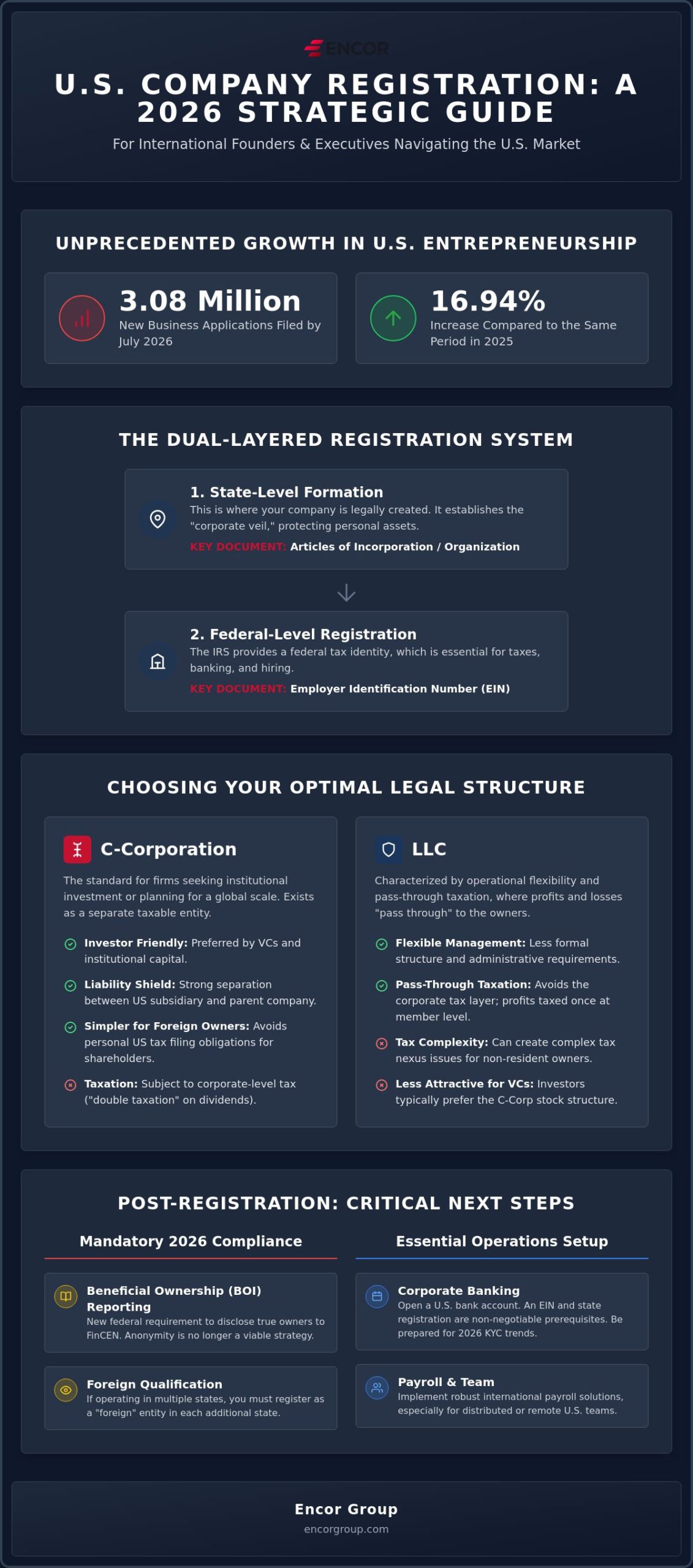
By July 2026, entrepreneurs had already filed 3.08 million new business applications in the United States, representing a 16.94 percent increase compared to the same period in 2025. This record-breaking pace confirms that the U.S. remains the primary destination for global commercial expansion, even as the regulatory environment becomes more sophisticated. Many international executives understand the immense potential of this market but find themselves stalled by the technical nuances of how to register a company in usa, particularly when balancing state-level filings with federal mandates.
Establishing a domestic entity requires more than just a simple filing; it demands a calculated approach to jurisdictional selection and long-term compliance. We recognize that managing fragmented regulations and the rigorous 2026 BOI reporting requirements can be daunting for non-resident owners. This article provides an authoritative framework designed to help you handle these complexities with the precision of a seasoned advisor. We’ll guide you through the strategic selection of your legal structure, the specific requirements for non-resident EIN applications, and the essential steps to secure corporate banking and operational continuity.
Key Takeaways
- Identify the multi-tiered requirements of U.S. incorporation, distinguishing between domestic formation and foreign qualification across various jurisdictions.
- Evaluate the strategic advantages of C-Corporations for institutional investment versus the operational flexibility and pass-through taxation offered by Limited Liability Companies (LLCs).
- Master the technical requirements of how to register a company in usa as a non-resident, including securing an EIN and meeting mandatory 2026 Beneficial Ownership Information (BOI) reporting standards.
- Establish critical operational infrastructure by navigating 2026 KYC trends for corporate banking and implementing robust international payroll solutions for distributed teams.
- Adopt a centralized approach to global entity management to ensure seamless regulatory alignment across your U.S., Hong Kong, and UAE corporate structures.
The Strategic Framework of US Company Registration
US company registration is the multi-tiered process of establishing a legal entity at federal, state, and local levels. It’s not a singular administrative act but a series of coordinated filings that define your firm’s legal standing within the American market. Understanding how to register a company in usa requires a perspective that extends beyond simple paperwork. You must distinguish between “domestic” formation, which occurs in the state where your entity is first created, and “foreign” qualification, which is required if your business expands operations into additional states. Each jurisdiction maintains its own set of incorporation requirements in the United States, making the initial choice of state a critical structural decision.
The year 2026 represents a pivotal shift toward increased transparency in US corporate filings. New federal mandates, specifically the Beneficial Ownership Information (BOI) reporting requirements under the Corporate Transparency Act, now require most entities to disclose their true owners to the Financial Crimes Enforcement Network (FinCEN). This regulatory evolution means that anonymity is no longer a viable strategy. Instead, successful market entry depends on integrating your US presence into a broader global business expansion strategy. Centralizing your compliance and operational data ensures that your US entity remains in good standing while supporting your international objectives.
Federal vs. State Jurisdictions
The United States is not a monolithic legal entity. It functions as a federation of fifty sovereign states, each possessing the authority to govern corporate law within its borders. Most international firms prioritize state-level registration first because the state creates the legal “personhood” of the business. Once the state approves your Articles of Incorporation or Organization, the federal government, through the IRS, provides a tax identity known as an Employer Identification Number (EIN). This dual-layered system ensures that your business is recognized for both legal liability at the state level and tax obligations at the federal level.
The Institutional Importance of Proper Registration
Executing the registration process with precision is essential for mitigating personal and parent-company liability. A properly structured US entity creates a “corporate veil” that protects international assets from domestic legal disputes. Beyond protection, formal registration establishes the necessary credibility with US-based financial institutions. Without a verifiable state filing and a federal EIN, opening a corporate bank account is impossible. This institutional foundation is also the prerequisite for accessing the US capital markets and the vast venture ecosystem, where investors demand rigorous adherence to statutory standards. Proper registration isn’t just a legal requirement; it’s a strategic asset that facilitates growth and operational stability.
Selecting the Optimal Legal Structure for International Expansion
Choosing the correct legal vehicle is the most consequential decision in the incorporation process. When executives evaluate how to register a company in usa, they must weigh the institutional advantages of a C-Corporation against the operational flexibility of a Limited Liability Company (LLC). The C-Corporation remains the standard for firms seeking institutional investment or planning for a global scale. It exists as a separate taxable entity, providing a clear boundary between the US subsidiary and the international parent. While this structure involves corporate-level taxation, it simplifies the tax reporting requirements for foreign shareholders who wish to avoid personal filing obligations with the IRS.
The LLC offers a different strategic profile, characterized by pass-through taxation. In this model, the entity’s financial results flow directly to the members. While this avoids the corporate tax layer, it can create complex tax nexus issues for non-resident owners. It’s essential to consult the specific requirements to Register your business with the U.S. Small Business Administration to understand how these structures interact with state-level mandates. For many global enterprises, the C-Corp is the preferred choice for a US subsidiary because it presents a familiar and stable profile to American banks and regulators.
C-Corp vs. LLC for Non-Resident Owners
Compliance burdens often dictate the final structural choice. C-Corporations require formal board meetings and meticulous record-keeping, but this rigor often facilitates smoother interactions with financial institutions. Banks generally view the C-Corp as a more transparent vehicle for foreign-owned entities. If your expansion requires specialized bank account opening assistance, adopting a C-Corp structure can reduce the friction often encountered during the KYC process. Conversely, the LLC is favored for smaller, closely-held operations that prioritize administrative simplicity over institutional scaling.
Jurisdictional Analysis: Delaware and Beyond
State selection is as critical as the legal structure itself. Delaware remains the premier jurisdiction due to its Court of Chancery, which offers unparalleled legal predictability for corporate disputes. This specialized court system allows boards to make decisions based on decades of established case law. However, states like Wyoming and Nevada offer compelling alternatives. Wyoming is frequently selected for its lower annual report fees and robust asset protection laws, while Nevada is known for its privacy-centric approach. Regardless of the state, you must appoint a Registered Agent to maintain a physical presence for legal correspondence. This ensures your global entity remains compliant with local statutes without requiring a physical office in every jurisdiction.
Navigating Federal and State Compliance Requirements
Maintaining a US entity requires strict adherence to a multi-layered regulatory framework. While the initial filing creates the legal structure, ongoing compliance ensures the company’s continued authorization to operate. This involves managing both federal obligations with the Internal Revenue Service (IRS) and state-level requirements with the Secretary of State. Understanding how to register a company in usa as a non-resident involves navigating specific hurdles, such as securing federal identification without a domestic Social Security Number. Failure to align with these mandates can result in administrative dissolution or significant financial penalties.
Every US business must also appoint a Registered Agent in its state of incorporation. This agent serves as the official point of contact for legal service of process and state correspondence. If your operations expand beyond your initial state of formation, you may need to pursue “Foreign Qualification.” This process grants your entity the authority to conduct business in additional jurisdictions, ensuring you remain compliant with local tax and labor laws. For a detailed overview of these requirements, you should consult the U.S. Small Business Administration guide to registering your business, which outlines the intersections of federal and state authority.
The EIN Acquisition Process
The Employer Identification Number (EIN) is the cornerstone of US financial operations. It’s required for opening corporate bank accounts, hiring employees, and filing federal tax returns. For international owners who don’t possess a Social Security Number, the application process relies on IRS Form SS-4. You must designate a “responsible party” to oversee the entity’s tax matters. In 2026, non-resident applicants should expect a processing timeline of four to six weeks for mail or fax submissions. This identification is essential because it anchors your business within the US financial system, allowing for seamless cross-border capital movements.
2026 Transparency Standards: BOI Reporting
The regulatory landscape shifted significantly with the implementation of mandatory Beneficial Ownership Information (BOI) reporting to the Financial Crimes Enforcement Network (FinCEN). By 2026, all non-exempt entities must identify their “Reportable Individuals.” These are persons who either exercise substantial control over the company or own at least 25 percent of the equity. In complex multinational structures, identifying these individuals requires a thorough analysis of ownership tiers. Deadlines are strict; new entities typically have 90 days from the date of formation to file their initial report. Centralized corporate secretarial services are now essential for managing these filings, as they ensure that your global records remain synchronized with US transparency standards.
Operational Infrastructure for Global Entities
Transitioning from a legal concept to a functioning business requires a meticulous operational strategy. As you finalize the technicalities of how to register a company in usa, your focus must shift toward financial and human resource management. Operational excellence in the United States requires a localized approach to banking and employment that remains synchronized with your parent company’s standards. Establishing this infrastructure correctly from the outset prevents the administrative friction that often stalls international expansion.
Banking and Financial Setup
The evolution of Know Your Customer (KYC) standards in 2026 reflects a global trend toward heightened transparency. While some digital platforms offer remote onboarding for simple structures, institutional-grade banking for multinational subsidiaries often requires a more rigorous process. Tier-1 national banks provide the stability and global reach necessary for high-revenue firms; however, they frequently demand evidence of a physical presence or an in-person meeting with a designated officer. Selecting between a national powerhouse and a specialized commercial bank depends on your transaction volume and cross-border needs. Professional bank account opening assistance provides the necessary bridge to these institutions, ensuring your financial setup aligns with federal anti-money laundering standards.
HR and Payroll Compliance
Labor law compliance is another critical pillar of your US infrastructure. Managing a US workforce introduces distinct legal concepts, such as “At-Will” employment, which may differ significantly from your home jurisdiction. Implementing international payroll solutions is vital for maintaining compliance across various state lines. Each state maintains its own regulations for tax withholding, unemployment insurance, and social security contributions. A centralized system ensures that your distributed global team receives compensation through a framework that respects both US statutes and your corporate HR policies. This level of organization is essential for mitigating the risks of labor disputes and tax audits.
You must also manage the complex “nexus” between your US entity and your foreign holdings. This involves filing annual reports with the Secretary of State and managing federal tax returns that account for international treaties. Maintaining accurate bookkeeping isn’t just a regulatory requirement; it’s a strategic necessity for global financial consolidation. If you require expert oversight for your American operations, Encor Group provides comprehensive compliance management to ensure your expansion remains efficient and secure.
Centralizing US Market Entry with Encor Group
Encor Group serves as an institutional bridge for enterprises seeking to establish a definitive presence in the American market. While the technical steps of how to register a company in usa provide the legal foundation, long term success depends on a centralized management model. We provide unified compliance management that synchronizes your Hong Kong, UAE, and US entities within a single strategic framework. This approach ensures that your global expansion remains cohesive and that your international holdings don’t suffer from the administrative fragmentation often seen in cross-border operations.
Our strategic consulting services focus on operational optimization and international growth. We don’t just facilitate filings; we act as a navigator for your entire market entry journey. By leveraging our human resources and recruitment services, you can build a US leadership team that possesses the local expertise necessary to scale. This comprehensive support structure transforms a standard incorporation into a robust, high-performance market entry strategy that prioritizes precision and institutional stability.
The Encor Advantage: Beyond Incorporation
The value of an elite consultancy lies in the continuity of service after the initial formation. We provide ongoing corporate secretarial services to ensure your entity maintains “Good Standing” across all jurisdictions. This involves meticulous management of annual returns, state filings, and the evolving federal transparency mandates discussed previously. Our tax advisory and compliance experts work to optimize your cross-border fiscal structures, mitigating the risks of double taxation while ensuring full adherence to international treaties. Clients benefit from a single point of contact for global entity management, which significantly reduces the internal resources required to oversee multiple regional hubs.
Next Steps for Strategic Expansion
Establishing a US presence is a methodical process that requires proactive planning. Our engagement begins with an initial consultation to define your specific structural requirements based on your capital needs and operational goals. Once the structure is finalized, we handle the document preparation and execute expedited filing strategies to minimize downtime. The final phase involves finalizing your US operational and financial infrastructure, including bank account opening assistance and the implementation of localized payroll solutions. This structured journey ensures that your firm is not just registered, but fully operational and compliant from day one. If you’re ready to initiate your expansion, how to register a company in usa becomes a seamless reality through our professional facilitation.
Strategic Implementation for Global Market Entry
Establishing a definitive presence in the American market is a transformative step for any international enterprise. It’s essential to remember that success requires more than just knowing how to register a company in usa; it demands a rigorous commitment to structural integrity and regulatory transparency. By selecting the optimal legal vehicle and maintaining strict adherence to 2026 transparency standards, you protect your global assets while positioning your firm for institutional scaling. Centralizing these efforts ensures your US subsidiary operates as a seamless extension of your global portfolio.
Encor Group provides the elite consultancy and operational support necessary to handle these complexities with precision. With 10 regional hubs and specialized expertise in international tax and compliance advisory, we offer end-to-end corporate secretarial services that secure your firm’s future. Partner with Encor Group for your US and global business expansion to ensure your market entry is both efficient and enduring. Your journey toward global leadership starts with a foundation of institutional excellence.
Frequently Asked Questions
Can a non-US resident register a company in the USA?
Yes, non-residents can legally own and operate a U.S. business entity without holding a visa or maintaining domestic residency. The U.S. legal system allows for 100 percent foreign ownership of both Limited Liability Companies and C-Corporations. While the registration process is accessible, you’ll need to secure specific federal tax identification to facilitate banking and hiring.
What is the best US state for an international business to incorporate in?
Delaware is widely considered the premier jurisdiction for international entities due to its sophisticated Court of Chancery and predictable corporate case law. It’s the preferred choice for firms seeking venture capital or institutional investment. Wyoming and Nevada are viable alternatives for smaller operations prioritizing lower annual fees or enhanced privacy, though Delaware remains the global benchmark for legal clarity.
How long does it take to register a US company from abroad in 2026?
State-level approval typically occurs within two to five business days, though expedited services can reduce this to 24 hours in many jurisdictions. However, the total timeline for international owners in 2026 is often dictated by federal processing. Securing an EIN without a Social Security Number currently takes four to six weeks via mail or fax, which is a necessary step before opening a bank account.
Do I need a US physical address to register a company?
You don’t need a physical office or warehouse, but you’re required to appoint a Registered Agent with a physical address in your state of incorporation. This agent acts as your official point of contact for legal service of process and state correspondence. Many global firms utilize a registered office address or virtual office service to satisfy administrative requirements while maintaining operations abroad.
What are the ongoing compliance requirements for a US corporation?
Standard compliance includes filing an annual report with the Secretary of State and paying the required franchise taxes. At the federal level, you must file annual income tax returns with the IRS and maintain updated records of corporate minutes and bylaws. Failure to meet these deadlines can result in the loss of “Good Standing,” which complicates banking relationships and legal protections.
How do I get an EIN if I don’t have a US Social Security Number?
You must apply for an Employer Identification Number by submitting IRS Form SS-4 via fax or mail. Since you don’t have a Social Security Number, you’ll designate a “responsible party” for the entity who provides their foreign identification details. Mastering how to register a company in usa requires this critical step, as the EIN serves as your entity’s primary identity for all domestic financial transactions.
What is Beneficial Ownership Information (BOI) reporting?
BOI reporting is a mandatory federal filing with the Financial Crimes Enforcement Network (FinCEN) that identifies the individuals who own or control a company. As of 2026, most new entities must submit this report within 90 days of their formation. You’re required to disclose anyone who owns at least 25 percent of the equity or exercises substantial management control over the business.
Can I open a US corporate bank account remotely?
Remote account opening is possible through specialized fintech platforms, but traditional Tier-1 national banks often require a physical presence. Most institutional banks demand a face-to-face meeting with at least one company officer to satisfy rigorous 2026 KYC standards. Utilizing professional bank account opening assistance can help you identify which institutions offer the most flexible onboarding for your specific corporate structure.