
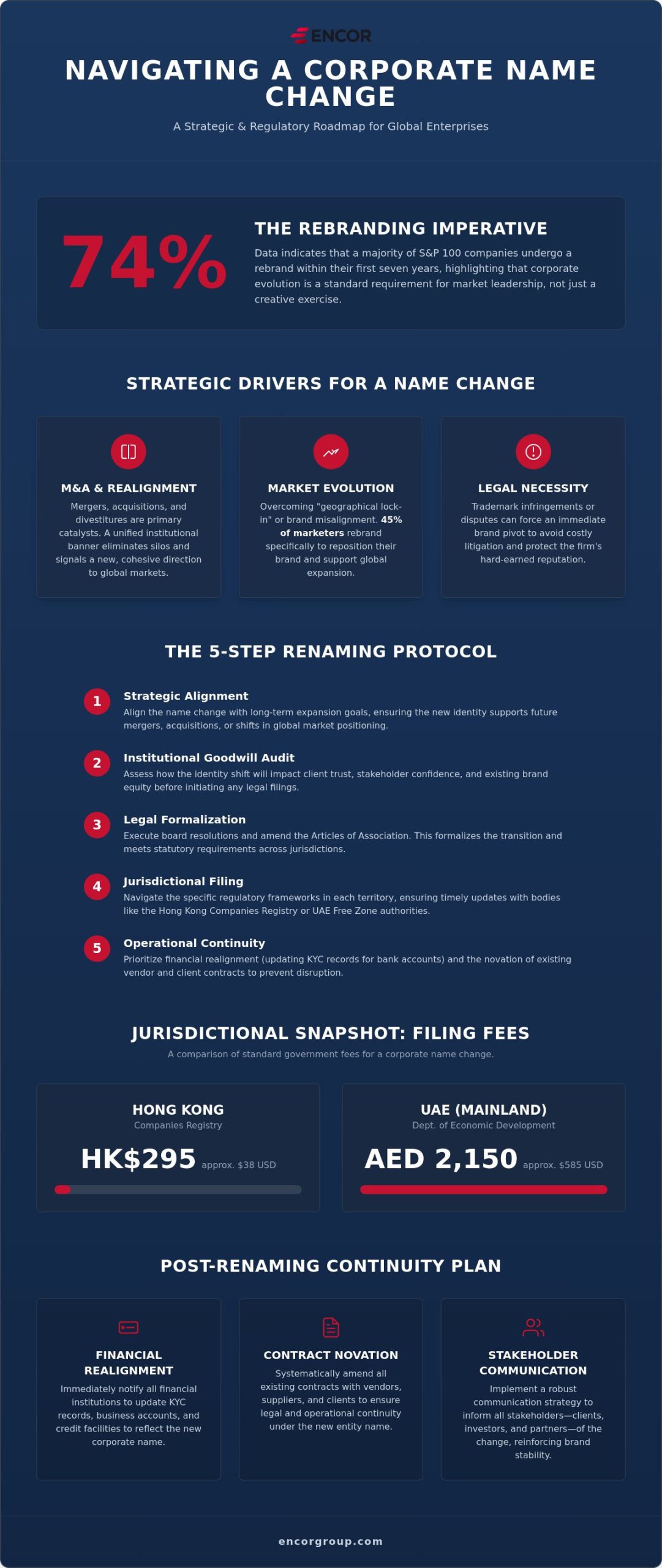
Data indicates that 74% of S&P 100 companies undergo a rebrand within their first seven years of operation, proving that corporate evolution is a standard requirement for market leadership. However, renaming a business is far more than a creative exercise; it’s a high-stakes corporate governance event that demands precise jurisdictional synchronization and meticulous regulatory compliance. For executives operating across global hubs like Hong Kong and the UAE, the transition requires a calculated approach to maintain operational continuity and protect existing brand equity.
The anxiety surrounding complex regulatory filings and the potential disruption of banking or contract continuity is a legitimate concern for any established entity. This guide provides a comprehensive framework for navigating the strategic and regulatory complexities of a corporate name change across international borders. You’ll find specific details on filing requirements, updated 2026 fee structures, and a methodical roadmap to ensure your new identity remains fully compliant while minimizing operational downtime during the transition.
Key Takeaways
- Align renaming a business with your long-term expansion goals to ensure the new identity supports mergers, acquisitions, or shifts in global market positioning.
- Conduct an institutional goodwill audit to assess how a corporate identity shift impacts client trust and existing brand equity before initiating legal filings.
- Formalize the transition by executing board resolutions and amending the Articles of Association to meet statutory requirements across international jurisdictions.
- Navigate specific regulatory frameworks in Hong Kong and the UAE, ensuring timely updates with the Companies Registry or relevant Free Zone authorities.
- Maintain operational continuity by prioritizing financial realignment, including updated KYC records for bank accounts and the novation of existing vendor contracts.
Strategic Impetus: Identifying the Necessity of Renaming a Business
Renaming a business is a tactical pivot driven by strategic necessity. It’s rarely a purely aesthetic decision; instead, it serves as the final step in a significant corporate transformation. Organizations initiate this process to reflect a new reality, whether that involves a shift in ownership, a change in core services, or a move into a new jurisdiction. A successful Rebranding strategy ensures that the legal and commercial identity remains congruent with the company’s long-term objectives and institutional values.
M&A and Structural Realignment
Mergers, acquisitions, and divestitures are the primary catalysts for a name change. When two entities consolidate, adopting a single institutional banner eliminates internal silos and signals a unified direction to global markets. This alignment is critical for maintaining shareholder confidence during periods of transition. It’s not merely about a fresh start; it’s about ensuring the new name adheres to the specific naming conventions of every active jurisdiction. For example, a name that functions effectively in a Western market must still comply with the strict trade name regulations of the UAE Department of Economic Development or the Hong Kong Companies Registry. Failure to synchronize these names can lead to administrative friction and fragmented brand equity.
Market Evolution and Brand Misalignment
Many enterprises encounter “geographical lock-in,” where a name that served them well in a domestic market becomes a liability during international growth. A name referencing a specific city or product line can inadvertently limit a firm’s perceived scope and scalability. Aligning your corporate identity with a broader global business expansion strategy allows for a more diversified presence. In sophisticated hubs like Hong Kong or the UAE, cultural resonance and linguistic clarity are paramount. A product-specific name may fail to convey the breadth of a conglomerate’s operations, necessitating a pivot to a more versatile, minimalist corporate identity that can withstand future market shifts.
Beyond growth, legal necessity often dictates the pace of change. Trademark infringements or disputes can force an immediate brand pivot to avoid costly litigation and protect the firm’s reputation. Proactive organizations use these moments to strengthen their position by selecting names that are legally defensible and strategically sound. Data from 2026 indicates that 45% of marketers rebrand specifically to reposition their brand in the market, often as a response to these external pressures. By addressing these misalignments early, leadership can ensure the business remains competitive and compliant in an increasingly crowded global landscape.
Evaluating the Impact: Brand Equity vs. Regulatory Compliance
Renaming a business requires a precise balance between strategic marketing aspirations and the rigid requirements of global regulatory frameworks. While a new identity can signal innovation or market expansion, it also triggers a cascade of administrative obligations that can disrupt operational continuity if not managed with institutional precision. Organizations must evaluate whether the projected growth justifies the comprehensive overhaul of their legal and financial infrastructure.
Preserving Institutional Goodwill
Institutional Goodwill is the intangible value of a company’s reputation. When a firm alters its legal name, it risks diluting this equity unless a robust communication strategy is implemented. High-value institutional clients and stakeholders rely on the stability of a brand; sudden changes without clear rationale can create unnecessary friction. Maintaining continuity in the global supply chain is equally critical. Vendors and partners must be notified well in advance to ensure that logistics, invoicing, and service delivery remain uninterrupted during the transition period.
The Cost-Benefit Analysis of Corporate Identity Shifts
The administrative burden of global entity management is often underestimated during the creative phase of a rebrand. Quantifying the administrative hours required for global license amendments is essential for an accurate cost-benefit analysis. Beyond government filing fees, such as the HK$295 fee for a “Notice of Change of Company Name” in Hong Kong or the AED 2,150 required for a mainland Dubai trade name change, firms must account for the internal resources needed to update every facet of the business. This includes everything from the IRS business name change process in the U.S. to the complex updates required for trademark portfolios at the USPTO, where filing fees can reach $350 per class of goods.
One significant risk during this period is “compliance drift.” This occurs when the legal name change is finalized in one jurisdiction but lags in others, creating a period of inconsistency that can complicate international banking and tax filings. To mitigate this, some organizations opt for a “Doing Business As” (DBA) or a trade name registration. This allows the company to market itself under a new banner without the extensive legal requirements of a full corporate name change. However, for firms seeking a total structural realignment, a full legal change remains the most definitive path. Engaging a specialized Compliance & Regulatory Advisory partner can help synchronize these efforts across multiple markets, ensuring that the transition remains seamless and the institutional reputation stays intact.
Ultimately, the decision to pivot requires a calculated look at intellectual property. A name change often necessitates a full audit of existing trademarks to ensure the new identity is protectable and does not infringe on existing rights. By treating the renaming process as a governance event rather than a marketing task, leadership can protect the firm’s long-term stability while pursuing its new strategic vision.
The Multi-Step Administrative Protocol for Business Name Changes
Executing a formal Board Resolution is the foundational step in the administrative protocol for renaming a business. This governance event requires the drafting of a Special Resolution, which must use precise legal language to authorize the change and amend the company’s constitutional documents. Shareholder consensus is mandatory, and the resolution must be passed in strict accordance with local corporate laws to ensure the validity of the subsequent filings. Without this documented internal mandate, any external filings remain legally vulnerable.
Governance and Internal Approvals
The internal approval process demands meticulous documentation to withstand regulatory scrutiny. In hubs like Hong Kong, a Hong Kong company formation services provider acts as a critical facilitator, managing the logistics of board meetings and ensuring that the Special Resolution meets statutory standards. Beyond legal compliance, leadership must weigh strategic rebranding considerations such as how the new name aligns with the company’s long-term mission and stakeholder expectations. This internal alignment prevents future disputes and ensures that the Articles of Association or Memorandum of Association are amended with precision.
Statutory Filings with Regulatory Bodies
Once internal approval is secured, the organization must proceed with statutory filings to the relevant Registrar of Companies. In Hong Kong, for instance, the “Notice of Change of Company Name” (Form NNC2) must be filed within 15 days of passing the resolution, accompanied by the HK$295 filing fee. The Registrar then issues a “Certificate of Change of Name,” which serves as the official proof of the new corporate identity. In the UAE, the protocol involves multiple layers; a mainland business in Dubai must manage a trade name change that costs approximately AED 2,150, including advertisement charges and license updates.
Notification periods for these filings vary significantly, typically ranging from 30 to 90 days depending on the jurisdiction and the complexity of the entity’s license structure. Updating tax authorities is a parallel requirement that cannot be overlooked. In the United States, while there’s no fee for notifying the IRS, the name change must be synchronized with the Employer Identification Number (EIN) to prevent disruptions in payroll or tax reporting. Securing updated business licenses and permits in every active market is the final administrative hurdle. This step ensures that the company maintains its legal right to operate under the new banner without incurring penalties or experiencing operational downtime during the transition.
Jurisdictional Variations: Navigating Hong Kong and UAE Requirements
Renaming a business in international commercial hubs requires a granular understanding of local administrative protocols. In Hong Kong and the UAE, the process is not merely a name update but a full regulatory realignment that impacts everything from tax status to employee residency. Executing these changes requires linguistic and legal precision to avoid operational friction in markets that prioritize strict adherence to corporate nomenclature.
Hong Kong: Certificate of Change of Name
The Hong Kong Companies Registry enforces a strict 15-day window for submitting Form NNC2 following the passing of a special resolution. The filing fee is HK$295, and once processed, the Registry issues a Certificate of Change of Name. This document is the legal foundation for all subsequent updates, including the Business Registration Certificate (BRC) with the Inland Revenue Department (IRD). You must update the BRC within 30 days of the change to avoid penalties. For 2026/27, the one-year BRC renewal fee is HK$2,350, while a three-year certificate costs HK$6,170. A unique requirement in this jurisdiction is the management of bilingual names; companies must ensure that both English and Traditional Chinese names comply with the Companies Ordinance and do not infringe on existing trademarks.
UAE Free Zones: Licensing and Visa Implications
In the UAE, the complexity of a name change depends on whether the entity is registered in a Free Zone or on the Mainland. For a Dubai Mainland business, the Department of Economy and Tourism (DET) charges approximately AED 2,150 for a trade name change, which includes mandatory advertisement fees and license updates. Free Zones maintain independent fee structures; IFZA typically charges AED 1,000 for name amendments, while Sharjah and RAK Free Zones range between AED 750 and AED 800.
Unlike other jurisdictions, renaming a UAE entity often necessitates a full license amendment. This transition has a direct impact on Establishment Cards and employee visa sponsorships. Every residency visa linked to the company must eventually reflect the new corporate identity, a process that requires coordination with the Dubai Chamber of Commerce and the Ministry of Human Resources and Emiratisation. Failure to synchronize these updates can lead to delays in visa renewals or issues with corporate bank accounts. Middle Eastern financial institutions are particularly rigorous regarding KYC (Know Your Customer) updates; they often freeze account activity until a revised license and updated chamber of commerce certificate are provided.
Managing these cross-border requirements demands a proactive approach to global entity management. If you are preparing for a corporate transition in these markets, engage our Corporate Secretarial Services to ensure every filing is executed with institutional precision.
Strategic success in these regions also hinges on “Name Availability” searches. In the UAE, reserving a trade name with the DET costs AED 620 and requires a search in both English and Arabic scripts to ensure no phonetic or literal conflicts exist. This linguistic audit is a critical safeguard against future legal disputes and ensures that the new identity resonates within the local cultural and regulatory landscape.
Post-Renaming Continuity: Managing Global Compliance and Operations
The issuance of a new Certificate of Incorporation marks the beginning of a critical operational transition. While the legal name change is finalized with the registrar, the “Day 2” checklist requires a methodical update of all institutional touchpoints to prevent compliance gaps. Renaming a business is a high-stakes governance event that extends into every facet of the organization’s financial and administrative infrastructure. Failure to synchronize these updates can lead to frozen accounts, invalidated contracts, or disruptions in global supply chains.
Financial and Banking Realignment
International financial institutions maintain rigorous standards for entity verification. Following a name change, a comprehensive KYC (Know Your Customer) refresh is mandatory for every corporate bank account. This process isn’t merely a notification; it’s a formal re-verification that requires the new certificate of name change, amended Articles of Association, and updated board resolutions. Banks often freeze inbound and outbound SWIFT transfers if the beneficiary name on the transfer doesn’t match the account record exactly. Leadership must also prioritize updating letters of credit and trade finance instruments, as discrepancies in corporate nomenclature can lead to delayed payments and strained vendor relationships.
Operational and HR Synchronization
Human resources and payroll systems require immediate realignment to maintain statutory compliance. Employment contracts must be amended or supplemented to reflect the new legal employer name, ensuring that the continuity of service remains intact for all staff. This update is vital for maintaining the validity of international payroll solutions and ensuring that tax filings match the records held by local authorities. Organizations must also update statutory insurance policies, pension fund registrations, and employee benefits schemes to avoid any lapse in coverage.
Contractual novation is another critical consideration. While many agreements include clauses that allow for a name change without a full contract rewrite, some high-value vendor or client agreements require formal amendments or deeds of novation. An outsourced corporate secretary plays a vital role in managing this transition, ensuring that every legal instrument is updated in a logical sequence.
Digital infrastructure and brand visibility also face unique risks during this period. Beyond domain migrations and email security protocols like SPF and DKIM, firms must manage the risk of “AI invisibility.” Data from 2026 shows that inconsistent messaging during a rebrand can lead to a 40-60% monthly decay in AI mentions as systems lose confidence in the brand’s identity. By executing a calculated, synchronized rollout across all digital and legal channels, organizations can protect their market position and ensure a seamless transition to their new corporate identity.
Executing Your Global Identity Transition
Transitioning a corporate identity is a complex governance requirement that demands more than creative vision. Success relies on the precise synchronization of board resolutions, statutory filings, and post-renaming operational updates. Whether you’re addressing geographical lock-in or integrating entities after a merger, renaming a business requires a methodical approach to maintain regulatory standing and protect institutional goodwill across international markets. Precise execution ensures that your brand equity remains intact while you expand into sophisticated new territories.
The administrative burden of updating KYC records, bank accounts, and payroll systems in hubs like Hong Kong and the UAE shouldn’t disrupt your core operations. Encor Group provides the strategic depth and global reach necessary to navigate these high-stakes transitions with quiet efficiency. We offer expertise in 10+ global markets, institutional-grade compliance support, and end-to-end secretarial and HR services tailored to your expansion goals. Consult with Encor Group for Strategic Entity Management to ensure your corporate realignment is handled with professional precision. Your transition to a new identity can be a seamless catalyst for your next phase of global growth.
Frequently Asked Questions
Does renaming my business require a new EIN or Tax ID?
Renaming a business typically doesn’t require a new Employer Identification Number (EIN) if the legal structure and ownership of the entity remain unchanged. You must notify the IRS of the change by checking the appropriate box on your annual tax return or mailing a formal notification to the filing office. However, if the name change occurs alongside a merger or a change in your business structure, a new EIN might be mandatory to maintain tax compliance.
How long does the legal process of renaming a business typically take in Hong Kong?
The administrative process in Hong Kong generally concludes within four to six weeks for full jurisdictional synchronization. Once the special resolution is passed, you must file Form NNC2 within 15 days, and the Companies Registry typically issues the Certificate of Change of Name within several working days. You then have a 30-day window to update your Business Registration Certificate with the Inland Revenue Department to ensure your operational records remain accurate and compliant.
Do I need to notify my bank immediately after a name change?
Immediate notification to your financial institution is essential to prevent the disruption of inbound and outbound SWIFT transfers. Banks must refresh your KYC records using the new Certificate of Incorporation and amended Articles of Association. If you delay this update, the bank may freeze your account or reject transactions because the beneficiary name on incoming payments won’t match the legacy records on file. This step is vital for maintaining uninterrupted financial operations.
Will renaming my company affect my existing trademarks or intellectual property?
A corporate name change doesn’t automatically update your trademark registrations or intellectual property records. You must file separate amendments with the relevant patent and trademark offices, such as the USPTO, to ensure the owner of record aligns with your new legal identity. Failing to synchronize these records can complicate your ability to enforce IP rights or execute licensing agreements. It’s critical to conduct a full IP audit before finalizing the transition.
What happens to my business contracts and leases after a name change?
Most business contracts and leases remain legally valid after a name change, but you should review the “successors and assigns” clauses in your existing agreements. While a name change doesn’t usually create a new legal entity, high-value vendors or landlords often require a formal amendment or a deed of novation to reflect the update. Providing a copy of your name change certificate to all major counterparties ensures that invoicing and legal notices continue without administrative friction.
Is a “Doing Business As” (DBA) name the same as a legal name change?
A “Doing Business As” (DBA) name is a trade alias and doesn’t represent a change to the underlying legal identity of the entity. In contrast, renaming a business through a legal name change involves a formal amendment to the company’s constitutional documents and registration with government authorities. While a DBA offers marketing flexibility with fewer filings, it doesn’t provide the same level of institutional realignment or structural finality as a comprehensive legal name change.
Do I need to issue new share certificates to my shareholders?
Issuing new share certificates is a standard requirement to ensure that your internal corporate records accurately reflect the new legal name. While legacy certificates remain evidence of ownership, they reference an entity name that no longer exists in official registries. Shareholders should exchange their old certificates for updated versions that cite the new corporate identity and the effective date of the change. This practice maintains the integrity of your share register and simplifies future equity transfers.
How do I handle a name change in a UAE Free Zone like IFZA?
Renaming an entity in the IFZA Free Zone requires a formal application for a license amendment and the submission of a board resolution. You must return your original trade license for cancellation and reissuance under the new name, which typically involves an amendment fee of AED 1,000. Once the new license is issued, you must also update your Establishment Card and all employee visa records to ensure full compliance with UAE residency and labor regulations.