
A public limited company is far more than a legal designation; it’s the ultimate strategic vehicle for securing institutional credibility and accessing global capital markets. While the transition offers unparalleled growth potential, many executives hesitate because they fear the weight of onerous regulatory reporting or the potential loss of operational control. It’s a valid concern, as the shift from private to public requires a fundamental transformation in governance, transparency, and share capital management.
This guide provides the clarity you need to master the structural requirements, regulatory obligations, and strategic advantages of the public limited company to scale your global operations effectively. We provide a clear framework for deciding between public and private structures, alongside a comprehensive roadmap for maintaining international compliance across diverse jurisdictions. From understanding the £50,000 minimum share capital requirement in the UK to implementing the latest 2026 corporate governance standards, you’ll gain the insights necessary to lead your organization through this critical expansion phase with confidence and precision.
Key Takeaways
- Assess how the public limited company structure serves as a strategic vehicle for institutional credibility and global capital acquisition.
- Master the fundamental requirements for transition, including minimum allotted share capital and the necessity of professional secretarial oversight.
- Compare the regulatory landscapes of premier international hubs, specifically focusing on Hong Kong and the UAE, to optimize your global footprint.
- Develop a robust framework for managing the increased transparency and reporting obligations inherent in public-scale operations.
- Explore methodologies for centralizing global entity management to ensure consistent compliance across multiple jurisdictions.
Defining the Public Limited Company (PLC) in a Global Context
A public limited company represents the apex of corporate structures for enterprises seeking global scale. It’s a distinct legal entity that possesses its own rights and obligations, separate from those who own or manage it. While private entities serve as the foundation for most businesses, the PLC structure allows for the issuance of shares to the general public. This capability facilitates the acquisition of significant capital necessary for cross-border expansion and major infrastructure projects. A foundational definition of a Public Limited Company centers on its ability to offer shares to the general public, providing a structured mechanism for large-scale capital accumulation.
Beyond capital access, the PLC suffix serves as a marker of institutional maturity. It signals to international banks, government bodies, and institutional investors that the organization adheres to the highest standards of transparency and regulatory oversight. It’s vital to distinguish between a company being “publicly traded” and “publicly listed.” While a listed company is admitted to an official list on a stock exchange, a public limited company may exist without being traded on a major market. The status itself, regardless of listing, provides a level of prestige that private structures cannot replicate.
The Legal Framework of Limited Liability
The principle of limited liability ensures that the financial exposure of shareholders is restricted to the amount they’ve invested in their shares. This “corporate veil” remains robust in a public context, protecting the personal assets of directors and investors from the company’s liabilities. In 2026, limited liability within the PLC framework continues to serve as the definitive legal barrier that separates corporate debt from personal wealth, facilitating institutional risk-taking on a global scale. This protection is essential for attracting high-level talent to board positions, as it ensures that professional decisions don’t result in personal financial ruin.
PLC vs. Private Limited Company (LTD)
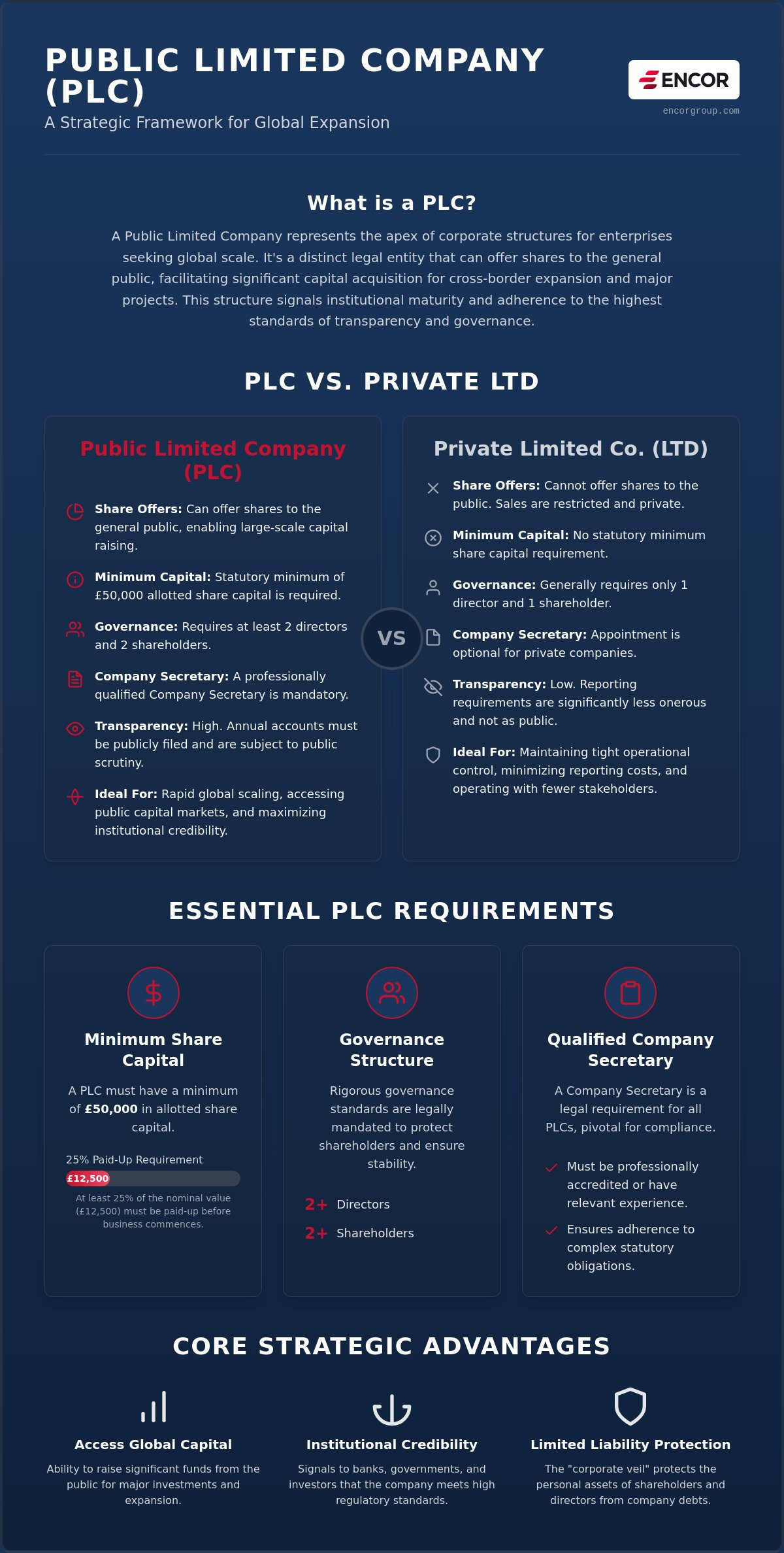
The primary divergence between these structures lies in share transferability and regulatory burden. Private companies (LTDs) typically restrict share sales and have no minimum capital requirements. Conversely, a public limited company must maintain a statutory minimum share capital. In jurisdictions like the UK, this is set at £50,000, with at least 25% paid up before business commences.
Transparency requirements are significantly higher for public entities. They must file annual accounts within six months of the financial year end and face intense public scrutiny. Choosing between these structures is a strategic decision. If the objective is rapid global scaling and institutional credibility, the PLC is the logical choice. If the priority is maintaining tight operational control and minimizing reporting costs, remaining private is often more efficient. The transition to a public structure is a clear signal that a company is ready for the rigors of the global stage.
Essential Requirements for Incorporating or Converting to a PLC
Establishing a public limited company involves a significant elevation in regulatory compliance compared to private entities. The primary prerequisite is the statutory minimum share capital. In the UK, this is currently fixed at £50,000. It’s critical to understand that while the full amount must be “allotted”, meaning issued to shareholders, only 25% of the nominal value and the full amount of any share premium must be “paid-up” before the registrar issues a certificate to commence business. This capital serves as a demonstration of the entity’s financial stability and a buffer for creditors. For those beginning this journey, understanding the fundamental requirements to set up a PLC is the first step toward institutional credibility.
Governance standards are equally rigorous. A PLC must have at least two directors and two shareholders. Unlike private companies, a public entity is legally mandated to appoint a qualified Company Secretary. This individual must possess professional accreditation, such as membership in the Chartered Governance Institute, or have held a similar post for three of the preceding five years. Their role is pivotal in ensuring the board adheres to complex statutory obligations and maintains the company’s statutory registers. Managing these high-stakes governance requirements is a core component of the corporate secretarial services provided by seasoned advisors.
Capital Requirements and Share Structure
Beyond the £50,000 threshold, the nominal value of shares must be clearly defined and certified. Companies must demonstrate that these requirements are met through an audit of the balance sheet. PLCs often utilize multiple share classes, such as Ordinary shares for voting and Preference shares for prioritized dividends, to attract diverse investor profiles. This structure allows the board to raise capital while strategically managing voting power and dividend obligations.
The Conversion Process: From Private to Public
Converting an existing private limited company into a public one is a methodical process. It begins with the shareholders passing a special resolution for re-registration. This necessitates a comprehensive update to the Memorandum and Articles of Association to reflect the new public status and share transferability rules. The application is then submitted to the relevant national registrar, accompanied by a balance sheet that’s no more than seven months old and an unqualified audit report.
If the intent is to offer shares to the public, a Prospectus becomes mandatory. This document is a legal requirement that provides detailed financial and operational disclosures to potential investors. It must be vetted by the relevant financial authority, such as the FCA in the UK. This level of disclosure is what separates a standard public limited company from its private counterparts, ensuring that the public can make informed investment decisions based on verified, institutional-grade data.
Strategic Advantages vs. Regulatory Obligations
Operating as a public limited company provides a level of financial agility that private entities simply cannot match. The primary advantage lies in the direct access to public capital markets. While private firms are often constrained by the personal wealth of founders or limited private credit lines, a public entity can generate substantial liquidity through Initial Public Offerings (IPOs) and subsequent secondary offerings. This capital influx is not merely for operational maintenance; it serves as a powerful engine for aggressive growth. By utilizing its own shares as a form of “acquisition currency,” a company can execute a sophisticated global business expansion strategy, acquiring competitors or entering new markets without depleting cash reserves.
The trade-off for this strategic flexibility is a rigorous and non-negotiable commitment to transparency. The transition to a public structure places the organization under the permanent spotlight of regulators and the investing public. This scrutiny is not a burden to be avoided but a standard to be mastered. Adherence to the official UK government guidance on business structures ensures that the company remains on a stable legal footing while projecting an image of institutional reliability to banks, suppliers, and high-tier institutional investors.
Institutional Transparency and Reporting
The regulatory burden for a public limited company is significant and requires a dedicated internal infrastructure. Boards must deliver comprehensive annual reports within six months of the financial year end, alongside mandatory half-yearly financial disclosures. Every set of accounts must undergo an independent statutory audit by a qualified firm to verify the accuracy of the financial position. Regarding governance, the UK Corporate Governance Code requires boards to provide an explicit declaration on the effectiveness of their material controls, ensuring that accountability moves beyond mere policy descriptions to actual operational outcomes. These mandates ensure that the company maintains the trust of its diverse shareholder base.
Market Perception and Brand Value
The PLC suffix acts as a powerful branding tool in the global marketplace. It confers a “Prestige Factor” that is often a prerequisite for participating in international tenders or securing large-scale government contracts. This status also fundamentally changes the recruitment landscape. The ability to offer publicly traded share options allows the company to attract and retain elite executive talent who seek a stake in a high-growth, transparent organization. Managing these complex shareholder relations requires a steady hand, but the resulting brand equity often far outweighs the costs of compliance. A public company doesn’t just compete; it sets the standard for its industry.
Global Variations: PLCs in International Business Hubs
Scaling an enterprise requires a precise understanding of how the public limited company operates within diverse legal traditions. Common law jurisdictions, such as Hong Kong and the UK, provide a predictable framework for businesses accustomed to judicial precedent and flexible shareholder agreements. Conversely, civil law environments, including the UAE mainland, impose specific mandates regarding local ownership and significantly higher capital thresholds. Selecting the right hub isn’t merely a matter of geography; it’s a strategic decision that dictates your access to specific investor pools and regulatory ease.
The distinction between common law and civil law affects every aspect of corporate governance. In common law systems, the board’s fiduciary duties are often shaped by decades of case law, providing a nuanced approach to director liability. Civil law jurisdictions rely more heavily on codified statutes, which can offer less flexibility but greater certainty in statutory interpretation. Understanding these nuances is critical when choosing where to establish your primary public vehicle or how to structure international subsidiaries.
Hong Kong as a PLC Gateway
The “Public Company Limited by Shares” in Hong Kong is governed by the rigorous Hong Kong Companies Ordinance. It’s the primary vehicle for organizations seeking a listing on the Stock Exchange of Hong Kong (HKEX), one of the world’s most liquid capital markets. This hub is particularly effective for enterprises targeting the Asia-Pacific region. Managing the complex regulatory environment here requires integrated support, from initial Hong Kong company formation services to the implementation of international payroll solutions that meet stringent public disclosure standards. The strategic link between HK PLCs and mainland Chinese capital flows remains a unique advantage for global entities.
UAE Public Joint Stock Companies (PJSC)
In the United Arab Emirates, the equivalent of a public limited company is the Public Joint Stock Company (PJSC). These entities fall under the supervision of the Securities and Commodities Authority (SCA). PJSCs on the Mainland traditionally require higher minimum capital than their Free Zone counterparts and are subject to specific ownership requirements depending on the business activity. Transitioning from a Free Zone entity to a Mainland PJSC is a complex strategic move, often required for companies seeking to list on the Abu Dhabi Securities Exchange (ADX) or the Dubai Financial Market (DFM). The regulatory landscape in the UAE is evolving rapidly, with a clear trend toward aligning with international transparency standards.
Our advisors provide the strategic navigation necessary to manage these cross-border complexities with precision. Contact Encor Group for compliance and regulatory advisory tailored to your global expansion objectives.
Navigating Corporate Complexity with Encor Group
Transitioning to a public limited company requires more than meeting statutory capital thresholds; it demands a fundamental shift in how an organization manages its global compliance architecture. Encor Group acts as a strategic navigator, centralizing the multifaceted requirements of public-scale entities across diverse jurisdictions. By consolidating corporate secretarial, tax, and accounting functions, we eliminate the fragmentation that often leads to regulatory friction during international expansion. Our approach ensures that your leadership remains focused on market strategy while we handle the intricate mechanics of institutional governance.
The Encor Advantage for Public Entities
We provide end-to-end support for the conversion process, managing the transition from private to public status with surgical precision. This includes the drafting of special resolutions and the updating of constitutional documents to meet the rigorous standards of national registrars. Beyond the initial setup, our team provides continuous regulatory reporting and audit liaison services, ensuring your financial disclosures remain beyond reproach. Encor Group leverages its deep institutional relationships to facilitate bank account opening assistance for complex public structures, navigating the enhanced due diligence protocols required by global financial institutions. This proactive management mitigates the risk of operational delays that often plague large-scale corporate restructurings.
Strategic Advisory and Operational Excellence
A successful public limited company must maintain operational excellence across every regional hub. We offer strategic advisory for cross-border tax and regulatory alignment, ensuring that your global footprint is both compliant and tax-efficient. Our institutional-grade human resources and recruitment services, paired with robust payroll solutions, provide the infrastructure necessary to attract and manage elite talent in markets like Hong Kong and the UAE. This integrated model allows for seamless operations optimization, where every administrative function is aligned with the company’s broader strategic objectives.
Next Steps for Institutional Growth
The path to becoming a public entity is a journey of calculated innovation. Assessing your current organizational structure for PLC readiness is the first step in our expansion roadmap. We invite you to schedule a strategic consultation with our advisors to evaluate your objectives and identify the optimal jurisdiction for your next phase of growth. Whether you’re targeting the capital markets of the Asia-Pacific or the emerging hubs of the Middle East, our regional experts in Hong Kong and the UAE are prepared to facilitate your transition with quiet efficiency and professional gravity. Contact Encor Group today to secure the compliance and regulatory advisory necessary for your global success.
Securing Institutional Longevity Through Strategic Public Structures
Transitioning to public status represents a definitive commitment to institutional growth and market transparency. By mastering the core requirements of share capital and professional governance, an enterprise secures the credibility necessary to dominate international tenders and access public capital markets. Success on this global stage depends on a precise understanding of the regulatory nuances across different hubs; localized expertise remains the primary safeguard against compliance friction.
Managing these complexities requires a partner with a proven global presence and institutional-grade compliance standards. Encor Group operates across 10+ international markets, providing the specialist knowledge required to align your corporate structure with the mandates of the HK and UAE regulatory environments. We provide the steady, authoritative guidance necessary to navigate high-stakes conversions and ongoing entity management with quiet efficiency. Consult with Encor Group for your public limited company conversion to ensure your organization is prepared for its next phase of global expansion. A structured approach to public status ensures that your business remains resilient and competitive on the world stage.
Frequently Asked Questions
What is the difference between a public and private limited company?
The primary distinction lies in the ability to offer shares to the general public. While a private limited company restricts share transfers and typically has no minimum capital requirement, a public limited company is designed for large-scale capital acquisition. This status also imposes more stringent financial reporting obligations and higher transparency standards than its private counterparts.
How many directors are required for a public limited company?
A public limited company must have a minimum of two directors at all times. This requirement ensures a baseline of collective oversight and accountability at the board level. Additionally, the entity is legally mandated to appoint a professionally qualified company secretary, a role that’s optional for most private limited companies.
What is the minimum share capital for a PLC in 2026?
In the UK, the statutory minimum issued share capital for a PLC remains £50,000 in 2026. At least 25% of this nominal value, amounting to £12,500, must be fully paid up before the registrar issues the certificate to commence business. Requirements in other international hubs like the UAE vary significantly depending on the specific jurisdiction and business activity.
Can a PLC be a private company?
No, a PLC cannot be a private company by definition. While both structures offer limited liability, the PLC is a public legal entity subject to public disclosure laws. Even if the company chooses not to list its shares on a stock exchange, it remains a public structure and cannot revert to private status without a formal re-registration process.
What are the main disadvantages of becoming a public limited company?
The disadvantages center on the increased regulatory burden and the substantial costs associated with transparency. Public entities face higher audit fees, mandatory half-yearly financial disclosures, and intense public scrutiny. There is also a risk of losing operational control as the board becomes accountable to a broad base of external shareholders and institutional investors.
How does a company convert from private to public status?
Conversion requires shareholders to pass a special resolution for re-registration. The organization must update its Memorandum and Articles of Association and submit a formal application to the relevant national registrar. This application must be accompanied by an unqualified audit report and a balance sheet that demonstrates the company meets the minimum capital requirements.
Who owns a public limited company?
Ownership is held by shareholders, who may include individual retail investors, company employees, and large institutional funds. In a public structure, these owners hold transferable shares that represent a portion of the company’s total equity. The board of directors is responsible for managing the company’s strategic direction on behalf of these shareholders.
Is a PLC required to be listed on a stock exchange?
Listing on a stock exchange is not a legal requirement for maintaining PLC status. Many organizations choose the public structure to secure institutional prestige and capital flexibility without the added complexity of a market listing. However, a listing is necessary if the company intends to provide high liquidity and allow its shares to be traded by the general public.