

Establishing a presence in a foreign market is often viewed as a bureaucratic hurdle; however, for the sophisticated investor, the wfoe is a high-performance strategic instrument rather than just a legal registration. You likely recognize that entering a complex regulatory environment requires more than just a local office. It demands a structure that preserves your institutional standards while managing the intricacies of foreign investment laws and cross-border payroll. Relying on outdated entry models can lead to restricted oversight and significant hurdles when it’s time to move capital back to your headquarters.
This guide provides the clarity you need to master the complexities of the setup process to ensure you maintain absolute operational control and regulatory compliance. We’ll examine the updated 2026 requirements, including the five-year capital contribution rule and the strategic advantages of a Hong Kong holding structure. You’ll gain a clear roadmap for profit repatriation and the insights necessary to integrate your new subsidiary seamlessly into a global holding framework. By the end of this analysis, you’ll have the strategic depth required to navigate this expansion with institutional confidence.
Key Takeaways
- Identify the strategic advantages of the wfoe structure compared to Joint Ventures to maintain complete institutional oversight of your foreign subsidiary.
- Understand the critical importance of defining an accurate business scope to prevent regulatory restrictions during the initial registration phase.
- Leverage the synergy between a Hong Kong holding entity and mainland operations to optimize profit repatriation and fiscal efficiency.
- Establish a robust compliance framework that addresses the 2026 requirements for capital contributions and annual auditing cycles.
- Integrate your international expansion into a broader global entity management strategy for unified payroll and operational excellence.
Understanding the WFOE: Definition and Strategic Value
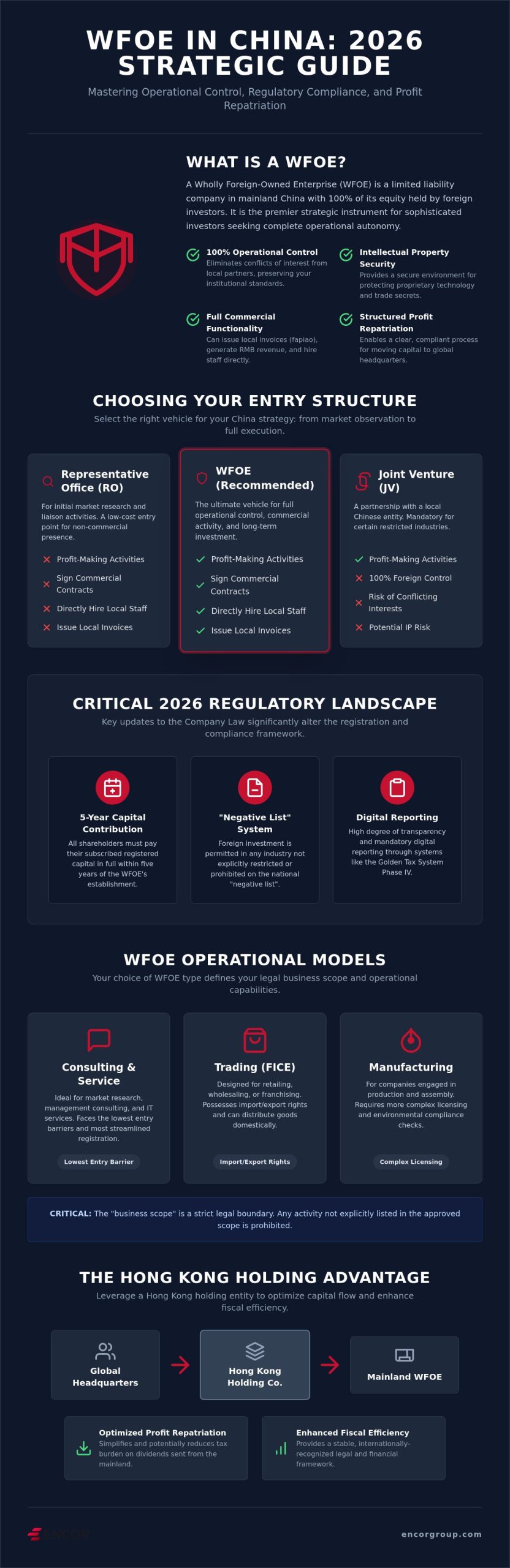
A Wholly Foreign-Owned Enterprise (WFOE) is a limited liability company established in mainland China where 100% of the equity is held by foreign investors. This structure allows for total operational autonomy, distinguishing it from Joint Ventures (JVs) where local partnerships are mandatory. For many executives, the wfoe is the preferred choice because it eliminates the risk of conflicting interests with a local partner. It provides a secure environment for protecting proprietary technology and sensitive intellectual property. This independence is vital for maintaining the institutional standards your organization demands across its global footprint.
Beyond governance, the wfoe functions as a complete commercial entity. It possesses the legal authority to issue local tax invoices, known as fapiao, which are essential for conducting business with domestic clients. This capability enables the company to generate revenue in Renminbi (RMB) and manage local expenses directly. It’s a structure built for scale. By controlling the entire value chain, from procurement to sales, your organization maintains the same standards of excellence found in your global headquarters. This model ensures that profit repatriation remains a clear, structured process rather than a series of regulatory hurdles.
WFOE vs. Representative Office: Choosing the Right Vehicle
A Representative Office (RO) is often used for initial market research or liaison activities. However, it’s strictly prohibited from engaging in profit-making activities or signing commercial contracts. The pivot point occurs when your strategy shifts from observation to execution. If your business needs to hire local staff directly or bill clients within the country, a transition to a wfoe is necessary. This structure also protects the parent company’s balance sheet; as a separate legal entity, the subsidiary’s liabilities don’t automatically extend to the global holding structure.
The Evolution of WFOE Regulations in 2026
Recent updates to the Company Law, specifically those that took effect on July 1, 2024, have significantly altered the registration landscape for 2026. All shareholders must now pay their subscribed capital in full within five years of the company’s establishment. Market entry is managed through a “negative list” system, which specifies industries where foreign investment is restricted. If your sector isn’t on this list, you’re granted the same treatment as domestic private enterprises. The 2026 regulatory environment is characterized by a high degree of transparency and digital reporting through the Golden Tax System Phase IV.
Operational Models: Types of WFOE Structures
Selecting the appropriate operational model is the most critical decision in the setup process. The authorities categorize every wfoe based on its intended business scope, which serves as a strict legal boundary for all commercial activities. If an activity isn’t explicitly listed in the approved scope, the entity cannot legally issue invoices for it or generate related revenue. In 2026, the three primary structures remain Consulting, Trading, and Manufacturing, each requiring a distinct approach to capital allocation and licensing. Professional navigation of these categories ensures that your entity remains agile and compliant from day one.
Consulting and Service WFOEs
Service-oriented entities typically face the lowest entry barriers and the most streamlined registration paths. These structures are ideal for market research, management consulting, and IT services. While there’s no longer an official minimum registered capital for most industries, the subscribed amount must realistically cover the first year of operations. Under the revised Company Law, all subscribed capital must be paid in full within five years. As these entities scale, managing human capital becomes a primary focus. Implementing robust international payroll solutions ensures that your regional team remains compliant with local labor laws while staying integrated with your global financial reporting.
Trading WFOEs (FICE) and Manufacturing WFOEs
A Foreign-Invested Commercial Enterprise (FICE) is designed for companies focused on retailing, wholesaling, or franchising. These entities possess the rights to import and export goods, as well as distribute products within the domestic market. For a deeper understanding of these logistics, the International Trade Administration guide on China provides comprehensive insights into distribution and sales channels. High-barrier industries, such as pharmaceuticals or telecommunications, require additional administrative licenses in 2026, which must be secured before the business license is issued.
Manufacturing WFOEs require the most significant physical infrastructure and regulatory scrutiny. They must undergo rigorous environmental impact assessments and secure specific facility permits before operations begin. Managing supply chain compliance within this framework requires a proactive approach to local regulations. For organizations seeking to optimize these complex setups, professional compliance and regulatory advisory is essential to avoid operational delays. This level of oversight ensures that your manufacturing facility meets the high standards of the Corporate Social Credit System while maintaining peak efficiency.
The Strategic Holding Advantage: Hong Kong and the WFOE
Establishing a wfoe directly from a Western parent company often results in unnecessary fiscal friction and administrative complexity. A more sophisticated approach utilizes a “Hub-and-Spoke” model, positioning a Hong Kong entity as the primary holding company for mainland operations. This structure serves as a strategic buffer, providing a familiar common-law legal framework and a stable banking environment that facilitates international capital movement. For a foundational understanding of these structures, the US-China Business Council WFOE Fact Sheet details the baseline requirements for foreign investment. This intermediary layer isn’t just about administrative convenience; it’s a calculated move to maximize operational control and long-term flexibility.
Hong Kong remains the preferred gateway due to its deep integration with mainland markets and its unique tax status. It allows for a seamless transition between international standards and local requirements. By centralizing regional management in this hub, multinational enterprises can maintain institutional standards while navigating the specificities of the mainland’s regulatory environment. It’s a structure designed for stability in a high-stakes market.
Tax Optimization and Dividend Repatriation
Profit repatriation is a primary concern for international executives managing a foreign subsidiary. Direct investment from many jurisdictions typically incurs a 10% withholding tax on dividends distributed by the mainland entity. However, utilizing Hong Kong company formation services allows investors to leverage the Double Taxation Arrangement (DTA). Under the HK-Mainland DTA, the withholding tax on dividends paid from a China wfoe to a qualifying Hong Kong holding company is reduced to 5% if the parent holds at least 25% of the shares and maintains “beneficial owner” status. This 50% reduction in tax liability creates substantial annual savings, such as RMB 250,000 on a RMB 5 million dividend distribution, directly impacting the net ROI of your expansion.
Legal and Exit Strategy Considerations
A holding structure also simplifies future corporate actions and simplifies the eventual exit process. Transferring equity at the Hong Kong level is significantly faster and less administratively burdensome than changing the ownership of a mainland entity directly. This flexibility is a core component of a modern global business expansion strategy, allowing for efficient regional risk management and potential restructuring. By isolating mainland operations within a specific holding spoke, you protect the global parent from direct liability. It ensures that the local subsidiary remains a high-performance asset while the parent company maintains a safe, strategic distance.
Compliance and Operational Management in 2026
Maintaining a wfoe in 2026 requires a transition from initial setup to a rigorous, ongoing compliance cycle. Operational endurance depends on a precise adherence to monthly, quarterly, and annual reporting requirements. The Chinese regulatory environment has shifted toward a data-driven model, primarily through the Golden Tax System Phase IV. This system integrates tax data with other government databases, making transparency a prerequisite for market access. Failure to maintain these standards directly impacts your standing within the Corporate Social Credit System; a centralized digital record that dictates your entity’s ability to secure licenses, participate in public procurement, and maintain stable banking relationships.
Transparency requirements have intensified for 2026, particularly regarding beneficial ownership reporting. Authorities now demand granular detail on ultimate controllers to prevent the use of shell companies. This level of scrutiny ensures that every wfoe operates with genuine economic substance. Managing these complexities requires a local presence that understands the intersection of domestic law and international corporate standards. It’s no longer sufficient to treat compliance as an annual checkbox; it’s a core component of daily operational management.
Accounting, Tax, and Financial Reporting
Standardizing the Chart of Accounts is a critical step for multinational enterprises. You must ensure that local financial statements meet Chinese Accounting Standards (CAS) while remaining reconcilable with global IFRS or GAAP requirements. The 2026 regulatory environment includes a unified VAT Law that took effect on January 1, 2026, consolidating rates at 13%, 9%, and 6% depending on the sector. While the standard Corporate Income Tax (CIT) remains 25%, qualified small low-profit enterprises may benefit from an effective rate as low as 5% through 2027. Securing professional tax advisory and compliance is essential to navigate these tiered structures and avoid the pitfalls of double taxation or missed incentives.
HR, Payroll, and Social Security
Managing a regional workforce involves more than just salary disbursements. You’re required to contribute to the “Five Insurances and One Fund” system, which includes pension, medical, unemployment, work-related injury, and maternity insurance, alongside the Housing Provident Fund. These contributions are mandatory for both local and foreign employees. In the current digital regulatory environment, payroll data is synchronized with tax authorities in real-time. This leaves no room for error in social security calculations or individual income tax (IIT) withholdings. Establishing a robust framework is essential for long-term success; our team facilitates this through comprehensive compliance and regulatory advisory to ensure your expansion remains stable and secure.
Executing Your WFOE Strategy with Encor Group
Success in international expansion is rarely the result of chance; it’s the product of meticulous structural design and authoritative execution. As we’ve explored, the wfoe is a powerful vehicle for operational control, yet its effectiveness depends entirely on the precision of its setup. Encor Group serves as a strategic navigator for multinational enterprises, providing the institutional depth required to handle high-stakes requirements with quiet efficiency. We manage the entire lifecycle of your expansion, from initial hub selection in regions like Hong Kong to the ongoing complexities of mainland compliance.
Our approach centralizes global entity management, allowing your leadership to maintain a unified perspective across multiple markets. By integrating your regional spokes into a cohesive framework, we ensure that your global standards are never compromised by local administrative hurdles. This centralized model provides the scale and stability necessary for long-term growth in a rapidly evolving regulatory environment. It ensures that your expansion remains a high-performance asset rather than an administrative burden.
Why Institutional Expertise Matters
Navigating the negative list and defining an accurate business scope are tasks that allow no margin for error. A partner with deep knowledge of local markets and global corporate standards prevents the common pitfalls that lead to operational delays or restricted revenue streams. We ensure that your capital injection strategy aligns with the 2024 Company Law revisions, ensuring full compliance with the five-year contribution mandate. This level of oversight significantly reduces the administrative burden on your internal legal and finance teams, allowing them to focus on core strategic objectives rather than bureaucratic liaison.
Next Steps for Global Expansion
The journey begins with a comprehensive feasibility study and structural design tailored to your specific industry. We handle every detail of document preparation and regulatory liaison, ensuring a seamless transition from concept to operational reality. Once established, our ongoing support through corporate secretarial services ensures that your entity remains in good standing through every audit cycle. This proactive management style is essential for maintaining your status within the Corporate Social Credit System and securing your position in the market.
As you refine your 2026 expansion plans, the need for a seasoned advisor becomes paramount. We invite you to a strategic consultation to discuss how a wfoe can be integrated into your broader global holding structure. Our team is committed to your high-level corporate success, providing the clarity and trust required to navigate complex international environments with confidence. Let’s ensure your next phase of growth is built on a foundation of precision and excellence.
Securing Your Strategic Position in Global Markets
Navigating international expansion requires more than just local registration; it demands a structure that ensures long-term operational control and fiscal efficiency. By mastering the wfoe setup and leveraging the strategic advantages of a Hong Kong holding entity, your organization can optimize profit repatriation while protecting its intellectual property. Success in 2026 depends on a proactive approach to digital compliance and the Corporate Social Credit System. It’s a complex landscape, but the rewards of a well-executed strategy are substantial.
Encor Group provides the institutional-level consulting and comprehensive tax advisory necessary to facilitate these high-stakes requirements. With a global presence across more than 10 markets, we act as your strategic navigator through every phase of the expansion process. We invite you to consult with our strategic advisors for your WFOE setup to ensure your subsidiary is positioned for excellence. Your expansion journey represents a significant corporate milestone. With the right structural design and professional oversight, your business is well-equipped to achieve sustained international success.
Frequently Asked Questions
What is the minimum registered capital for a WFOE in 2026?
There is no official minimum registered capital for most industries in 2026. However, the subscribed capital must be sufficient to cover the entity’s operational expenses for at least the first year. Under the Company Law revision that took effect on July 1, 2024, all shareholders are required to pay their subscribed capital in full within five years from the date of establishment.
How long does the WFOE incorporation process typically take?
The registration process for a wfoe typically takes between six and eight weeks to complete. This timeline includes the initial name pre-approval, business license application, and post-registration procedures such as opening bank accounts and securing official company chops. Delays often occur if the business scope is poorly defined or if industry-specific administrative licenses are required before the business license is issued.
Can a WFOE engage in business activities outside its registered business scope?
No, an entity is strictly limited to the business activities listed in its approved business scope. Engaging in unauthorized activities prevents the company from issuing legal tax invoices, or fapiao, for those services and may result in regulatory penalties. If your strategic objectives change, you must apply for a formal amendment to your business license through the local authorities before commencing new operations.
How are profits repatriated from a WFOE to a foreign parent company?
Profits are repatriated as dividends after the entity has settled its annual tax liabilities and allocated at least 10% of after-tax profits to a mandatory reserve fund. Utilizing a Hong Kong holding company allows you to benefit from a reduced withholding tax of 5% under the China-Hong Kong Double Taxation Arrangement. Without this structure, the standard withholding tax rate is typically 10% for most foreign investors.
Do I need a physical office address to register a WFOE?
Yes, a physical, commercial-grade office address is a mandatory requirement for registration. Virtual offices are generally not accepted by the authorities during the incorporation phase. You must provide a valid lease agreement for a property that is zoned for commercial or industrial use, as this address will be verified by the local market supervision administration before the business license is granted.
What are the main tax obligations for a WFOE in Mainland China?
The primary obligations include Corporate Income Tax (CIT) at a standard rate of 25% and Value-Added Tax (VAT) at rates of 13%, 9%, or 6%. A unified VAT Law came into effect on January 1, 2026, which consolidated previous regulations into a single statutory framework. Additionally, companies must manage monthly and quarterly filings alongside an annual audit to maintain their standing within the national tax administration system.
Is a Joint Venture better than a WFOE for market entry?
A wfoe is generally superior for investors who prioritize 100% operational control and the protection of intellectual property. Joint Ventures are typically only utilized when entering industries on the “negative list” where foreign ownership is restricted. While a local partner can provide market insights, this structure eliminates the risk of conflicting management styles and ensures your global institutional standards are maintained without compromise.
How does the Corporate Social Credit System affect WFOE operations?
The Corporate Social Credit System functions as a centralized digital record that monitors your entity’s compliance with regulations and tax obligations. High credit ratings facilitate easier access to bank accounts, lower audit frequencies, and eligibility for government procurement. Conversely, a low rating due to late filings or labor law violations can lead to restricted operations, increased scrutiny, and potential blacklisting from key commercial activities.