

Why would a multinational enterprise settle for a joint venture when 100% operational control is achievable through a modern corporate structure? You likely recognize that entering high-stakes markets often feels like a trade-off between growth and the security of your intellectual property. The uncertainty surrounding profit repatriation and complex local laws can stall even the most ambitious expansion plans. Establishing a wofe is no longer just a market entry tool; it’s a critical component of a diversified global entity management strategy that protects your long-term interests.
This guide provides the strategic clarity required to master foreign enterprise setup, ensuring your international expansion remains both compliant and efficient. By following our framework, you’ll secure a clear path to RMB revenue and full alignment with 2026 SAMR regulations. We will examine the mandatory five-year capital contribution timelines, the implications of the 2024 Foreign Investment Negative List, and the precise operational requirements for maintaining a secure, independent legal entity in a shifting global environment.
Key Takeaways
- Understand the institutional framework of a wofe, which provides foreign investors with total operational control and a direct path to local revenue generation.
- Navigate the mandatory 2026 SAMR capital contribution requirements and ensure your Articles of Association align with global corporate standards.
- Evaluate the strategic benefits of a mainland entity compared to Hong Kong or UAE hubs to optimize your international tax and expansion footprint.
- Streamline the incorporation process by mastering the latest business scope definitions and leveraging simplified document authentication under the Apostille Convention.
- Implement a centralized entity management strategy to maintain full regulatory compliance and financial transparency across high-stakes global markets.
Defining the WOFE: The Institutional Framework for Foreign Investment
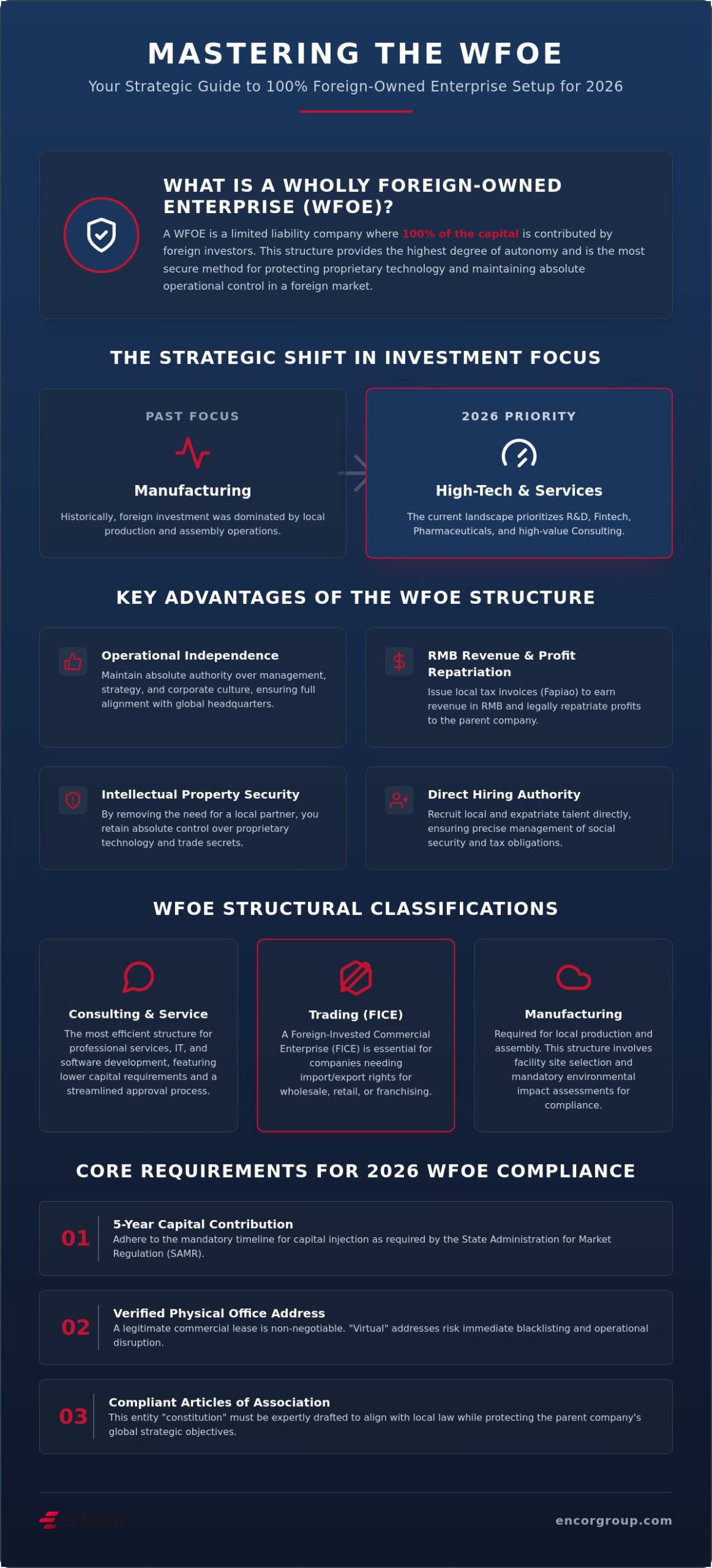
A Wholly Foreign-Owned Enterprise (WFOE), or wofe, is a limited liability company established where 100% of the capital is contributed by foreign investors. Historically, these entities operated under a separate legal regime that distinguished them from domestic firms. The 2026 regulatory environment now reflects the full implementation of the Foreign Investment Law, which unified the corporate framework for all enterprises. This consolidation provides a level playing field, ensuring that international firms are governed by the same administrative standards as domestic companies. It’s a structure that offers the highest degree of autonomy for global organizations seeking a permanent presence in the region.
The strategic focus of the wofe has transitioned significantly over the last few years. While manufacturing once dominated foreign investment, the current landscape prioritizes high-tech development and service-oriented consulting. This shift is reinforced by the “2026 Plan,” which aims to optimize the utilization of foreign investment in sectors like R&D, pharmaceuticals, and fintech. For executives, 100% ownership remains the most secure method for protecting proprietary technology. By removing the need for a local partner, you maintain absolute control over intellectual property and operational trade secrets, mitigating the risks often associated with joint ventures.
Structural Classifications of a WOFE
Your entity’s structure must match its intended activities. The SAMR requires a specific business scope that defines the entity’s classification and determines its regulatory obligations.
- Consulting and Service: This is the most efficient structure for professional services or software development. It features lower capital requirements and a streamlined approval process.
- Trading (FICE): A Foreign-Invested Commercial Enterprise allows for wholesale, retail, and franchise operations. It’s essential for companies requiring import and export rights.
- Manufacturing: Necessary for local production, this structure involves facility site selection and mandatory environmental impact assessments to ensure regulatory compliance.
Key Advantages for Global Enterprises
Operating through this structure provides institutional benefits that Representative Offices or Joint Ventures cannot match. These advantages are vital for long-term scalability and financial control.
- Operational Independence: You maintain absolute authority over management and strategy. This protects your corporate culture and ensures alignment with global headquarters.
- RMB Revenue: A mainland entity can issue formal tax invoices (Fapiao) to local clients. This enables you to earn revenue in local currency and repatriate profits to the parent company.
- Direct Hiring: You can recruit local and expatriate talent directly. Utilizing professional payroll solutions ensures that social security and tax obligations are met with precision.
Core Requirements for WOFE Incorporation in 2026
Establishing a wofe requires more than a simple registration; it demands a precise alignment of financial commitments and corporate governance with local law. Analyzing China’s Investment Climate highlights how modern regulations prioritize operational substance over mere shell entities. Central to this is the Articles of Association, which serves as your entity’s constitution. This document shouldn’t just meet local standards but must be drafted to reflect the parent company’s global strategic objectives, ensuring that voting rights and profit distribution remain under your absolute control.
A physical office address is a non-negotiable requirement for compliance in 2026. Authorities have intensified their scrutiny of “virtual” or non-compliant addresses. To pass the registration audit, your entity must secure a legitimate commercial lease that matches the scale of your intended operations. Failure to maintain a verified physical presence can lead to immediate blacklisting by the SAMR, complicating future licensing and banking activities. Integrating these local requirements into a comprehensive global business expansion strategy ensures your entry is both legally sound and operationally viable.
Capital Contribution and Financial Structuring
The revised Company Law, effective July 1, 2024, introduced a mandatory five-year window for the full contribution of registered capital. While fixed minimums are largely abolished for most sectors, you must declare an “optimal” amount sufficient to cover at least the first year of operational expenses. This capital serves as your initial working budget until the entity becomes self-sustaining. Strategic fund allocation is essential to avoid liquidity issues during the early phases of market entry.
Corporate Governance and Compliance Roles
Every wofe must appoint a Legal Representative, a Supervisor, and a Finance Manager. The Legal Representative holds significant authority and can be held personally liable for the company’s regulatory failures. It’s vital to define these roles clearly within your corporate structure to mitigate personal risks for executives. Professional compliance and regulatory advisory can help you navigate these high-stakes appointments with institutional precision.
Strategic Analysis: WOFE vs. Hong Kong and UAE Hubs
Choosing the correct jurisdiction requires a balance between market proximity and fiscal optimization. While a wofe provides direct access to the mainland’s vast consumer base, it carries a standard Corporate Income Tax (CIT) rate of 25%. In contrast, Hong Kong company formation offers a tiered tax regime and a familiar common law framework that many international executives prefer for holding assets. For enterprises prioritizing tax minimization on global profits, UAE Free Zones offer highly competitive rates, often as low as 0% for qualifying income. However, these regional hubs cannot issue local Fapiao or hire mainland staff directly. A deeper analysis of the Foreign Investment Law reveals that a mainland entity remains the only vehicle for full operational integration within the domestic market.
Many sophisticated investors adopt a Hub and Spoke model to manage risk and capital. They place a Hong Kong or UAE entity as the direct shareholder of the mainland wofe. This structure simplifies the eventual exit strategy. Selling a Hong Kong holding company is significantly faster than deregistering a mainland entity, which requires a rigorous tax clearance audit and can take up to 12 months. This intermediary layer also facilitates more efficient dividend repatriation, as many jurisdictions maintain double taxation avoidance agreements that can reduce withholding tax from the standard 10% to as low as 5%.
The Role of Holding Companies in Expansion
Incorporating in Hong Kong before establishing a mainland presence serves as a strategic buffer. It streamlines the notarization of documents, as Hong Kong’s accession to the Apostille Convention simplifies the authentication process for mainland authorities. This structure also provides a flexible platform for managing cross-border capital flows. By centralizing treasury functions in a stable financial hub, you can better manage currency fluctuations and ensure that profits are moved efficiently between your global subsidiaries.
Regulatory and Compliance Comparison
Each jurisdiction demands a different level of administrative oversight. UAE entities must comply with Economic Substance Regulations (ESR), requiring proof of genuine local activity. Mainland entities face annual statutory audits and strict social security contribution requirements for all employees. These reporting standards must be integrated into your global business expansion strategy to ensure total transparency. Choosing the right mix of entities depends on whether your priority is direct market penetration or regional tax efficiency.
The Roadmap to Incorporation: A 2026 Step-by-Step Guide
The 2026 incorporation process for a wofe is characterized by increased digitalization and a unified management system. Your first step involves securing name pre-approval and defining a precise business scope with the State Administration for Market Regulation (SAMR). This definition is restrictive; your entity can only engage in the activities listed on its license. Once approved, you must prepare the parent company’s identification documents. China’s accession to the Apostille Convention has significantly accelerated this phase, replacing the cumbersome embassy legalization process with a streamlined authentication method that facilitates faster market entry.
After submitting your application through the unified foreign investment management system, the local SAMR office issues the business license. However, the process doesn’t end with the license. You must immediately carve the company’s official chops (seals), which serve as the legal signature for all corporate actions. This is followed by tax registration and the setup of social insurance accounts for your wofe. These post-incorporation steps are time-sensitive. They’re critical for maintaining a compliant status from day one and ensuring your entity is recognized by all relevant administrative bodies.
Navigating the Banking and KYC Hurdle
Opening a corporate bank account remains one of the most significant hurdles in the setup journey. Banks now apply rigorous Know Your Customer (KYC) standards that require the physical presence of the Legal Representative. You’ll need to present the original business license, articles of association, and the company chops. Given the high rejection rates for foreign entities, utilizing professional corporate bank account opening assistance is essential to ensure your financial infrastructure is established without delay.
Post-Incorporation Compliance and HR
Once the entity is financially operational, you must transition to workforce management. Implementing international payroll solutions ensures that your local team is paid in compliance with regional social security and housing fund regulations. Ongoing tax compliance requires monthly reporting and annual audits. This phase represents the shift from a legal project to an operational business, where precision in financial reporting dictates your long-term stability and success.
Secure your market entry by partnering with an advisor who understands the intricacies of 2026 regulations. Contact Encor Group to begin your incorporation journey with institutional precision.
Institutional Excellence with Encor Group
Strategic navigation of high-stakes regulatory environments requires more than administrative filing; it demands an institutional partner capable of managing complex cross-border requirements. Encor Group provides the specialized expertise necessary to establish and scale a wofe within a larger global entity management framework. Our approach prioritizes long-term operational excellence, ensuring that your expansion remains compliant with the evolving standards of 2026. We move beyond the initial incorporation phase to provide the robust financial and HR infrastructure required for sustainable success in competitive markets.
Centralizing your global operations through a single advisor ensures total transparency and mitigates the risks of regulatory drift. We specialize in aligning your mainland entity with international standards, providing a seamless transition from market entry to full-scale operation. By leveraging our deep knowledge of local laws and global corporate standards, we help you maintain absolute control over your assets while optimizing your tax and operational footprint. This commitment to precision allows the modern C-suite to focus on strategic growth rather than administrative complexity. Our team acts as a strategic navigator, handling the granular details of compliance so you can lead with confidence.
Comprehensive Global Support
Managing a portfolio of entities across diverse jurisdictions like Hong Kong, the UAE, and mainland China requires a unified strategy. We ensure every entity meets its specific local regulatory and economic substance standards, preventing the fragmentation of your corporate structure. Our advisors simplify the complexities of international business, providing a clear view of your global obligations. This institutional oversight is vital for maintaining financial transparency and ensuring that dividend repatriation and capital flows are handled with surgical precision. We don’t just set up entities; we maintain their health across multiple markets.
Next Steps for Your Expansion
The decision to establish a mainland presence or utilize a regional hub must be backed by data and strategic foresight. We conduct comprehensive feasibility studies to determine the most effective structure for your specific business goals. Our expert advisors work with you to map a 2026 expansion roadmap that accounts for capital requirements, staffing needs, and regulatory shifts. Consult with Encor Group for your global business setup to ensure your international journey is built on a foundation of stability and expertise. It’s time to secure your position in the global market with a partner dedicated to your institutional success.
Strategic Implementation for Global Market Leadership
Transitioning into a high-stakes market requires more than just legal registration; it demands a comprehensive alignment of your corporate structure with long-term operational goals. The 2026 regulatory environment has standardized the wofe framework, offering foreign investors total control while necessitating strict adherence to capital contribution timelines and business scope definitions. By integrating these entities into a broader global strategy, you protect your intellectual property and ensure a transparent path to local revenue generation.
Navigating these complexities alone often leads to administrative friction that can stall growth. Encor Group provides institutional-grade compliance management and expertise in complex financial and HR solutions across 10+ international markets. We ensure your expansion is built on a foundation of stability and precision. It’s time to solidify your presence in the global arena with a partner who understands the intricacies of cross-border operations. Secure your global expansion with Encor Group’s expert incorporation services and lead your organization toward a successful international future.
Frequently Asked Questions
What is the minimum registered capital for a WOFE in 2026?
There is no longer a fixed minimum registered capital requirement for most industries. However, the declared capital must be sufficient to cover operational expenses for at least the first year. Under the revised Company Law, shareholders must contribute the full registered capital within five years of the company’s establishment. Regulated sectors like finance still maintain specific minimums, such as $10 million USD for finance and leasing companies.
Can a WOFE be 100% foreign-owned in all industries?
No, foreign ownership is restricted in sectors specified on the Foreign Investment Negative List. While the 2024 edition removed all restrictions in the manufacturing sector, other areas like telecommunications, education, and healthcare still require local joint venture partners or are prohibited entirely. You must verify your specific business activities against the latest 29-item list to ensure a 100% foreign-owned structure is permitted for your operations.
How long does the WOFE incorporation process typically take?
Establishing a wofe typically takes between three and six months. This timeframe includes name pre-approval, document authentication under the Apostille Convention, and the issuance of the business license by the SAMR. Post-incorporation tasks, such as carving chops, opening corporate bank accounts, and tax registration, account for a significant portion of this duration. Precise documentation and expert guidance can prevent delays during the bank KYC phase.
Is a physical office required to register a WOFE?
Yes, a legitimate physical office address is mandatory for registration. Authorities do not accept virtual addresses or residential properties for wofe incorporation. You must provide a valid commercial lease agreement and a property ownership certificate during the application process. The SAMR frequently conducts on-site inspections or address verification checks to ensure the entity maintains a genuine operational presence and substance.
Can a WOFE hire foreign employees directly?
A wofe has the legal authority to hire both local and expatriate staff directly. For foreign employees, the entity must sponsor work permits and Z-visas, proving that the candidate meets specific professional and educational criteria. Utilizing professional payroll and HR services ensures that all social security contributions and individual income tax (IIT) withholdings comply with regional labor laws and institutional reporting standards.
What are the main tax obligations for a WOFE?
The standard Corporate Income Tax (CIT) rate is 25%. However, High and New Technology Enterprises (HNTEs) may qualify for a reduced 15% rate. Other obligations include Value Added Tax (VAT), which ranges from 3% to 13% depending on the industry, and a 10% withholding tax on dividends. Double taxation avoidance agreements can often reduce this withholding rate to between 5% and 7% for qualifying jurisdictions.
How do I repatriate profits from a WOFE to my home country?
Profit repatriation occurs through the distribution of dividends after the entity completes its annual tax clearance and statutory audit. You must ensure that any previous years’ losses are covered and that the mandatory reserve fund, typically 10% of after-tax profits, is funded until it reaches 50% of the registered capital. Once these requirements are met, funds can be converted and transferred to the parent company’s overseas account.
What is the difference between a WOFE and a Representative Office?
A wofe is a separate legal entity that can generate revenue, issue formal invoices (Fapiao), and hire staff directly. In contrast, a Representative Office (RO) is a non-revenue-generating liaison office limited to market research and promotional activities. ROs cannot sign contracts or bill clients. For enterprises seeking full operational independence and a clear path to local currency revenue, the wofe structure is the superior choice.