
Middle East market entry success in 2026 is predicated on structural excellence and centralized compliance rather than local marketing alone. For global executives, the primary challenge isn’t identifying opportunity, it’s managing the friction of a fragmented regulatory environment. You likely recognize that a “one-size-fits-all” approach to the GCC is obsolete. Between the UAE’s 9% corporate tax rate on income over AED 375,000 and Saudi Arabia’s aggressive Saudization targets, the margin for operational error has vanished. Developing a robust middle east market entry strategy requires more than just a local partner. It demands an institutional-grade roadmap that aligns your global standards with regional mandates.
This framework provides the clarity you need to master these complexities. We’ll guide you through the critical decisions of entity selection, from UAE Free Zones to Saudi investment licenses, while addressing the nuances of new corporate tax regimes and global minimum tax standards. You’ll gain a clear strategy for centralizing compliance across multiple jurisdictions and securing reliable localized support for payroll and HR. This article delivers a definitive blueprint to scale your operations with the precision and confidence of a market leader.
Key Takeaways
- Establish an institutional roadmap that aligns with the GCC’s 2026 economic shift toward technology and renewable energy.
- Select between Free Zone and Mainland incorporation using a framework designed for structural excellence and long-term stability.
- Implement a robust middle east market entry strategy by utilizing Hong Kong as a strategic launchpad for GCC expansion.
- Address the complexities of the 9% UAE corporate tax and Saudi Arabia’s Nitaqat program to ensure operational continuity.
- Centralize cross-border operations by integrating international payroll and financial infrastructure through a single strategic partner.
Defining the 2026 Middle East Market Entry Landscape
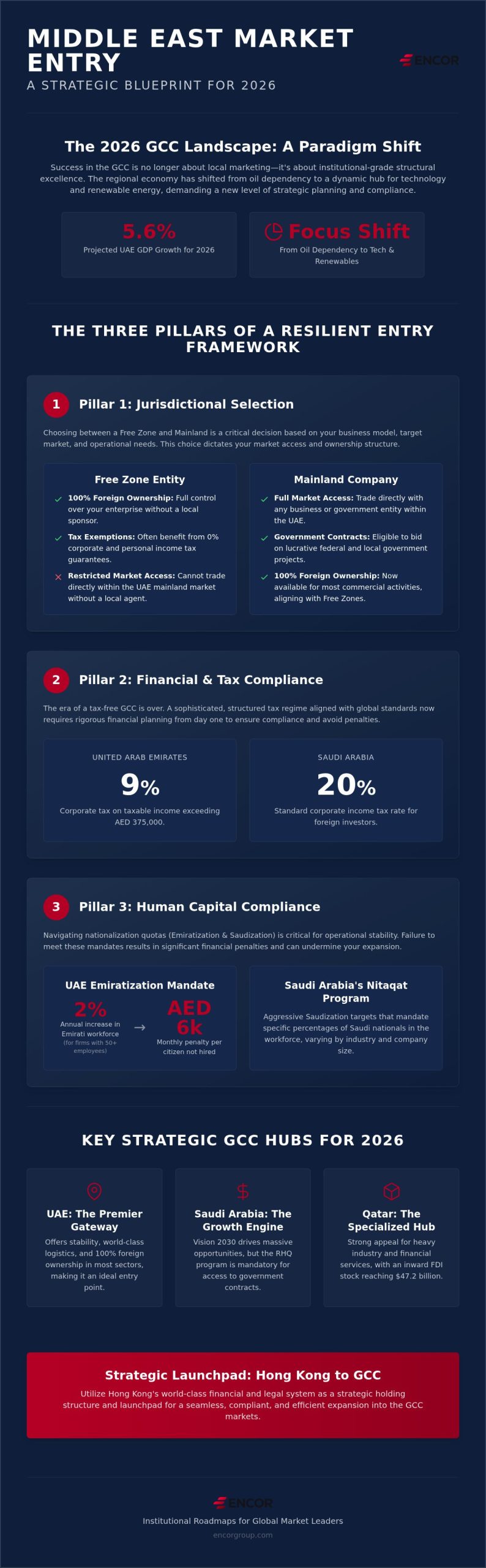
A middle east market entry strategy for 2026 is no longer a peripheral expansion plan; it’s a comprehensive institutional roadmap required to navigate the Gulf Cooperation Council (GCC). The regional economy has moved decisively away from oil dependency. Growth is now concentrated in technology, renewable energy, and massive infrastructure projects. The UAE Central Bank projects a 5.6% GDP growth for 2026, primarily fueled by these non-hydrocarbon sectors. For any executive, a global business expansion strategy must now prioritize structural compliance as its foundation. Success depends on aligning corporate architecture with the region’s rapid industrial diversification.
By 2026, the GCC has solidified its position as a primary engine of global growth. This shift isn’t merely about capital; it’s about the integration of advanced digital infrastructure and sustainable energy solutions. Companies entering the market must recognize that local governments are no longer just looking for vendors. They’re seeking partners who can contribute to long-term economic visions. Consequently, an effective market entry strategy must account for local content requirements and the specific developmental goals of each member state.
The Strategic Importance of the GCC Hubs
The UAE remains the premier gateway for global trade. Recent amendments, such as Federal Decree-Law No. 20 of 2025, have solidified 100% foreign ownership in most commercial activities. This makes the Emirates an ideal starting point for firms looking for stability and world-class logistics. Saudi Arabia represents the region’s largest growth opportunity through Vision 2030. However, the Regional Headquarters (RHQ) requirement mandates that multinational firms establish their primary regional base in Riyadh to qualify for government contracts. Qatar and Oman have carved out specialized roles in energy and logistics. Qatar’s inward FDI stock reached $47.2 billion by early 2026, demonstrating its appeal for heavy industry and financial services.
Regulatory Evolution: What Has Changed by 2026?
The landscape has evolved from tax-free simplicity to a structured corporate tax regime. The UAE now enforces a 9% corporate tax on income exceeding AED 375,000. Saudi Arabia maintains a 20% corporate income tax for foreign investors, while wholly Saudi-owned entities pay a 2.5% Zakat. These changes coincide with stricter Economic Substance Requirements (ESR) and transparency mandates. Organizations must ensure their middle east market entry strategy accounts for these fiscal obligations from the outset to avoid penalties. The current GCC regulatory environment has transitioned from a deregulated frontier to a sophisticated framework aligned with OECD transparency and reporting standards.
The Three Pillars of a Successful Entry Framework
A resilient middle east market entry strategy for 2026 rests on three structural pillars: jurisdictional selection, financial infrastructure, and human capital compliance. These elements don’t function in isolation; they are the foundational components of strategic business consulting international goals. By aligning these pillars, organizations move beyond mere presence toward operational excellence. While many firms focus on market share, successful entrants prioritize the legal and financial frameworks that allow that share to be defended and scaled. Pillar 3, human capital, is particularly critical in 2026. This involves navigating nationalization quotas, such as the UAE requirement for companies with 50 or more employees to increase their Emirati workforce by 2% annually. Failure to manage these international payroll and HR mandates can result in monthly contributions of AED 6,000 for each citizen not employed, undermining the financial viability of the expansion.
Jurisdictional Selection: Free Zones vs. Mainland
The choice between a Free Zone and Mainland setup is a strategic decision based on your target client base. UAE Free Zones offer 100% foreign ownership and specific tax exemptions, making them ideal for export-oriented or digital-first businesses. However, a Mainland license is essential for companies seeking to bid on government contracts or trade directly within the local market without an agent. As detailed in the official UAE market entry strategy guide, recent amendments now allow 100% foreign ownership on the mainland for most activities, reducing the traditional advantage of Free Zones. Selecting the right authority requires an audit of regulatory oversight, as different zones offer varying levels of administrative support and sector-specific infrastructure.
Financial Setup and Banking Strategy
Securing a local financial footprint is often the most significant bottleneck for new entrants. Utilizing corporate bank account opening assistance is vital to navigate the stringent KYC (Know Your Customer) and AML (Anti-Money Laundering) requirements of 2026. Banks in the GCC now demand comprehensive documentation regarding global ownership structures and economic substance. A sophisticated banking strategy must support multi-currency accounts to manage regional volatility and facilitate seamless cross-border transfers. Establishing these accounts early ensures that your middle east market entry strategy isn’t delayed by administrative hurdles. For firms looking to streamline this transition, Encor Group provides the localized expertise needed to bridge the gap between global corporate standards and regional banking expectations.
Hub Selection: Synergy Between Hong Kong and the UAE
For global enterprises, a middle east market entry strategy shouldn’t be viewed in isolation. By 2026, the relationship between Hong Kong and the UAE has evolved into a strategic partnership. This corridor creates a “dual-hub” system where Hong Kong serves as the gateway to North Asia and Mainland China, while the UAE provides access to the Middle East and North Africa. Enterprises that understand how to expand business to Asia often find that the structural requirements for both regions are highly complementary. Centralizing corporate secretarial services across these hubs reduces administrative friction and ensures that global compliance remains consistent across different time zones and regulatory frameworks.
Using Hong Kong as a holding jurisdiction for Middle Eastern operations offers significant tax efficiency. The synergy between Hong Kong’s territorial tax system and the UAE’s structured corporate tax regime allows for optimized capital allocation. This dual-hub approach facilitates seamless capital flow between East Asia and the GCC, enabling multinational groups to reinvest profits with minimal leakage. It’s a calculated strategy that leverages the stability of two world-class financial centers to support a broader global expansion.
The Hong Kong Advantage for Middle East Investors
Utilizing Hong Kong company formation services allows firms to establish a robust regional headquarters. Hong Kong’s legal system provides a familiar, common-law-based environment for international contracts. When this is paired with the UAE’s evolving regulatory landscape, it creates a secure bridge for investment. This corridor is particularly effective for facilitating trade finance and managing the complex cash flow requirements of large-scale infrastructure or technology projects. It’s about building a structure that is both resilient and adaptable to the shifting economic tides of 2026.
UAE Free Zones as the Regional Operational Base
While Hong Kong handles the holding and capital management, UAE free zone incorporation provides the ideal operational base for the Middle East. Selecting the correct zone is a matter of industry focus. DMCC remains a leader for commodities and trade, while Meydan and IFZA offer agile environments for service-based businesses and tech startups. These zones provide the infrastructure necessary to execute a high-level middle east market entry strategy while maintaining 100% foreign ownership. While the UAE serves as a central hub, businesses should also consider the broader regional landscape. For example, Oman market entry strategies highlight the importance of localized negotiation and specialized logistics in niche energy sectors. Integrating these diverse regional nodes into a centralized holding structure ensures that your expansion is both broad and well-governed.
Operationalizing Entry: Tax, Compliance, and HR
Managing compliance often serves as the primary deterrent for international firms entering the GCC. A successful middle east market entry strategy must solve for the transition from tax-free simplicity to a structured, globalized fiscal environment. By 2026, the UAE’s 9% corporate tax rate on taxable income exceeding AED 375,000 is fully operational. Larger multinational groups with revenues over €750 million must also navigate the 15% minimum effective tax rate under OECD Pillar Two. Implementing international tax advisory services is no longer optional; it’s a prerequisite for operational stability and long-term profitability.
Beyond tax, companies must adhere to Economic Substance Requirements (ESR). This means demonstrating that core income-generating activities actually occur within the jurisdiction. Establishing a robust middle east market entry strategy requires a careful audit of physical office requirements and local management control to ensure that the entity’s presence is substantive rather than merely formal. Meeting these standards doesn’t require excessive overhead if structural efficiencies are built into the initial roadmap from the outset.
Navigating UAE Corporate Tax and International Standards
The 9% threshold offers a competitive entry point for smaller entities, but Free Zone companies must understand the specific Qualifying Income criteria to maintain their 0% status. Meticulous bookkeeping and professional accounting provide the only reliable defense for these positions during a tax audit. It’s a critical requirement that Free Zone entities submit annual audit reports to their respective authorities to verify compliance and maintain their operational licenses. This level of transparency aligns the region with international standards, providing a more stable environment for institutional investors.
Global HR and Payroll Solutions for Regional Teams
Managing a diverse workforce across multiple GCC borders introduces significant administrative friction. Centralizing international payroll solutions allows for a unified view of labor costs and ensures compliance with local Wage Protection Systems (WPS). Local PRO services are essential for managing the granular details of visa processing and work permits, particularly as nationalization quotas become more stringent. Building a localized leadership team requires a sophisticated executive recruitment strategy that balances global corporate culture with regional market nuances. To streamline your operational setup and ensure full regulatory adherence, contact Encor Group for an integrated compliance and HR framework.
Strategic Navigation with Encor Group
Encor Group functions as the strategic navigator for organizations requiring a sophisticated middle east market entry strategy. We operate through a “Four Regional Hubs” model that facilitates seamless global expansion by bridging the gap between international corporate standards and regional requirements. This methodology integrates financial, regulatory, and human capital services into a single, cohesive framework. By centralizing these critical functions, multinational enterprises can eliminate the operational friction typically associated with cross-border expansion. Strategic consulting at this level isn’t just about establishing a presence; it’s about optimizing every layer of the corporate structure for efficiency and long-term resilience across more than 10 regional markets.
End-to-End Business Setup and Support
The transition from a global concept to a regional reality requires meticulous execution. Encor Group manages the entire lifecycle of market entry, from initial incorporation in UAE Free Zones to ongoing corporate secretarial management. We provide essential assistance with corporate bank account opening, navigating the rigorous KYC and AML protocols that characterize the 2026 financial landscape. Our team handles the granular details of regulatory reporting and offers tailored tax advisory for multinational enterprises. This support is particularly critical for groups managing the 9% UAE corporate tax or the 15% minimum effective rate applicable to entities with global revenues exceeding €750 million. By providing a stable administrative foundation, we ensure that your entry is compliant from day one.
Optimizing for Long-Term Regional Success
Sustaining growth in the GCC requires permanent compliance with evolving regional laws. Encor Group enables organizations to scale effectively through outsourced accounting and localized HR solutions. This approach ensures that international payroll remains compliant with current Wage Protection System (WPS) mandates and nationalization targets, such as the 2026 Emiratisation and Saudization quotas. Our operations optimization methodology identifies structural inefficiencies and implements solutions that protect your margins. By managing these complex operational requirements, we allow your leadership to focus on high-level market objectives and regional growth. Consult with Encor Group on your Middle East entry strategy.
Securing Your Regional Footprint in 2026
Establishing a sustainable presence in the GCC requires moving beyond reactive measures toward a proactive, institutional-grade framework. Success in 2026 is defined by structural precision and the ability to navigate a sophisticated regulatory landscape. By aligning your jurisdictional selection with the strategic Hong Kong-UAE corridor, you create a resilient foundation for long-term growth. Centralizing your operations ensures that tax obligations and nationalization quotas are managed with the accuracy that institutional investors expect. A robust middle east market entry strategy isn’t merely a launch plan; it’s a commitment to operational excellence and regulatory transparency.
Encor Group provides the strategic depth needed to master these complexities across 10+ global markets. Our team delivers comprehensive compliance and tax advisory expertise alongside specialized HR and international payroll management. We ensure that your expansion is supported by stable financial infrastructure and localized operational support. Partner with Encor Group for your Middle East Market Entry to transform regional challenges into a distinct competitive advantage. The opportunities within the GCC are vast for those who enter with the right structural roadmap.
Frequently Asked Questions
What is the best entry mode for the Middle East market in 2026?
The most effective entry mode for 2026 depends on whether your target is the local consumer market or global trade. UAE Free Zones remain the premier choice for service-based and export-oriented firms due to 100% foreign ownership and specialized infrastructure. Conversely, a Mainland license is superior for those bidding on government contracts. A successful middle east market entry strategy must balance these structural benefits against long-term operational costs and regional tax obligations.
How does the new UAE Corporate Tax affect market entry strategy?
The UAE Corporate Tax regime introduces a 9% standard rate on taxable income exceeding AED 375,000. This shift mandates that companies maintain meticulous financial records and professional accounting standards to qualify for potential exemptions or 0% rates in Free Zones. For large multinational groups with global revenues over €750 million, a 15% minimum effective tax rate applies. This regulatory change transforms market entry from a tax-free endeavor into a structured compliance exercise.
Can a foreign company own 100% of its business in the Middle East?
Foreign investors can now own 100% of their business in most commercial and industrial sectors across the UAE, Saudi Arabia, and Qatar. Federal Decree-Law No. 20 of 2025 solidified this in the UAE, while Saudi Arabia’s 2026 Investment Law allows full ownership with minimal restricted activities. While some strategic sectors like banking and insurance still require local participation, the general trend toward liberalization has significantly lowered the barriers for international enterprises.
What are Economic Substance Requirements (ESR) in the UAE?
Economic Substance Requirements mandate that UAE entities performing “Relevant Activities” must demonstrate a genuine economic presence within the country. This includes having physical offices, local management, and adequate expenditure in the jurisdiction. Companies must submit annual notifications and reports to avoid significant penalties. These regulations ensure that the UAE aligns with global standards on tax transparency and prevents the use of “shell” companies for tax avoidance purposes.
How long does it typically take to set up a business in a UAE Free Zone?
Establishing a business in a UAE Free Zone typically takes between one and four weeks, depending on the specific authority and the complexity of the corporate structure. Digital-first zones like IFZA or Meydan offer expedited processing, while more specialized hubs may require additional time for activity approvals. This timeline covers initial name reservation, license issuance, and the start of visa processing. It doesn’t include the separate process of opening a corporate bank account.
Is it necessary to have a local partner for a Middle East market entry?
A local partner is no longer a mandatory requirement for the majority of business activities in the GCC. Recent legal reforms across the UAE and Saudi Arabia have removed the need for a 51% local shareholder in most commercial and industrial categories. However, certain strategic sectors, such as oil and gas or defense, may still necessitate a local partner or agent. Most modern middle east market entry strategy frameworks now focus on full ownership models to maximize corporate control.
How can a Hong Kong company facilitate Middle East expansion?
A Hong Kong entity facilitates expansion by acting as a highly efficient holding jurisdiction for Middle Eastern operations. This structure leverages Hong Kong’s territorial tax system and common-law legal framework to manage regional profits and facilitate capital flow between East Asia and the GCC. It provides a stable bridge for multinational groups to centralize their global compliance while benefiting from the strategic synergy between two of the world’s most significant financial hubs.
What is the “Regional Headquarters” requirement in Saudi Arabia?
The Regional Headquarters requirement in Saudi Arabia mandates that multinational firms must establish their primary regional base in Riyadh to qualify for government contracts. This policy aims to attract direct investment and talent to the Kingdom as part of Vision 2030. Companies that fail to comply may be excluded from bidding on state-funded projects. The RHQ status offers specific incentives, including tax exemptions and relaxed Saudization quotas for a defined period to support initial setup.