

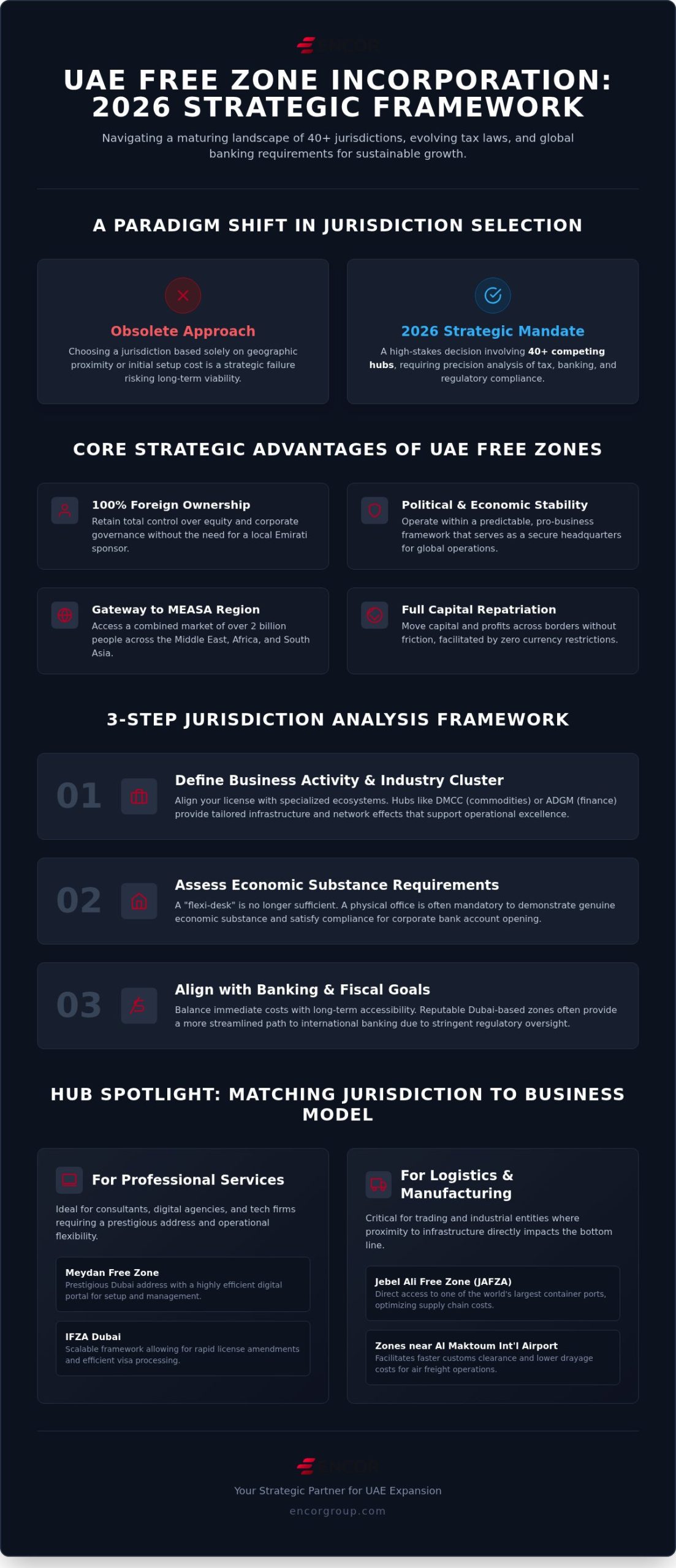
In 2026, selecting a jurisdiction based solely on geographic proximity or initial setup cost is a strategic failure that risks long-term fiscal viability. The era of simple, low-touch setups has passed. You likely recognize that UAE free zone incorporation is no longer a mere administrative task; it’s a high-stakes decision involving over 40 competing hubs and a maturing tax environment. Precision is now mandatory for sustainable growth.
We understand that the complexity of corporate tax exemptions and the persistent difficulty of securing corporate bank accounts can stall even the most ambitious expansion plans. This guide provides a comprehensive framework for executives to navigate jurisdiction selection, regulatory compliance, and operational setup in the UAE’s premier business hubs. You’ll gain the insights needed to ensure full compliance, optimize your tax structure, and access global talent through integrated HR and payroll solutions. We’ll examine the critical criteria for selecting the right hub, the nuances of Economic Substance Regulations, and the steps required for a seamless operational launch.
Key Takeaways
- Identify the strategic advantages of 100% foreign ownership and political stability within the 2026 UAE market.
- Apply a comparative framework to the 40+ available hubs to ensure your UAE free zone incorporation aligns with specific license activities and fiscal goals.
- Secure your corporate standing by mastering the 2026 requirements for corporate tax and ultimate beneficial owner reporting.
- Follow a structured roadmap for legal setup and name reservation to facilitate a predictable and efficient path to market entry.
- Optimize long-term operations by integrating recruitment and payroll solutions into your initial expansion strategy.
The Strategic Rationale for UAE Free Zone Incorporation
UAE free zones function as autonomous economic jurisdictions designed to attract foreign direct investment through a ring-fenced regulatory environment. Unlike mainland configurations, these zones permit 100% foreign ownership of the entity. For executives evaluating UAE free zone incorporation in 2026, the core value proposition centers on the nation’s unwavering political stability. While many global markets encounter increasing volatility, the UAE maintains a predictable, pro-business framework that serves as a secure headquarters for international operations. Stability drives these strategic decisions.
The UAE’s geographic location provides a strategic gateway to the MEASA region. This corridor links the Middle East, Africa, and South Asia, offering access to a combined market of over two billion people. Entities within these zones benefit from the full repatriation of capital and profits, facilitated by a total absence of currency restrictions. This financial autonomy is vital for multinational firms that need to move liquidity across borders without friction. Capital remains fluid and accessible.
100% Foreign Ownership and Capital Repatriation
The legal structure of a free zone removes the need for a local Emirati sponsor. This ensures that international investors retain total control over their equity and corporate governance. Full ownership isn’t just a legal perk; it’s a fundamental component of a global asset protection strategy. It allows subsidiaries to operate with maximum flexibility, ensuring that capital remains accessible for reinvestment or distribution. You can consult a complete list of UAE free trade zones to see how different emirates categorize these legal frameworks. This autonomy is essential for maintaining institutional standards across global branches.
Strategic Industry Clustering
Modern jurisdictions have evolved into specialized ecosystems that cater to specific sectors. Hubs like the Dubai Multi Commodities Centre (DMCC) or Abu Dhabi Global Market (ADGM) provide tailored environments for commodities trading and financial services. Proximity to industry peers and specialized service providers creates a network effect that benefits tech and finance firms alike. For instance, logistics entities in the Jebel Ali Free Zone (JAFZA) benefit from direct access to one of the world’s largest container ports. This connectivity reduces transit times and optimizes supply chain costs. By situating operations within these clusters, companies leverage advanced local infrastructure to streamline their global logistics. This approach ensures that a firm’s physical location directly supports its operational excellence and long-term growth objectives.
Selecting the Optimal Jurisdiction: A Comparative Framework
Strategic UAE free zone incorporation requires a multi-dimensional analysis. License type, facility requirements, and capital allocation are the primary drivers. While Northern Emirates hubs like SHAMS provide competitive entry points for lean startups, Dubai-based zones often provide a more streamlined path for international banking. Reputation is everything. Most top-tier banks prioritize entities registered in jurisdictions with stringent regulatory oversight.
Substance requirements have moved beyond mere administrative checkboxes. While a “flexi-desk” suffices for basic licensing, a physical office is often necessary to demonstrate genuine economic substance and satisfy compliance departments during bank account opening. Your choice must reflect your long-term operational scale. It’s a balance of immediate cost and future accessibility.
Meydan and IFZA: Premier Hubs for Professional Services
For consultants and digital agencies, the business setup in Meydan Free Zone offers a prestigious Dubai address coupled with a highly efficient digital portal. It’s an institutional favorite for service-based startups. Similarly, an IFZA Dubai company formation provides a scalable framework that allows for rapid license amendments and visa processing. These zones balance cost-effectiveness with the high-level corporate image required by global clients. They provide the professional gravitas needed to compete in international markets.
Logistics and Manufacturing-Focused Zones
Industrial and trading entities must prioritize proximity to infrastructure. Zones located near Jebel Ali Port or Al Maktoum International Airport facilitate faster customs clearance and lower drayage costs. These specialized hubs offer extensive warehouse facilities and industrial land, often with specific customs duty exemptions for re-export activities. Selecting the right geography here directly impacts your bottom-line margins. Efficiency in movement is the primary goal.
A misaligned choice can lead to significant delays in operational launch. Consulting a specialist ensures your UAE free zone incorporation is strategically sound from day one. You can explore our compliance and regulatory advisory to refine your selection process.
Navigating the 2026 Regulatory and Compliance Landscape
The regulatory environment governing UAE free zone incorporation has undergone a fundamental transformation. By 2026, the UAE has fully integrated into the global tax architecture, moving away from its historical reputation as a purely tax-neutral environment. Compliance is now a pillar of operational longevity rather than a secondary administrative task. Entities must demonstrate rigorous adherence to Anti-Money Laundering (AML) and Know Your Customer (KYC) standards to maintain their standing with both regulators and financial institutions. It’s a shift toward total transparency.
Corporate Tax and Qualifying Income
The introduction of the UAE Corporate Tax regime represents a significant fiscal shift for international investors. Free Zone Persons may still benefit from a 0% tax rate, but this is strictly contingent on generating “Qualifying Income” and maintaining “Adequate Substance” within the zone. Income derived from transactions with the mainland or non-qualifying activities is generally subject to the standard 9% corporate tax rate. Distinguishing between these revenue streams requires precise accounting and proactive planning. Utilizing international tax advisory services is essential to ensure your corporate structure remains optimized under these evolving rules. Failure to segregate these income types can lead to the loss of tax-exempt status for the entire entity.
ESR and UBO Compliance Standards
Transparency is the new benchmark for corporate legitimacy. Adhering to UAE ultimate beneficial owner regulations is mandatory for all registered entities. These rules require companies to maintain accurate, up-to-date registers of their real owners and submit this data to the relevant authorities. Parallel to this, Economic Substance Regulations (ESR) demand that companies performing “Relevant Activities” prove they have a physical presence, employees, and operating expenditure within the UAE. Administrative non-compliance carries heavy financial penalties and, in severe cases, the suspension of trade licenses. In 2026, compliance isn’t a one-time event. It’s an ongoing requirement that must be integrated into the annual corporate secretarial cycle.
- Reporting deadlines: ESR notifications and reports must be submitted within specific windows following the financial year-end.
- Documentation: Entities must maintain a clear audit trail of board meetings and strategic decisions made within the UAE.
- Risk Mitigation: Proactive audits prevent the “fire-drill” approach to regulatory requests and ensure long-term stability.
Precision in these areas protects the group’s global reputation and ensures uninterrupted access to the UAE’s economic benefits. It’s no longer enough to exist on paper; your entity must demonstrate active, compliant participation in the local economy. This structured approach to regulation facilitates a more secure environment for cross-border operations.
The Institutional Roadmap to UAE Incorporation
Successful UAE free zone incorporation requires a methodical, phase-based approach to ensure all legal and operational benchmarks are met. The process begins with the selection of the legal structure, typically a Free Zone Establishment (FZE) for single shareholders or a Free Zone Company (FZCO) for multiple partners. Precise activity selection is critical during this initial phase. Misaligned activities can lead to operational restrictions or compliance failures during later regulatory reviews. Once the structure is defined, the entity name must be reserved through the relevant authority, followed by the drafting of the Memorandum of Association (MOA) and the execution of an office lease agreement. These steps form the legal foundation of the business.
Following the issuance of the trade license, the entity initiates visa processing for directors and employees. This involves the issuance of an entry permit, a mandatory medical fitness test, and biometrics for the Emirates ID. The Emirates ID is the cornerstone of local residency. It’s required for all subsequent personal and corporate registrations, including utility connections and vehicle registrations. Each phase must be executed with precision to avoid costly delays in market entry.
Documentary Requirements and Legalisation
Requirements vary significantly between individual and corporate shareholders. Individual applicants typically provide passport copies and proof of residency, while corporate entities must submit board resolutions, certificates of incorporation, and articles of association. If these documents originate outside the UAE, they require a multi-stage attestation process. This includes legalisation by the UAE Embassy in the country of origin and the Ministry of Foreign Affairs (MOFA) within the UAE. Ensuring all filings align with Dubai business setup for foreigners standards prevents administrative rejection. Accuracy at this stage is non-negotiable for institutional investors.
Financial Setup: Banking and Capital
The final, and often most complex, phase is bank account activation. In 2026, non-resident directors face heightened scrutiny from institutional compliance departments. Banks require comprehensive evidence of business activity, clear source of funds documentation, and proof of local substance. Because of this complexity, the necessity of corporate bank account opening assistance cannot be overstated. While many zones have abolished minimum capital requirements, others still require a specific deposit before full operational status is granted. We recommend initiating this process as early as possible to ensure liquidity is available for the launch phase.
If you’re ready to initiate your expansion, you can explore our UAE free zone incorporation services to streamline this roadmap and ensure a seamless transition into the market.
Encor Group: Your Strategic Partner for UAE Expansion
Encor Group serves as a strategic navigator for organizations pursuing UAE free zone incorporation. We don’t simply facilitate a license; we deliver a comprehensive framework for cross-border success. Our expertise spans the specific complexities of premier hubs like Meydan and IFZA, ensuring that your initial setup aligns with long-term fiscal and operational goals. For multinational entities, we provide international payroll solutions that ensure total compliance across diverse jurisdictions from day one. This integration removes the friction typically associated with global team management. We prioritize institutional confidence and reliability in every engagement.
Comprehensive Compliance and Secretarial Support
We serve as the institutional bridge between your entity and the free zone authorities. Managing annual filings and regulatory reporting requires a high degree of precision to avoid the penalties associated with ESR and UBO non-compliance. Our corporate secretarial services ensure that all documentation remains current and compliant with evolving standards. We handle the granular details of regulatory advisory so your leadership can focus on market penetration. Operational excellence is maintained through a proactive approach to risk mitigation and steady, methodical management of corporate records. It’s about building a stable foundation for high-stakes requirements.
Scaling Beyond Incorporation
Scaling requires more than a legal presence. It demands access to global talent and a robust global business expansion strategy. Encor Group facilitates this transition by providing strategic recruitment and HR management services tailored to the UAE’s unique labor market. We help you move from the initial UAE free zone incorporation phase to full-scale operations with speed and institutional precision. Our advisors identify the specific talent necessary for your sector and manage the entire onboarding and payroll lifecycle. This end-to-end support ensures that your operational launch is seamless and sustainable. To secure a tailored market entry framework and optimize your corporate structure, request a consultation with our expansion experts today.
Strategic Implementation for Long-Term Growth
Success in the Emirates depends on aligning jurisdiction selection with the rigorous demands of the 2026 corporate tax and substance regulations. A structured institutional roadmap ensures your entity isn’t only legally compliant but also operationally optimized for global trade. The transition from initial planning to a functional hub hinges on precision in documentation and a deep understanding of the local banking environment. Precision drives long-term viability.
Strategic UAE free zone incorporation serves as the foundation for your expansion into the MEASA region. Encor Group provides the institutional depth required to manage this transition. With expertise across over 10 global markets, we offer end-to-end compliance and tax advisory alongside dedicated corporate bank account assistance. Our team acts as your navigator through the evolving regulatory landscape, ensuring your business remains resilient. Scale your business with Encor Group’s UAE incorporation services and secure your position in a premier economic hub. Your growth in the UAE starts with a calculated, expert-led entry.
Frequently Asked Questions
What is the primary difference between UAE Mainland and Free Zone companies?
The primary difference lies in the geographic scope of operations and the regulatory framework. Mainland companies can trade freely across the entire UAE and bid for government contracts, whereas Free Zone entities are generally restricted to trading within their specific zone or internationally. While mainland firms now allow 100% foreign ownership in many sectors, Free Zones offer a more specialized, ring-fenced environment tailored to specific industry clusters.
Can a UAE Free Zone company trade within the UAE local market?
Free Zone entities cannot trade directly with the UAE mainland market without utilizing a licensed local distributor or agent. To engage in “onshore” commerce, the company must either appoint a local agent or establish a mainland branch. However, providing services to mainland companies is permitted under specific conditions, provided the work is performed within the boundaries of the zone or outside the UAE.
How long does the typical UAE Free Zone incorporation process take in 2026?
The typical timeline for UAE free zone incorporation in 2026 ranges from three to ten working days for the initial trade license issuance. This duration depends heavily on the chosen jurisdiction and the complexity of the selected business activities. Additional phases, including visa processing and corporate bank account activation, extend the total operational launch timeline to several weeks or months depending on the bank’s compliance review.
Are Free Zone companies exempt from the 9% UAE Corporate Tax?
Free Zone companies aren’t automatically exempt from the 9% UAE Corporate Tax regime. While “Qualifying Free Zone Persons” can benefit from a 0% rate on qualifying income, they must meet strict criteria, including maintaining adequate substance and complying with transfer pricing rules. Non-qualifying income is subject to the standard corporate tax rate once it exceeds the specified statutory threshold for taxable profits.
Is it mandatory to have a physical office in a UAE Free Zone?
A physical office or a registered “flexi-desk” is mandatory for all entities to maintain a valid trade license. While many jurisdictions allow virtual or shared desk options for lean operations, larger entities or those requiring multiple visas often need a dedicated physical space. Furthermore, a physical office is frequently a prerequisite for satisfying institutional bank compliance and demonstrating compliance with Economic Substance Regulations.
Can I obtain residency visas for my family through Free Zone incorporation?
Investors and employees can sponsor residency visas for their immediate family members once their own residency status is finalized. This process requires proof of suitable housing and meeting the minimum salary thresholds defined by the UAE immigration authorities. Successful UAE free zone incorporation serves as the legal basis for the primary applicant’s residency, which then facilitates the sponsorship of dependents through the relevant emirate’s visa portal.
What are the ongoing annual costs for maintaining a Free Zone entity?
Maintaining a Free Zone entity involves several recurring annual expenses, including trade license renewal fees and office lease payments. Additionally, companies must budget for mandatory annual audits, corporate secretarial services, and regulatory filings such as ESR and UBO reports. These costs vary based on the specific zone’s requirements and the scale of the company’s operational activities. It’s essential to account for these during the initial fiscal planning phase.
Is a local sponsor required for UAE Free Zone incorporation?
A local Emirati sponsor isn’t required for any company formed within a UAE Free Zone. One of the primary advantages of these jurisdictions is the provision for 100% foreign ownership and full management control. This legal framework allows international investors to retain total equity without the need for a local partner, regardless of the business activity or industry, providing a secure environment for international asset protection.