

Selecting a jurisdiction based solely on ownership rights is a strategy that belongs in the previous decade. In 2026, the distinction between these two paths has shifted from legal control to a complex trade-off between geographic market reach and administrative fiscal optimization. You’re likely managing the friction of shifting tax regulations while attempting to scale global teams without operational bottlenecks. The fear of selecting a structure that limits your future agility is a significant hurdle for any seasoned executive.
This article provides an institutional framework for your UAE mainland vs free zone comparison, offering the clarity required to navigate 100% foreign ownership rules and the 9% corporate tax threshold. We’ll deliver a definitive decision-making matrix that aligns your corporate structure with the latest Federal Decree-Laws. You’ll gain a precise understanding of how the 2026 e-invoicing mandates and the Qualifying Free Zone Person status impact your bottom line, ensuring your UAE expansion is both compliant and strategically sound.
Key Takeaways
- Identify how recent legislative shifts allow for 100% foreign ownership across most mainland sectors, fundamentally altering the traditional jurisdictional selection process.
- Execute a precise UAE mainland vs free zone comparison to balance the need for direct local market access against the administrative benefits of specialized economic zones.
- Master the 2026 corporate tax landscape by distinguishing between the standard 9% rate and the specific qualifying income criteria for free zone entities.
- Align your operational infrastructure with mandatory e-invoicing deadlines and UAE Labour Law requirements to ensure seamless regional scaling.
- Explore the dual licensing framework as a strategic mechanism to bridge the gap between international trade advantages and domestic market reach.
The Evolving UAE Regulatory Landscape in 2026
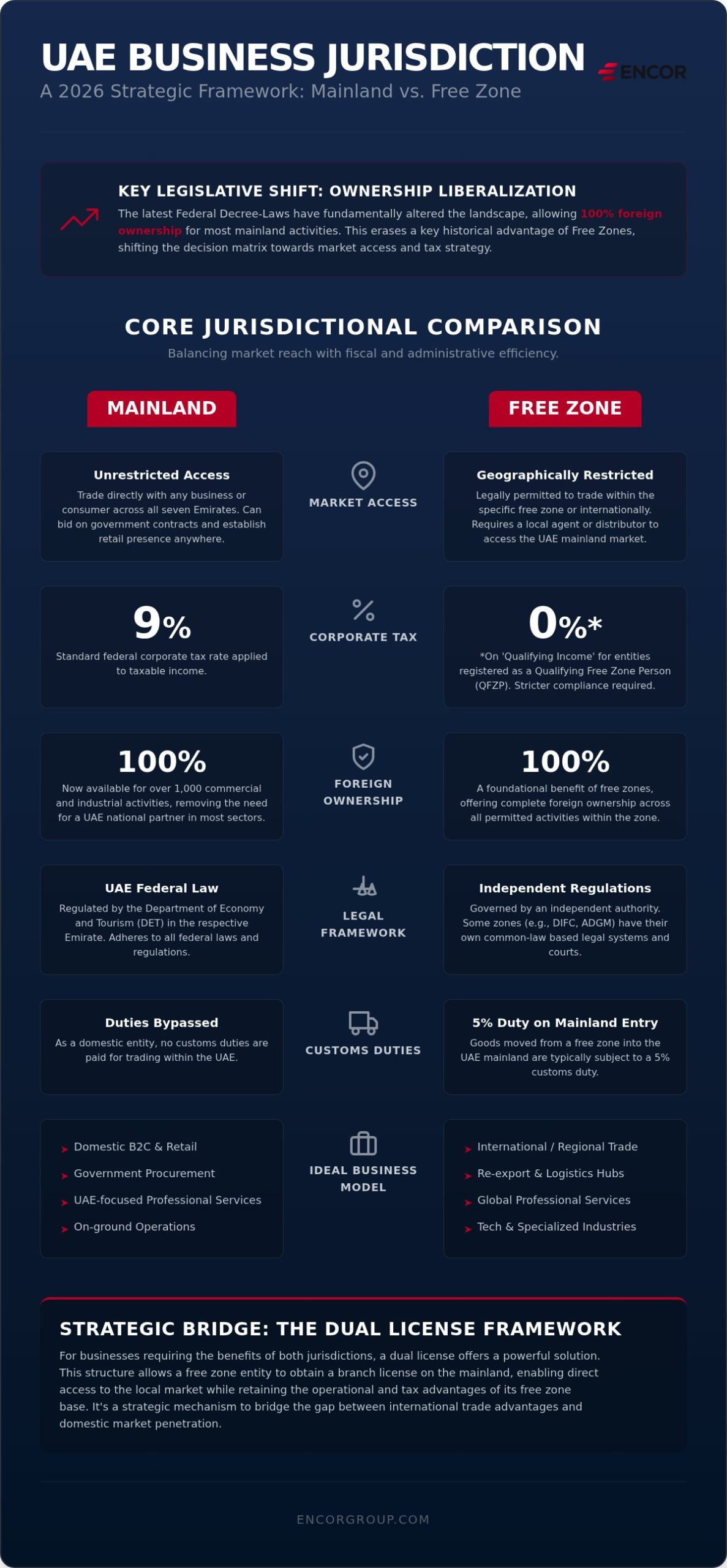
The UAE economy operates through two distinct jurisdictional frameworks: the mainland, regulated by the Department of Economy and Tourism (DET) in each emirate, and various UAE Free Zones, governed by their own independent authorities. Choosing between these structures is the foundational decision for any Middle East market entry strategy. While the mainland offers unrestricted access to the domestic market, free zones provide specialized ecosystems designed for specific industrial clusters. Understanding the UAE mainland vs free zone comparison requires a deep dive into how these jurisdictions have converged and where they remain strategically distinct.
The Shift in Foreign Ownership Standards
The implementation of Federal Decree-Law No. 20 of 2025 has fundamentally transformed the mainland landscape. This legislation solidified the shift toward 100% foreign ownership for over 1,000 commercial and industrial activities, removing the historical requirement for a UAE national partner in most sectors. This change has narrowed the gap between mainland and free zone benefits. However, the mainland still maintains restrictions on strategic sectors, including oil and gas, security, and defense, where local participation remains mandatory. Free zones maintain their appeal by offering “sovereign” regulatory environments and specialized court systems, such as the DIFC or ADGM, which provide a high degree of legal predictability for international firms.
Defining Your Strategic Objectives
Your target audience and operational model are the primary drivers of jurisdiction selection. A mainland license is essential for businesses that adopt a B2C model requiring a physical retail presence across the emirates or those seeking to secure government contracts. Mainland entities can trade directly with any local business or consumer without geographic limits. Conversely, free zones are optimized for regional re-export, global professional services, and tech-driven enterprises. While a free zone entity can trade within the mainland through a distributor or a local agent, it cannot open a physical branch in the mainland without additional licensing. This distinction makes the mainland the preferred choice for domestic market penetration, while free zones remain the gold standard for international service hubs.
The role of the DET on the mainland is to act as the central registrar and licensing body, ensuring businesses adhere to federal and local commercial laws. In contrast, free zone authorities operate as one-stop shops, handling everything from company formation to visa processing and building permits within their specific geographic boundaries. This administrative autonomy often results in faster setup times for free zone entities, though the mainland’s digital transformation has significantly reduced the historical lead-time disparity.
Structural Dichotomy: Physical Presence and Geographic Scope
The structural choice between a mainland entity and a free zone firm dictates your operational reach. A comprehensive UAE mainland vs free zone comparison highlights that mainland companies enjoy unrestricted trade across all seven emirates. They can engage in government procurement and retail activities without intermediaries. Free zone companies, however, are legally restricted to trading within their specific zone or internationally. To access the local UAE market, these entities must appoint a local distributor or agent, which adds a layer of operational complexity and cost. This “workaround” is often suitable for product-based businesses, but it doesn’t offer the same flexibility as a mainland license for service-oriented firms.
Market Access and Trading Boundaries
Mainland entities operate as domestic players. They bypass the 5% customs duties often applied when moving goods from a free zone into the mainland. For service-based firms, this means the ability to consult for any client in the UAE without jurisdictional conflict. If your strategy focuses on regional re-export or global professional services, the free zone model remains efficient. It allows you to manage cross-border logistics within a specialized ecosystem, though it limits your ability to scale a physical B2C presence in the local market. Using a local distributor allows free zone firms to reach the mainland, but it often results in a loss of brand control and a share of the margins.
Infrastructure and Office Realities
Physical presence requirements vary significantly between the two frameworks. Mainland companies must secure a physical office and register a lease through the Ejari system. This space isn’t just a cost center; it’s the metric that determines your visa quota. Typically, the Department of Economy and Tourism (DET) allocates one visa for every 80 to 100 square feet of office space. While some professional licenses offer exemptions, most commercial activities require a minimum of 200 square feet to secure approval. If you plan to scale a large local team, your real estate investment must grow proportionally.
Free zones offer more flexible entry points. Many startups utilize “Smart Desks” or “Flexi-desks,” which provide the necessary legal address for a license without the overhead of a dedicated suite. These arrangements often include a fixed visa allocation, such as two or three visas per desk. As your operations expand, you can transition to private offices within the zone to unlock higher headcount quotas. Managing these transitions requires foresight to avoid hiring freezes caused by space constraints. For enterprises requiring a tailored setup, Encor Group provides operations optimization to ensure your physical infrastructure aligns with your long-term staffing projections. This strategic approach prevents the operational friction often associated with rapid regional growth.
The Fiscal Divide: Corporate Tax and Compliance Standards
The UAE’s transition from a tax-neutral environment to a globally compliant fiscal hub has redefined the UAE mainland vs free zone comparison. Since the implementation of Federal Decree-Law No. 47 of 2022, all business entities must navigate a federal corporate tax framework. While the mainland is subject to a standard rate, free zones offer potential exemptions that require strict adherence to “qualifying” criteria. This fiscal landscape demands a high degree of regulatory precision to avoid penalties and optimize tax liabilities in 2026.
Navigating the 2026 UAE Corporate Tax Regime
The standard corporate tax rate is 9% on taxable income exceeding AED 375,000. This threshold applies to both mainland and free zone entities. However, free zone companies can maintain a 0% tax rate if they achieve the status of a Qualifying Free Zone Person (QFZP). This status isn’t automatic. It requires the entity to maintain adequate substance in the UAE, derive “qualifying income” as defined by the Ministry of Finance, and comply with all transfer pricing requirements. Income derived from “excluded activities” or transactions with mainland branches may still be taxed at the 9% rate. Because these nuances are complex, many multinational enterprises utilize professional international tax advisory services to ensure their revenue streams are structured correctly.
Customs duties and VAT also play a critical role in this divide. Mainland companies operate within the UAE’s domestic VAT zone, facilitating easier local trade. Certain free zones, categorized as “Designated Zones,” are considered outside the UAE for VAT purposes regarding specific goods. This status allows for the deferral of VAT and customs duties on imports, provided the goods remain within the zone or are re-exported. This makes Designated Zones highly efficient for logistics and manufacturing firms that don’t prioritize the domestic consumer market.
Regulatory Compliance: ESR and UBO
Compliance standards have intensified for all UAE entities. Economic Substance Regulations (ESR) remain a critical requirement for companies engaging in “Relevant Activities,” such as banking, insurance, or distribution and service centers. Entities must prove they conduct core income-generating activities within the UAE, a requirement that aligns with global OECD standards. Failure to meet ESR benchmarks can result in significant administrative fines and the potential suspension of trade licenses.
Transparency is another pillar of the 2026 regulatory environment. All firms must adhere to UAE Ultimate Beneficial Owner regulations, which involve maintaining accurate registers of real owners and senior management. While mainland firms file this data with the Department of Economy and Tourism (DET), free zone entities report directly to their respective authorities. Both jurisdictions now require annual audited financial statements to support tax filings and license renewals, ensuring that the UAE remains a transparent and stable jurisdiction for international capital.
Operational Logistics: Managing HR, Payroll, and Market Entry
Operationalizing a UAE entity requires moving beyond the initial license issuance into the complexities of human capital management and financial integration. While many advisors focus strictly on the “day one” setup, the long-term success of your UAE mainland vs free zone comparison depends on how effectively you navigate the “day two” operational requirements. In 2026, the integration of digital compliance systems has made the administrative landscape more transparent but also more rigorous for international enterprises.
Human Resources and Payroll Compliance
Employee sponsorship is governed by the UAE Labour Law, which provides a unified framework for private sector employment. A critical component of this is the Wages Protection System (WPS), a mandatory electronic salary transfer system. While WPS is a staple for mainland companies, many free zones have also adopted this system to ensure timely compensation and regulatory oversight. Compliance isn’t optional; failure to process payroll through an authorized agent can lead to work permit suspensions and administrative fines. For firms managing a global workforce, utilizing international payroll solutions is essential to synchronize regional requirements with global reporting standards. Beyond monthly salaries, companies must also calculate and accrue end-of-service gratuity, a mandatory benefit for employees that requires precise accounting to avoid future liabilities.
The Banking and Financial Setup
Securing a local bank account remains one of the most significant hurdles for new market entrants. UAE financial institutions have implemented stringent Know Your Customer (KYC) and Anti-Money Laundering (AML) protocols that often favor mainland entities due to their perceived deeper ties to the local economy. Free zone entities, particularly those with complex foreign ownership structures, may face extended onboarding timelines. Banks in 2026 prioritize companies that can demonstrate physical substance and clear business activities. Because of these complexities, seeking corporate bank account opening assistance is a strategic move to ensure all documentation meets the evolving standards of local and international lenders. Centralizing your financial operations within the UAE requires a partner who understands the specific jurisdictional preferences of local banks.
Recruitment in the UAE is highly competitive, and your ability to attract top-tier talent is directly linked to your visa quota. As established in previous sections, your physical office footprint dictates your headcount. Managing this relationship between real estate, recruitment, and visa processing is a logistical balancing act. To streamline these processes and ensure your entity remains compliant with all Ministry of Human Resources and Emiratisation (MOHRE) mandates, you can leverage Encor Group’s comprehensive payroll solutions and HR services. This proactive management allows your leadership to focus on market expansion rather than administrative friction.
Strategic Decision-Making: Aligning Jurisdiction with Growth
The final stage of a UAE mainland vs free zone comparison requires aligning jurisdictional choice with the broader growth trajectory of the enterprise. While the initial setup focuses on immediate compliance and market entry, the long-term strategic value lies in how the entity integrates into a global business expansion strategy. For many multinational enterprises, the ‘Dual License’ framework has emerged as a sophisticated solution. This arrangement allows a free zone company to obtain a secondary license from the Department of Economy and Tourism (DET), enabling trade with the mainland without the overhead of a second physical office. This hybrid model effectively bridges the gap between international fiscal optimization and domestic market penetration.
Scaling from a free zone to a mainland branch is a natural progression for businesses that find their domestic client base exceeding their international trade volume. This transition requires a meticulous re-evaluation of visa quotas and office space mandates. Encor Group facilitates this move by managing the regulatory handover between jurisdictions, ensuring that corporate history and compliance records remain intact during the restructuring. Our approach minimizes operational friction, allowing leadership to maintain focus on regional market share rather than administrative hurdles.
Hub Selection: Beyond Dubai
Selecting the right ecosystem is as vital as the jurisdiction type. Financial institutions and fintech firms often gravitate toward the Abu Dhabi Global Market (ADGM) or the Dubai International Financial Centre (DIFC) for their common law frameworks and specialized regulators. Conversely, businesses prioritizing cost-efficiency and rapid digital setup often look toward the International Free Zone Authority (IFZA) or Meydan Free Zone. The Northern Emirates, including Sharjah and Ras Al Khaimah, offer industrial and logistics hubs that provide significantly lower operational costs for large-scale manufacturing. Matching your specific business activity to the zone’s ecosystem ensures you benefit from localized industry clusters and specialized infrastructure.
Next Steps for Global Enterprises
Before initiating incorporation, a jurisdiction-specific feasibility study is essential. This study must account for the 2026 e-invoicing mandates and the specific “Qualifying Income” definitions relevant to your sector. Leveraging expertise in Dubai business setup for foreigners allows leadership teams to bypass common pitfalls related to bank account opening and local regulatory nuances. Finalizing an incorporation roadmap with Encor Group provides the institutional confidence required to handle high-stakes requirements with quiet efficiency. Our consultants deliver a structured journey of discovery, moving from high-level strategic selection to granular operational execution, ensuring your UAE entity serves as a stable pillar for international growth.
Future-Proofing Your UAE Corporate Structure
The evolution of the UAE’s commercial landscape has transformed jurisdiction selection into a sophisticated exercise in fiscal and operational alignment. It’s no longer just about where you register; it’s about how your structure supports long-term market penetration and global tax efficiency. By conducting a rigorous UAE mainland vs free zone comparison, you’ve identified the trade-offs between unrestricted domestic access and the specialized benefits of economic clusters. Maintaining compliance with e-invoicing and the 9% corporate tax threshold is now the baseline for any successful enterprise.
Encor Group serves as your strategic navigator, offering expertise across 10+ global markets and specialized authority in UAE Free Zone Incorporation. We provide the institutional depth required to manage your HR, tax, and compliance needs with quiet efficiency. Consult with Encor Group for a Strategic UAE Jurisdiction Assessment to finalize your roadmap and secure your position in the region. Your successful expansion into the UAE starts with an authoritative partner who understands the complexities of international business.
Frequently Asked Questions
Can a UAE free zone company trade on the mainland in 2026?
Free zone companies can trade on the mainland only through a local distributor or agent, or by establishing a mainland branch. Direct B2C or B2B sales within the mainland territory are legally restricted for entities registered within a free zone. This restriction ensures the integrity of the mainland regulatory framework while allowing free zone firms to reach the domestic market through specialized channels or a secondary mainland license.
Is 100% foreign ownership available for all business activities in UAE mainland?
No, 100% foreign ownership is available for most commercial and industrial activities, but strategic sectors remain restricted. Under Federal Decree-Law No. 20 of 2025, over 1,000 activities allow full ownership. However, sectors such as oil and gas, security, and defense still require a UAE national partner or a specific shareholding structure. Investors must verify their specific activity with the Department of Economy and Tourism before proceeding with incorporation.
What is the minimum office space requirement for a mainland company in Dubai?
A mainland company in Dubai typically requires a minimum of 200 square feet of physical office space to satisfy licensing requirements. This space must be registered through the Ejari system. The size of the office directly impacts the entity’s visa quota, generally following a ratio of one visa per 80 to 100 square feet. Certain professional licenses may allow for smaller premises, but commercial activities must adhere to the 200 square foot mandate.
Do free zone companies have to pay the 9% UAE corporate tax?
Free zone companies are subject to the 9% corporate tax on taxable income exceeding AED 375,000 unless they qualify as a Qualifying Free Zone Person (QFZP). QFZPs can benefit from a 0% rate on qualifying income, provided they maintain adequate substance and adhere to transfer pricing rules. Non-qualifying income is taxed at the standard 9% rate, making a detailed UAE mainland vs free zone comparison essential for fiscal planning.
How many visas can I get with a free zone license?
The number of visas allocated depends on the specific free zone’s regulations and the type of office facility selected. A “Smart Desk” or “Flexi-desk” package typically includes an allocation of two to three visas. If a company requires a higher headcount, it must lease a physical office within the zone. In these cases, the visa quota is generally determined by the square footage of the leased premises, mirroring mainland space-to-visa ratios.
What happens if my free zone company wants to open a branch on the mainland?
A free zone company can open a mainland branch by applying through the Department of Economy and Tourism (DET). This branch operates as an extension of the parent company and can trade directly in the local market. While the branch doesn’t have a separate legal personality, it must comply with all mainland regulations, including office space requirements and the Wages Protection System, effectively bridging the gap in a UAE mainland vs free zone comparison.
Is it mandatory to have a physical office for a UAE mainland company?
Yes, a physical office is a mandatory requirement for maintaining a UAE mainland license. This office serves as the legal address of the business and is verified through the Ejari registration process. Virtual offices or flexi-desks aren’t permitted for mainland entities, as the physical space is used by authorities to determine the company’s operational capacity and to allocate employee visa quotas based on the total area of the premises.
How long does it take to open a corporate bank account for a free zone entity?
Opening a corporate bank account for a free zone entity typically takes between four and twelve weeks, depending on the complexity of the ownership structure. Banks perform rigorous Know Your Customer (KYC) checks and require proof of physical substance and clear business activities. Onboarding timelines are often extended for foreign-owned firms, as institutions must verify the source of funds and ultimate beneficial owners according to international AML standards.